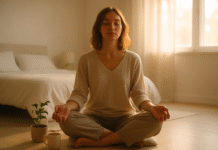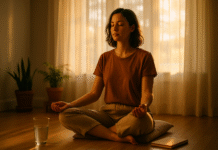
















If your mind is racing and your body feels wired, pairing gratitude breathing exercises with simple, paced breaths can cue your nervous system to settle and your mood to steady. This guide shows you how to use seven evidence-informed techniques you can do almost anywhere—each blending calm, controlled breathing with a brief gratitude focus so you feel grounded without forcing positivity. You’ll learn exact steps, recommended pacing, safety notes, and when to use each method (daytime focus vs. bedtime wind-down). This article is for anyone who wants practical, compassionate tools that work even on stressful days. Quick disclaimer: this is educational and not a medical diagnosis or treatment; if you have respiratory, cardiovascular, or mental-health conditions, check with a clinician before trying new techniques.
Fast definition: Gratitude breathing means intentionally pairing slow, rhythmic breaths with a short moment of appreciation—about a person, place, ability, or tiny win—to downshift stress physiology and widen attention. Research shows that slow, regulated breath activates the body’s relaxation response, and gratitude practices are linked to better mood and resilience.
Quick start (60–90 seconds):
- Sit tall; exhale fully. 2) Inhale through your nose ~4–5 seconds, feel your belly rise. 3) Exhale gently ~6–8 seconds. 4) On the exhale, name one thing you appreciate (quietly or mentally). 5) Repeat for 6–10 breaths. If you feel light-headed, slow down and breathe more naturally.
1. Diaphragmatic Breathing with Gratitude Labeling
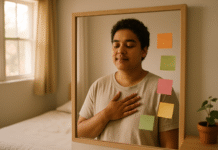
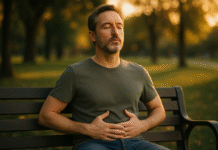
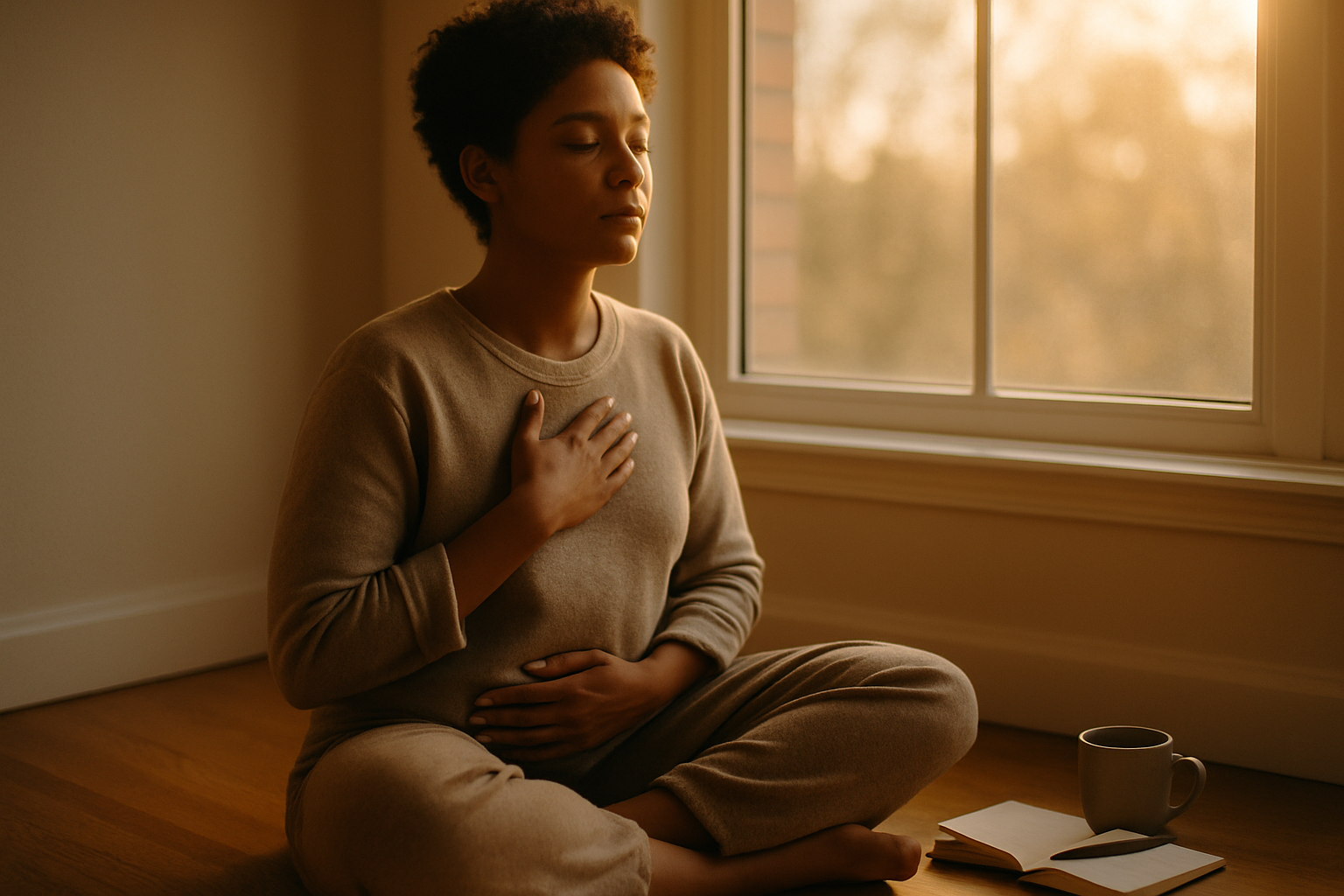
Diaphragmatic (or “belly”) breathing is the foundation for most calming breath practices and an ideal place to anchor gratitude. Start by letting your belly expand on each inhale and soften on each long, gentle exhale. This pattern recruits the diaphragm, slows breathing, and signals safety to your nervous system, which many people experience as a drop in tension across the neck and shoulders. On every exhale, add a short gratitude label like, “thank you for warm light,” “thank you for supportive friends,” or “thank you for my breath.” Even on hard days, aim for something small and honest—sun on your skin, a pet’s nudge, a comfortable chair. Practiced for 2–5 minutes, the combination often feels more grounding than breathwork alone because it engages both body and attention in the same calming direction. Health organizations teach belly breathing for stress, and it pairs naturally with mindful appreciation. NCCIH
How to do it
- Sit or lie down. Place one hand on your chest and one on your belly.
- Inhale through your nose 4–5 seconds, letting the belly rise more than the chest.
- Exhale through pursed lips 6–8 seconds, letting the belly fall.
- On each exhale, quietly label one specific thing you appreciate.
- Continue 10–20 breaths (about 2–4 minutes).
Numbers & guardrails
- Pace: 6–10 breaths per minute feels comfortable for most.
- Time: 2–5 minutes is a solid set; repeat as needed.
- If you get dizzy, shorten holds and breathe more naturally.
- Back/neck pain? Try this lying down with a small pillow under knees.
Mini-case
At her desk between meetings, Saira does 12 slow belly breaths, tagging each exhale with a small “thank you”—a teammate’s help, a clean spreadsheet, her working Wi-Fi. She reports her shoulders drop and she returns to work more patient and clear-headed.
Bottom line: Belly breathing + honest gratitude is a low-effort, high-payoff reset you can weave into micro-breaks all day.
2. Box Breathing with “Four Corners of Thanks”
Box breathing uses equal-length inhales, holds, exhales, and holds—like tracing the four corners of a square. It’s simple, discreet, and widely recommended to steady the nervous system in high-pressure moments. Add a gratitude cue by dedicating each “corner” to one thing you appreciate: corner 1 (inhale): “this breath,” corner 2 (hold): “my body trying to help,” corner 3 (exhale): “someone who showed up,” corner 4 (hold): “a small comfort nearby.” This structure occupies the mind, interrupts stress spirals, and creates a rhythmic, calming cadence you can use before presentations, tough conversations, or anytime you need to “collect yourself” quickly. Clinical guides outline box breathing as an accessible stress technique you can do anywhere.
How to do it
- Exhale gently.
- Inhale through your nose for 4 counts (corner 1).
- Hold for 4 (corner 2).
- Exhale for 4 (corner 3).
- Hold for 4 (corner 4).
- Repeat 4–6 rounds; adjust to 3–5 counts if 4s feel too long.
Common mistakes
- Forcing the breath (creates more tension).
- Letting shoulders hike up (keep them heavy).
- Over-holding (light-headedness means shorten or skip holds).
Numbers & guardrails
- Good “anytime” set: 1–3 minutes.
- For sleep, drop holds and simply do even 4-in/4-out.
- People who are pregnant, have cardiovascular issues, or feel faint with breath holds should shorten or skip the holds.
Bottom line: Trace a mental square, thank four small things—one per corner—and you have a portable calm-down you can use in a lift, lobby, or car (parked).
3. 4-7-8 Breathing with Appreciative Imagery
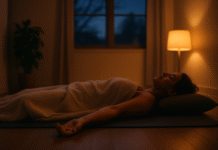
The 4-7-8 pattern—inhale 4, hold 7, exhale 8—emphasizes a longer exhale, which many people find especially soothing before bed. Pair it with a brief appreciative image on the exhale: imagine releasing tension into a warm scene you value—sunset light, a safe home, a supportive face. The hold builds gentle CO₂, which can deepen the next exhale; the longer out-breath stimulates the body’s rest-and-digest response. Many clinical explainers recommend starting with just 4 cycles and building gradually; if the 7-count feels too long, reduce it or skip the hold. This pattern is frequently recommended for winding down at night and easing pre-sleep mind-chatter.
How to do it
- Sit or lie down comfortably. Tip of tongue behind top teeth.
- Inhale silently through the nose 4 counts.
- Hold the breath 7 counts (or shorter if needed).
- Exhale audibly through the mouth 8 counts (gentle “whoosh”).
- Repeat 4 cycles; after a week or two, work up to 8 cycles.
Numbers & guardrails
- Ideal use: evenings, wake-ups at night, or anytime anxiety spikes.
- If you feel air hunger, shorten the 7-count to 3–4 or skip holds entirely.
- Keep the exhale smooth—not forced—to avoid tension.
Bottom line: Lengthen the out-breath and “soft-focus” on a warm, appreciative image to cue drowsiness and ease rumination.
4. Coherent Breathing (5–6 Breaths/Min) with a Quiet “Thank You” Mantra
Coherent (or resonance-frequency) breathing targets roughly 5–6 breaths per minute—about 5 seconds in, 5 seconds out—to maximize heart-rate variability (HRV), a marker linked with flexible stress recovery. Think of it as tuning your cardiorespiratory system to a calm rhythm. Add a quiet “thank you” on the last second of each exhale to weave a light gratitude cue into the cadence without crowding your attention. Multiple reviews and trials indicate that slow, even breathing around 0.1 Hz (≈6 breaths/min) increases HRV and supports autonomic balance; HRV biofeedback trains a similar rhythm using real-time feedback. You don’t need a sensor to benefit from the basic pace; a simple timer or app that chimes every five seconds works.
How to do it
- Set a metronome or app to 5s in / 5s out (or 4.5s in / 5.5s out).
- Breathe lightly through the nose; relax the jaw and tongue.
- Whisper or think “thank you” during the last beat of each exhale.
- Practice 5 minutes daily; extend to 10 minutes as comfortable.
Tools & examples
- HRV-aware apps/timers (no wearable required) can cue 6-per-minute pacing.
- If you use a smartwatch with HRV, note trends (e.g., higher RMSSD on calm days).
- For desk practice, sync inhales with mouse moves and exhales with keystrokes.
Numbers & guardrails
- Light, quiet breaths are the goal—avoid big gulps of air.
- If you get drowsy, try 4s in / 6s out for a gentle exhale emphasis.
- If you feel anxious, shorten the inhale slightly and lengthen the exhale.
Bottom line: A steady 5–6 BPM rhythm—decorated with a tiny “thank you”—is a powerful daily baseline for calm and emotional flexibility.
5. Alternate Nostril Breathing with Thankful Intention (Nadi Shodhana)
Alternate Nostril Breathing (ANB), a classic pranayama technique, involves breathing through one nostril at a time using a gentle hand seal. Many people find it centers attention and smooths energy before focus-heavy tasks. To integrate gratitude, silently set a thankful intention on each switch—e.g., “thank you for clarity,” “thank you for this moment.” Studies suggest ANB can influence autonomic balance (often interpreted as a tilt toward parasympathetic activity), though results vary by protocol and population; the practice remains a safe, low-tech way to calm pre-task jitters for many users. If you’re congested, save this one for another day, as forcing airflow defeats the calming effect.
How to do it
- Sit tall. Right hand in a relaxed “nasal valve” position: thumb near right nostril, ring finger near left (index/middle resting lightly between brows).
- Close the right nostril gently with the thumb; inhale left for 4–5.
- Close both briefly; open right and exhale 4–6.
- Inhale right 4–5; close both briefly; open left and exhale 4–6.
- That’s 1 cycle. Do 4–8 cycles (2–5 minutes), breathing gently. On each switch, add a quiet thankful phrase.
Why it helps (and limits)
- Gentle nasal breathing can slow rate, increase focus, and reduce perceived stress in some settings; effects on anxiety can be modest and protocol-dependent.
- Good before study, writing, or after scrolling breaks; less ideal if sinuses are inflamed.
Guardrails
- Skip if you’re overly congested or feel air hunger; return to belly breathing.
- Keep pressure light—no hard pinching of the nostrils.
Bottom line: ANB adds a tactile rhythm for attention + a soft gratitude intention; it’s a steadying pre-focus ritual for many people.
6. The Physiological Sigh (Cyclic Sighing) with “Three Things” Gratitude
A physiological sigh is a double inhale followed by a long exhale: a short, sharp nose-inhale to top up lung inflation, a second small sniff to “pop open” alveoli, then a slow, long exhale through the mouth. Practiced in short sets, it can quickly reduce arousal. A randomized controlled study found five minutes per day of exhale-emphasized cyclic sighing improved mood and lowered respiratory rate more than mindfulness meditation; other brief pieces corroborate cyclic sighing as a rapid down-regulation tool. Pair it with a micro-list of “three things” you’re grateful for—one on each exhale—so your mind has something kind to land on as the body lets go. PubMed
How to do it
- Inhale through the nose to ~80% (1–2 seconds).
- Add a second tiny sniff to fully inflate.
- Exhale slowly through the mouth 4–8 seconds.
- Repeat for 1–2 minutes (about 6–12 sighs). On each exhale, name one small thing you appreciate; after three sighs, refresh the list.
Common mistakes
- Over-inhaling (keep both inhales gentle).
- Forcing a loud exhale (aim for soft, extended).
- Doing long sets; this is a short intervention.
Numbers & guardrails
- Great “acute stress” tool (post-meeting, before a call).
- If you feel tingly or dizzy, switch to normal nasal breathing.
- Asthma/COPD: clear with your clinician and keep exhales easy.
Bottom line: Three or four well-timed physiological sighs, each tagged with a tiny thank-you, can defuse stress quickly and discreetly.
7. The 3-Minute Gratitude Breathing Micro-Break (Anywhere, Anytime)
When you’re squeezed for time—or feel too frazzled for longer practices—use this compact, structured reset. It blends even paced breathing, one-line gratitude prompts, and a closing exhale-lengthen to switch gears in three minutes flat. You can do it between classes, after doom-scrolling, or before walking into a room that matters. Health services commonly recommend five minutes of calm breathing for stress; even shorter bouts can help you regain control in the moment. The gratitude prompts prevent mind-wandering into to-do lists and nudge you to notice one specific good thing right now, without pretending everything’s perfect.
How to do it (Script)
- Minute 1 — Arrive: Sit tall. Breathe in 4 / out 4 through the nose. On each exhale, say, “thank you for…” and finish the sentence with something in your immediate environment (light, chair, fresh air).
- Minute 2 — Settle: Shift to in 4 / out 6. On each exhale, appreciate a personal capacity (curiosity, persistence, learning, asking for help).
- Minute 3 — Close: Keep in 4 / out 6–8. On each exhale, appreciate a person (name them). End with one longer, gentle out-breath and a half-smile.
Mini-checklist
- Shoulders soft, jaw unclenched, tongue resting gently.
- Breathe through the nose unless congested; exhale lightly.
- If your mind blanks on gratitude, notice something neutral (the floor, your breath) and call it “good enough.”
Bottom line: Three minutes of paced breaths plus small, honest thanks is a realistic, repeatable way to reset on busy days.
FAQs
1) What exactly are “gratitude breathing exercises,” and how do they help?
They’re standard calming breath techniques with a short gratitude cue layered in—naming one true, specific thing you appreciate during each exhale. Slow breathing activates the body’s relaxation response (lower breathing rate, calmer physiology), while gratitude practices are linked to better mood and resilience. The pairing gives attention something kind to rest on while your body settles. If you feel forced positivity, keep the cue tiny and honest. NCCIH
2) How many minutes should I practice to feel calmer?
Many people notice a shift in 1–3 minutes during acute stress and deeper calm by 5–10 minutes of steady practice. Options like the physiological sigh work in very short sets; coherent breathing and 4-7-8 often benefit from a few minutes of relaxed repetition. Consistency matters more than marathon sessions—brief daily reps build the reflex.
3) Which technique is best for sleep versus focus?
For sleep or evening wind-downs, choose 4-7-8 or coherent breathing with a longer exhale. For focus between tasks, box breathing or alternate nostril breathing can center attention. For quick “pressure valve” relief, try a few physiological sighs. Experiment; the “best” technique is the one you’ll repeat.
4) What if breath holds make me uncomfortable?
Skip or shorten the holds. You can get most of the calming benefit from even in/out or longer exhales without any holds (e.g., in 4 / out 6). Light-headedness is your cue to ease up. People who are pregnant or have cardiovascular/respiratory issues should be extra conservative.
5) Do I need gadgets or an app for coherent breathing?
No. A simple timer or metronome works. HRV biofeedback devices can coach your personal resonance rate near 5–6 breaths/min, but the basic cadence alone can increase HRV and calm reactivity. If you enjoy data, an HRV-enabled wearable may motivate practice, but it’s optional. FrontiersPMC
6) Is there real evidence behind gratitude practices, or is it just feel-good advice?
There’s decades of research linking gratitude practices with improved well-being and prosocial behavior. Classic experiments showed that “counting blessings” increased life satisfaction and optimism versus control activities; large public-facing medical outlets regularly summarize benefits like better sleep and mood. It’s not a cure-all, but it’s more than a slogan.
7) Can I combine these with meditation or yoga?
Yes. Breath-focused meditation and yoga often include the same elements—slow nasal breathing, attention on sensations, and a gentle mantra. Many people weave gratitude into the end of a yoga session or a short breath meditation to reinforce positive attention. Evidence summaries note both modalities can help with stress when appropriately used. NCCIH
8) How often should I practice to see results?
Aim for 5 minutes daily for a week and reassess. Short, scattered reps (e.g., two 3-minute breaks) often fit better than one long session. In a randomized trial, just five minutes of daily exhale-focused breathwork improved mood over a month—consistency compounds the benefit.
9) What if I can’t think of anything to be grateful for when I’m stressed?
Shrink the target: pick something tiny and true (warm water, a chair, a kind text last week). Or use neutrality as a bridge—“thank you for this breath” or “thank you for this pause.” The point isn’t to deny difficulty; it’s to place your attention on one safe, steadying thing while your body settles.
10) Are there risks or people who should avoid these techniques?
These practices are generally low-risk when done gently, but people with uncontrolled asthma/COPD, severe anxiety with breath-focus triggers, pregnancy, low blood pressure, or cardiovascular issues should avoid straining, minimize holds, and consult a clinician. If breathing exercises increase panic, stop and use alternative grounding (cold water on wrists, five-senses check, or a brief walk). NCCIH
Conclusion
Calm is a skill you can train in minutes, and breath is the built-in tool you already carry. When you pair paced breathing with a small, honest note of gratitude—something as simple as “thank you for this chair” or “thank you for this breath”—you direct both physiology and attention toward steadiness. The seven exercises here cover a spectrum of needs: belly breathing and coherent breathing as daily anchors; box breathing and alternate nostril breathing to focus before you act; 4-7-8 and the physiological sigh to downshift quickly; and the three-minute micro-break when time is tight. Start with one technique that feels natural, practice lightly (never straining), and let repetition make it reflexive. When the next wave of stress hits, your body will remember the rhythm—and your mind will have a kind place to land.
Try this today: set a 3-minute timer, breathe in 4 / out 6, and tag each exhale with a tiny “thank you.” Repeat tomorrow.
References
- Relaxation Techniques: What You Need To Know. National Center for Complementary and Integrative Health (NCCIH). June 8, 2021. NCCIH
- Breathing exercises for stress. NHS (UK). nhs.uk
- Breathing Exercises. American Lung Association. American Lung Association
- How To Do the 4-7-8 Breathing Exercise. Cleveland Clinic. September 6, 2022. Cleveland Clinic
- How Box Breathing Can Help You Destress. Cleveland Clinic. August 17, 2021. Cleveland Clinic
- Brief structured respiration practices enhance mood and reduce physiological arousal. Cell Reports Medicine, 4(1), 100895. January 17, 2023. Cell
- ‘Cyclic sighing’ can help breathe away anxiety. Stanford Medicine News. February 9, 2023. Stanford Medicine
- Heart rate variability biofeedback: how and why does it work? Frontiers in Psychology. 2014. PMC
- How Breath-Control Can Change Your Life: A Systematic Review on Psycho-Physiological Correlates of Slow Breathing. Frontiers in Human Neuroscience. 2018. Frontiers
- Effect of Resonance Breathing on Heart Rate Variability and Blood Pressure. Meditation and Mindfulness. 2022. PMC
- Assessment of the Effects of Pranayama/Alternate Nostril Breathing on the Autonomic Nervous System. International Journal of Yoga. 2013. PMC
- Yoga: Effectiveness and Safety. NCCIH. NCCIH
- Giving thanks can make you happier. Harvard Health Publishing. August 14, 2021 (web update). Harvard Health
- How Gratitude Changes You and Your Brain. Greater Good Science Center, UC Berkeley. June 6, 2017. Greater Good
- Counting blessings versus burdens: an experimental investigation of gratitude and subjective well-being in daily life. Journal of Personality and Social Psychology. 2003;84(2):377–389. PubMed