






















Gratitude meditation is a simple, structured way to train your attention on what’s working in your life and to let appreciation shift your mood and physiology. If you’re new to meditation, this 10-step, beginner-friendly guide will help you sit down, settle your mind, and cultivate sincere thanks—without forcing positivity or ignoring real challenges. You’ll learn how to set up your space, anchor with the breath, recall specific moments and people, expand appreciation, handle common obstacles like mental chatter or numbness, and close with small actions that keep the practice alive during your day. Brief note: this article is educational and not medical advice; if you live with a mental health condition or trauma history, consider practicing with a qualified professional, and pause any exercise that increases distress.
Quick definition: Gratitude meditation is a mindfulness practice that focuses attention on things you genuinely appreciate—people, moments, or simple experiences—allowing the feeling of thanks to fill awareness and guide attitudes and actions.
Fast-start steps (skim first, then dive deeper):
1) Set a kind intention and pick a time; 2) Prepare a comfortable posture; 3) Settle with 6–12 slow breaths; 4) Do a 60–90-second body scan; 5) Recall one specific good thing or benefactor; 6) Name 3 concrete details; 7) Repeat a simple gratitude phrase; 8) Include yourself with gentle self-appreciation; 9) Work kindly with obstacles; 10) Close by journaling one line and planning a tiny thank-you.
1. Choose Your Intention and Daily Slot (2–10 Minutes)
Start by deciding what you want from this practice and when you’ll do it each day. A clear intention (“I’m practicing to notice small good things and reduce stress”) acts like a compass when attention wanders. Beginners often think meditation requires long sessions, but consistency beats duration: two to ten minutes practiced most days creates a stable habit and measurable benefit. Pick a low-friction slot—after brushing your teeth, on your commute (eyes open, safely), or just before bed. Name a trigger (“after coffee, I sit for 5 minutes”), a time, and a place. Expect your motivation to fluctuate; build for real life, not ideal circumstances.
1.1 Why it matters
- Intention aligns your attention and reduces second-guessing once you sit.
- A fixed daily slot automates repetition and lowers the willpower cost.
- Short starts prevent overreaching; you can lengthen later if helpful.
1.2 Mini-checklist
- Intention: one plain-language sentence.
- Time: same time daily (±30 minutes), 2–10 minutes.
- Trigger: cue that leads straight into practice (e.g., “after I put down my mug…”).
Synthesis: Decide why and when now; small, steady sessions create momentum that makes every later step easier to do.
2. Set Your Space and Posture for Easy Stillness
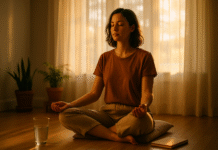
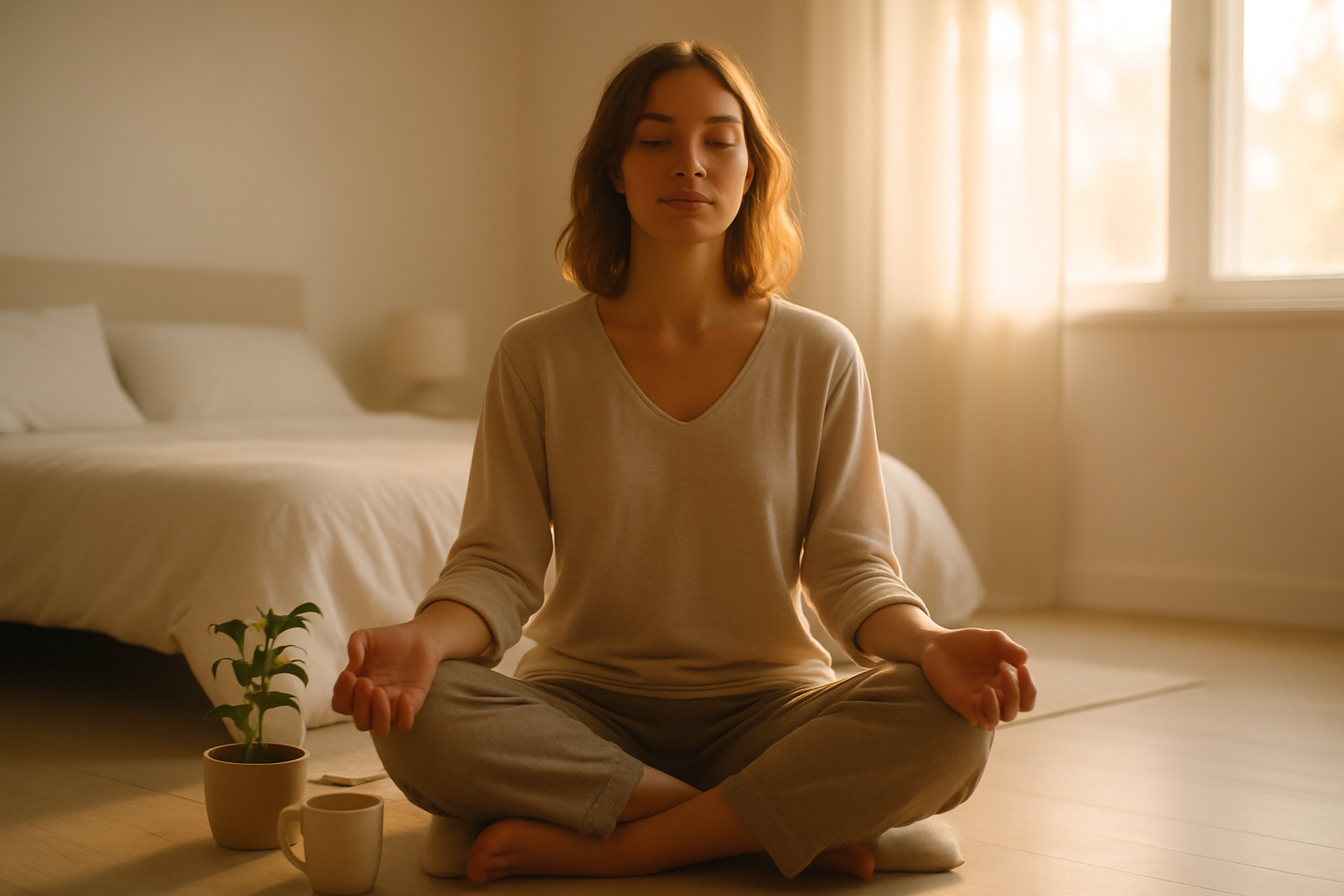
A friendly setup reduces fidgeting and discomfort so you can actually attend to gratitude. Choose a spot you can reuse: a chair with your feet flat and back supported, or a cushion with hips slightly higher than knees. Keep the spine long but not stiff, chin level, shoulders soft. If sitting isn’t possible, lie down with knees supported or practice standing. Dim harsh lights, silence notifications, and have what you need within reach—timer, journal, tissues, water. Minimalism helps, but a small “anchor” item (a photo, plant, or memento) can prime appreciation without becoming a distraction.
2.1 How to do it
- Chair: Sit toward the front edge, feet hip-width, hands on thighs.
- Floor: Use a firm cushion; elevate hips 2–4 inches; shins comfortable.
- Lying down: Support knees with a pillow; keep arms a little away from sides.
2.2 Common mistakes
- Chasing perfection: Spending 10 minutes staging candles can become avoidance.
- Rigid posture: Over-bracing leads to pain; think “tall and relaxed.”
- Phone creep: Airplane mode or a basic timer keeps the session clean.
Synthesis: Comfort plus alertness is the sweet spot—good posture is what helps you forget about posture.
3. Settle With a Simple Breath Anchor
Begin by anchoring attention to the natural breath for one to three minutes. Gently feel the coolness at the nostrils, the rise and fall in the chest or belly, or the full inhale-exhale cycle. Count breaths if it helps—inhale 1, exhale 1, up to 6 and repeat—or lengthen exhalations by a beat or two. The goal isn’t special breathing but steadying attention. When thoughts pull you away, notice that kindly and return without drama. This trains the very skill you’ll use to stay with gratitude later.
3.1 Numbers & guardrails
- Duration: 6–12 slow breaths (about 1–2 minutes) to begin; up to 3–5 minutes over time.
- Cueing: Silently say “in” and “out” or count to six, restart when lost.
- If anxious: Keep breaths natural; forcing long inhales can feel agitating.
3.2 Mini-checklist
- Pick one breath sensation (nostrils, chest, or belly).
- Count or label gently; drop the count when you feel settled.
- If distracted, note and return; that return is the rep.
Synthesis: A steady breath anchor is like stabilizing a camera before you zoom in on gratitude.
4. Do a Quick Body Scan to Prime Awareness
Spend 60–90 seconds sweeping attention from crown to toes. You’re not fixing anything; you’re noticing. If you find pockets of tension—jaw, shoulders, belly—soften by 5–10%. Let the tongue rest; loosen the brow. If you feel nothing, that’s information too; label it “neutral” and keep moving. This brief scan tunes interoception (your sense of the body) so gratitude later lands not just as an idea but as a felt experience in the chest, throat, eyes, or belly.
4.1 How to do it
- Move attention: scalp → eyes → jaw → throat → chest → belly → hips → legs → feet.
- At each spot: notice → soften → move on (3–5 seconds per area).
- End with three easy breaths, letting the whole body be included.
4.2 Common mistakes
- Hunting for bliss: Sensations vary; curiosity beats chasing “nice.”
- Overcorrecting: If you fidget to fix every twinge, pause and return to noticing.
- Skipping: The scan is short; it pays dividends in groundedness.
Synthesis: A brief scan brings your mind into your body so appreciation has somewhere to land.
5. Recall One Specific Benefactor or Good Moment
Now bring to mind a single concrete source of gratitude. Specificity is key: a friend who checked in last week, a nurse’s kindness, a child’s laugh on the stairs, the shade of a tree on a hot walk. Visualize the scene or person; name details—the color of the mug, the tone of voice, the temperature of air. Let appreciation arise naturally; you’re not forcing a mood. If nothing big comes, choose something tiny and real (clean water from the tap counts). Rest in that felt thankfulness for 60–120 seconds.
5.1 Why it matters
- Research shows gratitude grows when we count specific blessings rather than vaguely “being positive.” Specifics make emotions sticky and believable.
- Anchoring in the recent and concrete reduces compare-and-despair and “toxic positivity.”
5.2 Tools/Examples
- Prompts: “Who helped me this week?” “What eased my day?” “What tasted good today?”
- Sensory anchors: What did I see, hear, smell, touch, taste in that moment?
- Alternate focus: If people feel complicated, use a moment in nature or a simple comfort (a fan on a hot night).
Synthesis: Go small and specific; gratitude grows fastest when it’s rooted in one real scene.
6. Name Three Concrete Details (The 3×3 Method)
To deepen sincerity, describe three details about your chosen moment, and for each detail, note three qualities. Example: “My friend’s voice—warm, steady, unhurried.” “The tea—citrusy, hot, steam swirling.” “The chair—solid, textured fabric, cool to the touch.” This shifts gratitude from a concept to a multi-sensory memory, engaging more of the brain and gently crowding out ruminative loops. If your mind wanders, bring it back to the next detail; if emotions swell, soften the breath and stay with the most manageable sensation.
6.1 Steps
- Pick one moment or person.
- List 3 details; for each, name 3 qualities.
- Pause between each set and feel the appreciation for 2–3 breaths.
6.2 Common pitfalls
- Abstract labels: “It was nice” is vague; aim for tangible words.
- Speeding: If you rush, gratitude stays thin; slow the nouns and adjectives.
- Perfectionism: It’s okay if one detail feels flat; move to the next.
Synthesis: The 3×3 turns a general thank-you into a high-resolution experience your nervous system can trust.
7. Add a Simple Gratitude Phrase and Let It Soak
Pair the felt sense with a phrase you repeat for 60–120 seconds. Choose language that fits your voice: “Thank you for ____,” “I appreciate ____,” or “I’m glad that ____ happened.” Whisper mentally on the out-breath. If you’re appreciating a person, you might add, “May they be safe and well,” borrowing a line from loving-kindness practice. Keep it sincere and brief; fewer words, more feeling. Let the warmth (or even the subtle softening) spread through chest and face; notice any tension that relaxes.
7.1 Phrase menu
- “Thank you for this small ease: ____.”
- “I appreciate the way ____ showed up for me.”
- “May I remember this good thing when today gets noisy.”
7.2 Mini case
- Before: After a hard meeting, you recall a colleague’s supportive text.
- During: You picture the text bubbles, feel your shoulders drop, repeat “Thank you for having my back.”
- After: You write one line in your journal: “Grateful for A.’s check-in—kept me grounded.”
Synthesis: A brief, honest phrase acts like glue, helping appreciation linger long enough to shift mood and behavior.
8. Include Yourself: Gentle Self-Appreciation Without Corniness
Gratitude often flows outward—to helpers and happenstance—but beginners forget to include themselves. Once your appreciation is steady, add a 30–60-second visit to anything you did that supported your day: showed up on time, chose water over a second coffee, took a walk, texted a friend back, asked for help. This isn’t bragging; it’s acknowledging effort and values, which sustains motivation. If this feels awkward, start small and neutral (“I answered that email carefully”) and pair it with breath to avoid self-judgment spikes.
8.1 How to do it
- Recall one micro-effort you made today or yesterday.
- Name what you did, why it mattered, and how it felt—one phrase each.
- Offer a phrase: “Thank you, body, for ____” or “I appreciate that I ____ today.”
8.2 Common mistakes
- Grandstanding: Keep it factual and linked to effort, not ego.
- All-or-nothing: Mixed days still contain worthy moments; find one.
- Skipping entirely: Without self-appreciation, the practice can feel dependent on others’ behavior.
Synthesis: Including yourself builds agency; you’re not waiting for life to be perfect before you can feel grateful.
9. Work Kindly With Obstacles (Negativity Bias, Numbness, Restlessness)
Every mind has a negativity bias—we notice threats more than comforts—and some days gratitude feels far away. Treat obstacles as part of practice, not failure. If numb, lower the bar to one neutral thing (running water, shade, a working lock). If restless, shorten the session and add light movement before sitting. If grief or anger surface, acknowledge them; you can sit with breath only, return to gratitude later, or close early. Evidence suggests mindfulness and gratitude can support well-being, yet not every session feels good; on rare occasions, meditation can stir difficult emotions, so go gently and seek guidance if distress persists.
9.1 Tools/Examples
- RAIN: Recognize, Allow, Investigate (gently), Nurture—then return to breath.
- If “toxic positivity” fears arise: Phrase gratitude as “and,” not “but” (e.g., “This is hard, and I’m grateful for the nurse’s patience”).
- Anxiety spike: Eyes open, soften exhale, ground feet; shorten by 1–2 minutes.
9.2 Mini-checklist
- One thing is enough on tough days.
- Keep phrases honest; avoid sugarcoating.
- Stop if distress escalates; try again another day or with support.
Synthesis: Obstacles are expected; flexible, honest practice keeps gratitude trustworthy and sustainable.
10. Close and Carry It Into Your Day (Journal, Micro-Thanks, Tiny Habit)
End each session by writing one line in a journal or notes app (date + one sentence). Then choose a micro-action that expresses thanks: send a two-line message, smile and name something you appreciate out loud, or look someone in the eye and say “Thank you for ___.” To keep the habit, stack it with an existing routine (put the journal by your toothbrush) and track streaks lightly—aim for 4–5 days/week. Over time, consider a weekly “gratitude walk” or a brief evening replay of three good moments to reinforce the circuit you’re building.
10.1 How to do it
- Write: “8/21—Grateful for cool air after the storm.”
- Act: Two-line text or a sincere sentence in person.
- Stack: Journal next to kettle; sit while water heats.
10.2 Numbers & guardrails
- Duration: 30–90 seconds to close.
- Frequency goal: 20+ sessions/month is realistic for beginners.
- Review: Re-read entries weekly; notice patterns (people, places, times).
Synthesis: A concrete close turns a private feeling into a lived behavior and keeps your practice alive between sits.
FAQs
1) What is the difference between gratitude meditation and gratitude journaling?
Gratitude meditation is a felt, in-the-moment practice: you sit, anchor attention, and let appreciation expand in your body and mind. Gratitude journaling is a written reflection, often listing three good things. They pair well—meditation deepens sincerity; journaling reinforces recall—so many beginners do a two-minute sit and then a one-line entry. If time is tight, alternate days and keep both simple.
2) How long until I notice benefits?
It varies. Many beginners report a warmer baseline mood within 2–3 weeks of practicing most days, with more noticeable shifts in reactivity and sleep over 6–8 weeks. Meta-analyses suggest gratitude interventions produce small but reliable boosts in well-being across many studies and cultures. Treat benefits as a side effect of consistent practice rather than something to chase; pushing for outcomes tends to backfire.
3) Is gratitude meditation safe if I’m dealing with grief, anxiety, or trauma?
It can help some people and feel difficult for others. Mindfulness-style practices are usually considered low risk, but a minority of participants report negative effects like increased anxiety. If you notice rising distress, scale back to breath only, keep eyes open, practice for shorter periods, or work with a clinician or trauma-sensitive teacher. Your safety and agency come first.
4) What if gratitude feels fake or forced?
Drop abstract “I’m grateful for everything” statements and get specific. Pick one tiny, real moment from the last day and name three sensory details. Use “and” instead of “but” when life is hard (“This hurts, and I’m grateful for the friend who called”). Authenticity beats enthusiasm—aim for honest, small appreciations that you actually feel.
5) Should I meditate in the morning or at night?
Choose the slot you can reliably protect. Mornings often work because willpower is fresher and the practice colors the day; evenings can aid decompression and sleep. Some people do a 2–5-minute morning sit plus a one-line evening reflection. The best time is the one you’ll keep four or more days per week.
6) Can I do gratitude meditation while walking?
Yes—keep eyes open and attention on both movement and appreciation. Try a gratitude walk: feel your feet, breathe, and mentally thank what you notice (shade, a neighbor’s wave, a safe crossing). Shorten phrases to fit steps (“thanks for…”) and skip headphones to keep awareness wide and safe.
7) Do I need an app or teacher?
Not required. A simple timer and this 10-step sequence are enough. Apps and teachers can help if you want guided audio, accountability, or trauma-sensitive options. Look for programs with clear instructions, short practices, and an emphasis on specific, sincere appreciation rather than vague positivity.
8) How does gratitude meditation affect the brain and body?
Early research links gratitude practices with activation in regions tied to reward and social bonding, and mindfulness training more broadly is associated with improvements in stress and sleep for many participants. Results vary and effects are often modest, but they’re meaningful when stacked daily. Think of it as building a skill: attention, interpretation, and expression.
9) What if my culture or faith already includes thankfulness practices?
Great—gratitude meditation is adaptable. Use language and objects that fit your tradition (prayer beads, phrases, or scriptures) and keep the structure: settle, recall, specify, feel, express, and act. The point isn’t adopting new beliefs; it’s training attention to notice and savor what’s already aligned with your values.
10) How do I measure progress without obsessing?
Track process over outcomes. Log session date and one-line gratitude. Every two weeks, rate 1–10 your average mood, sleep quality, and reactivity to stress. Look for gentle trends rather than perfect streaks. If numbers slide, shrink the session (2–3 minutes), change the trigger, or practice while walking.
11) Can I practice with kids or as a family?
Yes—keep it playful and brief. Try a one-minute “show and tell gratitude” after dinner: each person names one specific thing and why it mattered. Teens often prefer writing or texting a quick appreciation; model specificity and sincerity rather than length.
12) What if I fall asleep or get bored?
Make the posture more alert (sit upright, eyes slightly open) and shorten to 3–5 minutes. Rotate focuses: one day a person, next day a small comfort, next day something in nature. Boredom often signals you’re skimming; slow down and use the 3×3 detail method to re-engage the senses.
Conclusion
Gratitude meditation isn’t about pretending everything is fine; it’s a practical way to train attention toward what’s supportive so you can meet life with steadier nerves and a kinder stance. The 10 steps you’ve learned—intention, setup, breath, body scan, specific recall, sensory detail, simple phrases, self-appreciation, obstacle skills, and a concrete close—form a compact routine you can fit into real days. Start small and honest. Let one good thing be enough. Over weeks, you’ll likely notice that appreciation arises more easily, that relationships feel warmer, and that tough moments share space with small eases. Keep notes, share thanks out loud, and adjust the practice to your body, culture, and season of life.
Ready to begin? Set a 3-minute timer, choose one tiny good thing, and let your next exhale say “thank you.”
References
- Meditation and Mindfulness: Effectiveness and Safety, National Center for Complementary and Integrative Health (NCCIH), June 3, 2022. https://www.nccih.nih.gov/health/meditation-and-mindfulness-effectiveness-and-safety
- 8 Things to Know About Meditation and Mindfulness, NCCIH, 2022. https://www.nccih.nih.gov/health/tips/8-things-to-know-about-meditation-and-mindfulness
- Emmons, R. A., & McCullough, M. E. (2003). Counting blessings versus burdens: An experimental investigation of gratitude and subjective well-being in daily life. Journal of Personality and Social Psychology, 84(2), 377–389. PubMed: https://pubmed.ncbi.nlm.nih.gov/12585811/
- Diniz, G., et al. (2023). The effects of gratitude interventions: a systematic review and meta-analysis. einstein (São Paulo), 21:eAO7765. PubMed Central: https://pmc.ncbi.nlm.nih.gov/articles/PMC10393216/
- Choi, H., et al. (2025). A meta-analysis of the effectiveness of gratitude interventions on well-being across cultures. Proceedings of the National Academy of Sciences (PNAS), 122(…); PubMed: https://pubmed.ncbi.nlm.nih.gov/40627390/
- Kyeong, S., et al. (2017). Effects of gratitude meditation on neural network functional connectivity and brain–heart coupling. Scientific Reports, 7:5057. https://www.nature.com/articles/s41598-017-05520-9
- Black, D. S., et al. (2015). Mindfulness Meditation and Improvement in Sleep Quality and Daytime Impairment Among Older Adults With Sleep Disturbances: A Randomized Clinical Trial. JAMA Internal Medicine, 175(4), 494–501. https://jamanetwork.com/journals/jamainternalmedicine/fullarticle/2110998
- Gratitude (definition), APA Dictionary of Psychology, American Psychological Association, April 19, 2018. https://dictionary.apa.org/gratitude
- Expanding the Science and Practice of Gratitude, Greater Good Science Center, University of California, Berkeley, n.d. https://ggsc.berkeley.edu/what_we_do/major_initiatives/expanding_gratitude
- Boggiss, A. L., et al. (2020). A systematic review of gratitude interventions: Effects on physical health and health behaviors. Journal of Psychosomatic Research, 135:110165. https://www.sciencedirect.com/science/article/abs/pii/S0022399920301847