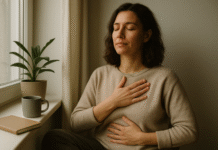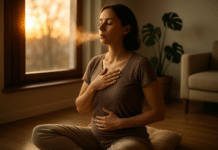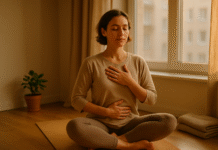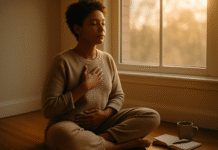



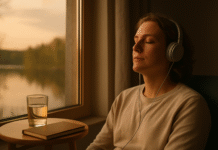









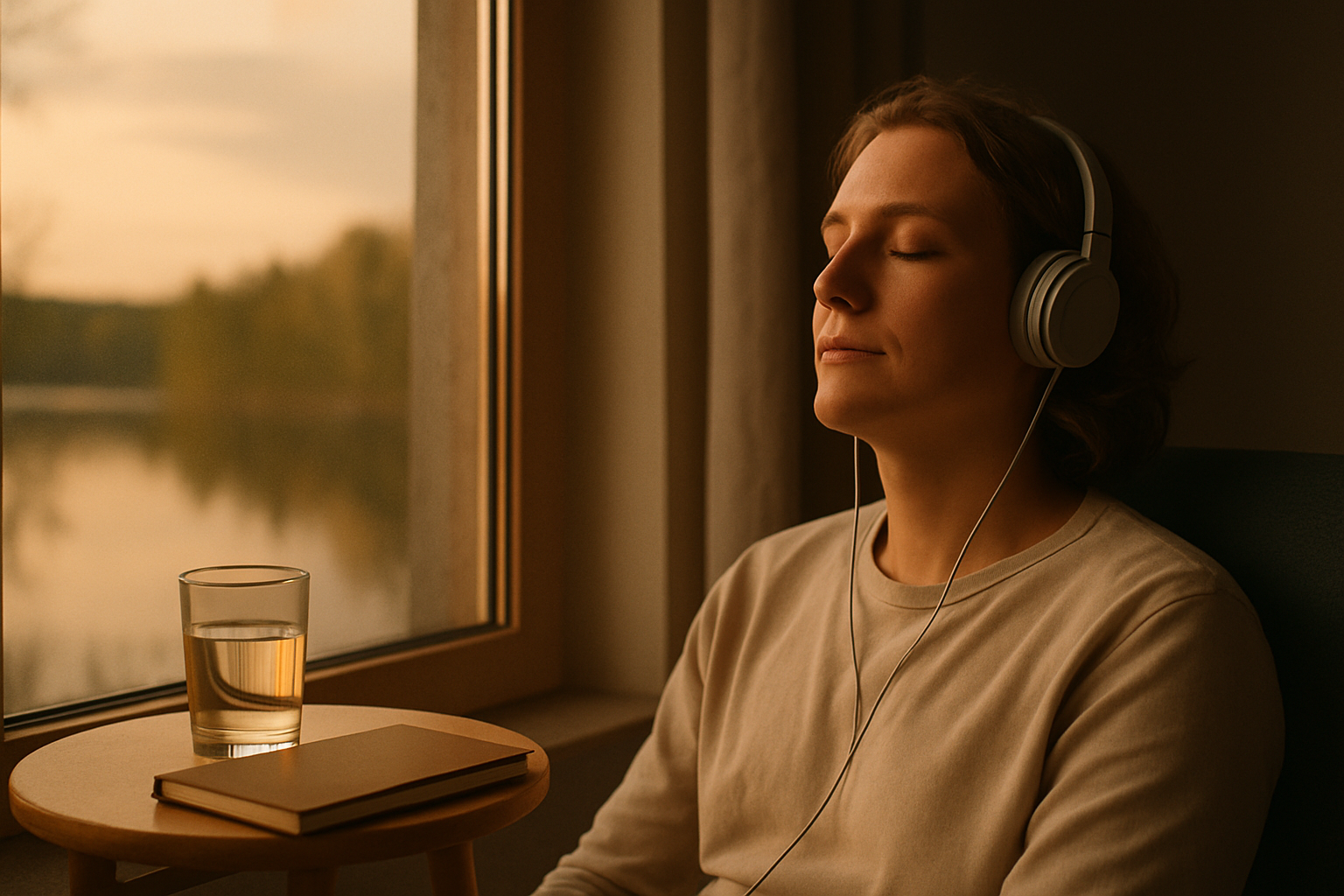
Guided imagery is a brief, structured practice where you use vivid mental pictures—often prompted by audio—to shift your body into a calmer state and reduce anxious thoughts. In simple terms: you picture a safe, pleasant scene and let your senses “fill it in” until your breath steadies and your muscles unclench. Research identifies guided imagery as a type of relaxation technique that can slow breathing and heart rate and support anxiety relief when used consistently.
Quick start: Sit comfortably, close your eyes, take 3–4 slow breaths, picture a calm place, engage all five senses, and anchor the feeling with a cue word (e.g., “soft”). Repeat for 5–10 minutes.
A brief, important note: This article is educational and not a medical diagnosis or treatment plan. If anxiety is severe, persistent, or disrupts daily life, talk to a licensed clinician. For emergencies, seek local urgent care. General anxiety care often includes psychotherapy (like CBT), medication when appropriate, and lifestyle supports; guided imagery can complement—not replace—these treatments.
1. Safe-Place Scene: Build an Immediate Sense of Safety
A safe-place scene is the fastest way to reduce arousal because it directly answers your brain’s “Am I safe?” question. Picture one specific location—real or imagined—where nothing bad happens: a quiet beach at dawn, a favorite room, a shaded garden. Begin by telling yourself, “Right now, I am safe.” Then vividly layer sights, sounds, textures, scents, and temperature. This multisensory detail recruits more of your brain, helping your nervous system downshift from threat monitoring to rest-and-digest. Use this when worries spike, before sleep, or ahead of a stressful event. Studies of guided imagery show reductions in state anxiety in medical settings, and the same core mechanism—sensory-rich calming images—applies at home practice.
1.1 How to do it
- Sit or lie down; take 4 slow breaths (in 4, out 6).
- Name the place (“the pine-shore cove”).
- Add five senses: What do you see, hear, feel, smell, and taste?
- Add motion: a breeze over skin, water lapping, curtains moving.
- Choose a cue word (“soft,” “steady”) and repeat it quietly.
- When done, take one normal breath and open your eyes.
1.2 Numbers & guardrails
- Typical session: 8–12 minutes, 1–2 times daily; quicker “micro” versions in 60–90 seconds.
- If imagery feels blank, use a photo from your camera roll to prime the scene.
- If trauma memories intrude, stop and switch to open-eyes breathing; consider working with a clinician.
Synthesis: Returning to the same safe place builds a conditioned association—your body learns to relax faster each time.
2. Color Breathing: Pair Breath with Color to Quiet the Body
Color breathing links slow exhalations with calming color imagery (e.g., inhale “cool blue,” exhale “grey static”). It works because it couples two potent regulators—paced breathing and visual focus—into one rhythm. On a neurophysiological level, pacing the exhale longer than the inhale nudges the vagus nerve and can help down-regulate stress responses; the color overlay keeps attention from drifting back to worry. It’s discreet, so you can use it during meetings or commuting. As with other relaxation techniques, evidence supports guided imagery for reducing anxious arousal when practiced regularly and alongside standard care.
2.1 Mini-script
- Inhale 4: picture a cool color entering the chest.
- Exhale 6: imagine warm grey leaving as static/smoke.
- Repeat 10–12 cycles; then breathe normally and notice your baseline.
2.2 Tips & pitfalls
- Pick colors that feel calming to you.
- If you get lightheaded, shorten the exhale to 5.
- If images fade, label sensations: “see,” “hear,” “feel,” then return to color.
Synthesis: The color label keeps the mind engaged while breath mechanics do the heavy lifting.
3. Body-Scan Imagery: Relax Muscles with Pictures, Not Tension
Body scans typically involve noticing each region in turn; here you add imagery—warm sunlight melting shoulder knots, heavy sand grounding the legs, cool water smoothing a furrowed brow. Because anxious arousal often shows up as muscle tension, this “picture-plus-release” format gives your mind something concrete to do while relaxing the body. Trials of guided imagery in health settings commonly pair it with progressive relaxation and report meaningful reductions in preoperative anxiety and pain, suggesting the combo is practical and effective.
3.1 Step-by-step
- Crown of head to toes, move in 10–12 zones.
- For each zone: inhale (notice), exhale (imagine warmth/heaviness), release.
- Add a phrase: “Soft forehead,” “Loose jaw,” “Warm hands.”
3.2 Numbers & guardrails
- 10–20 minutes suits most people; a single 20-minute session has shown benefits in hospital contexts.
- Skip any areas that feel uncomfortable; you can work around injuries.
Synthesis: Imagery offers a handle for letting go—your muscles follow the picture.
4. Anchor Object: Put Calm in Your Pocket
An anchor object is a small item (stone, bracelet, ring) linked to a rehearsed calming image. You build the association during daily practice so the object “carries” the scene into anxious moments. It’s especially helpful in public places where closing your eyes isn’t feasible. In behavioral terms, you’re creating a conditioned stimulus for relaxation: touch the anchor → recall the image → body settles. Pairing imagery with a physical cue also supports generalization beyond practice sessions.
4.1 How to set it up
- Choose a smooth, portable object.
- Practice your safe-place scene for 5 minutes while holding it.
- Squeeze/release the object on every exhale for 10 breaths.
- In real life, touch → picture → exhale three times.
4.2 Checklist
- Keep one anchor at home, one in your bag.
- Replace objects that pick up stressful associations.
- If you forget to use it, set a phone reminder after lunch for a quick rehearsal.
Synthesis: Consistency wires the link—over days, the object quickly triggers the calm scene.
5. Rehearsal Imagery for Tricky Situations (CBT-Compatible)
Rehearsal imagery walks you through a feared but important situation (giving feedback, attending a gathering) successfully. It differs from avoidance: you enter the scene in your mind, anticipate hotspots, and picture coping responses (steady breath, kind self-talk, solution steps). In CBT this is called coping imagery or imaginal rehearsal, and it can reduce anticipatory anxiety while priming adaptive behaviors. Use neutral, realistic scripts—no perfection pressure. Evidence from perioperative and clinic settings shows imagery can lower state anxiety; rehearsal adapts the mechanism for everyday stressors.
5.1 How to script it
- Start line: “I arrive, feel a flutter, breathe out.”
- Hotspot: “They ask a tough question.”
- Coping move: “Exhale 6, say ‘good point,’ ask for details.”
- Finish: “I leave with relief and one clear next step.”
5.2 Numbers & guardrails
- 6–10 minutes is plenty; run 2–3 reps per day the week before the event.
- If rehearsal spirals into catastrophe movies, swap to Safe-Place and try again later.
Synthesis: Practiced calm makes real-world calm more likely.
6. Compassionate-Other Imagery: Borrow a Steady Nervous System
Here you picture a supportive, wise presence—real, remembered, or fictional—who offers grounded reassurance. This taps social-safety wiring: humans regulate through connection. Imagine this presence noticing your struggle and guiding you to a calmer breath. Some people prefer a future-self version (“the me who got through this before”). The tone matters: warm, non-judgmental, quietly confident. Use this when self-talk turns harsh or when you feel alone with anxiety.
6.1 How to do it
- Visualize face, posture, voice, and a small gesture (hand on shoulder, nod).
- Hear a tailor-made line, e.g., “Breathe—nothing urgent right now.”
- Let them “coach” you through 3 slow exhales.
6.2 Mini-checklist
- Avoid images linked to complicated relationships.
- Keep messages short; one sentence beats a lecture.
- If the image blurs, anchor it with a scent (tea, soap) you can actually smell.
Synthesis: The brain treats warmly imagined support as a cue to stand down.
7. Nature Journey: Walk a Track Your Body Knows
A guided “walk”—down a forest path, along a shore, across a field—uses gentle forward motion and predictable landmarks to settle restless energy. The repeating rhythm (step, step, wave, wave) helps pull attention out of worry loops. Many hospital recordings feature a beach or garden scene for this reason, and clinical trials using similar imagery scripts repeatedly show reductions in state anxiety around procedures and recovery.
7.1 Step sequence
- Gate → path → clearing → favorite spot → return.
- At each stop, name one sight + one sound + one touch.
- Pace step with breath: inhale 4 / exhale 6.
7.2 Numbers & guardrails
- 10–15 minutes works well; shorten to 3 minutes for daytime resets.
- If you feel unsteady with eyes closed, do it eyes open and gaze softly at the floor.
Synthesis: Repeating the same “route” builds familiarity—your body anticipates calm halfway in.
8. Cloud-Passing (Thought Diffusion) with Visual Metaphors
Imagine thoughts as clouds drifting across a blue sky or as leaves on a stream. You notice them without climbing aboard. This ACT-style diffusion strategy reduces struggle with anxious thoughts and lets physiology settle. The metaphor gives your mind a job (“watching”) so worry has less fuel. Pair it with an exhale cue—each out-breath moves a cloud along.
8.1 How to do it
- Name the thought (“What if I panic?”).
- Place it on a cloud/leaf and watch it pass.
- Repeat for 1–2 minutes, then return to a safe-place scene for warmth.
8.2 Tools & tips
- Use a gentle timer for 3–5 minutes.
- If sticky thoughts return, label “thinking” and resume watching.
- Not a replacement for exposure therapy if avoidance rules your day—seek a clinician for that work.
Synthesis: You don’t have to wrestle every thought; letting them drift makes room for calm.
9. Breath-Paced Shapes: Visualize a Box, Triangle, or Wave
Visual shapes help you keep a steady breath count when anxious math feels hard. Picture tracing the sides of a box: inhale 4, hold 4, exhale 4, hold 4—or try a triangle (inhale 4, exhale 6, rest 2). The shape acts like a mental metronome. This pairs well with color breathing (Section 2) and can be used eyes open while commuting or walking.
9.1 Mini-script
- Pick a shape (box, triangle, wave).
- Trace it slowly in your mind (or fingertip).
- Keep the exhale slightly longer than the inhale.
9.2 Numbers & guardrails
- Do 1–3 minutes before a meeting; 5–10 at bedtime.
- Skip breath holds if they feel uncomfortable; prioritize smooth exhales.
Synthesis: The picture paces your breath, and the breath paces your nerves.
10. Five-Senses Immersion: Make the Scene Feel Real
Anxiety narrows attention to threats; five-senses immersion widens the beam. You construct a scene and systematically add vivid sensory details. The goal isn’t perfection—it’s enough richness that your body starts responding as if the place were real. This is the heart of guided imagery, and reviews show it can meaningfully lower situational anxiety when paired with simple instructions and a calm voice track.
10.1 Build the scene
- Sight: colors, light angle, horizon.
- Sound: near and far layers (footsteps vs. birds).
- Touch: temperature, textures, weight.
- Smell/Taste: breeze scents, a sip of tea.
- Motion: swaying trees, ripples, curtain flutter.
10.2 Practice plan
- Two 10–12 minute sessions daily for 2 weeks, then adjust.
- Record your own script or use a clinician-approved audio.
Synthesis: Sensory density is your friend—more detail, calmer body.
11. Guided Imagery + Music (GIM-Inspired): Let Sound Carry You
Adding gentle background music can make imagery feel less effortful and more absorbing. Many clinical recordings use soft ambient tracks under a calm voice. In hospital research, both guided imagery and music therapy have separately shown benefits for anxiety around procedures; combining them at home is reasonable if the music supports relaxation rather than mood-matching anxiety. Keep volume low enough that breath cues remain clear.
11.1 How to do it
- Choose slow, lyric-light music.
- Press play, then begin Safe-Place or Nature Journey.
- Keep volume at 30–40%; if you start thinking about the song, turn it down.
11.2 Guardrails
- Avoid tracks tied to strong memories.
- If music makes you tearful, switch to Ambient Noise (fan, rain).
Synthesis: Music can be a gentle carrier wave for your imagery—supporting rather than stealing the spotlight.
12. 90-Second Micro-Imagery for Surges (On-the-Spot Reset)
When anxiety spikes in a checkout line or during a call, you need a compact tool. Micro-imagery compresses a full script into 90 seconds: one scene, one sensory detail per sense, and three paced breaths. It’s not about deep relaxation; it’s about arresting the escalation. Evidence from clinical contexts suggests even single, brief guided sessions can reduce state anxiety and lower physiological stress markers like cortisol; this downsized version borrows that principle for everyday life.
12.1 The 90-second protocol
- Second 0–15: Choose the scene; soften gaze.
- 15–45: Add sight + sound + touch.
- 45–75: Three 4-in / 6-out breaths; cue word on exhale.
- 75–90: Open eyes; name one next action.
12.2 Mini-checklist
- Practice twice daily so it’s ready under pressure.
- Pair with your Anchor Object for faster recall.
- If panic continues, step outside, sip water, and lengthen exhales.
Synthesis: When seconds matter, a tiny, well-rehearsed scene can break the surge.
FAQs
1) What is guided imagery, exactly?
Guided imagery is a relaxation technique where you use detailed mental pictures—often prompted by audio—to evoke a calmer physiological state (slower breath, steadier heart rate) and quieter thinking. It relies on multisensory imagination rather than forceful thought control and can be practiced seated, lying down, or even with eyes open.
2) Does guided imagery really help anxiety—or is it just “distraction”?
Multiple reviews and trials—especially in medical and preoperative settings—show guided imagery can reduce state anxiety and improve subjective comfort. While early effects can feel like distraction, repeated practice conditions the body to settle more quickly, and benefits often persist beyond the session. Use it alongside—not instead of—evidence-based care. NCBI
3) How long should a session be, and how often should I practice?
Most people do well with 10–20 minutes, once or twice daily, and a few 60–90 second micro-sessions during the day. Some hospital protocols used a single ~20-minute track with benefit; you can start small and build. Consistency trumps length—aim for most days of the week.
4) Is there any brain-based evidence for what imagery does?
Yes. Experimental work has found guided imagery sessions can increase alpha-band brain activity (often linked with relaxed wakefulness) and reduce self-reported stress while improving performance on attention tasks—signals that the nervous system is shifting state.
5) What if my mind can’t picture images well?
You don’t need “movie-quality” images. Focus on nonvisual senses—temperature, texture, sound, or motion. Use photos or nature sounds as primers. Many people find they “sense” rather than “see,” and that’s enough to trigger calmer breathing.
6) Can guided imagery make anxiety worse?
It’s uncommon, but certain images can trigger memories or sensations you’d rather avoid. If distress rises, open your eyes, ground in the room (notice 5 things you see), and switch to simple breath pacing. People with trauma histories may benefit from working with a trauma-informed clinician to tailor safe imagery.
7) How does guided imagery compare with mindfulness or CBT?
They can complement each other. Mindfulness trains present-moment awareness; CBT targets thought patterns and behaviors; guided imagery uses sensory imagination to nudge physiology and attention. Many programs blend them (e.g., imagery during CBT exposures or mindful breathing within imagery), and all can be part of comprehensive anxiety care. JAMA Network
8) Is there evidence outside hospitals—like for everyday stress?
Yes, though hospital data are most robust. Lab and field studies find guided imagery can lower stress, enhance attentional control, and support self-regulation; home practice is reasonable and low-risk when used with standard care.
9) What gear or apps do I need?
None, but a timer, headphones, and a recording (your voice or a clinician-approved track) help. Choose audio with clear, slow pacing and minimal lyrics if music is included. Keep your phone on Do Not Disturb during practice.
10) How do I know it’s “working”?
Track two signals: (1) in-session changes (breath rate, muscle tension, mental noise), and (2) between-session spillover (fewer spikes, quicker recovery). Many people notice 10–30% relief after the first week, with faster settling by week two. If nothing changes after 2–3 weeks, troubleshoot with a clinician or try a different modality.
Conclusion
Anxiety pulls attention into threat and primes the body to defend. Guided imagery does the opposite: it recruits your senses to construct a safe, predictable world where your breath can lengthen and your muscles can loosen. Across the 12 exercises above—from Safe-Place scenes and Color Breathing to Rehearsal and Micro-Imagery—you’ve got options for long sessions and on-the-spot resets. The common thread is sensory richness plus steady exhalation, repeated often enough that your nervous system learns the way back. Start with one practice that feels natural (most people choose Safe-Place or Color Breathing), schedule 10 minutes on your calendar for the next five days, and add a 90-second micro-reset after lunch. If your anxiety is persistent or disabling, pair imagery with evidence-based care like CBT and, when appropriate, medication. Your next step is simple: pick a scene, set a timer, and breathe into it—calm is a skill you can practice.
CTA: Take 10 minutes now—record the Safe-Place script in your own voice and try it tonight.
References
- Effectiveness of preoperative guided imagery on anxiety and pain: a systematic review. Journal of PeriAnesthesia Nursing (2024). https://pmc.ncbi.nlm.nih.gov/articles/PMC11749993/ Website Name Not Available
- The effects of preoperative guided imagery interventions on preoperative anxiety and postoperative pain: A meta-analysis. Complementary Therapies in Clinical Practice (2020). PubMed
- Guided imagery relaxation therapy on preoperative anxiety: a randomized clinical trial. Revista Latino-Americana de Enfermagem (2018). SciELO
- Relaxation Techniques: What You Need To Know. National Center for Complementary and Integrative Health (NCCIH), fact sheet (accessed 2025). NCCIH
- Meditation and Mindfulness: Effectiveness and Safety. NCCIH (June 3, 2022). NCCIH
- Guided meditation: A pathway to relaxation. Mayo Clinic (Dec 14, 2023). https://www.mayoclinic.org/healthy-lifestyle/consumer-health/in-depth/meditation/art-20045858 Mayo Clinic
- Anxiety Disorders: Causes, Symptoms, Treatment & Types. Cleveland Clinic, Health Library (last reviewed July 3, 2024). Cleveland Clinic
- Investigating the Impact of Guided Imagery on Stress, Brain Functions, and Attention: A Randomized Trial. Sensors (July 7, 2023). MDPI
- Anxiety Disorders. National Institute of Mental Health (NIMH) (accessed 2025). NIMH
- Guided imagery for anxiety disorder: Therapeutic efficacy and changes in quality of life. Industrial Psychiatry Journal (Nov 30, 2023). PubMed