



























Habit stacking is the practice of attaching a new behavior to a routine you already do without fail—like brushing your teeth, making coffee, or locking the front door. Done well, it removes decision fatigue, leverages reliable cues, and turns “I should” into “I just do.” This guide is for anyone who wants practical, research-backed ways to make new habits stick by piggybacking on the ones you already have. In one sentence: Habit stacking means you pair a specific new action with a specific existing cue so the sequence becomes automatic over time. To get started, identify a dependable anchor, define a tiny add-on action, and rehearse the sequence daily.
Quick start—habit stacking in 5 steps:
- Pick a routine you do every day (anchor).
- Define a tiny version of your new habit (30–120 seconds).
- Write an if-then plan linking anchor → action.
- Arrange your environment so the action is easy and obvious.
- Track a simple streak; scale only after it feels automatic.
Note: This article offers educational guidance, not medical advice. If your habit touches health, safety, or mental health, consult a qualified professional.
1. Choose a Rock-Solid Anchor Routine
The most reliable way to stack a habit is to attach it to something you already do at the same time and place every day. Start by mapping your day and circling actions that occur with near-perfect consistency—boiling water for tea, placing your phone on a charger at night, or buckling your seatbelt. These anchors are powerful because they’re already automatic; your brain treats them as “set and forget.” When you attach a small new behavior immediately after the anchor, you turn a single cue into a sequence. The biggest mistake is picking a wobbly anchor (“after work” varies; “after I hang my keys” doesn’t). Strong anchors are specific, observable, and location-bound.
1.1 Why it matters
Linking to an existing cue exploits how habits work: context cues (time, place, preceding action) trigger automatic responses. Over weeks, the brain binds the new behavior to that cue, reducing the need for willpower.
1.2 How to do it
- Audit a weekday and weekend; underline tasks you do ≥5×/week at similar times.
- Prefer anchors that take place in the same location you’ll perform the new habit.
- Use “after I [anchor], I will [new action]” to lock timing to seconds, not minutes.
- Avoid anchors tied to variable events (meetings, traffic, “when I feel like it”).
- Choose one anchor per new habit to prevent ambiguity.
Mini checklist: Is the anchor daily? Observable? Seconds-precise? Same-room? If yes, you’ve got a keeper. A single dependable anchor beats three inconsistent ones. Start here, and everything else gets easier.
2. Write an If-Then Plan (Implementation Intentions)
If-then planning turns intent into a preloaded script: “If I brew coffee, then I’ll fill my water bottle.” This matters because most habit failures aren’t about knowledge—they’re about forgetting in the moment. A written if-then plan hard-codes what to do when the cue appears, so you act without debating. Keep the action tiny at first (1 minute or less), and place it immediately after the anchor to reduce wandering and distraction. The closer in time, the stronger the link; the more concrete the phrasing, the easier it is to execute under stress.
2.1 Templates and examples
- After I brush my teeth at night, I will floss one tooth.
- After I sit in the driver’s seat, I will take three slow breaths.
- After I place my mug on the counter, I will write one line in my food log.
- After I tap my phone on the charger, I will read one paragraph.
2.2 Numbers & guardrails
- Keep the action ≤120 seconds in week 1; expand only after ≥10 straight days.
- Anchor–action gap: 0–10 seconds. Longer gaps weaken the cue-behavior link.
- One if-then plan per anchor per week to avoid cognitive clutter.
Close each plan by reading it aloud once per day for the first week—verbal rehearsal boosts recall. If-then plans make habit stacking concrete enough to happen even on busy or tired days.
3. Start Tiny: Two-Minute Versions That You Can’t Not Do
The most common reason stacks collapse is overreach—trying to add a 30-minute workout to a 3-minute anchor. Begin with a two-minute (or smaller) version that feels laughably easy, like doing one push-up, drinking a glass of water, or opening your planner. “Tiny” bypasses the brain’s threat detectors, builds trust, and creates reliable reps that strengthen the anchor-action bond. Once the tiny version is automatic, you can optionally expand it; if you’re tired or short on time, you still complete the tiny action and preserve the streak.
3.1 How to choose the tiny version
- Define the first visible action (e.g., “put on shoes” not “go for a run”).
- Make it complete by itself (one line, one stretch, one minute of tidying).
- Ensure it requires no extra decisions or setup beyond the anchor.
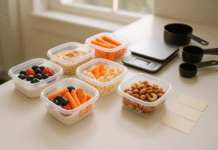
- Use physical props (mat, bottle, book) staged within arm’s reach.
3.2 Mini case
Anchor: start the kettle at 7:10 a.m.
Tiny habit (week 1): hold a 20-second calf stretch while the water heats.
Scaling (week 3+): add a second stretch or 60-second mobility flow if energy allows.
Outcome: 21/21 mornings completed; mobility becomes the “default while kettle boils.”
By shrinking to two minutes, you create a habit you’ll perform even on rough days. Consistency compounds; intensity can wait.
4. Make Cues Laser-Specific (Time, Place, Preceding Action)
Specificity turns “sometime after breakfast” into “after I place my bowl in the sink, I’ll take my vitamin.” The brain prefers exact triggers—visible actions in the same room—over fuzzy times like “later.” Add micro-details: the object you’ll touch, the surface you’ll stand on, the sound you’ll hear. These concrete elements shorten the mental distance between cue and action. If your routine varies by weekday/weekend, write separate if-then plans so each context has its own reliable cue.
4.1 Cue examples that work
- Sound cue: “When the toothbrush timer buzzes, I’ll floss one tooth.”
- Tactile cue: “After I buckle my seatbelt, I’ll check posture and relax shoulders.”
- Visual cue: “When I see the kettle light, I’ll fill a glass of water.”
4.2 Common mistakes
- Using time-only cues (“at 7 p.m.”) without tying to a physical action.
- Linking to an infrequent or optional activity (“after yoga class” if you skip often).
- Stacking multiple new habits onto a single weak cue in week 1.
Region & routine note: If your schedule shifts (shift work, travel), base cues on portable actions you always do—like charging your phone at night or washing hands before meals—so the stack survives time zones and new environments. Precision prevents drift; the crisper the cue, the stronger the stack.
5. Engineer the Environment: Reduce Friction, Increase Obviousness
Habits are easier when your surroundings nudge you. Before relying on motivation, make the desired action obvious and frictionless: place a water bottle next to the coffee maker, keep floss on the sink, or set an open notebook beside your keyboard. Each minute of setup you remove can double your completion rate because you’re no longer fighting tiny obstacles. Conversely, add friction to competing behaviors: store the TV remote in another room during weeknights, or log out of social apps on your laptop.
5.1 Practical setup checklist
- Proximity: Put tools within 30–60 cm of the anchor location.
- Visibility: Use trays, stands, and clear containers to keep cues in sight.
- Readiness: Pre-measure, pre-fill, or pre-lay out equipment the night before.
- Simplicity: One container, one spot, one action—avoid rummaging.
- Friction to blockers: Hide or unplug competing devices during the anchor window.
5.2 Numeric example
- Without setup: “drink water after coffee” succeeds 3/7 mornings.
- With setup (bottle filled, on the left of the machine): success jumps to 6/7.
- Add tactile cue (hand hits bottle first): 7/7 for two weeks, then automatic.
Environment design turns “I should remember” into “it’s hard not to do it.” Do the setup once; reap the benefits every morning.
6. Bundle Rewards Wisely (Temptation Bundling Without Backfire)
Temptation bundling pairs a pleasurable activity with a virtuous one—listen to a favorite podcast while you tidy, or make your best tea only during your language-study stack. Used carefully, this strengthens the anchor→action chain by giving your brain an immediate reason to show up. The key is to bundle enjoyment with the process, not with outcomes like “cheat foods after a workout,” which can undermine goals. Keep rewards intrinsic or neutral (music, scenery, social connection) and tie them tightly to the moment you execute the habit.
6.1 Safe bundling ideas
- Audio treat (playlist, podcast) during your two-minute mobility flow.
- Favorite pen reserved for nightly two-line journal.
- Stand at a sunny window while doing breathing practice.
- Brew premium tea only when you open your study app.
6.2 Guardrails
- Avoid calorie or purchase-based rewards that can overrun goals.
- Don’t delay the reward; it should start with the new action.
- Keep the reward consistent for the first 2–3 weeks to cement the link.
A good bundle makes your stack something you look forward to, not just something you “have to” do. Pleasure helps repetition; repetition builds automaticity.
7. Track Streaks and Celebrate Small Wins (But Don’t Let the App Be the Habit)
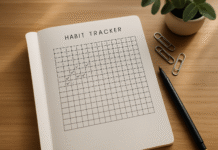
Tracking creates visibility: what gets measured tends to continue. Use a paper calendar, the Notes app, or a simple habit tracker to mark each successful stack with an “X.” The goal isn’t gamification for its own sake; it’s to reinforce identity (“I’m the kind of person who…”) and provide feedback loops. Celebrate small wins with a quiet “nice” or a checkmark; over-the-top rewards can turn the habit into a performance. Be careful not to let tracking become the main behavior—if it takes longer to log than to act, you’ve added friction.
7.1 Minimalist tracking system
- One line per habit: “After coffee → take vitamin.”
- Columns Mon–Sun; mark an “X” when complete.
- Weekly review: if <5/7, adjust anchor or shrink the action.
- Use a single sheet on your fridge or desk—visible, low friction, low noise.
7.2 Common pitfalls
- Chasing streaks over substance (checking the box without doing the action well).
- Adding too many metrics at once (time, reps, notes) during week 1.
- Letting a missed day nuke motivation—use “never miss twice” as a recovery rule.
Tracking is not the habit—but it’s the mirror that keeps the habit honest. Keep it light, and keep moving.
8. Escalate With Clear Rules (When and How to Grow the Habit)
Once your tiny habit runs on autopilot for two weeks, add a simple escalation rule. Growth without rules becomes guesswork, and guesswork leads to bursts and backslides. Escalation rules specify when to increase and by how much—for example, “After 14 consecutive days, add 30 seconds,” or “Increase by 10% weekly if effort feels ≤6/10.” These constraints protect you from doing too much on good days and too little on bad days, preserving the core stack while gradually building capacity.
8.1 Example escalation ladders
- Breathing or mobility: +30 seconds every 14 consecutive days.
- Strength micro-sets: +1 rep every 7 days after a comfortable week.
- Reading habit: from one paragraph → one page after 10 days of consistency.
- Hydration: add one 250 ml glass after week 2 if mornings feel easy.
8.2 Numbers & guardrails
- Ceiling rule: if effort >7/10 for three days, revert to the previous level.
- Floor rule: keep the tiny version as the minimum forever (streak saver).
- One change per week—don’t escalate time and difficulty simultaneously.
Escalation is a bonus, not a requirement. Your tiny habit sustains the streak; the rule just gives you a safe, predictable path to growth.
9. Build a Reset Plan: “If Derailed, Then Resume”
Life happens—travel, illness, guests, late nights. The difference between temporary detours and dead-ends is a reset plan you define in advance: “If I miss a day, then tomorrow I do the tiny version immediately after the anchor—no make-up, no guilt.” Two helpful principles: (1) Never miss twice—interrupt the slide quickly; (2) Return small—restart with the easiest version to rebuild momentum. Store portable props (floss picks, resistance band, travel-size vitamins) in your bag so your stack survives away from home.
9.1 Mini-checklist for resets
- Prewrite the reset line on your tracker: “If I miss → tiny version tomorrow.”
- Keep travel kits for your top 1–2 habits in your backpack or suitcase.
- Use universal anchors (charging phone, washing hands) when your routine shifts.
- Forgive fast; resume faster—focus on the next rep, not the last miss.
9.2 Example scenarios
- Travel day: Anchor shifts to “after I plug in my phone at the hotel”; action = one minute of stretching.
- Sick day: Keep only the smallest versions (sip water after tea, 10-second breath).
- Long day: Trigger the “floor” version; check the box; call it a win.
A reset plan turns setbacks into speed bumps. By predeciding your response, you keep identity intact and streaks recover within 24 hours.
FAQs
1) What exactly is habit stacking?
Habit stacking is pairing a new, specific action with an existing, reliable routine so the cue triggers the new behavior automatically. For example, “After I make coffee, I’ll fill my water bottle.” Over time, repetition under the same cue builds automaticity, reducing the need for motivation or reminders.
2) How long does it take for a stacked habit to feel automatic?
It varies widely. Research on daily habits shows a median of about two months, with a range from three to eight months depending on complexity, context stability, and consistency. Instead of chasing a date, use streaks to monitor progress and expect variability after travel or schedule changes.
3) What if I don’t have a consistent routine?
You likely do—just smaller than you think. Look for universal anchors like brushing teeth, washing hands, sitting in the driver’s seat, or plugging in your phone at night. If your schedule is irregular, create separate stacks for workdays and off-days so each context has its own cue.
4) Can I stack multiple habits on one anchor?
Yes—eventually. Start with one new action per anchor for two weeks. If it’s effortless, add a second micro-habit, but keep the sequence short (≤5 minutes total). Too many add-ons dilute the cue and increase failure points.
5) Is habit stacking the same as “temptation bundling”?
They’re related but different. Habit stacking links a new action to an existing cue, while temptation bundling pairs a desired action with a pleasant reward (e.g., a podcast). You can combine them—do the new habit and enjoy the reward at the same time—to strengthen consistency.
6) What if I miss a day and feel like the streak is broken?
Use the never miss twice rule. Your only job is to complete the tiny version at the next anchor. Streaks are a tool, not a judgment. A fast reset matters more than a perfect run.
7) Which tools or apps work best for tracking stacked habits?
Any low-friction option you’ll use daily: a paper wall calendar, a single-page checklist, or a basic app with tap-to-check functionality. Avoid complex setups in week 1. The best tool is the one that stays visible and takes <10 seconds to update.
8) How big should my tiny habit be?
Small enough that you can do it when tired, busy, or stressed—often 30–120 seconds. If you feel resistance, shrink it further. The “laugh test” helps: if it feels almost silly, it’s probably right for week 1.
9) Can I stack habits for nutrition or exercise safely?
Yes, but keep changes incremental and talk with a health professional if you have medical conditions. Good examples: water after coffee, a 60-second stretch after showering, or placing fruit on the counter after unloading groceries.
10) How do I choose between time-based and event-based cues?
Event-based cues (the action right before yours) usually outperform clock times because they’re more salient. If you must use a time, tie it to a device alarm and an immediate physical action to reduce drift.
11) How do I scale from tiny to meaningful results?
Apply a simple escalation rule: once the tiny version is effortless for 10–14 days, add 10–20% volume or +30–60 seconds. Keep the tiny version as your “floor” forever so you can maintain momentum during busy weeks.
12) What’s the fastest way to know if my stack is well-designed?
Run a 7-day pilot. If you can’t complete it at least 5/7 times without reminders, either the anchor is weak (too variable) or the action isn’t tiny enough. Fix one variable at a time and rerun.
Conclusion
Habit stacking works because it piggybacks on the routines you already execute without thinking. By choosing a rock-solid anchor, writing a crisp if-then plan, and starting with a two-minute version, you make the new behavior too easy to skip. Precision cues and smart environment design reduce friction, while gentle rewards and minimalist tracking help you repeat the sequence until it becomes automatic. Clear escalation rules guide growth without inviting burnout, and a prewritten reset plan keeps momentum alive when life gets messy. You don’t need more willpower; you need fewer decisions and better cues. Pick one anchor today, write one tiny if-then plan, and prove to yourself you can show up—consistency first, intensity later.
CTA: Choose one anchor and one tiny action, write your if-then plan, and complete your first stack in the next 10 minutes.
References
- How are habits formed: Modeling habit formation in the real world, European Journal of Social Psychology, 2009. https://onlinelibrary.wiley.com/doi/abs/10.1002/ejsp.674
- Implementation Intentions: Strong effects of simple plans, Gollwitzer, American Psychologist, 1999. https://psycnet.apa.org/record/1999-10128-004
- The Fogg Behavior Model, BJ Fogg, Behavior Design Lab (Stanford), 2009 (overview page updated periodically). https://behaviormodel.org/
- Temptation Bundling: Leveraging Immediate Rewards to Increase Costly Behaviors, Milkman et al., Management Science, 2014. https://pubsonline.informs.org/doi/10.1287/mnsc.2014.1901
- The Power of Habit, Charles Duhigg, Random House, 2012. https://charlesduhigg.com/the-power-of-habit/
- Tiny Habits: The Small Changes That Change Everything, BJ Fogg, Houghton Mifflin Harcourt, 2019. https://tinyhabits.com/book/
- Habit formation and behavior change, Wood & Neal, Annual Review of Psychology, 2007. https://www.annualreviews.org/doi/10.1146/annurev.psych.56.091103.070258
- Mental contrasting with implementation intentions (WOOP), Oettingen, Social and Personality Psychology Compass, 2012. https://woopmylife.org/science/
- A 52-week megastudy of behavior change strategies, Milkman et al., PNAS, 2021. https://www.pnas.org/doi/10.1073/pnas.2016686118
- Atomic Habits, James Clear, Avery, 2018. https://jamesclear.com/atomic-habits
- Habit Stacking: 127 Small Changes to Improve Your Health, Wealth, and Happiness, S.J. Scott, 2014. https://www.developgoodhabits.com/habit-stacking/