




























When home feels organized and respectful, everything else gets lighter. Clear household boundaries—agreed rules for who owns which tasks and how personal spaces are used—turn daily frictions into predictable, fair routines. In this guide you’ll get nine evidence-informed rules for splitting chores and protecting privacy, whether you live with a partner, roommates, kids, or extended family. Brief note: this is practical guidance, not legal advice.
Quick definition: Household boundaries are shared agreements that define responsibility, standards, and personal space so the home runs fairly without one person carrying the “mental load.” Done well, they reduce conflict and protect everyone’s time.
Fast start (5 steps): 1) List all recurring tasks, including invisible planning work. 2) Set standards (what “done” means). 3) Assign ownership (one owner per task). 4) Protect personal spaces and quiet hours. 5) Hold a 30-minute weekly check-in to review and rebalance.
1. Start With Shared Values and Non-Negotiables
The fastest way to fair boundaries is to anchor them to shared values; people follow rules they helped create. Begin by agreeing on 3–5 values (e.g., “health,” “calm evenings,” “respect for study time”) and translate each into one or two non-negotiables you can measure. This prevents debates about chores and space from becoming moral arguments and keeps decisions solution-focused. Open with a 20–30 minute conversation where each person names what a “good week at home” looks like. Capture recurring moments that feel unfair or intrusive (e.g., dishes piling up, unannounced guests, noise during work calls) and convert them into boundary statements.
Mini-checklist to draft values into rules
- Value: Health → Non-negotiable: kitchen wiped nightly; fridge check every Friday.
- Value: Calm evenings → Non-negotiable: quiet hours 10:00 pm–7:00 am; headphones after 9.
- Value: Respect for study/work → Non-negotiable: no interruptions when the door is closed except emergencies.
- Value: Safety & hygiene → Non-negotiable: trash out when >¾ full; bathroom cleaned weekly.
- Value: Privacy → Non-negotiable: ask before borrowing or entering personal zones.
Why it matters
Values first, tasks second. When conversations drift into “who does more,” people get defensive. Values ground the plan in shared purpose and make later trade-offs easier (“Does switching this task still protect calm evenings?”). For households with children, naming values gives kids clear reasons behind rules and encourages cooperation.
Numbers & guardrails
Globally, adults spend about 2.9 hours per day on unpaid care and domestic work (as of 2023), so clarity about boundaries isn’t optional—it’s what keeps unpaid work distributed and sustainable.
Close by writing your values and non-negotiables on a visible surface (whiteboard, shared note). Revisit them quarterly.
2. Make the Invisible Work Visible (Audit the Mental Load)
Before assigning chores, capture the invisible work—the planning and monitoring behind the scenes. Ordering prescriptions, tracking gift lists, noticing we’re low on detergent, or booking the electrician often consumes more bandwidth than the visible execution. If it’s not listed, it won’t be shared.
Open a 30–45 minute “home audit.” Walk room by room and time-span by time-span (daily, weekly, monthly, seasonal). Note every task from conception (noticing/anticipating), through planning (sourcing, scheduling), to execution (doing). Many households underestimate by 30–50% because they only list execution tasks. To avoid this, write tasks as “owning the outcome” (e.g., “Laundry, end to end,” not “fold towels”).
How to do it
- Room sweep: Kitchen, bathrooms, bedrooms, entryway, laundry, outdoor, vehicles.
- Calendar sweep: Daily (dishes), weekly (vacuum), monthly (filters), quarterly (deep clean), seasonal (taxes, tires).
- Life domains: Groceries, bills, maintenance, health, kids/pets, social, admin, safety.
- Data cues: Look at digital order histories and past calendars to surface forgotten tasks.
- Time reality check: For homes with young kids, adults spend ~2.3–2.5 hours/day on primary childcare (2023–2024), which squeezes chore bandwidth; plan accordingly.
Tools/Examples
- Frameworks: The Fair Play system popularized “ownership from conception to execution,” useful language for making invisible work explicit.
- Templates: Use 100-task card lists (adapted from Fair Play) or a spreadsheet with C/P/E columns to mark gaps.
Close by totaling recurring hours for a normal week and a peak week (guests, exams, deadlines). Plan for peaks, not fantasies.
3. Allocate Chores With a Fairness Formula (Not a 50/50 Myth)
A fair split isn’t always 50/50; it’s proportional to available time, energy windows, and preferences/skills—and it prevents one person from having significantly less leisure time. Start with a workload picture: paid work, commute, caregiving, sleep, and recovery time. In many households, women still shoulder more unpaid housework and caregiving while men record slightly more leisure; if you ignore that baseline, resentment lingers even after you “divide chores.” Use time-use data as a neutral mirror before assigning tasks.
Fairness formula (example)
- Calculate each adult’s weekly free capacity: total waking hours minus paid work/commute, essential personal care, and caregiving averages (e.g., 17.5 hours/week of primary childcare for toddlers, per ATUS trend lines).
- Sum recurring household tasks (from your audit) and assign hours.
- Distribute tasks so everyone’s net leisure stays within ~1–2 hours/week of each other.
- Respect energy windows: morning lark handles AM tasks; night owl does PM resets.
3 ways to operationalize fairness
- Preference swap: Each person drafts A/B/C lists (love, neutral, dislike). Trade to maximize motivation.
- Capability match: Assign tasks that leverage speed/skill, then rotate quarterly to avoid pigeonholing.
- Capacity balancing: During crunch seasons (exams, deadlines), shift 5–10 hours/week of chores to the person with more bandwidth; revisit later.
Common mistakes
- Counting only visible chores (skips planning).
- Double ownership (“We both handle laundry”)—leads to diffusion and last-minute scrambles.
- Ignoring leisure parity; small weekly gaps become big feelings over months.
Close by documenting who owns which outcomes and the estimated weekly minutes per owner.
4. Assign End-to-End Ownership (One Owner per Outcome)
Nothing sabotages boundaries faster than “shared” ownership of a task that needs a single accountable person. Adopt a one owner per outcome rule: the owner handles Conception → Planning → Execution and communicates status. Others can assist, but accountability stays with the owner. This reduces nagging (“Did you…?”), prevents last-minute crises, and builds trust.
How to implement
- Replace “we should” with a named owner and a due rhythm (e.g., “Jordan owns bathrooms weekly by Sunday 6 pm”).
- Use a light RACI-style note: Owner (accountable), Helper (optional), Informed (who needs updates).
- Tie ownership to triggers: trash out when ¾ full; dishwasher run at >90% load; linens every 2 weeks.
- Post ownership on a visible board or shared app (Cozi, Todoist, Notion; pick one).
Why this works
The approach mirrors the Fair Play system’s card “ownership” principle—no partial accountability, no invisible project manager on the sidelines. The explicit transfer of ownership is what ends “nagging” loops and weaponized incompetence concerns because success criteria are clear.
Mini case
Two-adult household with a cat: Owner A holds “Groceries” (meal plan, list, shop, put away) and “Litter” (monitor, scoop, refill, deep clean monthly). Owner B holds “Laundry” and “Bills.” Each task lists standards (see Rule 6). At the weekly check-in, owners report “green/yellow/red” status.
Close by agreeing that crises trigger temporary swaps with explicit hand-back dates to avoid permanent drift.
5. Protect Personal Spaces and Quiet Hours (Zones, Signals, Storage)
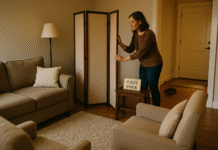
Fair division isn’t only about chores; personal space and quiet time prevent burnout and conflict. Start by mapping the home into Zones: Shared (kitchen, living), Semi-private (desk corner), and Private (bedroom, locker, drawer). Define signals (closed door, headphones) and quiet hours that match work/school schedules. In small apartments, carve micro-zones—folding screens, bookshelf dividers, or a “quiet corner” with chair + lamp—to anchor restorative time.
Practical moves
- Door policy: Closed = do not disturb unless urgent; knock and wait.
- Guest policy: Agree on notice (e.g., 24–48 hours), max frequency, and shared costs.
- Storage: Label personal bins; shared shelves get clear rules (first in, first out; expiring date labels).
- Noise: Headphones after 9 pm; white-noise machines for sleepers; rugs for sound dampening.
- Work calls: Post a mini schedule on the fridge for predictable quiet blocks.
Region & household type notes
- Roommates/Student housing: Many residence life programs encourage roommate agreements covering quiet hours, guests, cleaning rhythms, and privacy—use their templates to speed consensus.
- Multigenerational homes: Add cultural or prayer times, and ensure elders’ rest windows.
- Parents with infants: Quiet hours flex around sleep regressions; re-balance chores to protect adult sleep.
Close with a 2-line “Personal Space Charter” posted near common areas. Re-negotiate when jobs or school terms change.
6. Define Standards and “Done” Criteria (End the Rework)
Half of chore fights aren’t about who—they’re about how clean is clean. Create “done” definitions for each task to avoid rework and resentment. Standards should be observable (“counter wiped, crumbs cleared, sink empty”), time-boxed (10–15 minutes for a daily reset), and hygiene-anchored (bathroom disinfect weekly). If standards feel high, scale frequency rather than arguing quality: e.g., deep clean monthly, quick wipe daily.
Standards template (example)
- Kitchen reset (daily): Load/run dishwasher if >90% full; wipe counters/stove; clear sink; sweep crumbs.
- Bathroom weekly: Toilet bowl/seat, sink, mirror, tub; replace towels; empty trash.
- Floors: High-traffic vacuum 2x/week; mop weekly.
- Laundry: Wash/sort; fold within 24 hours; put away same day (no clean-clothes mountains).
Numbers & realities
As of 2025, national time-use data show persistent gaps in who spends time on housework, with women performing more unpaid domestic work in many households. Being explicit about “done” levels ensures that standards don’t track gender stereotypes but shared hygienic baselines. Use ATUS/Pew visuals as a neutral arbiter when revisiting loads and expectations.
Common pitfalls
- Perfectionism (sets failure traps).
- Ambiguity (breeds micromanagement).
- All-or-nothing cleaning (skip small daily resets, then dread massive deep cleans).
Close by linking standards to triggers (Rule 4) so tasks self-activate without nagging.
7. Build a Weekly Check-In and Quarterly Rebalance
Boundaries drift unless you maintain them. Hold a 30-minute weekly meeting (same time each week) to scan the board: What went red? What’s upcoming (guests, exams)? Swap cards if capacity changes. Then, every quarter, run a deeper rebalance: review time-use realities, confirm standards, and retire or add tasks.
Weekly agenda (15–30 minutes)
- Wins & friction (2 minutes each).
- Red/yellow tasks and swaps.
- Upcoming week preview (appointments, travel, deadlines).
- Personal-space needs (quiet hours, guests).
- One small improvement (e.g., add a trigger or label).
Repair & reset after conflict
Disagreements will happen. Use a repair attempt quickly—any statement or action that stops escalation (“I got defensive; let’s restart in 10 minutes”). Schedule the topic for the weekly check-in if emotions run hot. The Gottman Institute highlights repairs as key to long-term stability; plan them explicitly.
Metrics to watch
- Leisure parity: Are free-time hours within ~1–2 hours/week? Pew time-use snapshots help you sanity-check.
- Task aging: Any task >1 cycle overdue needs a standards tweak or a reassignment.
Close by keeping the meeting lightweight and consistent; rituals beat marathons.
8. Use Tools and Automation to Lower the Friction
The best boundary is the one you don’t have to remember. Automate and externalize where you can so habits carry the load. Use one shared hub (calendar/app) to prevent duplication and “I didn’t see it” excuses. Adopt labels, timers, and sensors to turn chores into self-activating routines.
Practical stack
- Shared calendar (Google/Apple/Outlook): cleaning blocks, trash days, guest nights, bill due dates.
- Task apps: Todoist/Notion/Cozi with owners and recurring triggers (“every Friday 6 pm: fridge check”).
- Shopping: Shared lists; subscribe & save for staples; pantry labels with use-by dates.
- Home tech: Robot vacuum on a 3x/week schedule; smart plugs for lamps; moisture meter to avoid plant over/under-watering.
- Visuals: Whiteboard chore board with columns: Owner | Trigger | Standard | Status.
Why tools matter
Automation reduces reliance on memory and mental load, making boundaries feel less like policing and more like the environment doing the nudging. For roommates and families alike, a single source of truth eliminates “But I thought…” loops and supports transparent rebalancing during heavy weeks (e.g., when childcare spikes for parents of under-6s).
Mini-checklist
- Pick one hub.
- Turn standards into recurring tasks with checkboxes.
- Add alerts for quiet hours/guest nights.
- Review automations in the weekly check-in.
Close with a simple rule: if a task matters, it lives in the system—not in someone’s head.
9. Plan for Boundary Crossings: Consequences, Mediation, and Repair
Even great systems get tested—missed chores, borrowed items without asking, late-night noise. Decide in advance how you’ll respond. Consequences should be proportionate, predictable, and aimed at repair, not punishment. For small misses, the owner makes it right within 24 hours and communicates. For repeated misses, you escalate: swap tasks to someone with better follow-through, adjust standards that are unrealistic, or bring in a third-party mediator.
Boundary repair framework
- Acknowledge quickly: Name the boundary and impact (“The 10 pm quiet hour was missed; my early call suffered”).
- Offer/ask for repair: Propose a make-good (e.g., cover a task, buy replacement, adjust schedule).
- Reset the agreement: Confirm the standard and the trigger.
- Use a repair attempt to de-escalate so the conversation stays productive.
Roommates vs. family note
Student housing and residence life teams often recommend formal roommate agreements that cover chores, guests, and quiet hours; borrowing their structure can help any shared home keep boundaries clear. If conflicts persist, bring in a neutral RA/mediator or use a written amendment to the agreement. Grand Valley State University
Big-picture fairness
Remember that persistent inequities in domestic work are common; use time-use data as a compass rather than a cudgel. The goal is not perfect equality but sustainable fairness that preserves health, relationships, and dignified personal space.
Close by documenting what counts as a boundary crossing and the default repair path so no one is guessing in the moment.
FAQs
1) What exactly are “household boundaries,” and how are they different from rules?
Boundaries are shared agreements that protect time, energy, and privacy while defining task ownership. Rules can sound top-down; boundaries are co-authored and tied to values (“calm evenings,” “health”). A boundary might say, “Quiet hours 10 pm–7 am; headphones after 9,” or “One owner per outcome.” They prevent overload and resentment by clarifying expectations before conflict starts.
2) Is it better to split chores 50/50?
Not always. Fairness aligns with capacity (work hours, caregiving), energy windows, and skills/preferences. Start by mapping each person’s weekly bandwidth and aim for leisure parity—free time within roughly 1–2 hours/week of each other. Research shows women often perform more unpaid housework and caregiving, while men report slightly more leisure; calibrate with that in mind and rebalance over time.
3) How do we account for childcare when dividing chores?
Caregiving squeezes chore capacity. Adults in households with children under 6 average about 2.3–2.5 hours/day on primary childcare (2023–2024). Protect sleep and recovery, and temporarily reassign other chores during intense phases. Reassess monthly as routines shift.
4) What’s the best way to capture the “invisible” mental load?
Audit tasks from Conception → Planning → Execution and assign one owner per outcome. The Fair Play system popularized this language and offers card decks listing common tasks. Whether you use cards, a spreadsheet, or an app, the key is to track full ownership, not just execution.
5) We keep fighting about “how clean is clean.” How do we stop?
Write “done” definitions for each task that are observable and time-boxed (“wipe counters, empty sink, sweep crumbs—10 minutes”). If standards feel too high, reduce frequency rather than arguing quality. Tie standards to triggers (trash out when ¾ full) so tasks self-activate without nagging.
6) We live in a small apartment—how do we protect personal space?
Create zones (Shared, Semi-private, Private) and clear signals (closed door, headphones). Use vertical dividers, shelves, or a folding screen to carve micro-zones. Set quiet hours aligned with work/school. For roommates, adopt a simple roommate agreement to codify guest and noise policies; many universities provide templates worth borrowing.
7) How often should we revisit our split?
Have a weekly 30-minute check-in and a quarterly rebalance. Track what’s slipping, preview the next week, and adjust for life changes (deadlines, travel, exams). Use a shared board/app so changes are visible.
8) What if someone repeatedly breaks boundaries?
Plan a repair path: quick acknowledgment, make-good action, and reset. If it keeps happening, swap tasks to someone with better follow-through, lower standards or frequency to something sustainable, or bring in a mediator. Use repair attempts to de-escalate during the conversation.
9) Which apps actually help?
Any tool you’ll actually use is best. Pick one shared hub (Google/Apple calendar, Cozi, or Todoist/Notion with recurring tasks). Automate reminders for bills, trash day, and fridge checks. Label shelves and bins in shared zones to reduce friction. The goal is to get tasks out of heads and into systems.
10) How do we involve kids fairly?
Give kids age-appropriate ownership (feeding pets, wiping tables, sorting laundry) with clear “done” criteria and positive reinforcement. Avoid redoing their work in front of them; teach standards and let them practice. Rotate tasks quarterly so skills grow.
11) How do we handle visiting guests without drama?
Agree on notice windows (24–48 hours), frequency caps, and shared costs (toilet paper, extra groceries). Post guest nights on the shared calendar and adjust quiet hours if needed that week. If a guest repeatedly strains the house, raise it at the check-in and amend the agreement.
12) What metrics show our plan is working?
Look for: fewer last-minute scrambles, chores completed on rhythm, leisure parity within ~1–2 hours/week, and fewer boundary escalations requiring mediation. If any metric drifts for three weeks, run a mini-reset meeting.
Conclusion
Boundaries that stick are built, not declared. Start with values and non-negotiables to keep decisions anchored in shared purpose. Make the invisible work visible so “fair” captures planning and monitoring—not just doing. Assign end-to-end ownership so one person isn’t forced into being the household project manager. Protect personal spaces and quiet hours so everyone gets the recovery time that fuels patience. Then cement the system with weekly check-ins, quarterly rebalances, and light automation so routines—not willpower—carry the load. Keep an eye on leisure parity to ensure there isn’t a hidden inequity. When boundaries get crossed, repair quickly, reset, and move forward. Do this consistently and your home starts running on agreements, not arguments.
Ready to begin? Schedule your first 30-minute boundary check-in this week, list tasks end-to-end, and assign one owner per outcome—then enjoy your reclaimed time.
References
- In a Growing Share of U.S. Marriages, Husbands and Wives Earn About the Same, Pew Research Center, April 13, 2023, Pew Research Center
- Working husbands in the U.S. have more leisure time than working wives do—especially among those with children, Pew Research Center (The Short Read), October 27, 2023, Pew Research Center
- Time spent caring for household children in 2023, U.S. Bureau of Labor Statistics (The Economics Daily), November 12, 2024, Bureau of Labor Statistics
- American Time Use Survey—2024 Results (News Release), U.S. Bureau of Labor Statistics, June 26, 2025, Bureau of Labor Statistics
- Technical Brief: Forecasting Time Spent in Unpaid Care and Domestic Work, UN Women, October 2023, UN Women
- OECD Time Use Database (overview), Organisation for Economic Co-operation and Development, accessed August 22, 2025, OECD
- The Cards (Fair Play—100 Household Tasks & Rules), Fair Play Life (official site), accessed August 22, 2025, fairplaylife.com
- R is for Repair, The Gottman Institute (Blog), July 2, 2025, Gottman Institute
- Roommate Agreement (template and guidance), University of Evansville Residence Life, accessed August 22, 2025, evansville.edu
- Roommate Agreement (sample and policy), University of North Florida Housing, updated August 2025, UNF Home
- American Time Use Survey (Program overview), U.S. Bureau of Labor Statistics, accessed August 22, 2025, Bureau of Labor Statistics
- Proportion of time spent on unpaid domestic and care work (female, % of 24-hour day), World Bank Data—OECD members, accessed August 22, 2025, data.worldbank.org