







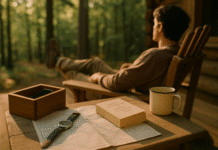
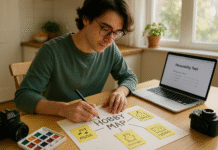

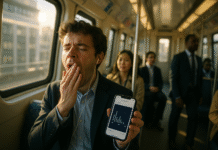
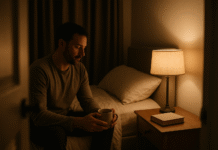


When you work out can nudge your internal clock earlier or later, changing when you feel alert, hungry, and sleepy. In chronobiology terms, exercise is a “non-photic zeitgeber”—a time cue that shifts circadian phase alongside light. In practical terms: morning and early-afternoon sessions tend to pull your sleep-wake rhythm earlier (phase advance), while late-evening vigorous sessions push it later (phase delay). Use this to sleep better, dial in performance, and handle jet lag or shifts. (Brief, important note: this article is educational and not medical advice; if you have a medical condition, talk to your clinician about safe timing.)
Quick answer: Exercise timing influences circadian rhythms by shifting melatonin timing, core body temperature, and autonomic tone. Morning/early-afternoon training tends to advance your clock; late-evening vigorous sessions tend to delay it. Use at least a 4-hour buffer before bedtime for hard workouts (as of August 2025).
1. Morning exercise advances your clock (helps earlier sleep and wake)
Morning workouts are one of the most reliable ways to move your circadian rhythm earlier. The strongest human data come from phase-response curves (PRCs) showing that exercise around ~7:00 a.m. produces significant phase advances in melatonin timing, which translates to feeling sleepy and waking earlier over subsequent days. Mechanistically, morning training combines a mild non-photic time cue (muscle, metabolic, and autonomic signals) with natural bright light exposure if you train outside—both advance the clock. In adolescents and late chronotypes (night owls), even low-to-moderate morning activity can shift bedtime earlier by dozens of minutes across a few weeks, improving sleep quality and daytime alertness.
1.1 Why it matters
- PRC data show peak advances from early morning exercise; think of it as a “nudge” to your melatonin rhythm.
- Morning sessions often coincide with bright outdoor light, which independently advances circadian phase and amplifies the effect.
- In real-world cohorts, morning exercise advanced circadian markers and improved sleep, especially for later chronotypes.
1.2 How to do it
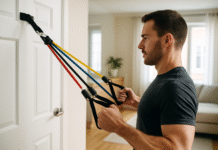
- Timing window: Start 30–120 minutes after wake-up; add outdoor light when possible.
- Volume & intensity: 20–60 minutes at easy-to-moderate intensity is enough to get the signal started; add intervals if you like.
- Stack the cues: Finish with a cool shower and bright light exposure; delay caffeine ~60–90 minutes after waking to protect the natural cortisol awakening response.
- Expectations: Shifts are gradual—think ~20–45 minutes across days to weeks depending on consistency and exposure to light.
Bottom line: If you want to fall asleep earlier without medication, string together 5–7 mornings of outdoor movement.
2. Late-evening vigorous exercise delays your clock—buffer at least 4 hours before bed
Vigorous exercise within a few hours of bedtime tends to delay sleep onset and reduce sleep quality for many people by raising heart rate, body temperature, and sympathetic arousal. As of August 2025, a large Nature Communications analysis of 14,689 adults wearing wearables found a dose–response relationship: later timing and higher “strain” were linked to later sleep onset, shorter duration, higher nocturnal resting heart rate, and lower HRV. Crucially, when workouts ended ≥4 hours before sleep, disruptions disappeared—even for hard sessions. Meta-analyses also show that moderate evening sessions aren’t universally bad; the main risk is high intensity too close to bedtime.
2.1 Numbers & guardrails
- Hard cutoff: Finish vigorous sessions ≥4 hours before your target sleep time (e.g., 11:00 p.m. bedtime ⇒ last rep by ~7:00 p.m.).
- Intensity effect: The higher the strain, the more nocturnal HR rises and HRV drops for several hours.
- Meta-analytic nuance: Evening exercise can be neutral or beneficial if intensity is moderate and ends ≥1–2 hours pre-bed.
2.2 Mini-checklist (evening trainer’s edition)
- Prefer easy-to-moderate sessions after dinner (zone 1–2 cardio, light circuits, yoga).
- Use an extended cool-down (10–15 min), light snack, and dim lights post-workout.
- Keep bedroom cool (18–20 °C / 64–68 °F) and avoid caffeine ≥6 hours pre-bed.
Close with this rule of thumb: go hard earlier; go easy later. Your clock—and sleep—will thank you.
3. Early-afternoon exercise also advances phase (a stealth tool for early rising & eastbound travel)
PRC data reveal a second advance zone in the early-to-mid-afternoon (≈1–4 p.m.). Training here can push your melatonin rhythm earlier without the dawn alarm, making it a useful option for people who can’t exercise in the morning. It’s also practical for eastbound jet-lag: pairing light in the new morning with early-afternoon workouts accelerates adaptation by layering photic and non-photic cues that both advance the clock.
3.1 How to deploy for eastward trips
- T-3 to T+3 days: Shift workouts into your early afternoon (destination time); seek morning light there; avoid bright light at local evening.
- Session types: Aerobic base, tempo runs/rides, or steady resistance sessions work well.
- Expectation: Each day of consistent cues yields incremental phase advances; better results when aligned with light.
3.2 Mini case
- Karachi → Singapore (≈3-hour advance): Land day 1, walk/jog 30–45 min between 1–3 p.m. local, bright light after sunrise the next two mornings, and avoid heavy night workouts. Most travelers feel aligned by day 3–4.
This “afternoon advance” is underused—try it when mornings are impossible.
4. Match training to your chronotype for better adherence and results
Your innate preference for morning or evening (chronotype) shapes when you feel strongest, tolerate intensity, and actually show up. Morning types generally perform better earlier; evening types often peak later. Training at your preferred time reduces perceived exertion and can amplify gains at that time of day—useful for sport scheduling. But if you’re a night owl trying to shift earlier for life or work, consistent morning training plus morning light can gradually retrain your clock.
4.1 What the evidence says
- Morning-types outperform in the morning; evening-types in the evening on aerobic tests; sleep quality modulates evening performance. Frontiers
- Reviews suggest performance peaks later day; training where you’ll compete can improve test-time performance.
4.2 Practical playbook
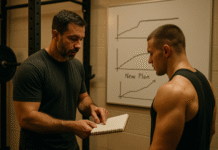
- Adherence first: Pick a time you can keep 4–5 days/week.
- Performance goals: If racing at 6 p.m., anchor at least 2 of your weekly key sessions at that time.
- Shifting goals: To become an earlier riser, front-load easy-moderate training most mornings for 2–3 weeks, plus bright light after sunrise.
Honor your biology to build the habit; tweak timing to engineer the shift you want.
5. Combine exercise with light (and sometimes melatonin) to move your clock faster
Exercise and light operate through different—but complementary—pathways. Morning outdoor workouts layer photic (light) and non-photic (exercise) time cues to create a bigger phase advance than either alone. For bigger shifts (e.g., severe delayed sleep phase or stubborn jet lag), clinicians sometimes combine morning bright light with properly timed low-dose melatonin in the late afternoon/early evening; the principle carries to self-care when used responsibly.
5.1 How to stack cues (general guidance)
- Morning: 20–60 minutes of outdoor exercise after waking + bright light exposure; avoid sunglasses unless necessary.
- Afternoon (advance goal): Add a steady workout between 1–4 p.m.
- Evening: Dim lights; avoid bright/blue light on screens pre-bed to prevent counter-shifts. PNAS
5.2 Evidence notes
- Morning exercise + morning/forenoon light advances circadian phase; light timing is a powerful lever.
- Light and melatonin used together can speed phase advances under clinical guidance.
Stacking cues is like pulling the same rope from two ends—your clock moves faster and more predictably.
6. Intensity and modality: what to schedule when (HIIT, resistance, cardio, mobility)
Different workouts place different loads on your nervous system and temperature regulation—two levers that matter for sleep. High-intensity intervals, sprints, and heavy resistance drive big sympathetic activation and raise core temperature for hours; moderate aerobic and mobility raise it less and recover faster. That’s why many people tolerate easy evening sessions but struggle with late-night HIIT.
6.1 Evidence snapshot
- Evening exercise isn’t automatically bad; meta-analyses show neutral or small benefits for sleep when intensity is moderate and not right before bed.
- Vigorous sessions near bedtime shorten REM and can elevate nighttime HR; larger strains worsen effects.
- Thermoregulation links temperature to sleep onset; better heat loss predicts faster sleep. PubMed
6.2 Timing template
- AM (advance goal / focus & metabolism): Intervals, tempos, or strength; finish with daylight and a protein-rich breakfast.
- Mid-PM (advance assist / performance): Steady endurance or strength blocks.
- Evening (sleep-friendly): Yoga, stretching, zone-1 walks, or easy spins; avoid all-out sessions ≤4 hours before bed.
Choose the right tool for the time: save the sledgehammer for earlier; use the feather late.
7. Use exercise timing to handle shift work and jet lag
Shift work and rapid time-zone travel misalign your internal clock with the environment, degrading sleep, mood, and safety. Strategically timed exercise can accelerate adaptation by delivering phase shifts in the desired direction—delays for night shifts, advances for early shifts or eastbound travel—especially when paired with targeted light.
7.1 Practical protocols
- Night shift (delay clock): Do late-evening exercise (ending 1–3 hours before the shift) and expose yourself to bright light during the first half of the shift; avoid morning light on the commute home (dark glasses). Sleep in a dark, cool room.
- Early shift / eastbound travel (advance clock): Use morning and early-afternoon exercise at destination time; add early-day bright light; block evening light.
- Westbound travel (delay goal): If you must stay up later, a late-evening moderate session can help delay bedtime, but keep it non-vigorous on arrival days.
7.2 Mini-checklist
- Lock meal timing to target schedule on day 1.
- Use caffeine judiciously and cut it ≥6 hours before planned sleep.
- Prioritize consistency for 3–5 days; the clock adapts incrementally.
Done right, exercise timing is a low-cost, side-effect-light lever for circadian realignment.
8. Temperature, cool-down, and the “sleep gate”: why your post-workout routine matters
Falling asleep is easier when your body can shed heat from the skin (especially hands and feet) as core temperature drifts down—sometimes called opening the “sleep gate.” Vigorous exercise raises core temperature and delays that drop. The solution isn’t to avoid evening movement entirely, but to engineer faster heat loss post-workout: extend the cool-down, rehydrate, use lukewarm-to-cool showers, and keep the bedroom cool.
8.1 What the science shows
- The strongest physiological predictor of falling asleep quickly is distal skin warming (hands/feet) that helps dump heat—more than raw core temperature alone.
- Heat and humidity at night impair slow-wave and REM sleep; cooling the sleep environment helps.
- A warm bath or shower 1–2 hours pre-bed can paradoxically speed sleep onset by triggering heat loss after you get out. BioMed Central
8.2 Wind-down checklist (10–30 minutes)
- 10 minutes easy spinning or walking; nasal breathing.
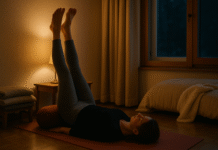
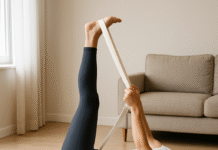
- Legs-up-the-wall or gentle hamstring stretches.
- Lukewarm shower; dry thoroughly; put on dry socks only if your feet feel cold (to encourage distal warming).
- Dark, quiet, 18–20 °C (64–68 °F) bedroom; no bright screens.
Cooling the system after late sessions is the difference between tired and sleepy; build it in. PubMed
9. Build your personalized timing plan (weekly template, tracking, and guardrails)
There’s no single best time for everyone. The winning plan suits your schedule, aligns with your chronotype and goals, respects recovery, and—crucially—protects sleep. Start with a weekly template, track how timing affects sleep latency, duration, and HRV, and adjust. Use the latest guardrails: hard workouts ≥4 hours before bed, caffeine ≥6 hours before sleep, and light hygiene that matches your timing goal.
9.1 Weekly template (example)
- Mon (AM): 40-min tempo run + 10-min mobility (advance signal).
- Tue (PM): 45-min strength before 6 p.m.; extended cool-down.
- Wed (AM): 30-min intervals outdoors + bright light.
- Thu (PM): 30-min easy spin or yoga after dinner; lights dimmed.
- Fri (PM early): 50-min steady ride; finish by 7 p.m. if 11 p.m. bedtime.
- Sat (late AM): Long aerobic; nap optional (≤30 min, before 3 p.m.).
- Sun (AM): Walk + planning session for the week.
9.2 Tracking & tools
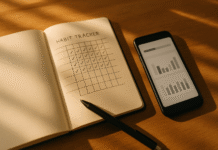
- Wearables: Note time of last mile vs. sleep onset, resting HR, HRV, and sleep efficiency. Look for patterns over 2–3 weeks.
- Adjustments: If HRV tanks and sleep onset drifts later after PM sessions, move them earlier or lighten intensity.
- Caffeine & light guardrails: No caffeine within 6 hours of sleep; keep evenings dim/warm light.
Treat timing like a training variable. Small, consistent tweaks beat heroic one-offs.
FAQs
1) What does “exercise advances or delays the clock” actually mean?
It means the internal timing of processes like melatonin secretion, body temperature, and sleep propensity shifts earlier (advance) or later (delay). Morning and early-afternoon workouts generally advance phase; late-evening vigorous sessions tend to delay it. These effects have been mapped with phase-response curves in controlled studies of 100+ adults.
2) If I can only train after work, will my sleep be ruined?
Not necessarily. Meta-analyses show evening exercise can be neutral or even beneficial for sleep—if intensity is moderate and you finish well before bedtime. As of Aug 2025, large wearables data suggest ending vigorous sessions ≥4 hours before sleep removes most disruption. Keep hard days earlier; keep late sessions easy.
3) How many minutes can morning training shift my bedtime?
Shifts vary, but studies in adolescents and late chronotypes show ~20–40 minutes of phase advance across several weeks of consistent morning exercise, especially with morning light. Expect gradual, stackable changes rather than a single dramatic jump.
4) Which workouts are best for advancing my clock?
Anything you’ll do consistently in the morning: moderate cardio, intervals, or resistance. The key is timing plus light; outdoor sessions after waking add a potent photic cue that accelerates advances.
5) Is HIIT at night always bad?
It’s not universally bad, but the risk of delayed sleep is higher when HIIT ends close to bedtime because of lingering sympathetic arousal and elevated temperature. If HIIT is your only option, end ≥4 hours before sleep, extend your cool-down, and dim lights afterward.
6) Can exercise help with night shifts?
Yes. Strategically timed late-evening exercise before a night shift can help delay the clock, especially when paired with bright workplace light and morning-light avoidance after the shift. Individualize based on schedule safety and recovery. Nature
7) Does caffeine timing interact with exercise timing?
Absolutely. Caffeine within 6 hours of bedtime reduces total sleep time and can offset the sleep benefits of a well-timed workout. Use it earlier in the day, and taper on late-training days. PubMed
8) What about melatonin supplements?
Under clinical guidance, small evening doses can be combined with morning light (and morning exercise) to speed phase advances in delayed sleep phase or jet lag. Timing and dose matter; don’t self-experiment recklessly.
9) Does timing matter for performance gains?
Some evidence suggests performance peaks later day, and training at the time you’ll compete can improve performance at that time. But for general fitness and health, consistency is more important than chasing a single “best” time.
10) I live in a hot climate—any special timing tips?
In hot, humid evenings, vigorous late sessions can raise body temperature for hours. Prefer early mornings for hard work, keep evening sessions light, and prioritize a long cool-down plus a cool bedroom to help sleep. The thermoregulation–sleep link is strong. BioMed Central
Conclusion
Exercise is more than “calories out”—it’s a clock setter. Morning and early-afternoon sessions pull your circadian rhythm earlier; late-evening vigorous sessions push it later. When you align workouts with sleep-wake goals—and stack them with light and temperature cues—you can fall asleep faster, wake more refreshed, and perform better at the right times. The most practical framework is simple: go hard earlier, go easy later, and leave ≥4 hours between strenuous work and sleep (as of Aug 2025). Track your own response with HRV, resting heart rate, and sleep latency; then iterate your schedule week by week. Do this for a month and you’ll feel the difference—at night, on the clock, and in your training log.
CTA: Pick one change—move your hardest weekly session earlier—and protect tonight’s sleep.
References
- Youngstedt SD et al. “Human circadian phase–response curves for exercise.” The Journal of Physiology. 2019. https://pmc.ncbi.nlm.nih.gov/articles/PMC6462487/
- Thomas JM et al. “Circadian rhythm phase shifts caused by timed exercise.” JCI Insight. 2020. https://insight.jci.org/articles/view/134270
- Stutz J, Eiholzer R, Spengler CM. “Effects of evening exercise on sleep in healthy participants: a systematic review and meta-analysis.” Sports Medicine. 2019. https://pubmed.ncbi.nlm.nih.gov/30374942/
- Yue T et al. “Different intensities of evening exercise on sleep in healthy adults: systematic review and network meta-analysis.” Nature and Science of Sleep. 2022. https://pmc.ncbi.nlm.nih.gov/articles/PMC9760070/
- Leota J et al. “Dose–response relationship between evening exercise and sleep in free-living adults.” Nature Communications. 2025. https://www.nature.com/articles/s41467-025-58271-x
- Crowley SJ et al. “Phase advancing human circadian rhythms with morning bright light and afternoon melatonin.” Sleep. 2014. https://pmc.ncbi.nlm.nih.gov/articles/PMC4344919/
- Kim N et al. “Effects of exercise timing and intensity on physiological and sleep-related outcomes: systematic review.” Sleep Medicine Reviews. 2023. https://pubmed.ncbi.nlm.nih.gov/37946447/
- Hesketh SJ et al. “Influence of circadian biology on exercise performance.” Redox Biology. 2024. https://www.sciencedirect.com/science/article/pii/S0891584924006075
- Lang C et al. “Low-intensity scheduled morning exercise advances circadian phase in adolescents.” Sleep Advances. 2022. https://academic.oup.com/sleepadvances/article/3/1/zpac021/6617691
- Drake CL et al. “Caffeine effects on sleep taken 0, 3, or 6 hours before going to bed.” Journal of Clinical Sleep Medicine. 2013. https://pmc.ncbi.nlm.nih.gov/articles/PMC3805807/
- Brown TM et al. “Recommendations for daytime, evening, and nighttime indoor light exposure.” PLOS Biology. 2022. https://journals.plos.org/plosbiology/article
- Sports Medicine Open Consensus. “Best time of day for strength and endurance training to improve health?” Sports Medicine—Open. 2023. https://sportsmedicine-open.springeropen.com/articles/10.1186/s40798-023-00577-5