
























A good power nap is the fastest legal performance boost you can give yourself in the middle of a busy day. Done correctly, it sharpens attention, steadies mood, and restores working memory without wrecking your nighttime sleep. This guide shows you exactly how to take a restorative power nap in nine practical steps—timing, length, setup, alarms, wake-up routines, and a “coffee nap” option—so you wake up clear-headed instead of groggy. It’s written for knowledge workers, students, shift workers, and anyone who needs a reliable reset. Brief disclaimer: this is educational information, not medical advice; if you have a sleep disorder, significant daytime sleepiness, or health concerns, talk with a qualified clinician.
Fast answer: A restorative power nap is a short, planned nap—typically 10–20 minutes, up to 30—taken in the early afternoon. You prepare a quiet, cool, dark space, set a firm alarm, optionally drink a small coffee right before lying down, and then spend 5–15 minutes after waking re-acclimating with light and movement.
Quick steps at a glance: time it (early afternoon), set length (10–20 minutes), prep the room (cool/dark/quiet), wind down for 60–120 seconds, optionally do a coffee-nap, set a non-snooze alarm with a backup, wake with light and gentle movement, leave a 10–15-minute buffer before demanding tasks, and adapt these rules for special cases like night shift or long drives.
1. Time it during your natural early-afternoon dip
Aim to nap when your biology already wants a breather: the early-afternoon circadian dip. For most people, this lands roughly between 1:00–3:00 p.m., when core body temperature falls slightly and alertness ebbs. Napping during this window helps you fall asleep faster and reduces the odds of interfering with nighttime sleep. Conversely, napping late—close to your usual bedtime—can delay sleep onset, fragment nighttime sleep, or both. The sweet spot is early enough that you still feel sleepy, yet far enough from bedtime to avoid carryover effects.
Choosing the timing is about more than the clock; it’s about your personal schedule. If you wake at 5:30 a.m., your dip may arrive earlier; if you wake at 9:00 a.m., expect it later. On days with heavy evening commitments, shift your nap slightly earlier (e.g., 12:30–1:00 p.m.) to protect your night. If you’re consistently fighting afternoon drowsiness before 1:00 p.m., that can be a signal your nighttime sleep is inadequate; use naps as a short-term aid, not a crutch for chronic sleep deprivation.
1.1 Why it matters
- The early-afternoon window aligns with a predictable circadian lull, making short sleep more attainable and refreshing.
- Napping too late increases the risk of disrupting your sleep drive and pushing your bedtime later.
- Nighttime sleep remains the foundation; a nap should complement, not replace, a 7+ hour nightly target.
1.2 Numbers & guardrails
- For most adults: start between 1:00–3:00 p.m.
- Keep at least 6–8 hours between your nap and your target bedtime.
- If you routinely work nights, your “afternoon” may be mid-shift—adapt timing relative to your anchors.
Synthesis: Pick a consistent early-afternoon slot and guard it like an appointment; the right timing makes every other step easier.
2. Lock your nap length: 10–20 minutes (up to 30) for alertness without grogginess
The most restorative power naps are short. Aiming for 10–20 minutes limits deep slow-wave sleep, reducing the risk of sleep inertia—the heavy grogginess that can follow longer naps. Some classic operational research (including NASA cockpit-rest data) used a ~26-minute target to maximize post-nap performance while keeping inertia manageable. If you nap longer than 30 minutes, you’re more likely to wake from deep sleep and feel disoriented for a time.
Length is a tool, not a rule. If you’ll face hours of monotony (long driving, data entry, repeated tasks) or you’re clawing back significant deprivation, a longer, planned nap (60–90 minutes) can be appropriate—but that’s no longer a “power nap,” and it may impact night sleep. For daily productivity, keeping it short wins.
2.1 How to set the length
- Use a countdown timer for 15–20 minutes (not a flexible reminder).
- Start the timer as your head hits the pillow; don’t subtract “fall-asleep time.”
- If you repeatedly wake groggy, trim to 12–15 minutes and retest for a week.
2.2 Numbers & guardrails (as of August 2025)
- 10–20 minutes is the restorative sweet spot; up to 30 minutes can still work.
- Expect benefits to begin immediately and last 1–3 hours after short naps.
- Longer naps can deliver extended benefits later, but raise inertia risk right after.
Mini case: Alex tries 20-minute naps but wakes foggy. They adjust to 12–15 minutes for a week; grogginess vanishes and afternoon code reviews improve.
Synthesis: Keep it short to avoid inertia; adjust by feel, but favor 10–20 minutes for day-to-day use.
3. Prepare a sleep-friendly environment: cool, dark, quiet, and safe
Even the best timing and duration won’t help if your environment fights you. Aim for a space that’s cool (18–20 °C / 65–68 °F), dark, quiet, and safe. Darkness nudges melatonin and discourages visual distractions. Cooler ambient temperatures help your core body temperature drop. Quiet reduces micro-arousals that steal minutes from short naps. Safety matters practically: you should be relaxed enough to let go, not guarding your belongings or worrying you’ll miss a meeting.
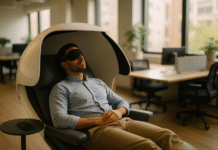
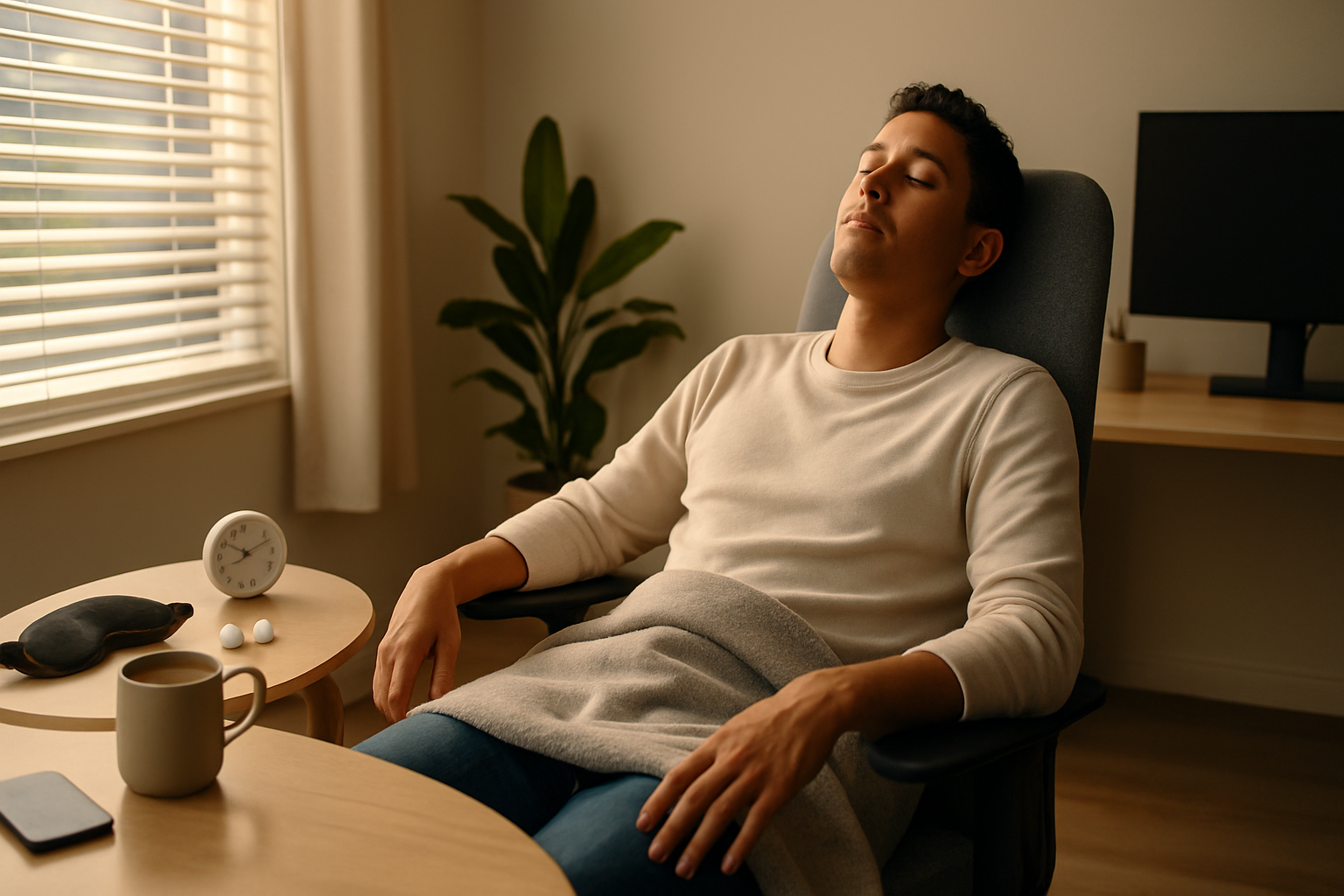
A portable “nap kit” lets you reproduce this environment anywhere. Keep an eye mask, foam earplugs (or noise-blocking earbuds), and a light throw or sweater for temperature control. Flip your phone to Do Not Disturb and face-down. If you can’t darken the space, a cap or hoodie with an eye mask underneath can be surprisingly effective. For office nappers, a reclining chair set to about 110–120° hip angle can improve comfort and reduce neck strain.
3.1 Tools & quick wins
- Eye mask + earplugs: cheapest, biggest gains.
- White-noise app/fan: masks variable sounds (voices, doors, traffic).
- Travel pillow: supports the neck and reduces post-nap kinks.
- Do Not Disturb: whitelist urgent contacts; silence everything else.
- Sticky note outside your door: “Back at 2:25—please text.”
3.2 Mini-checklist (30 seconds)
- Dim lights, drop blinds, or put on an eye mask.
- Cool the space slightly or remove a layer.
- Place phone face-down, DND on.
- Start timer, recline, and close eyes.
Synthesis: Your micro-environment does 80% of the work; assemble a simple kit and you’ll fall asleep faster almost anywhere.
4. Use a 60–120-second wind-down ritual before you close your eyes
Short naps benefit from a short runway. Instead of scrolling or working to the last second, give yourself a 1–2 minute ritual that signals “off duty.” This can be as simple as two slow breaths, a shoulder drop, and a single sentence like “I’ll wake clear and calm.” These cues reduce pre-sleep cognitive arousal—rumination, planning, and self-talk—that otherwise consumes your limited nap time. You don’t need full meditation; you need a tiny pattern your brain recognizes.
If your mind resists shutting off, add a breathing pattern (e.g., 4-second inhale, 6-second exhale for 8–12 cycles) or a body scan from crown to toes, naming each area once. The goal isn’t sleep; it’s drift—letting your attention soften so sleep can arrive if it wants to.
4.1 How to do it (options)
- Box or 4–6 breathing for ~60–90 seconds.
- Phrase anchor: “Nothing to do, nowhere to go.”
- 30-second body scan: forehead, jaw, shoulders, chest, belly, hips, legs, feet.
- Light stretch: neck turns, shoulder rolls, wrist flexion, 2–3 reps.
4.2 Common pitfalls
- Working until the last second and lying down still “in gear.”
- Checking messages after you set the timer—loop re-engagement.
- Over-engineering a ritual so it takes longer than the nap.
Synthesis: A tiny, repeatable wind-down helps you fall asleep faster; keep it short, simple, and identical every time.
5. Consider a coffee nap (optional) to curb sleep inertia
A coffee nap means drinking a modest dose of caffeine immediately before your short nap, so the stimulant peaks as you wake. Because caffeine takes roughly 15–30 minutes to begin working, it can reduce post-nap grogginess and add an extra alertness bump. This can be especially useful before monotonous or safety-critical tasks (e.g., a long drive), or when you’re battling the after-lunch dip on limited sleep.
It’s not for everyone. If caffeine worsens anxiety, reflux, or sleep onset at night—or if you’re pregnant, on certain medications, or have specific heart or GI conditions—skip this step. Also avoid coffee naps late in the day; even if you wake alert, lingering caffeine can push your bedtime later. When in doubt, use a smaller dose first and reserve coffee naps for days you need a “clean” wake.
5.1 How to do it
- Dose: 80–200 mg caffeine (≈ 1 small–medium coffee or 1–2 shots espresso).
- Timing: drink it swiftly, then lie down and start a 15–20-minute nap timer within 2–3 minutes.
- Alternatives: caffeine gum or a small tea if coffee upsets your stomach.
5.2 Guardrails & caveats
- Not after ~2–3 p.m. if you’re sensitive or have a 10–11 p.m. bedtime.
- Avoid daily reliance; treat as a tool for special demands.
- Skip if caffeine triggers palpitations or GI distress, or if you’ve been told to limit stimulants.
Synthesis: Used sparingly, a coffee nap can blunt inertia and extend alertness; tailor the dose to your sensitivity and schedule.
6. Set a reliable wake-up: firm alarm, gentle tone, no snooze
Your alarm is the boundary that keeps a power nap powerful. Set a single, non-negotiable alarm for your chosen length and place it slightly out of reach so you must sit up to stop it. Use a gentle tone that rises in volume; a blaring siren can spike stress and make grogginess worse. If you can’t risk oversleeping, set a backup alarm 1–2 minutes later on a separate device. Resist the snooze button—it can plunge you back toward deeper sleep and amplify inertia.
For wearable users, smart alarms that detect light sleep stages can help, but don’t rely on them exclusively. If a brightening light is available, pair your alarm with gradual light exposure (lamp or window blinds). For office environments, a subtle vibration on a smartwatch plus a soft phone alarm works well: the watch wakes you, the phone ensures you sit up.
6.1 Mini-checklist
- Choose a calm, rising tone; avoid harsh sounds.
- Place the device out of arm’s reach.
- Set a backup on a second device (1–2 min later).
- Disable snooze; treat the alarm as final.
6.2 Common mistakes
- No backup when oversleeping would have real costs.
- Snoozing into deeper sleep cycles.
- Shared spaces without headphones or vibration—disturbances can follow you.
Synthesis: A gentle but firm alarm, plus a backup, protects your nap length and your evening sleep.
7. Re-enter smoothly: 10–15 minutes of light, movement, and hydration
Even with a perfect nap, your brain needs a few minutes to transition back to peak performance. Plan for 10–15 minutes of re-entry time. Sit upright, hydrate (a glass of water is fine), and step into bright light—ideally daylight or a bright lamp—to suppress melatonin and cue alertness. Add light movement (a short walk, stairs, or gentle mobility work) to raise heart rate and circulation without creating a sweaty wardrobe change.
If your next task is cognitively demanding, do a 2-minute warm-up: skim a familiar document, outline the first three steps you’ll take, or do a quick mental math drill to prime attention. Avoid jumping into emotionally charged conversations or high-stakes decisions during this buffer; let your executive functions ramp up first.
7.1 How to do it (5-minute recipe)
- Stand, stretch, sip water (60 seconds).
- Light exposure: open blinds or step outside (2 minutes).
- Short walk: down the hall and back (2 minutes).
- Cognitive warm-up: write the first 3 actions for your next task (60 seconds).
7.2 Numbers & guardrails
- Expect mild fogginess for 5–15 minutes; it’s normal.
- If fog persists >30–45 minutes regularly, shorten your nap or try a coffee nap.
Synthesis: Treat wake-up as a phase, not a moment; light, movement, and a simple plan clear residual fog fast.
8. Make naps fit your day: scheduling, frequency, and tracking
Power naps work best when they’re planned. Put a 25–30-minute block on your calendar (setup, nap, re-entry), ideally at the same time daily. A consistent slot trains your body to anticipate rest and fall asleep faster. For most people, one short nap per day on demanding days is plenty. If you’re chronically sleep-restricted, prioritize nighttime sleep first; use naps as a supplemental tool, not a replacement.
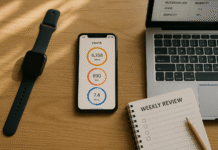
Track light metrics for two weeks: time you started, length you set, minutes you think you slept, and how you felt 30–60 minutes afterward (alertness, mood, focus). Use this to dial in your best length and timing. If you have insomnia, be cautious: daytime naps can make nighttime sleep onset harder; consult a clinician if unsure. For students, schedule naps between classes rather than right before demanding exams; short naps help memory consolidation but you’ll still want a buffer.
8.1 Practical scheduling tips
- Block 25–30 minutes on your calendar; treat it as a meeting with yourself.
- Pair your nap with a habitual anchor (after lunch cleanup, post-prayer, end of an early meeting).
- Communicate in shared spaces: a simple status message prevents interruptions.
- Skip the nap on evenings with very early bedtimes.
8.2 What to measure
- Start time / length set / perceived sleep minutes.
- Alertness score 0–10, 30–60 minutes post-nap.
- Notable confounders: caffeine, heavy meals, exercise, stress spikes.
Synthesis: Schedule and measure lightly; within two weeks you’ll know your personal “recipe” for reliable mid-day resets.
9. Adapt for special situations: driving, shift work, travel, and health flags
The basic nap template holds up, but some contexts need tweaks. Driving: if you feel drowsy, pull over somewhere safe and take a short nap; combining it with a small coffee beforehand can reduce impairment more than either alone. Never push through heavy eyelids; the cost is too high. Shift work: early-afternoon doesn’t apply on nights. Instead, place a planned nap mid-shift or before the commute home (in a safe location), and consider longer 2–3 hour anchor naps on rotation days, acknowledging trade-offs with inertia.
Travel and jet lag: short naps can bridge time-zone transitions, but avoid evening naps in your destination’s local time; target early-afternoon local hours to reinforce the new schedule. Students before exams: short naps support memory, but leave 15–20 minutes to re-enter before test time. Older adults: shorter naps (10–20 minutes) can be restorative; if you need longer or daily naps, check with a clinician to rule out underlying issues. Health flags: frequent daytime sleepiness, loud snoring, witnessed apneas, or restless legs merit evaluation; don’t self-medicate persistent fatigue with caffeine and naps alone.
9.1 Situation-specific notes
- Driving: coffee + 15–20 minute roadside nap in a safe area beats coffee alone.
- Night shift: plan a mid-shift nap; on rotations, use a longer nap to manage transitions.
- Jet lag: keep naps in local early afternoon; avoid evening naps during adaptation.
9.2 Safety checklist
- If you need a nap daily despite 7+ hours at night, consider screening for sleep disorders.
- Avoid caffeine naps if pregnant or medically contraindicated.
- Never nap somewhere unsafe; choose a secure, legal location.
Synthesis: Context changes tactics; tailor the template for safety-critical work, night shifts, and travel, and seek help when naps become a necessity rather than a choice.
FAQs
1) What is a “restorative power nap,” exactly?
It’s a short, planned nap—usually 10–20 minutes and capped at 30—that’s taken during the early-afternoon dip to boost alertness, mood, and working memory without compromising nighttime sleep. The nap is deliberate: you set up a good environment, use a firm timer, and give yourself a brief wake-up buffer so grogginess doesn’t linger.
2) Why do longer naps make me feel worse?
Longer naps increase the chance you’ll wake from deep slow-wave sleep, which can trigger sleep inertia—that heavy, foggy feeling that can last minutes to an hour or more. Short naps keep you in lighter stages of sleep so you wake clearer. Longer naps can still help later performance, but expect a groggier immediate recovery and more risk to nighttime sleep.
3) Is a coffee nap safe and worth it?
For many healthy adults, a modest 80–200 mg dose of caffeine right before a 15–20 minute nap reduces grogginess after waking and can extend alertness. It’s not advisable late in the day or for people who are sensitive to caffeine, pregnant, or told to limit stimulants. Use it as a situational tool, not a daily habit.
4) What’s the best time to nap if I wake up very early?
Shift your nap earlier relative to your wake time. If you’re up at 5:30 a.m., your dip may hit by 12:30–1:00 p.m. Keep at least 6–8 hours between your nap and bedtime. If you’re waking early due to chronic short sleep, prioritize building a consistent, longer night first.
5) Can power naps replace nighttime sleep?
No. Naps are a supplement, not a substitute. Most adults need 7+ hours of nightly sleep for health. Use power naps to patch an occasional deficit or sharpen performance, but if you need daily naps to function, investigate underlying causes with a clinician.
6) I have insomnia—should I avoid napping?
Often, yes. For people with insomnia, daytime naps can reduce your sleep drive at night and prolong sleep-onset problems. If you experiment anyway, keep naps very short (10–15 minutes), take them early afternoon, and track whether your night gets worse. Work with a sleep professional for structured strategies like CBT-I.
7) How do I nap at work without looking unprofessional?
Normalize it by scheduling a short block, using an eye mask and earbuds, and communicating with your team (“back at 2:25”). Choose a reclining chair or wellness room if available, and follow a crisp wake-up routine so you return on time, sharp and ready to contribute.
8) Are power naps good before workouts?
Yes, many people find a short nap improves rate of perceived exertion and focus, especially for skill or sprint sessions later in the day. Leave 15–20 minutes after waking for light movement and hydration before you start training to avoid sluggishness.
9) What if I can’t fall asleep—should I still lie down?
Absolutely. Treat the session as quiet rest with eyes closed and slow breathing. Even if you don’t sleep, you often regain calm and reduce sleep pressure slightly. If you never sleep during planned naps, shorten to 10–12 minutes, improve your environment, and keep the same daily time for a week to train the response.
10) How often should I take power naps?
Use them as needed—on demanding days, after short nights, before long drives, or when focus dips. For many, 0–3 per week is plenty. If you find yourself scheduling one daily, step back and improve your nighttime sleep routine first.
11) Do naps help memory and learning?
Yes, short naps can aid working memory and learning, especially when taken before study blocks that require sustained attention. Keep the nap brief, add a 10–15 minute re-entry, and then do a quick review session; you’ll often encode and recall faster.
12) What are the signs my naps are too long or too late?
You’ll notice harder sleep onset at night, multiple night awakenings, or morning grogginess. During the day, if inertia lasts >45 minutes after napping, shorten the nap to 10–15 minutes, move it earlier, or pause naps for several days to reset.
Conclusion
Short, planned naps are a simple, powerful lever for performance and well-being. By anchoring your nap to the early-afternoon dip, limiting length to 10–20 minutes, and preparing a cool, dark, quiet space, you give your brain exactly what it needs to reboot. A tiny wind-down ritual speeds sleep onset; a gentle alarm and backup protect your schedule; and a deliberate wake-up routine with light, movement, and water clears residual fog. For days when you need extra “lift,” an optional coffee nap can add a safe, situational edge. Most importantly, treat naps as a complement to—not a replacement for—7+ hours of nightly sleep, and adapt strategies for driving, shift work, or travel. Track your own data for a couple of weeks and you’ll discover a dependable formula that fits your life.
Take the next step: Block a 25-minute “reset” on your calendar this week and run the nine-step playbook once—then iterate to make it yours.
References
- Do Power Naps Work? Sleep Foundation, July 24, 2025. https://www.sleepfoundation.org/sleep-hygiene/power-nap
- Napping: Benefits and Tips. Sleep Foundation, March 11, 2024. https://www.sleepfoundation.org/napping
- NASA Nap: How to Power Nap Like an Astronaut. Sleep Foundation, October 27, 2023. https://www.sleepfoundation.org/sleep-hygiene/nasa-nap
- Crew Factors in Flight Operations IX: Effects of Planned Cockpit Rest on Crew Performance and Alertness in Long-Haul Operations. NASA Technical Report (Rosekind et al.), 1994. https://ntrs.nasa.gov/api/citations/19950006379/downloads/19950006379.pdf
- Sleep Inertia: Current Insights. Nature and Science of Sleep (Hilditch et al.), 2019. https://pmc.ncbi.nlm.nih.gov/articles/PMC6710480/
- The Effects of Napping on Cognitive Functioning. Progress in Brain Research (Lovato & Lack), 2010. https://pubmed.ncbi.nlm.nih.gov/21075238/
- The Effects of Coffee and Napping on Nighttime Highway Driving. Sleep (Philip et al.), 2006. https://pubmed.ncbi.nlm.nih.gov/16754920/
- The Alerting Effects of Caffeine, Bright Light and Face Washing After a Short Nap. Clinical Neurophysiology (Hayashi et al.), 2003. https://www.sciencedirect.com/science/article/abs/pii/S1388245703002554
- A Pilot Study Investigating the Impact of a Caffeine-Nap on Night Shift Performance. Industrial Health (Centofanti et al.), 2020. https://pubmed.ncbi.nlm.nih.gov/32819191/
- Napping, an Important Fatigue Countermeasure (NIOSH Work Hour Training for Nurses). CDC/NIOSH, last reviewed March 31, 2020. https://www.cdc.gov/niosh/work-hour-training-for-nurses/longhours/mod7/01.html
- Napping: Do’s and Don’ts for Healthy Adults. Mayo Clinic, November 6, 2024. https://www.mayoclinic.org/healthy-lifestyle/adult-health/in-depth/napping/art-20048319
- Seven or More Hours of Sleep per Night: A Health Necessity for Adults. American Academy of Sleep Medicine, July 30, 2024. https://aasm.org/seven-or-more-hours-of-sleep-per-night-a-health-necessity-for-adults/