



















Keeping up with daily fluids sounds easy until life gets busy. That’s where hydration habit tracking comes in: the simple, repeatable systems that make drinking enough water automatic. In this guide, you’ll learn how to pick a realistic daily target, choose the right tracking method, use cues you already have, calibrate with evidence-based checks, and set workout guardrails so hydration becomes a frictionless routine. This article is for anyone who wants fewer headaches, steadier energy, and better training—without obsessing over every sip.
Quick answer: Hydration habit tracking means monitoring your water intake with simple tools—like marked bottles, apps, or checklists—so you reliably meet your personal daily fluid needs. Do this by setting a target, logging progress, checking urine color, and adjusting for heat and exercise.
Medical note: The guidance below is general information for healthy adults and not a medical diagnosis or prescription. If you have kidney, heart, or endocrine conditions; are pregnant or breastfeeding; or take medications affecting fluid balance, talk to your clinician for personalized advice.
1. Set a Personal Daily Target You Can Actually Hit
Start with a clear, defensible number and you’ll remove the biggest barrier: not knowing what “enough” is. A practical benchmark for healthy adults is the Adequate Intake (AI) for total water (all beverages + water in foods): about 3.7 L/day for men and 2.7 L/day for women, which equates to roughly 13 cups vs. 9 cups of fluids, acknowledging about 20% typically comes from food. This isn’t a rigid quota; it’s a steady target to aim for and then adjust based on climate, activity, and life context. People in hot, humid environments or who are very active may need more; quieter, cooler days may require less. The key is to choose a target that feels achievable on ordinary days, then flex up when heat or workouts demand it.
1.1 Why it matters
A transparent daily goal removes guesswork, making it easier to plan bottle size, refill cadence, or app reminders. It also anchors your day for “habit stacking” (e.g., drink a glass with each meal). When tracking, you’ll know whether you’re 30% shy at 5 p.m. or well on pace by lunch.
1.2 Numbers & guardrails (as of August 2025)
- AI (total water): ~3.7 L men / 2.7 L women; typical fluids portion is ~3.0 L and 2.2 L respectively, with the remainder from foods.
- In hot/desert or tropical settings with activity, total daily needs can reach 6–8 L/day or more.
- Caffeinated drinks (coffee/tea) do count toward fluid intake for most healthy adults.
Mini-checklist
- Pick a daily number aligned to your body and lifestyle.
- Decide what counts toward it (water, tea/coffee, milk, broths, etc.).
- Set a minimum “floor” for busy days (e.g., 2 L) and an “active day boost” (e.g., +0.5–1.0 L).
Close the loop by writing your number somewhere visible—on your bottle, fridge, or phone—so you can track against it without mental math.
2. Use a Bottle-Based System That Tracks Itself
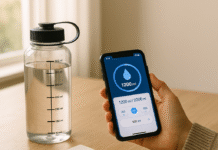
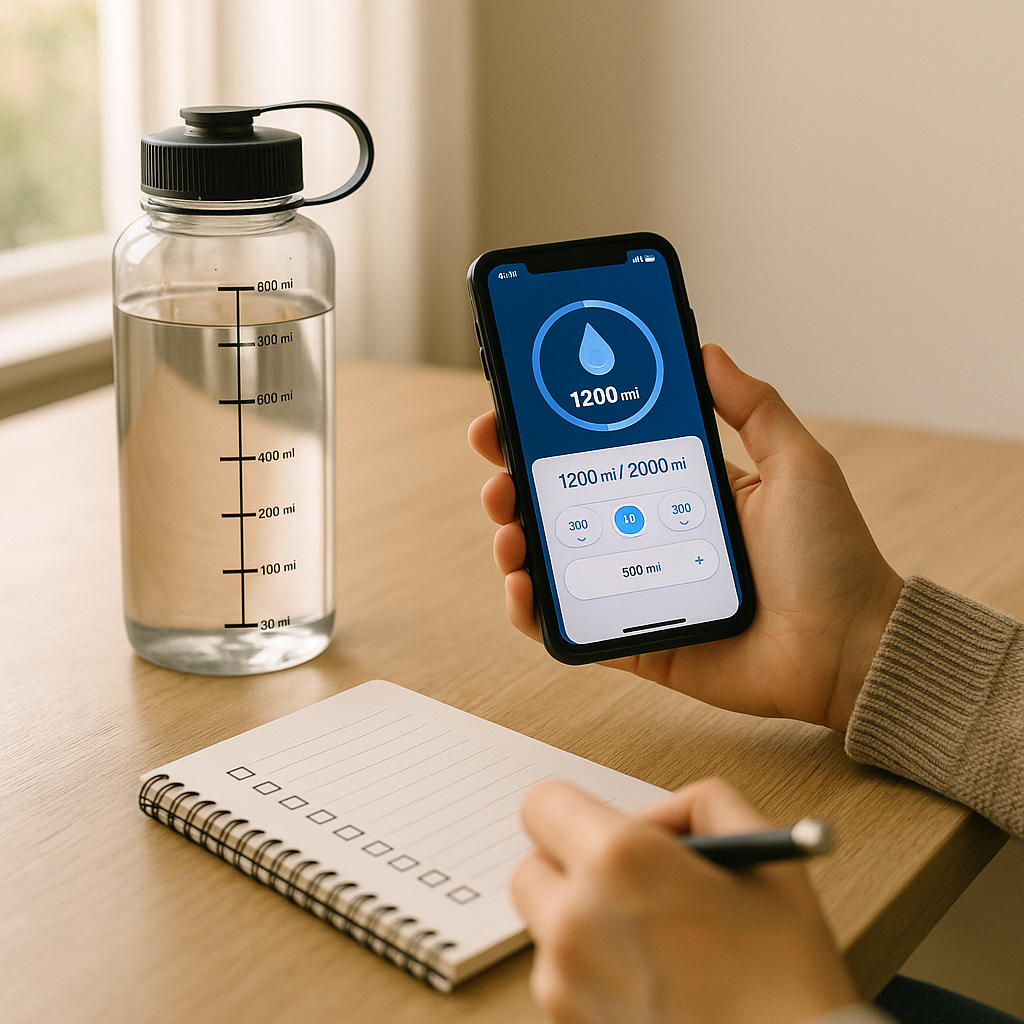
The most sustainable tracking system is the one that works when your phone is dead and your brain is fried. A marked bottle (e.g., 750 mL or 1 L) or a time-stamped jug creates a built-in “progress bar.” Each refill is a measurable chunk of your daily target, and volume lines let you estimate intake at a glance. This method is great if you prefer low-tech simplicity, work at a desk, or want quick visual accountability. It also plays nicely with “habit stacking” (e.g., 250 mL with every meal; 250 mL after each bathroom break), so your day naturally ladders up to your target without fuss.
2.1 How to do it
- Choose the right size: 750 mL to 1 L works for most; smaller bottles may require too many refills, larger jugs can be heavy or awkward.
- Mark your milestones: Add elastic bands or tape at 250 mL increments, or choose a bottle with etched markers.
- Tie to anchors: Sip 5–10 times whenever you sit down to work, finish a call, or complete a set at the gym.
- Refill cadence: If your target is 2.7 L, three 900 mL refills or four 700 mL refills gets you home.
2.2 Common mistakes
- Chug-and-forget: Slamming 1 L once doesn’t translate to steady hydration or comfort. Spread it out.
- Invisible bottle: If it’s in a bag or behind a monitor, you’ll under-drink. Keep it in your line of sight.
- No “evening taper”: Front-load daytime hydration to prevent sleep-disrupting bathroom trips.
Finish each day with a quick glance at your markers; if you’re behind at 6 p.m., add a moderate top-up—not a late-night deluge.
3. Log With Apps and Gentle Automation (So You Don’t Rely on Memory)
If you live by your phone or watch, hydration apps and device integrations can offload the cognitive load. Recording sips with a tap, using widgets/reminders, or syncing a smart bottle turns tracking into background automation. The point isn’t data for data’s sake—it’s timely nudges when you tend to fall off (afternoons, travel days, deep-work blocks), and cumulative totals that show whether you’re on pace.
3.1 Tools & examples
- Phone-first: Any hydration app with one-tap logging, progress rings, and streaks.
- Wearables: Use watch complications for glanceable progress; set vibration reminders during work sprints.
- Smart bottles: Useful if you forget to log; look for auto-sensing and an LED cue.
- Platform sync: If you already track activity or sleep, link hydration so you can spot patterns (e.g., low-fluid days = poor HRV).
3.2 Mini workflow
- Morning priming (1–2 min): Log a starter glass and glance at today’s goal.
- Midday audit (10 sec): Check progress ring; if <50% by lunch, add a refill now.
- Afternoon nudge: Enable one reminder at your personal “slump” time.
- Evening check: Review streaks but avoid late-liquid catch-up.
App data is only as good as your consistency. Keep taps simple, make cues obvious, and cut any feature that adds friction.
4. Calibrate With the Urine Color & Frequency Check (Simple, Science-Backed)
The easiest field check is urine color and output. Aim for pale straw to light yellow most of the day, with urination every few hours. Research shows the urine color chart correlates reasonably with hydration status and aligns with lab measures like osmolality and specific gravity, making it a practical tool outside the lab. Just remember, some vitamins, medications, and foods can alter color independently of hydration. Use this check as a sanity gauge to confirm your tracking is landing in the right ballpark.
4.1 How to use it
- Color target: Pale straw/light yellow = generally adequate; darker amber suggests you’re behind.
- Frequency: Every 2–4 hours in daytime is typical if you’re hydrating steadily.
- Context matters: First morning urine is naturally darker; evaluate the daytime trend, not one sample.
4.2 Numbers & caveats
- Food/med effects: B-vitamins can turn urine bright yellow; beets/rhubarb can add a reddish tint; certain meds change color.
- Athletes/older adults: Thirst and color can be misleading during/after long workouts and in older adults; combine methods when precision matters.
Use this check to validate your bottle or app logs. If your log says “on target” but afternoon urine runs dark, add a glass and re-check in an hour.
5. Anchor Hydration to Routines You Already Do (Habit Stacking That Actually Sticks)
Great habits piggyback on routines you already perform. Instead of adding yet another thing to remember, attach fluids to existing behaviors: wake-up, meals, coffee breaks, commute starts, pre-meeting moments, and post-bathroom stops. The win is twofold: automatic repetitions (multiple small sips) and low decision fatigue. Over a week, these micro-moments quietly push you over the line—without white-knuckling a refilled jug at 9 p.m.
5.1 Practical stacks
- Morning: 250–300 mL after you brush your teeth.
- Meals: 250 mL before or with each meal; another 150–250 mL with snacks.
- Work blocks: 3–5 sips before you open email or start a call.
- Bathroom loop: Replace what you just lost—drink 150–200 mL after each restroom break.
- Transit: Keep a small bottle in your bag; sip at red lights or station stops.
5.2 Quick pitfalls to avoid
- One giant chug: Spacing beats sporadic gulps for comfort and absorption.
- Out of sight: Put the bottle where your eyes land: desk edge, nightstand, bag side pocket.
- Late-day overload: Front-load daytime; taper after dinner to protect sleep.
Habit stacking turns tracking into an invisible autopilot—your day becomes a conveyor belt of cues that keep the bottle moving toward empty.
6. Add a Workout Hydration Playbook (Before, During, After—With Numbers)
Training days demand extra structure. The goal is to start euhydrated, pace intake to sweat, and replenish losses without overdoing it. A practical, evidence-aligned plan looks like this:
6.1 Before
Arrive hydrated. Eat normally and, when needed, prehydrate several hours before exercise so fluids absorb and urine returns toward normal before you start. In hot conditions or for long sessions, this prevents starting behind the curve.
6.2 During
Sip periodically to match sweat rate without gaining weight from fluids. For longer sessions (typically >60–90 minutes), adding carbohydrate and sodium helps with performance and fluid retention. Prolonged or very sweaty events benefit from electrolytes, not just plain water. ACSM
6.3 After
Replace what you lost, allowing for urine output during recovery. A widely cited guideline is to drink about 125–150% of the body mass lost over the next 2–6 hours. Practically, that’s ~20–24 oz (600–720 mL) per pound (0.45 kg) lost. Example: if you’re down 1 lb, aim for 600–720 mL post-workout, spaced out. Lippincott Journals
6.4 Tools & examples
- Sweat test: Weigh before/after a typical session (same clothes, towel dry). Every 1 lb (0.45 kg) lost ≈ ~0.5–0.7 L to replace, spread over a few hours.
- Electrolytes: For sessions >1 h or very sweaty conditions, use a drink with sodium; carbohydrate blends can help performance in endurance work.
- Hot climates: Expect higher sweat rates; plan extra fluids and cooling (shade, cold towels).
Don’t chase arbitrary liters during workouts—chase your sweat. This keeps hydration targeted, comfortable, and safer than “just drink more.”
7. Build Safety Guardrails: Don’t Overdo It, and Know When to Seek Help
More isn’t always better. While dehydration has clear downsides, overhydration—especially if large volumes are consumed quickly with low sodium—can cause hyponatremia (dangerously low blood sodium). Kidneys have an upper limit on how fast they can excrete water; urinary excretion can transiently reach roughly 0.6–1.0 L/hour under water loading, which sets a practical ceiling for rapid intake in most people. The safer approach is steady, moderate sipping and using sodium-containing fluids for very long, sweaty efforts. If you have a condition affecting fluid or electrolyte balance, your plan may be different—follow your clinician’s advice.
7.1 Guardrails & red flags
- Avoid rapid mega-intakes: Don’t exceed ~1 L/hour for multiple consecutive hours; space fluids and include sodium during prolonged efforts.
- Watch for symptoms: Headache, confusion, nausea, or unusual swelling with high fluid intake warrants medical evaluation.
- Caffeine & alcohol: Coffee/tea can count toward fluids for most, but alcohol can increase water loss; alternate with water and avoid binges.
- Kidney stone history: Producing ~2–3 quarts (1.9–3.0 L) of urine/day is commonly recommended to reduce recurrence—work with your clinician to set the right target. Mayo Clinic
- Pregnancy & lactation: Fluid needs rise; many references suggest ~10 cups (pregnancy) and ~13 cups (breastfeeding) of fluids daily as general guides—confirm with your provider.
The bottom line: thoughtful tracking protects you on both sides—enough for performance and well-being, not so much that you risk dilution problems.
FAQs
1) What’s the simplest way to start hydration habit tracking today?
Pick a daily target (e.g., 2.7 L for many women, 3.7 L for many men), fill a 1 L bottle, and commit to three refills spaced across your day. Use meal times and bathroom breaks as cues. Validate with the urine color check (aim for pale straw). This approach requires no app and works immediately.
2) Do coffee and tea count toward my hydration goal?
For most healthy adults, yes. Current evidence indicates caffeinated beverages contribute to total fluid intake; only very high caffeine intakes may increase short-term urination in some people. If you drink alcohol, remember it can increase water loss—alternate with water.
3) How much should I drink during exercise?
There isn’t a universal number. Use a sweat test: weigh before and after. Try to limit body mass loss and avoid weight gain from fluids. For longer sessions or heavy sweaters, include sodium and carbs. Afterward, replace ~125–150% of the weight you lost over the next few hours.
4) How can I tell if I’m hydrated without lab tests?
Urine color and frequency are practical checks. Pale straw to light yellow, with regular daytime urination, suggests adequate hydration. Remember some supplements and foods can alter color—look for trends, not single samples.
5) Is the “8×8 rule” (eight 8-oz glasses) accurate?
It’s a helpful mnemonic for some people, but not a scientific requirement. Needs vary with size, activity, climate, and diet. Benchmarks like 3.7 L (men) / 2.7 L (women) total water are better starting points that you can tailor over time.
6) Can I drink too much water?
Yes—especially if you drink large volumes quickly without electrolytes during long exercise or heat stress. This can dilute blood sodium (hyponatremia). Spread intake, add sodium for long/hot efforts, and don’t outdrink your kidneys’ excretion capacity. Seek medical care if you notice concerning symptoms.
7) What if I live somewhere hot and humid?
Expect higher needs—especially during outdoor activity. Active people in hot climates can require many liters per day. Plan ahead with extra fluids and cooling strategies, and use sweat tests to personalize your plan.
8) Do sparkling water and flavored waters count?
Unsweetened sparkling water counts. Lightly flavored waters can help if they’re low in sugar. If you rely on sugar-sweetened beverages, consider diluting or switching to unsweetened versions to avoid excess calories.
9) I get up at night to pee—how can I hydrate without wrecking sleep?
Front-load more fluids earlier in the day. Taper intake 2–3 hours before bedtime and shift any “catch-up” drinking to midafternoon instead of evening. Keep a small bedside sip if you wake thirsty, rather than a full glass.
10) I’ve had kidney stones—how should I track?
Your clinician may ask you to collect 24-hour urine and target a specific output (often ~2–3 quarts/day). Tracking with a marked bottle, plus a simple intake log tied to meal times, makes hitting that output more reliable.
11) I’m pregnant or breastfeeding—what should I know?
Fluid needs increase. Many reputable sources suggest ~10 cups in pregnancy and ~13 cups during breastfeeding as general guides, but individual needs vary. Track steadily, use thirst plus urine checks, and work with your clinician for personalized targets.
12) Are smart bottles worth it?
They can help if you struggle to remember or like automation. Look for reliable sensing and simple feedback (light cues, app sync). If you’re consistent with a marked bottle and habits, you may not need one—keep it as simple as possible.
Conclusion
Hydration habit tracking isn’t about perfection; it’s about making adequate fluid intake the path of least resistance. Start with a realistic daily target, then pick the tracking method that suits your brain—marked bottle, app automation, or both. Calibrate with the urine color check, anchor sips to routines you already do, and add a training-day playbook with before/during/after numbers. Finally, respect safety guardrails: don’t try to “win” hydration by chugging liters at once, and include electrolytes when sweat is heavy or the effort is long. Do this for a few weeks, and you’ll notice fewer energy dips, better workouts, and steadier focus—because your tracking system will be doing the heavy lifting for you.
Ready to start? Choose a bottle, pick today’s target, and take your first 250 mL now.
References
- Dietary Reference Intakes for Water, Potassium, Sodium, Chloride, and Sulfate (Chapter 4: Water), National Academies of Sciences, Engineering, and Medicine (Institute of Medicine), 2005. National Academies Press
- Water — The Nutrition Source, Harvard T.H. Chan School of Public Health, Updated Feb 26, 2025. The Nutrition Source
- About Water and Healthier Drinks, U.S. Centers for Disease Control and Prevention, Accessed Jan 2024–Aug 2025. CDC
- Fast Facts: Data on Water Consumption, U.S. Centers for Disease Control and Prevention, Jan 19, 2024. CDC
- Armstrong, L.E. (1994). Urinary indices of hydration status. International Journal of Sport Nutrition, 4(3), 265–279. PubMed. PubMed
- Sawka, M.N., et al. (2007). American College of Sports Medicine Position Stand: Exercise and Fluid Replacement. Medicine & Science in Sports & Exercise. PubMed record. PubMed
- McDermott, B.P., et al. (2017). National Athletic Trainers’ Association Position Statement: Fluid Replacement for the Physically Active. Journal of Athletic Training, 52(9), 877–895. PMC
- Water: How much should you drink every day?, Mayo Clinic, Updated 2025. Mayo Clinic
- Eating, Diet, & Nutrition for Kidney Stones, National Institute of Diabetes and Digestive and Kidney Diseases (NIDDK), Updated 2025. NIDDK
- Scientific Opinion on Dietary Reference Values for water, European Food Safety Authority (EFSA), 2010. European Food Safety Authority
- Water, drinks and hydration, NHS (UK), 2022. nhs.uk
- Water (Hyponatremia/Overhydration section), Harvard Health Blog, 2016. Harvard Health