





















If your hamstrings feel “permanently tight,” you’re not alone—and you’re not stuck that way. This guide shows you how to make real, measurable progress with safe stretches, smarter warm-ups, and the right kind of strength work. It’s written for active people, lifters, runners, and desk-bound movers who want fewer tugs behind the knee and more freedom at the hips. Quick note: this information is educational, not medical advice. If pain, numbness, or significant weakness shows up, see a qualified clinician.
Quick answer: Improving hamstring flexibility means increasing comfortable hip flexion and knee extension without pain by combining consistent stretching (generally 10–30-second holds totaling ~60 seconds per side), dynamic warm-ups before training, neural glides when nerve tension is the limiter, and eccentric strengthening for durable gains.
Fast steps overview
1) Warm up dynamically; 2) Use static stretches after activity; 3) Add PNF (contract–relax) progressions; 4) Strengthen eccentrically (e.g., Nordics, RDLs); 5) Include nerve glides if you feel “zingy” tension; 6) Groove your hip hinge; 7) Address hip flexors and calves; 8) Foam roll as an adjunct; 9) Program weekly volume; 10) Track with simple tests; 11) Tailor to your sport or desk life; 12) Watch for red flags.
1. Start With a Simple Assessment and Clear Targets
The fastest path to progress is knowing what you’re measuring. Begin by assessing straight-leg raise (SLR) and active knee extension (AKE) so you can see whether your limitation is more hip flexion or knee extension—and whether the sensation is muscular stretch or nerve-like “zinging.” State your goal in plain numbers (e.g., “+15° SLR in 8 weeks” or “touch mid-shin with neutral spine”). This lets you choose exercises that match your limiter and track real change. Reassessing every 2–4 weeks keeps motivation up and exposes what’s actually working.
1.1 How to do it
- Active Straight-Leg Raise (ASLR): Lie supine, keep the down-leg pressed long, brace lightly, lift the test leg straight up. Stop at first firm resistance or form loss.
- Active Knee Extension (AKE): Hip at ~90° (thigh vertical), slowly extend the knee until you feel a firm stretch.
- Sit-and-reach (optional): Only if you can keep a neutral lumbar curve; otherwise it over-weights spine motion.
1.2 Numbers & guardrails
- Test both sides, note side-to-side differences ≥10°.
- Retest at the same time of day and warm-up state for apples-to-apples comparisons.
- If you feel sharp or electric pain down the leg, prioritize neural glides and see a clinician.
Mini-checklist
- Baseline ASLR/AKE recorded
- Goal written in degrees or reach landmarks
- Retest scheduled in 2–4 weeks
A simple baseline prevents guesswork and makes each choice in this plan deliberate.
2. Warm Up With Dynamic Movements Before You Stretch
Before training or sport, use dynamic drills to raise temperature, move joints through range, and cue the posterior chain—not long static holds. Short static stretches (≤60 s per muscle) have only trivial effects on strength/power when embedded in a full warm-up, but dynamic warm-ups consistently set you up to move better and, in some studies, sprint a bit faster. Think leg swings, walking lunges, hip airplanes, and tall-kneeling hip rocks for 5–8 minutes. Save longer static work for after training or separate mobility sessions.
2.1 Quick dynamic circuit (4–6 minutes)
- 20 m walking lunges with a gentle reach
- 10–15 front & side leg swings each side
- 10 hip airplanes per side (slow)
- 2 × 10 hip hinge drills with a dowel (head–thoracic–sacrum contact)
2.2 Why it matters
- Dynamic warm-ups may slightly improve sprint/jump outcomes and prep tissues for forceful lengthening.
- Long static holds immediately before maximal power are unnecessary for most and can be deferred.
Finish warm, not fatigued, and you’ll move into the rest of this plan ready to make mobility gains.
3. Use Evidence-Based Static Hamstring Stretches (Right Dose, Right Time)
Static stretching still works—when you dose it correctly and place it smartly (after activity or as a stand-alone session). For most adults, hold each stretch 10–30 seconds and repeat 2–4 times to accumulate ~60 seconds total per side. Older adults often benefit from 30–60-second holds. Aim for a gentle, steady stretch at 3–4/10 intensity, breathing slow and keeping the pelvis neutral to target the hamstrings, not just your back.
3.1 How to do it (2 staples)
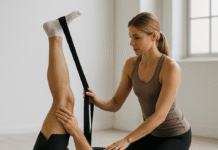
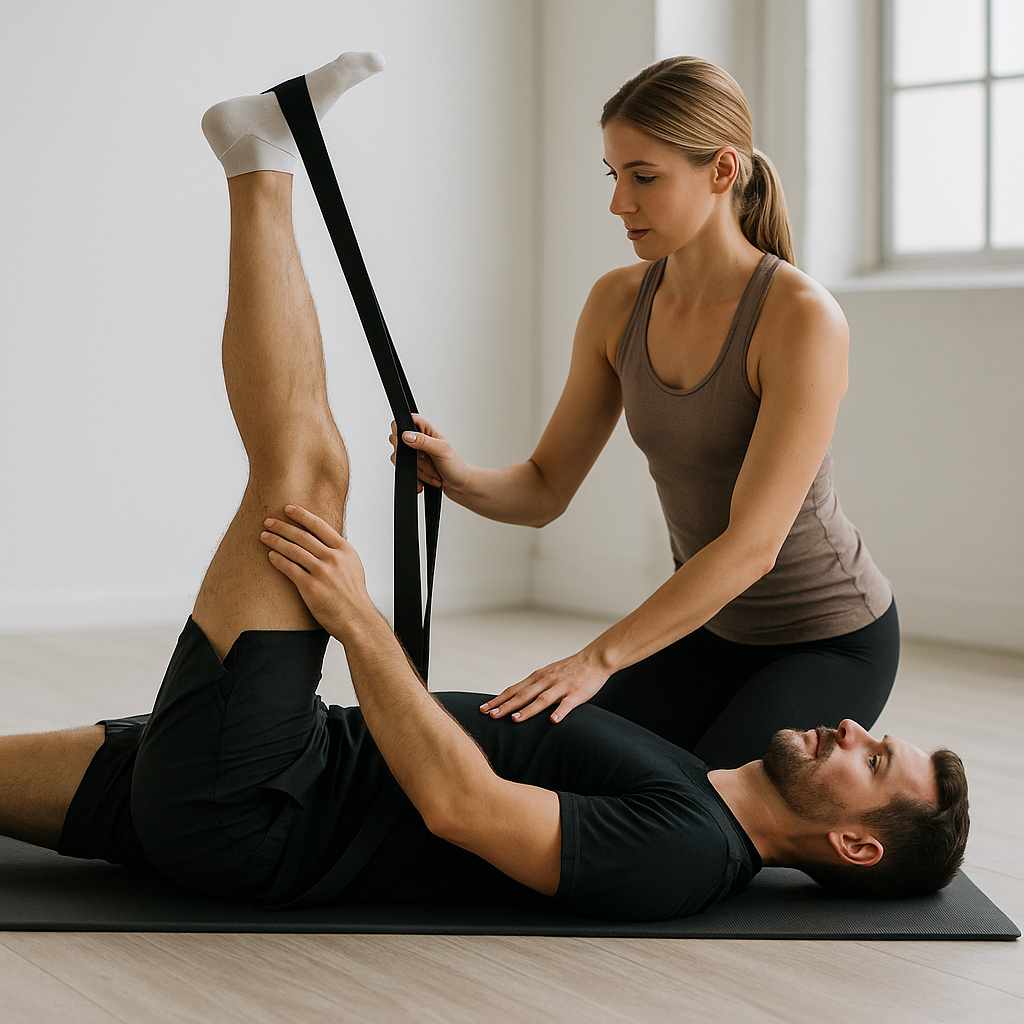
- Supine strap stretch: Loop a strap around the mid-foot, knee straight but not locked, pull the leg toward you while keeping ribs “down” and opposite thigh long.
- Hip-hinge wall touch: Stand 30–45 cm (12–18 in) from a wall. Soft knees, push hips back to tap the wall, maintain neutral spine, feel stretch high in the hamstrings.
3.2 Mini-progression
- Week 1–2: 2 × 20 s per side after workouts (3–4 days/week)
- Week 3–4: 3 × 20 s per side; explore slightly deeper range
- Week 5–8: 2 × 30 s per side; add a gentle ankle dorsiflexion “toe to shin” bias
Common mistakes
- Chasing toe-touch at all costs (rounds the back)
- Bouncing at end-range
- Letting the pelvis anteriorly tilt, turning a hamstring stretch into a back stretch
Static work is your steady foundation—simple, measurable, and reliably effective over weeks.
4. Add PNF (Contract–Relax) to Unlock Extra Range
Proprioceptive neuromuscular facilitation (PNF)—specifically contract–relax—can yield equal or sometimes greater ROM gains than plain static stretching, particularly when practiced consistently. After reaching a gentle end-range, lightly contract your hamstrings (about 20–50% effort) for 5–6 seconds, then exhale and move into a new range for 10–30 seconds. Two to three rounds is plenty. Over time (≥2 weeks), static and PNF are both effective; pick the one you’ll do consistently.
4.1 Contract–relax sequence (1–2 sets)
- Stretch to first barrier (mild discomfort only)
- 5–6 s gentle hamstring contraction against the strap or partner hand
- 10–30 s relax and drift a little deeper
- Repeat 2–3 rounds; switch sides
4.2 Numbers & guardrails
- Total per side: ~60 s of end-range time
- Frequency: 3–5 days/week for 2–8 weeks
- Stop if cramping or nerve-like zing appears
Mini case: A desk-based runner added 3×/week contract–relax after easy runs and improved ASLR 12° in six weeks while reporting less post-run tightness.
Use PNF when you’re already warm and have a minute to focus on quality breathing and control.
5. Strengthen Eccentrically to Make Flexibility Stick (Nordics, RDLs)
Long-term “looseness” comes from capacity, not just passive stretching. Eccentric hamstring training (muscle lengthening under load) increases strength and can lengthen biceps femoris fascicles—both linked to lower hamstring strain risk and better tolerance to end-range positions. The Nordic hamstring exercise (NHE) has strong evidence for reducing injury rates when included in programs; Romanian deadlifts (RDLs) and sliding leg curls add variety and hip-dominant control. Start light, mastered slowly, 2–3 days/week.
5.1 Starter template (2 days/week)
- RDL 3×6–8 (tempo 3-0-1), hinge to hamstring tension, neutral spine
- Nordic hamstring (assisted) 2–3×4–6, slow lower, push up
- Sliding leg curls 2×8–12, slow eccentric
5.2 Why it matters
- Short biceps femoris fascicles and low eccentric strength increase future strain risk; eccentrics target both.
- Prevention programs featuring NHE report ~50% fewer hamstring injuries across thousands of athletes.
Strength creates usable range—you won’t just reach it; you’ll own it under speed and load.
6. Use Neural Glides When Stretch Feels “Zingy” (Not Just Tight)
If your hamstring stretch feels like a sharp, linear zing, especially below the knee, nerve mechanosensitivity (often the sciatic nerve) may be the limiter. Neural mobilization (“sliders”) gently moves the nerve through its pathway—foot up while neck extends, foot down while neck flexes—reducing symptoms and improving apparent hamstring extensibility in multiple trials. Combine sliders with light static stretching for 2–4 weeks; stop if tingling or numbness worsens. PubMed
6.1 Slider setup (30–60 seconds)
- Sit tall on the edge of a bench
- Extend knee + dorsiflex ankle while extend neck (look up)
- Then flex knee + plantarflex ankle while flex neck (look down)
- Flow slowly through range—no end-range holds
6.2 Numbers & guardrails
- 1–2 sets of 10–15 reps per side, no pain
- Use on days you feel neural tension; avoid aggressive stretching afterward
- If symptoms persist >1–2 weeks or worsen, see a clinician
When the limiter is the nerve, sliders often unlock safer motion faster than yanking harder on the muscle. PubMed
7. Master the Hip Hinge to Load Hamstrings Without the Back
Many “tight hamstrings” complaints are really poor hinge mechanics—too much lumbar flexion and anterior pelvic tilt. Learning to send the hips back while stacking ribs over pelvis targets the hamstrings, not your spine. This improves stretch quality and makes RDLs, good mornings, and Jefferson-curl regressions productive instead of provocative. Film yourself from the side or use a dowel to keep head–thoracic–sacrum aligned as you move.
7.1 How to groove it
- Dowel drill: Keep 3 points of contact (back of head, between shoulder blades, sacrum) and hinge until you feel a high hamstring stretch.
- Belt-buckle cue: Imagine your belt buckle pointing slightly up (posterior pelvic tilt) as you hinge.
7.2 Mini-checklist
- Neutral spine maintained
- Shins nearly vertical
- Hips travel back, not down
- Stretch felt high on the backside of thigh
Dialed-in hinge mechanics multiply the value of every stretch and strength rep that follows.
8. Don’t Ignore Hip Flexors and Calves—They Change Hamstring Experience
Your hamstrings cross the hip and knee, so pelvic position and ankle motion affect how they feel. Tight hip flexors can bias you toward anterior pelvic tilt, which lengthens (and sensitizes) hamstrings at rest; targeted hip-flexor stretching can improve pelvic control and movement patterns. At the other end, limited ankle dorsiflexion encourages compensations that make forward-folds feel rough. Add short hip-flexor and calf routines to create space for hamstrings to lengthen comfortably.
8.1 Two key add-ons
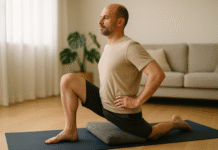
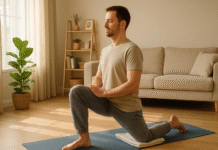
- Half-kneeling hip-flexor stretch (posterior tilt first): Tuck pelvis (belt buckle up), gently shift forward until you feel front-of-hip tension, 20–30 s × 2–3.
- Knee-to-wall ankle dorsiflexion: Knee taps wall with heel down, 8–12 reps, no arch collapse.
8.2 Numbers & notes
- 2–4 days/week alongside hamstring work
- Keep “belt-buckle up” to avoid cranking through the lumbar spine during hip-flexor work
- Small improvements here often reduce “hamstring tightness” sensation during hinges and squats
Creating room at the hip and ankle makes your hamstring changes more comfortable and more durable. ScienceDirect
9. Use Foam Rolling as an Adjunct (Not a Replacement)
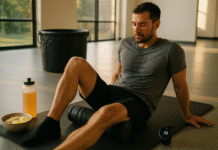
Foam rolling can acutely improve range of motion and, over >4 weeks, contribute to flexibility gains when paired with stretching and strength. Roll the posterior thigh for ~60–90 seconds, pausing at tender bands, then go do your dynamic warm-up or static work. It’s not magic fascia-melting; benefits likely come from short-term changes in tone and perception. Keep pressure tolerable and avoid rolling over the back of the knee joint. PMC
9.1 Quick protocol (2–4 minutes total)
- 60–90 s hamstrings (upper, mid, lower segments) each side
- Optional 30–60 s glute medius/piriformis area
- Follow immediately with dynamic drills or static stretching
9.2 Guardrails
- Don’t chase bruises; moderate pressure is enough
- If you feel nerve zings, switch to sliders instead of rolling that area
Roll to prepare, then stretch/strengthen to actually change tissue tolerance over time. ScienceDirect
10. Program Your Week: Frequency, Volume, and an 8-Week Plan
Consistency beats intensity. Most adults improve with 3–5 days/week of focused hamstring work: dynamic prep on training days, static/PNF after sessions or in short stand-alone blocks, and 2–3 days/week of eccentric strength. Use small, repeatable doses that accumulate. Aim for ~60 seconds total stretch time per side and 6–10 quality eccentric sets across the week.
10.1 Sample 8-week progression (overview)
- Weeks 1–2: Dynamic prep + static 2×20 s/side post-training; RDL 3×8; sliders if neural tension
- Weeks 3–4: Add PNF 2 rounds after static; NHE assisted 2×5; sliding curls 2×10
- Weeks 5–6: Static 2×30 s or PNF 3 rounds; RDL 4×6 (slightly heavier); NHE 3×4–6
- Weeks 7–8: Maintain static/PNF; introduce tempo RDL (3-0-1); NHE 3×6; track ASLR/AKE
10.2 Mini-checklist
- 3–5 mobility touchpoints/week
- 2–3 eccentric strength sessions/week
- Retest every 2–4 weeks; adjust only one variable at a time
A schedule you can actually execute will always outperform a perfect plan you abandon.
11. Tailor to Your Sport or Lifestyle (Runners, Lifters, Desk Workers)
The best plan is the one that matches what your body does most. Runners need eccentric strength that tolerates late-swing lengthening; lifters need a bulletproof hinge; desk workers need frequent mini-mobility doses and neural hygiene. The principles stay the same—dynamic before, static/PNF after, eccentrics weekly—but the emphasis changes.
11.1 Runner focus
- Before runs: 5–6 minutes dynamic (leg swings, lunges, hip airplanes)
- After easy runs: Static or PNF ~60 s/side
- Twice weekly: NHE and RDLs to protect late-swing hamstrings; NHE is linked to ~50% injury reduction when compliance is high.
11.2 Lifter focus
- Before lower days: Dynamic prep + hinge patterning
- Main work: RDLs, good mornings with strict tempo; finish with 1–2 PNF rounds
- Accessory: Sliding curls to challenge knee-flexor role under hip extension
11.3 Desk-work focus
- Twice daily (3–5 min): Sliders if “zingy,” plus 1–2 light static holds (20 s)
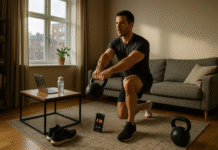
- Evenings: 10–15 minutes static/PNF + 2 sets of slow RDL with light kettlebell
- Weekend: Longer session with hip-flexor and calf work
Matching the plan to your daily demands turns flexibility gains into real-life ease.
12. Red Flags, Plateaus, and When to Get Help
Not all “tight hamstrings” are created equal. If you feel sharp pain, progressive tingling/numbness, or weakness that doesn’t resolve with gentle work, stop and get assessed. Likewise, recurrent hamstring pulls, big between-side strength gaps, or a sense that your pelvis “tilts forward” excessively during activity are reasons to bring in a pro. Sometimes the bottleneck is pelvic control, nerve sensitivity, or hip joint issues—not the hamstring itself. Addressing those upstream factors often unlocks the stubborn last 10–20°.
12.1 Plateau busters
- Swap a static block for PNF twice a week
- Add one more eccentric set (quality over load)
- Insert hip-flexor/calf mobility on off-days
- Retest with ASLR/AKE to see which limiter moved
12.2 When to refer out
- Night pain, progressive neuro symptoms, or back pain + leg weakness
- No improvement after 8–10 consistent weeks
- History of repeated strains despite solid compliance (investigate fascicle length/strength, pelvic mechanics)
Right help at the right time keeps you progressing safely and efficiently.
FAQs
1) How often should I stretch my hamstrings?
Most adults do well with 3–5 sessions per week, accumulating about 60 seconds of end-range per side per session (e.g., 3×20 s or 2×30 s). Older adults often prefer 30–60-second holds. More than frequency, consistency drives change—pick slots you’ll keep.
2) Static vs dynamic—when should I use each?
Use dynamic drills before training to prep tissues and coordination. Use static/PNF after training or in separate sessions to create longer-term gains. Short static holds inserted into a full warm-up generally have trivial impact on power, but longer holds are better saved for after.
3) Do PNF stretches work better than static?
Both improve range; PNF (contract–relax) can deliver equal or slightly greater short-term gains for some people. Over weeks, static and PNF both create meaningful changes—choose the method you’ll do consistently.
4) Will foam rolling actually make me more flexible?
Foam rolling provides acute ROM bumps and, if you practice >4 weeks as part of training, can contribute to flexibility increases. Treat it as an adjunct to stretching and eccentrics, not a replacement.
5) I feel a sharp, electric “zing” behind my knee when I stretch—what now?
That sensation often points to neural mechanosensitivity. Try gentle sciatic nerve sliders (foot up as head extends; foot down as head flexes) for 30–60 seconds, 1–2 sets, no end-range holds. If symptoms persist or worsen, see a clinician.
6) Can strengthening really improve flexibility?
Yes. Eccentric training (e.g., Nordics, RDLs) improves tolerance at long muscle lengths and may increase biceps femoris fascicle length—factors tied to lower injury risk and better end-range control. PMC
7) Are Nordics safe for beginners?
Start assisted (use a band or push off lightly), keep reps low (2–3×4–6), and focus on a slow lower. Done progressively, Nordics are safe and are linked to ~50% fewer hamstring injuries in large athlete samples.
8) Do tight hip flexors make hamstrings feel tighter?
They can. Excess anterior pelvic tilt lengthens hamstrings at rest and may increase strain during running; hip-flexor stretching and pelvic control drills often make hamstring work feel easier and safer.
9) How long until I notice results?
Many people notice immediate (small) changes from a single session, but meaningful, lasting gains usually appear after 2–8 weeks of frequent practice with proper dosage and eccentrics. PMC
10) Should I stretch before sprinting or heavy lifts?
Do a dynamic warm-up and keep any static holds short if you use them at all. Save longer static/PNF stretching for after. If you feel “zingy,” do sliders pre-session and static later.
11) What if one side is always tighter?
That’s common. Strengthen eccentrically and stretch both sides, but you can add one extra set of static/PNF and NHE to the tighter side for a cycle. If the gap persists or increases, get assessed.
12) Is it okay to feel soreness after hamstring work?
Mild, localized soreness is normal, especially after eccentrics (Nordics can be spicy). Delayed soreness peaks at 24–72 hours; manage load, hydrate, sleep, and keep blood flowing with light movement. Persistent sharp or radiating pain needs a professional look.
Conclusion
Improving hamstring flexibility isn’t about one perfect stretch—it’s about a system you can repeat. Dynamic prep gets you moving; static and PNF add safe range; neural glides tame “zingy” limiters; and eccentrics turn new range into durable capacity. Add a little hip-flexor and calf work, hinge well, and program small weekly doses that stack up. Track your ASLR/AKE numbers so you can see improvement, not just feel it. In 6–8 weeks of consistent practice, you’ll likely move with less tugging, more stride, and better confidence under the bar and on the road.
Ready to start? Pick two static stretches, one PNF drill, one eccentric exercise, and a 5-minute dynamic warm-up—and do them three times this week.
References
- DeSimone GT. Flexibility Versus Mobility: Why You Need Both. ACSM Health & Fitness Journal (LWW). 2023. Lippincott Journals
- The Ideal Stretching Routine. Harvard Health Publishing. Jan 9, 2025. Harvard Health
- Behm DG, et al. Acute effects of muscle stretching on physical performance, range of motion, and injury incidence. Appl Physiol Nutr Metab. 2016. and abstract summary https://cdnsciencepub.com/doi/10.1139/apnm-2015-0235 PubMedCanadian Science Publishing
- Chaabene H, et al. Acute Effects of Static Stretching on Muscle Strength and Power: An Attempt to Clarify Previous Caveats. Front Physiol. 2019. PMC
- Konrad A, et al. Chronic effects of stretching on range of motion. Sports Med – Open. 2023. PMC
- Lempke L, et al. Effectiveness of PNF Versus Static Stretching on ROM. Journal of Sport Rehabilitation. 2018. Human Kinetics Journals
- van Dyk N, et al. Including the Nordic hamstring exercise halves hamstring injuries: meta-analysis of 8459 athletes. Br J Sports Med. 2019. British Journal of Sports Medicine
- Opar DA, Timmins RG, et al. Short biceps femoris fascicles and eccentric knee flexor weakness increase HSI risk (prospective cohort). Br J Sports Med. 2016. and summary PubMedBritish Journal of Sports Medicine
- Nunes H, et al. Effects of Nordic Hamstring Exercise on Performance and Strength. Sports. 2024. PMC
- Konrad A, et al. Foam Rolling Training Effects on Range of Motion: Systematic Review. Int J Environ Res Public Health. 2022. PMC
- Areeudomwong P, et al. Neurodynamic sliders improved apparent hamstring extensibility (RCT). Malaysian Journal of Medical Sciences. 2016. PMC
- Castellote-Caballero Y, et al. Neurodynamic sliding vs static stretching in SHS. J Altern Complement Med. 2010. Liebert Publishing
- Konrad A, et al. Influence of Stretching the Hip Flexor Muscles on Performance. Sports Med – Open. 2021. PMC
- Mendiguchia J, et al. Anterior pelvic tilt increases hamstring strain. PubMed (Am J Sports Med). 2024. PubMed
- American Heart Association. How much and how often should people stretch? Aug 7, 2024. www.heart.org