




























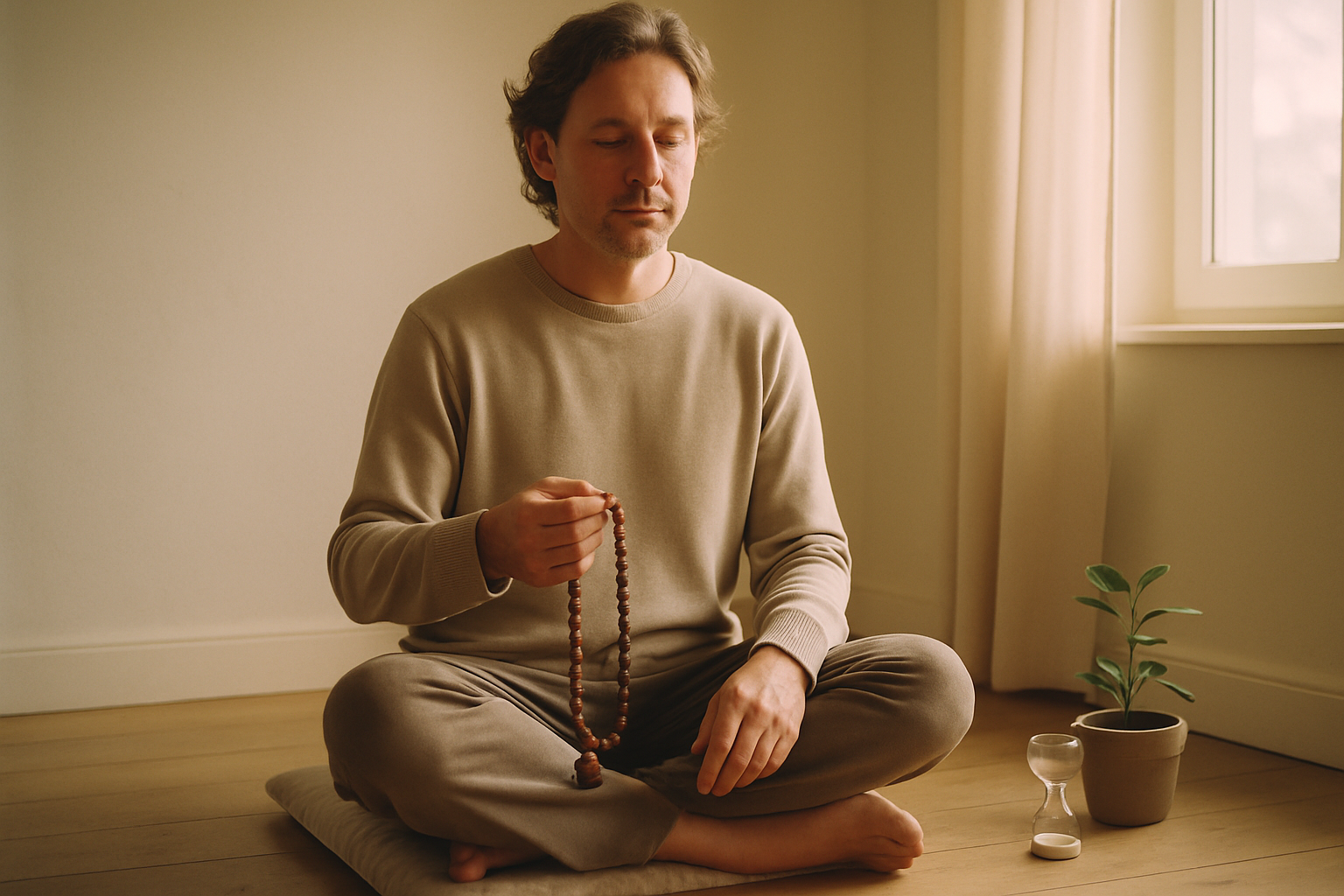
Mantra meditation is the practice of repeating a word, phrase, or sound—silently or aloud—to anchor attention and steady the mind. That steady repetition gives your brain a simple, reliable target, which reduces cognitive clutter and helps you concentrate even when life feels noisy. Whether your mantra is traditional (like “Om”) or secular (like “Calm”), the method is flexible, portable, and beginner-friendly. In this guide, you’ll learn nine practical ways to use repetition for focus, from choosing a mantra to structuring sessions and tracking progress. For anyone with health concerns—especially psychiatric or respiratory conditions—treat meditation as a complement to, not a replacement for, medical care and consult a qualified professional if unsure.
Quick definition: Mantra meditation focuses attention by repeating a sound or phrase to stabilize awareness and quiet mental distraction.
Fast start (5 steps): Sit comfortably → pick a short mantra → repeat at a relaxed, even pace → when distracted, notice and return → stop on a timer or after one round of beads.
1. Choose a Mantra That Fits Your Goal (and Your Mouth)
The fastest way to make mantra meditation work is to choose a mantra that you can repeat effortlessly. A good mantra feels smooth in the mouth (if spoken) or in inner speech (if silent), aligns with your intent (e.g., calm, steadiness, compassion), and doesn’t pull you into overthinking. While traditional Sanskrit sounds like “Om” or seed syllables are common, a secular word (“ease,” “soften,” “focus”) works just as well because the main mechanism is attention training through repetition. Pick something short—one to three syllables—so you can maintain a steady rhythm without breath strain. Your mantra is a tool, not a test; if it feels awkward or agitating after a few sessions, switch without guilt.
1.1 How to do it
- List 3–5 candidates tied to your goal (focus, composure, kindness).
- Say each 10–15 times aloud, then silently; notice which stays smooth when you’re a bit tired.
- Check neutrality: avoid phrases that trigger debate or judgment (“I must…”).
- Lock it for a week: commit to one mantra for seven days before re-evaluating.
- Optional tradition: if you prefer classical forms, try “Om,” “So Hum,” or “Om Shanti,” keeping meaning secondary to repeatability.
1.2 Common mistakes
- Overthinking “the perfect mantra.” A usable mantra now beats an ideal someday.
- Too long/complex phrases that tangle your rhythm.
- Attachment to meaning that keeps you analyzing instead of repeating.
Synthesis: A mantra that is brief, neutral, and easy to repeat creates a low-friction anchor; once you stop wrestling with the words, your attention can settle where you want it—on the practice.
2. Set a Repetition Tempo You Can Sustain
Consistency beats speed in mantra meditation. A sustainable tempo is one you can keep for several minutes without jaw tension, breath holding, or mental rushing. Think “gentle metronome,” not “drum solo.” If spoken, aim for a soft, conversational volume; if silent, imagine the sound at the back of the mind without straining to “hear” it. Many practitioners find it helpful to let the breath set the tempo—one mantra per inhale/exhale or a steady trickle independent of breath. The right tempo lowers effort and makes returning from distraction feel natural instead of forced.
2.1 Mini-checklist
- Comfort first: mouth, throat, and shoulders relaxed.
- Evenness: no speeding up when stressed or near the session’s end.
- Breath harmony: the mantra and breath shouldn’t compete; adjust one to suit the other.
- External cues: a ticking analog clock or phone metronome can help early on—fade it out as rhythm internalizes.
2.2 Tiny numeric example
- Trial 1 (spoken): 60 seconds repeating a 2-syllable mantra (~60–90 reps). Check for effort.
- Trial 2 (silent): 60 seconds gently in inner speech. Compare ease and steadiness.
- Choose the easier mode for your main practice this week.
Synthesis: A stable tempo preserves energy for attention itself; when the rhythm is smooth, returning after distraction feels like stepping back onto a moving walkway.
3. Coordinate Mantra and Breath Without Forcing
Pairing mantra and breath can deepen steadiness, but it should not feel like a breathing exercise competition. The simplest pattern is one repetition per inhale and one per exhale; another is letting the mantra flow continuously while breath moves naturally in the background. If you try breath ratios (e.g., longer exhales), keep them gentle and pain-free. The point is to reduce cognitive load, not add a second task. If you have respiratory issues, skip any breath manipulation and keep the mantra easy and neutral.
3.1 How to do it (gentle pairing)
- Sit tall but soft; let the belly and ribs move freely.
- Option A: Inhale: mentally repeat the first half of your mantra; exhale: the second half.
- Option B: Repeat steadily through both phases of breath, like a quiet inner hum.
- If you feel air hunger, drop the pairing and return to natural breathing.
3.2 Guardrails
- No breath-holding or straining.
- Dizziness or tingling = stop, breathe normally, resume later.
- Pairing should simplify attention; if it complicates things, you don’t need it.
Synthesis: Breath-mantra coordination is a convenience, not a requirement; use it only insofar as it keeps the mind calmly tethered.
4. Use a Mala or Counter to Keep Your Head Clear
Counting tools remove the mental overhead of “how long have I been doing this?” A traditional mala—a loop of prayer beads—lets you track repetitions bead by bead so your brain can stay with the sound. Many malas have 108 beads plus a larger “guru” bead marking the start/end; smaller wrist malas (e.g., 27 beads) can be cycled four times to reach 108. If you prefer not to use beads, a simple finger counter or quiet phone tally works. The tool isn’t sacred; your attention is.
4.1 How to use a mala
- Hold it lightly in the non-dominant hand.
- Start at the bead after the larger “guru” bead.
- After each repetition, move one bead with thumb/middle finger (avoid pinching).
- When you reach the “guru” bead again, stop or reverse direction for another round.
- Keep the movement subtle so it doesn’t compete with the mantra.
4.2 Alternatives & tips
- Digital clicker / ring counter for walking practice.
- Timer + no counting when you want a fully “hands-free” session.
- Noise policy: beads should be quiet; if they clack, cushion them or switch tools.
Synthesis: Externalizing the count frees cognitive bandwidth; one bead, one repetition, one moment—your mind learns the feel of single-tasking.
5. Structure Sessions for Reliability (Not Heroics)
The most effective plan is the one you’ll keep. Start small—5–10 minutes—then add time in 2–5 minute steps as repetition feels more natural. Many people prefer consistent anchor times (e.g., after waking or before bed) because decision fatigue is the enemy of practice. Keep posture simple: a chair with feet grounded or a cushion with neutral spine; pain is distracting, not noble. A quiet timer or one mala round is plenty; end cleanly rather than “half-meditating” while checking the clock.
5.1 Simple session template
- Set a timer (8–15 minutes) or commit to 1–2 mala rounds.
- Open with 30–60 seconds of natural breathing.
- Repeat the mantra at your chosen tempo.
- When distracted: notice → label it (“thinking,” “planning”) → gently return.
- Close with 20 seconds of stillness, then a slow breath and soft blink open.
5.2 Progression plan (four weeks)
- Week 1: 5–8 minutes daily.
- Week 2: 10 minutes daily or 1 mala round.
- Week 3: 12–15 minutes or 1–1.5 rounds.
- Week 4: choose your “forever” length (often 12–20 minutes).
Synthesis: Reliability beats intensity; a modest, repeatable container turns a technique into a habit.
6. Turn Distractions into Repetitions (the Return Technique)
Distraction isn’t failure; it’s the training stimulus. Treat each notice-and-return as one perfect rep for your attention muscles. The key is speed and gentleness: recognize the distraction, avoid the story about it, and re-engage the mantra within a breath or two. Harsh self-talk (“why can’t I focus?”) actually increases arousal and fragments attention. Curiosity and friendliness keep you practicing tomorrow.
6.1 The 3-step loop
- Notice: “I’m off the mantra.”
- Name: one word—“thinking,” “remembering,” “worrying”—to puncture the spell.
- Return: re-start your very next syllable at your steady tempo.
6.2 Mini case
During a 10-minute sit, you drift into planning dinner three times and replay a conversation twice. Each time you label it, then re-enter the mantra within about 3 seconds. You did five perfect returns. That’s training—not failure—and over weeks the intervals between returns lengthen.
Synthesis: Make the return an automatic reflex; the faster and kinder it is, the steadier your sessions (and your day) will feel.
7. Choose Your Mode: Aloud, Whispered, or Silent
Mantra can be practiced in three modes. Spoken aloud provides strong sensory feedback and is excellent for beginners or busy minds; whispered keeps tactile and auditory cues while reducing volume; silent (mental repetition) is the most portable and often becomes the long-term default. None is “better” in general—use the one that keeps you engaged without strain. Many practitioners start aloud, shift to whisper, then settle into silent repetition as the mind quiets.
7.1 When to use each
- Aloud: early practice, mid-day “reset,” or when sleepy.
- Whispered: shared spaces, night practice, or when you want a quieter body.
- Silent: commuting (not driving), waiting rooms, or any time you need stealth.
7.2 Practical tips
- If your jaw or throat tires, downshift to whisper or silent.
- Keep the same tempo across modes; stability matters more than volume.
- When switching modes mid-session, take one normal breath to reset.
Synthesis: Treat mode as a dial you can turn up or down to fit the situation; flexibility keeps the practice alive wherever you are.
8. Integrate Repetition into Daily Routines
Focus grows faster when you practice “off the cushion,” too. Use short, opportunistic reps to stitch attention through your day: three breaths with a mantra before a meeting, one silent round while walking to the bus, or a minute of repetition to transition between tasks. Habit cues (“after I close my laptop,” “when I lock the door”) make consistency automatic. Keep micro-sessions light so they refresh rather than deplete you.
8.1 Everyday integrations
- Transitions: start of work, end of work, pre-sleep.
- Movement: walking—match steps to syllables for a minute or two.
- Stress spikes: one minute of quiet repetition before replying.
- Study blocks: 30–60 seconds of mantra to “warm up” attention.
- Waiting: lines, elevators, loading screens (perfect stealth practice).
8.2 Mini-checklist for micro-reps
- Keep it short (30–90 seconds).
- Avoid turning it into a scorekeeping contest.
- End with one deep, easy breath and a soft re-entry to your task.
Synthesis: Regular tiny reps make focus a daily habit; you’ll notice smoother task starts and less rumination between activities.
9. Measure Progress and Adjust Intelligently
You can’t optimize what you don’t notice. Track simple, behavior-level signals: how quickly you return after distraction, how restless or settled you feel at session end, and how often you spontaneously use the mantra during the day. For count-based sessions, one mala round is a clear unit; for timed sessions, log minutes practiced. If your motivation dips or stress rises, adjust the mantra, tempo, or session length before assuming the practice “doesn’t work.”
9.1 What to track (lightweight)
- Minutes or rounds/day (basic consistency).
- Average “returns”/minute (trend over weeks matters, not perfection).
- Before/after mood on a 1–5 calmness scale.
- Notes on which mode (aloud/whisper/silent) felt best.
9.2 Iterate your setup
- If agitated: shorten sessions; pick a softer, shorter mantra; try whisper or silent.
- If sleepy: speed up slightly or speak aloud for the first minute.
- If bored: refresh your mantra or practice in a new location.
- Plateau: add one extra micro-rep during the day or a second short session.
Synthesis: Gentle tracking plus small adjustments keep practice adaptive; your attention gets stronger because the system supports it, not because you force it.
FAQs
1) What exactly is mantra meditation, and how is it different from mindfulness?
Mantra meditation centers attention on repeating a sound or phrase; mindfulness often emphasizes open, nonjudgmental awareness of whatever arises. Both can reduce stress and improve well-being; many people use them side by side. If your mind is busy, a simple repeated anchor can feel more concrete than observing the whole stream of experience.
2) Do I need a teacher or special initiation?
No special initiation is required for basic mantra practice. Some branded methods are taught in structured courses, which some learners find helpful for accountability. If you want personalized feedback on posture, pacing, or obstacles, a teacher or local meditation group can help—but you can start safely on your own with the guidance in this article.
3) How long should I practice each day?
Start with 5–10 minutes and grow toward a length that fits your life (often 12–20 minutes). The most important factor is regularity—daily or near-daily practice cements the skill of returning attention. You can also sprinkle 30–90-second “micro-reps” throughout the day to reinforce focus between formal sessions.
4) Is there science behind mantra meditation?
Yes. Reviews and clinical statements suggest meditation practices—including mantra-based approaches—can help with stress, mood, and some cardiovascular risk factors when used alongside standard care. The mechanism is likely multi-factor: attentional control, reduced rumination, and autonomic regulation. As always, results vary across individuals and studies.
5) Should I repeat the mantra out loud or silently?
Use the mode that feels easiest and most sustainable. Speaking aloud provides strong sensory cues (great for restless minds); silent repetition is discreet and often becomes the long-term default. Many practitioners shift among modes depending on context and energy.
6) What does “108 beads” mean, and do I have to use a mala?
Many traditional malas have 108 beads plus a larger “guru” bead to mark the start/end of a round, which makes counting effortless. You don’t have to use beads; a timer or clicker works fine. The value of a mala is practical—fewer decisions and cleaner focus—rather than mystical necessity.
7) Can I use a mantra from my own language or faith?
Absolutely. Choose a word or phrase that feels safe, steady, and non-argumentative in your inner dialogue. If your tradition has recommended mantras, use those; otherwise, a secular phrase like “soften” or “steady” works. Respect the cultural roots of practices you borrow and avoid using sacred phrases casually.
8) What if the mantra starts to feel annoying or fake?
That’s information, not failure. Switch to a simpler or more neutral mantra, change modes (aloud → whisper → silent), or shorten sessions for a week. Irritation often signals mismatch of tempo, length, or phrasing. Solve the friction and your focus returns.
9) Will mantra meditation make me emotionless or detached?
No. Repetition trains attentional stability; emotions still arise, but you’re less at their mercy. Many people report feeling more responsive and less reactive. If you notice numbness or blunting, reduce session length and add gentle movement or loving-kindness practice to balance things out.
10) Is it safe if I have anxiety, depression, or trauma history?
Many people with these concerns benefit, but go gently. Keep sessions short, avoid breath manipulation if it triggers discomfort, and consider support from a clinician familiar with meditation. If practice increases distress, pause and seek professional guidance. Meditation complements, not replaces, care plans.
Conclusion
Repetition is powerful because it simplifies how you use your attention. By giving your mind one small, repeatable task—sound after sound, bead after bead—you cut through much of the noise that keeps you scattered. The nine strategies above form a portable system: pick a smooth mantra, set an easy tempo, optionally pair it with breath, use tools to offload counting, structure short reliable sessions, return from distraction kindly and quickly, choose modes that fit the moment, integrate micro-reps through your day, and track simple signals to adjust. Done steadily, this approach strengthens your ability to start tasks, stay with them, and recover when you drift—skills that spill over into study, work, relationships, and rest.
If you’re ready to try, set a gentle timer for 8–10 minutes, choose a short mantra, and let each repetition carry you back to the moment. Sit, repeat, return. That’s the whole method.
References
- Meditation and Mindfulness: Effectiveness and Safety, National Center for Complementary and Integrative Health (NCCIH), June 3, 2022. NCCIH
- Levine, G.N., et al., Meditation and Cardiovascular Risk Reduction: A Scientific Statement From the American Heart Association, Journal of the American Heart Association, 2017. AHA Journals
- Tseng, A.A., et al., Scientific Evidence of Health Benefits by Practicing Mantra Meditation, International Journal of Environmental Research and Public Health, 2022. PMC
- Álvarez-Pérez, Y., et al., Effectiveness of Mantra-Based Meditation on Mental Health: A Systematic Review and Meta-analysis, Behavioral Sciences, 2022. PMC
- Meditation: A Simple, Fast Way to Reduce Stress, Mayo Clinic, December 14, 2023. Mayo Clinic
- Meditation, Mayo Clinic, February 10, 2024. Mayo Clinic
- Meditation: A Heartfelt Habit?, Harvard Health Publishing, July 1, 2024. Harvard Health
- Luberto, C.M., et al., A Perspective on the Similarities and Differences Between Mindfulness and Relaxation, Global Advances in Health and Medicine, 2020. PMC
- Rosary | In Buddhism and Hinduism, Encyclopaedia Britannica, last updated July 17, 2025. Encyclopedia Britannica
- Burke, A., et al., Prevalence and Patterns of Use of Mantra, Mindfulness and Spiritual Meditation, BMC Complementary and Alternative Medicine, 2017. BioMed Central