
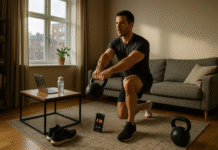























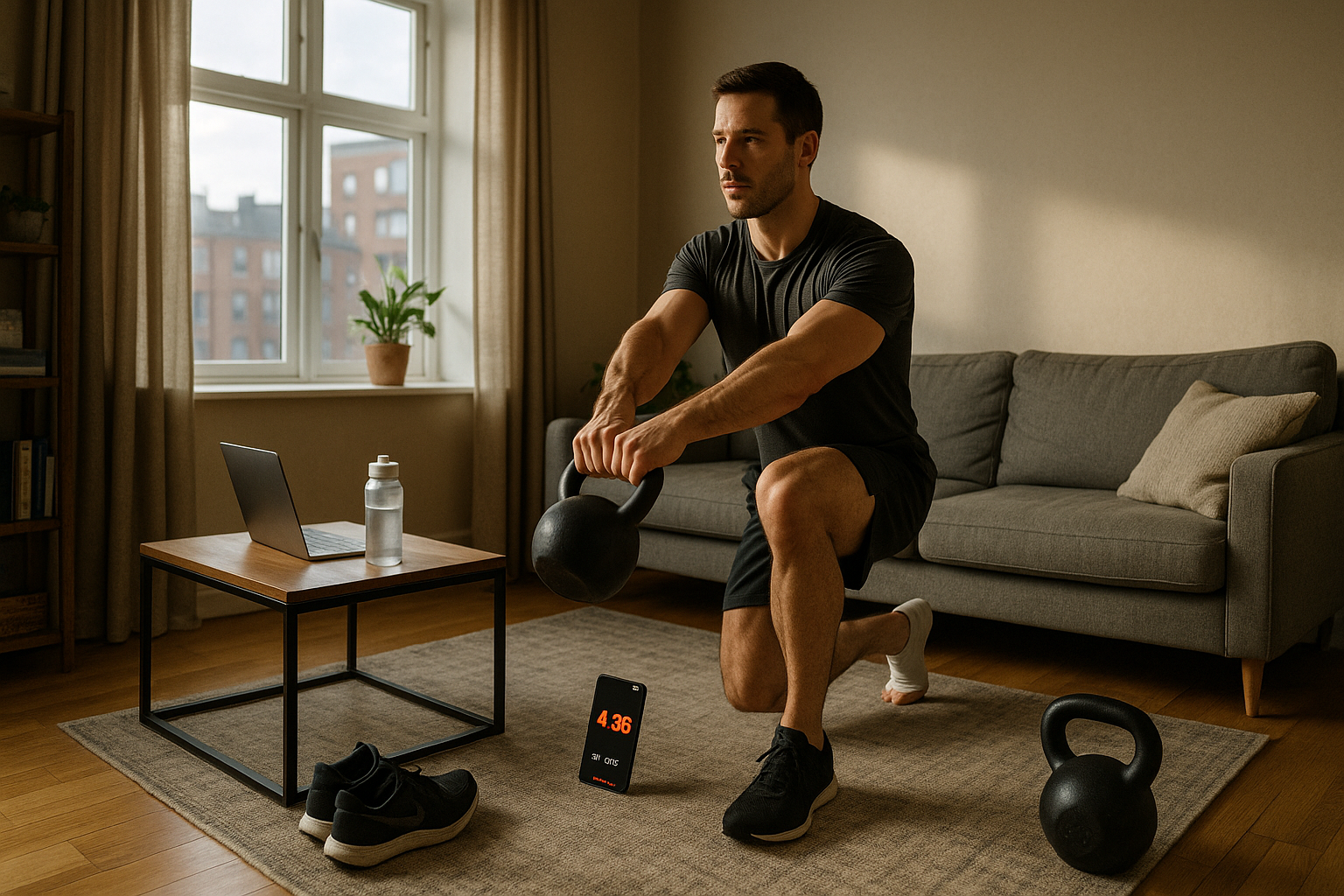
You’re slammed, but you still want a workout that actually moves the needle. Good news: short sessions can be wildly effective when you focus on intensity, exercise selection, and structure. This guide shows you exactly how to get more from 5–20 minutes—no fluff. In one line: maximizing short workouts on busy days means using time-boxed formats, compound moves, and the right intensity so every minute advances strength, cardio, and mobility. If you need a quick start, pick one format (EMOM, AMRAP, or intervals), choose 2–4 big movements, set a timer, and go.
Quick-start steps: 1) pick 10–15 minutes; 2) select 3 compound moves; 3) choose EMOM/AMRAP/intervals; 4) use the talk test or RPE to hit the right effort; 5) log reps to track progress.
Brief note: This article shares educational fitness guidance. If you have a medical condition or you’re new to vigorous exercise, consult a qualified professional first.
1. Time-Box Your Sessions With EMOM, AMRAP, or Tabata
Time-boxing is the fastest way to turn “I only have 12 minutes” into a focused, results-oriented session. EMOM (every minute on the minute) gives you a clear work/rest rhythm—finish your reps, rest in the remaining seconds, repeat next minute. AMRAP (as many rounds/reps as possible) lets you chase density by completing as much quality work as you can in a fixed window. Tabata (eight 20-second work bouts with 10-second rests) compresses high effort into four minutes; chain two or three rounds (with 1–2 minutes easy movement between) for a compact 10–15 minute blast. Start the clock, execute the plan, and the clock tells you when you’re done—perfect for tight schedules.
Why this works: A visible countdown reduces transition time, decision fatigue, and idle rest. EMOM enforces consistent pace and technique; AMRAP lets you auto-scale by moving at your current capacity; Tabata pushes peak intensity in minimal time (originally tested as 20/10 cycling intervals). As of August 2025, these structures are widely used by coaches for efficient conditioning and mixed-modal training.
1.1 How to do it
- EMOM 12: Minute 1 – 12 kettlebell swings; Minute 2 – 10 push-ups; Minute 3 – 12 alternating reverse lunges (each side = 1). Repeat 4 rounds.
- AMRAP 10: 6 goblet squats, 8 ring rows or bent-over rows, 10 mountain climbers (each leg).
- Tabata x2 (10 minutes): 8×(20s fast/10s rest) air bike or high-knee runs; 2 minutes easy walk; 8×(20/10) squat jumps or fast step-ups.
1.2 Mini-checklist
- Set a hard stop (10–20 minutes).
- Preload a timer app with your format.
- Pick 2–4 moves max; cap transitions to <10 seconds.
Finish with a one-line note in your log (rounds/reps or total cals). That’s your metric to beat next time.
2. Warm Up in 3–5 Minutes: Dynamic, Not Draining
Short workouts can’t afford long warm-ups—but they still need some ramp. A 3–5 minute dynamic warm-up raises temperature, primes joints, and activates key patterns so your first working set isn’t a shock. The goal is to hit light sweat + smooth range of motion, not to waste half your session. For most people, a brisk walk in place, light skips, dynamic leg swings, arm circles, and a few easy rehearsal reps of your first exercise is enough. Avoid long static holds right before power sets; save deeper static stretching for later in the day or post-session.
2.1 Numbers & guardrails
- Target time: 3–5 minutes (max 8 if heavy squats/hinges).
- Sequence: 60–90s easy cardio → 60–90s dynamic mobility → 60–90s rehearsal sets.
- Heavier days: Add 1–2 progressive warm-up sets of your first lift (e.g., empty bar → moderate load).
2.2 Mini-sequence (≈4 minutes)
- 45s brisk step-ups or marching in place
- 45s world’s greatest lunge (alternating)
- 45s hip hinge reach + T-spine openers
- 45s band pull-aparts or scap circles
- 60s rehearsal: light goblet squats + slow push-ups
Wrap up feeling warm but fresh. You should be ready to hit your first interval within a minute.
3. Lean on Compound Movements for Max Return
When minutes are scarce, pick exercises that train multiple joints and big muscle groups at once. Compound movements deliver more strength, cardio demand, and coordination per rep than isolation work, which makes them ideal for condensed sessions. Base your menu on squat/hinge/push/pull/carry patterns and rotate variations that fit your equipment and joints. For bodyweight days, think squats, split squats, push-ups, rows (table or ring), hip hinges/bridges, and loaded carries (bucket or backpack) if you have something to hold.
3.1 Go-to choices
- Squat: Goblet squat, front squat, step-ups
- Hinge: Kettlebell swing, RDL, hip thrust
- Push: Push-up progressions, dumbbell press
- Pull: Inverted row, 1-arm dumbbell row, banded row
- Carry/Core: Farmer’s carry, front rack carry, dead bug variations
3.2 Programming tips
- Pair non-competing patterns (e.g., hinge + push) to maintain output.
- Use rep targets you can keep crisp under fatigue (e.g., 6–12).
- If time is under 10 minutes, prefer time-based sets (e.g., 40s work/20s rest) to avoid overthinking reps.
Compound choices build total-body strength while nudging heart rate up—exactly what you want from short, dense sessions.
4. Prioritize HIIT or Sprint Intervals for Cardio Efficiency
If you’re training conditioning in 10–20 minutes, high-intensity interval training (HIIT) and sprint interval training (SIT) are your best bets. Intervals alternate hard efforts with easier recovery, producing large improvements in fitness with less total time than steady-state alone. For most busy adults, that means short hard bouts (e.g., 20–90 seconds) followed by equal or slightly longer easy movement. On a bike, rower, hill, or stairs, these formats deliver strong adaptation while respecting your calendar.
4.1 Numbers & guardrails
- Beginner: 6–10× (30s brisk / 60s easy) ≈ 15 minutes.
- Intermediate: 10× (40s hard / 20s easy) ≈ 10 minutes.
- SIT sample: 6× (20s near-all-out / 100–140s very easy) ≈ 15–20 minutes including warm-up.
- Frequency: 1–3× per week, not on back-to-back days if maximal.
4.2 Mini case
- 15-minute hill HIIT: 5-minute warm-up walk → 8× (40s hard uphill / 50–60s walk down) → 2-minute easy walk. Track distance or steps climbed per hard bout to measure progress.
Intervals let you bank a meaningful conditioning effect quickly. Keep the hard segments honest, the recoveries truly easy, and you’ll feel the difference within weeks.
5. Use a Minimal Effective Dose for Strength
You can hold—or even gain—strength with low-volume, high-quality work when time is tight. The playbook: 1–3 compound lifts, 1–3 hard sets per lift, and loads that feel challenging (RPE 7–9) while maintaining form. Trained lifters might need slightly more volume over the week, but single-set strategies still work surprisingly well for maintenance and busy seasons. Think 2–3 days per week, 10–20 total working sets, distributed efficiently.
5.1 Templates (pick one)
- Heavy + simple (12–18 minutes):
- A) Front squat or trap-bar deadlift — 3×5 @ RPE 8, 2–3 min rests
- B) Push-up or DB press — 3×AMRAP stopping 1–2 reps shy
- Strength circuit (15 minutes):
- EMOM 15: Min 1 – 5 goblet squats (heavy), Min 2 – 6–8 1-arm rows/side, Min 3 – 6 push-ups
5.2 Guardrails
- Choose loads you can move crisply; add weight or reps only if all sets were tidy.
- If you only have one bell/band, slow the eccentric (3s down) to increase stimulus.
- Keep a 2–3 min rest for heavy sets; for circuits, let the clock manage recovery.
Minimal dose doesn’t mean minimal intent. Hit quality reps, track your lifts, and you’ll get stronger—even in brief windows.
6. Superset Non-Competing Moves to Slash Idle Time
Supersets pair two exercises back-to-back with little rest, letting you do more work in less time without sacrificing quality. The trick is choosing non-competing patterns—like a hinge with a press—so the second movement isn’t limited by fatigue from the first. In 10–20 minutes, 3–4 rounds of a well-chosen superset can produce a potent strength and cardio stimulus.
6.1 Superset ideas
- Hinge + Push: Kettlebell swings (15) + push-ups (8–12)
- Squat + Pull: Goblet squat (10) + 1-arm row (8/side)
- Split Stance + Carry: Reverse lunge (8/side) + farmer’s carry (30–40m)
6.2 Efficiency checklist
- Pre-stage equipment to reduce transition time.
- Use time caps (e.g., 90s per round).
- Rest 30–60s after the pair, longer (90–120s) if lifting heavy.
You’ll maintain output and keep heart rate up—two wins for a brief session—while respecting form and recovery needs.
7. Turn Stairs Into a Science-Backed VO₂ Upgrade
If there’s a staircase where you live or work, you’ve got a free, time-efficient cardio tool. Short, vigorous stair-climbing bouts—as brief “exercise snacks” sprinkled through the day or in a compact interval session—can improve cardiorespiratory fitness in just a few weeks. Stairs drive intensity quickly, require no setup, and fit neatly between meetings.
7.1 Two ways to use stairs
- Exercise snacks (workday): 1–2 flights climbed as fast as safely possible, 3–5 times spread across the day (e.g., before coffee, mid-morning, after lunch).
- Stair intervals (10–15 minutes): Warm up 3–4 minutes easy stairs → 10× (20–30s hard up / walk down recovery) → 2 minutes easy.
7.2 Safety & scaling
- Use the handrail; prioritize safe foot placement.
- New to this? Start with brisk walking up and down.
- Progress from single flights to multiple flights or add a weighted backpack later.
Stair work punches above its weight for fitness and time savings. Keep sessions short, log climbs or total steps, and celebrate fast, tangible wins.
8. Break Up Sitting With 2-Minute Walks and Boost NEAT
On your busiest days, the most important “workout” might be breaking sedentary time. Short light-intensity walking breaks—as little as 2 minutes every 20–30 minutes—can meaningfully improve post-meal glucose and insulin responses. That’s huge when meetings swarm your calendar. Pair these breaks with NEAT (non-exercise activity thermogenesis): standing more, taking stairs, carrying groceries, pacing on calls, and light chores. These micro-movements add up.
8.1 Mini-protocol for desk days
- Every 30 minutes: 2 minutes of easy walking (hallway laps, stairwell).
- Lunch hour: 5–10 minute brisk walk outdoors if possible.
- On calls: Stand or pace for the first half of the meeting.
8.2 Why it matters
- Short walking breaks blunt post-meal spikes and improve metabolic markers.
- NEAT can contribute hundreds of extra calories burned weekly and supports weight regulation across diverse environments.
This isn’t a replacement for training; it’s a multiplier that keeps your physiology humming on days you can’t get a full session.
9. Auto-Scale Effort With the Talk Test and RPE
Short sessions demand the right intensity. Two simple tools help you calibrate without gadgets: the talk test and RPE (rating of perceived exertion). For aerobic intervals, if you can talk but not sing, you’re around moderate intensity; speaking only a few words suggests vigorous. For lifting and mixed circuits, RPE 7–9 means hard but controlled—1–3 reps left in the tank.
9.1 Practical cues
- Intervals: Hit “breathing hard, short phrases only” on the work bouts; recover until you can say a full sentence.
- Strength: Choose loads where last reps slow slightly but form stays sharp (RPE 8).
- Circuits: Use nasal breathing as a pacing cue—if you lose it entirely, extend rest 10–20s.
9.2 Common mistakes
- Confusing speed with quality on lifts—keep positions tight.
- Turning every EMOM into all-out sprints—save that for dedicated days.
Get this right and you’ll squeeze more adaptation from the same minutes while avoiding needless burnout.
10. Build a One-Bell (or Band) Kit and Leave It Out
Frictions kill short workouts. Reduce them by keeping a tiny home/office kit in plain sight: one kettlebell or dumbbell you can press and squat, a long resistance band, and a jump rope (space permitting). With just that, you can train every pattern in minutes. Stash it where you move daily—by the desk, TV, or door—so a 10-minute window instantly becomes a session rather than a search.
10.1 One-bell session ideas (10–15 minutes)
- EMOM 12: Min 1 – 12 swings, Min 2 – 8 goblet squats, Min 3 – 8/side row
- AMRAP 10: 6 push-ups, 8 1-arm rows, 10 alternating lunges
- Density 15: 10–8–6–4–2 ladder of presses/side + 10 swings each round
10.2 Environment checklist
- Keep kit visible and reachable.
- Pre-pick 3 go-to sessions for 10/15/20 minutes; save them as phone notes.
- Use a doorway pull-up bar or sturdy table for rows if bands aren’t available.
With one bell and a band, your “no time, no gym” excuse evaporates.
11. Keep 10-, 15-, and 20-Minute Menus You Can Run On Autopilot
Decide once, execute often. Make three grab-and-go menus that match your common time windows, then rotate them through the week. This prevents “paralysis by analysis” and ensures you hit all major patterns over time.
11.1 Example menus
- 10 minutes (move fast):
- Tabata x2: 8×(20/10) stair sprints; rest 90s; 8×(20/10) push-up to down-dog
- 15 minutes (mixed):
- EMOM 15: Min 1 – 12 swings, Min 2 – 8 push-ups, Min 3 – 10 step-ups/side
- 20 minutes (strength-leaning):
- 4 rounds for quality: 6 goblet squats (heavy), 8/side rows, 8–10 hip hinges, 30–40m farmer’s carry
11.2 Weekly rhythm (busy-friendly)
- Mon: 15-minute mixed
- Wed: 10-minute intervals
- Fri: 20-minute strength circuit
- Daily: 2-minute walking breaks, 3–5 stair “snacks” if possible
Menus protect your bandwidth and deliver balanced training—even in chaotic weeks.
12. Track Density and Celebrate Tiny Wins
Short workouts pay off when you track something you can beat. In condensed sessions, the simplest metrics are density (total work per minute), reps completed, rounds finished, or distance climbed on stairs. This keeps motivation high and progress visible without spreadsheets.
12.1 What to log (takes 30 seconds)
- Session type & duration (e.g., EMOM 12)
- Exercises + weights/bands used
- Rounds/reps completed or steps climbed
- One note on feel (e.g., “RPE 8, add a rep next time”)
12.2 Progress rules
- Beat your log by 1 rep, 1 lb, or 1 step—small edges add up.
- If you can’t beat it, match quality and move on.
- Every 4–6 weeks, swap one movement or add a minute.
Microwins compound. Track the work, keep it playful, and your short sessions will punch far above their weight.
FAQs
1) Are 10–15 minute workouts really enough to see results?
Yes—when structured well. Intervals and compound circuits can improve fitness and maintain or increase strength in surprisingly short sessions. Pair two to three short workouts per week with daily NEAT (walking, stairs, movement breaks). Progress by adding a rep, a kilo, or a minute over time.
2) How hard should I push in a short workout?
Use the talk test and RPE. For intervals, aim for “only a few words possible” during hard bouts; for strength sets, finish with 1–3 reps in reserve (RPE 7–9). That’s hard enough to stimulate adaptation without cratering form.
3) What if I’m brand new to exercise?
Start with 10 minutes at a conversational pace and basic movements—sit-to-stand, wall push-ups, rows with a band, and light step-ups. Increase difficulty slowly: add seconds before you add intensity. If you have medical concerns, get clearance first.
4) Which is better in a time crunch: cardio intervals or a strength circuit?
It depends on your goal and weekly mix. For pure conditioning, pick intervals. For overall fitness and calorie burn with muscle retention, do a mixed circuit or EMOM with compound lifts. Rotate both during the week for balance.
5) Should I stretch before or after short workouts?
Before: 3–5 minutes of dynamic warm-up and a few rehearsal reps. After: brief static stretches or mobility flows if flexibility is a goal. Long static holds right before explosive lifts can dampen performance; keep them for cooldowns or separate sessions.
6) Can I break 20 minutes into two 10-minute bouts?
Absolutely. Splitting sessions can match or even beat one continuous session for adherence, and short vigorous “snacks” (like stairs) improve cardiorespiratory fitness. Just try to separate bouts by at least an hour.
7) How many days per week do I need?
Aim for 3 short sessions (10–20 minutes) plus daily NEAT and a couple of 2-minute walking breaks each hour on desk days. If you can manage four sessions, alternate strength-leaning and interval-leaning formats.
8) What equipment gives me the most options?
A single kettlebell or adjustable dumbbell and a long resistance band handle nearly everything. Add a jump rope and a suspension trainer or a sturdy table for bodyweight rows if space allows.
9) How should I breathe during short, intense work?
For repeats and EMOMs, breathe rhythmically and use “focus breaths” (long exhales) in transitions. If you lose control of breathing entirely, extend recovery or cut reps to keep quality high.
10) How do I avoid injury in quick sessions?
Warm up dynamically, choose loads you can own, and stop 1–2 reps before form breaks. Stick with familiar movements when you’re rushed, and progress one variable at a time (reps or weight or rest).
11) What’s the best way to progress without adding time?
Increase density (more work in the same minutes). For example, add one rep to each round, nudge load up by 1–2 kg, or reduce transition time. Alternatively, keep reps the same but use a slightly more challenging variation.
12) Do short workouts “count” toward weekly health guidelines?
Yes. Bouts of moderate to vigorous activity contribute toward the widely recommended 150 minutes/week moderate or 75 minutes/week vigorous target. Short, repeated vigorous sessions can meaningfully contribute when the week is busy.
Conclusion
Short workouts aren’t a compromise—they’re a strategy. When you time-box your sessions, choose compound movements, and calibrate intensity with simple tools, 10–20 minutes becomes enough to maintain and even improve strength, cardio, and mobility. Use EMOM, AMRAP, or intervals to remove decision fatigue. Keep a 3–5 minute dynamic warm-up, pick a few high-value movements, and log one tiny metric. Layer in exercise snacks and 2-minute walking breaks to keep your physiology on track during packed days. Finally, protect momentum with ready-made 10-, 15-, and 20-minute menus. Do this consistently, and you’ll build a resilient, time-efficient fitness habit that survives real life.
Ready to start? Pick a 12-minute EMOM today, set your timer, and go.
References
- Physical Activity Guidelines for Americans, 2nd edition. U.S. Department of Health and Human Services, 2018. https://health.gov/sites/default/files/2019-09/Physical_Activity_Guidelines_2nd_edition.pdf
- Wattanapisit A., Wattanapisit S., Wongsiri S. “Summary and application of the WHO 2020 physical activity guidelines.” Family Medicine and Community Health, 2022. https://pmc.ncbi.nlm.nih.gov/articles/PMC9618974/
- “Measuring Physical Activity Intensity (Talk Test).” Centers for Disease Control and Prevention, updated 2024. https://www.cdc.gov/physicalactivity/basics/measuring/index.html
- Roy B.A. “Monitoring Your Exercise Intensity.” ACSM’s Health & Fitness Journal, 2015. https://journals.lww.com/acsm-healthfitness/fulltext/2015/07000/monitoring_your_exercise_intensity.3.aspx
- Dunstan D.W. et al. “Breaking Up Prolonged Sitting Reduces Postprandial Glucose and Insulin Responses.” Diabetes Care, 2012. https://pmc.ncbi.nlm.nih.gov/articles/PMC3329818/
- Dempsey P.C. et al. “Benefits for Type 2 Diabetes of Interrupting Prolonged Sitting With Brief Bouts of Activity.” Diabetes Care, 2016. https://diabetesjournals.org/care/article/39/6/964/29532/Benefits-for-Type-2-Diabetes-of-Interrupting
- Jenkins E.M. et al. “Do stair climbing exercise ‘snacks’ improve cardiorespiratory fitness?” Applied Physiology, Nutrition, and Metabolism, 2019. https://cdnsciencepub.com/doi/10.1139/apnm-2018-0675
- Emberts T. et al. “Exercise Intensity and Energy Expenditure of a Tabata Workout.” Journal of Sports Science and Medicine, 2013. https://pmc.ncbi.nlm.nih.gov/articles/PMC3772611/
- Iversen V.M. et al. “No Time to Lift? Designing Time-Efficient Training Programs.” Sports Medicine, 2021. https://pmc.ncbi.nlm.nih.gov/articles/PMC8449772/
- Nuzzo J.L. “Resistance Exercise Minimal Dose Strategies for Health and Performance.” Sports Medicine Open, 2024. https://pmc.ncbi.nlm.nih.gov/articles/PMC11127831/
- Grgic J. et al. “Effects of Rest Interval Duration in Resistance Training on Strength and Hypertrophy.” Sports Medicine, 2018. https://pubmed.ncbi.nlm.nih.gov/28933024/
- Levine J.A. “Nonexercise activity thermogenesis (NEAT): environment and biology.” American Journal of Physiology-Endocrinology and Metabolism, 2004. https://journals.physiology.org/doi/abs/10.1152/ajpendo.00562.2003