


























Mindfulness and meditation are practical, trainable skills that help your nervous system settle and your attention become steadier. In simple terms, mindfulness means paying attention to the present moment with curiosity and without judgment, while meditation is the structured practice that builds that capacity. Used consistently, these methods can reduce perceived stress, ease anxiety, improve sleep quality, and support sharper focus at work or school. This guide is written for beginners and experienced practitioners alike, with step-by-step instructions, realistic guardrails, and tools you can apply immediately. Quick note: These practices complement—not replace—medical care. If you live with trauma, severe depression, psychosis, or panic, consider practicing with a qualified clinician or teacher.
One-sentence definition (for quick reference): Mindfulness and meditation techniques are evidence-informed exercises that train attention and emotional regulation by repeatedly bringing awareness back to a chosen anchor (like the breath, body sensations, or phrases).
Fast start steps (2–5 minutes today):
- Pick one technique below.
- Set a 2–5 minute timer (build to 10–20 minutes).
- Sit or stand comfortably; soften your gaze or close your eyes.
- Follow the steps exactly as written; log how you feel before and after.
1. Diaphragmatic Breathing (Including Box and 4-7-8 Patterns)
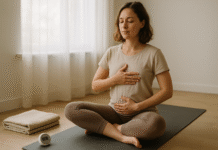
Diaphragmatic breathing is the fastest on-ramp to calm because it directly signals your autonomic nervous system to downshift. In practice, you breathe slowly into your belly (not just your chest), lengthen the exhale, and let your shoulders stay soft. Within one to three minutes, many people notice less muscle tension, a steadier heart rate, and fewer racing thoughts. Two structured patterns—box breathing (inhale–hold–exhale–hold in equal counts) and 4-7-8 breathing (inhale 4, hold 7, exhale 8)—offer simple, repeatable timing that’s easy to remember. These patterns are useful before tough conversations, presentations, or bedtime. If you feel lightheaded, shorten holds or switch to gentler belly breathing without holds.
1.1 How to do it (3–5 minutes)
- Place a hand on your belly and one on your upper chest; sit tall but relaxed.
- Inhale through your nose into your belly for 4 counts (feel your lower hand rise).
- Exhale through pursed lips for 6–8 counts (slightly longer than the inhale).
- Repeat 6–10 cycles, keeping shoulders and jaw relaxed.
- Optional: Try box breathing (4–4–4–4) or 4-7-8 (max 4 cycles when starting).
1.2 Numbers & guardrails
- Start with 3 minutes; build up to 10 minutes, 1–2× daily.
- If you have respiratory issues, skip long breath holds; use gentle exhales instead.
- For alertness (e.g., pre-meeting), keep exhale = inhale; for calm (evening), lengthen exhale.
Synthesis: Diaphragmatic breathing gives you a reliable, portable reset—use it as a stand-alone practice or a 60–120 second warm-up before any meditation below.
2. Body Scan Meditation (From Head to Toe)
The body scan trains attention by moving your focus systematically through the body, noticing sensation without trying to change it. It’s especially helpful for stress-related tension and sleep issues because it builds interoceptive awareness—the sense of what’s happening inside your body—and interrupts rumination loops. Expect your mind to wander; the skill is gently returning attention to the region you’re scanning. Many guided recordings last 10–30 minutes, but even a 5-minute scan can downshift your nervous system before bed or between tasks. If you encounter discomfort or emotion, label it (“pressure,” “tingling,” “sadness”), soften surrounding muscles, and reduce the scan area’s duration.
2.1 How to do it (step-by-step)
- Lie down or sit; let your eyes close.
- Start at the crown of your head; notice temperature, pressure, or no sensation.
- Move down to face, jaw, throat, shoulders, arms, hands; then chest, belly, back.
- Continue through pelvis, thighs, knees, shins, ankles, feet, toes.
- In each region, feel for 3–5 breaths, name sensations neutrally, then proceed.
2.2 Common mistakes & fixes
- Rushing: Set a timer and give each region equal attention.
- Judging sensations: Replace “this is tight” with “tightness is present.”
- Zoning out: Sit rather than lie down, or open eyes slightly to stay awake.
Synthesis: The body scan is your “system check,” ideal for transitioning from work mode to rest and for building non-reactive awareness that you’ll use in other techniques.
3. Mindful Walking (Attention in Motion)
Mindful walking turns any hallway or sidewalk into a meditation path, perfect if sitting still is difficult or you want to reset between meetings. The practice anchors attention in the physical sensations of walking—weight shifting, heel lifting, foot touching down—while also opening awareness to sights and sounds without getting lost in them. Because you’re moving, this approach can boost alertness and mood while reducing restlessness. It’s equally useful outdoors or in a quiet indoor corridor. If you’re in a busy area, take shorter steps and walk slower than usual; prioritize safety and awareness of your surroundings.
3.1 How to do it (short route: 5–10 minutes)
- Choose a 10–20 meter path; stand tall and relax your shoulders.
- Walk slowly; silently label phases: “lift,” “move,” “place,” “shift.”
- When thoughts pull you away, pause for one full breath, then resume.
- At the turn, stop, feel both feet, then continue back the other way.
- End by standing still for 3 breaths, noticing posture and mood.
3.2 Tips & guardrails
- Use this between desk blocks to reduce sitting time and eye fatigue.
- In public, drop the labels; simply feel the sensations of movement.
- For focus training, count 10 steps with full attention; restart if you lose count.
Synthesis: Mindful walking integrates attention training into daily life, giving you stress relief and a focus boost without adding more screen time or another seated task.
4. Loving-Kindness Meditation (Metta) for Warmth and Connection
Loving-kindness (metta) cultivates positive emotion and social connection by silently repeating phrases of goodwill—first to yourself, then to others. Rather than forcing a mood, you practice the intention behind phrases like “May I be safe, healthy, and at ease.” Over time, this tends to soften harsh self-talk, reduce resentment, and improve relationship satisfaction. It’s especially useful if stress shows up as irritability or isolation. If difficult feelings surface (common for people with trauma or grief), narrow the circle: start with neutral figures or pets, and keep phrases very simple. The goal isn’t to feel a certain way—it’s to train a kinder stance toward experience.
4.1 How to do it (sequence and phrases)
- Sit comfortably; take 2 grounding breaths.
- Start with self for 1–2 minutes: “May I be safe. May I be healthy. May I be at ease.”
- Move to a benefactor (someone who supports you), a friend, and a neutral person.
- Optionally include a difficult person when you feel steady.
- Close with all beings: “May all beings be safe, healthy, and at ease.”
4.2 Why it matters & common adjustments
- Positive affect broadens attention and helps recovery from stress.
- If phrases feel awkward, use your own wording that carries sincerity.
- If strong emotions arise, switch to diaphragmatic breathing for a few minutes.
Synthesis: Loving-kindness retrains your inner voice and social reflexes, making everyday stressors easier to navigate and supporting prosocial focus at work and home.
5. Focused Attention (Breath or Chosen Anchor)
Focused attention is the classic meditation for building mental steadiness. You choose a single anchor—most often the breath at the nostrils or chest—and return to it every time your mind wanders. This simple loop (notice → return → continue) increases meta-awareness (seeing thoughts as events rather than commands) and reduces the time you spend lost in rumination. Expect distraction; the “rep” is the gentle return, not holding perfect focus. If breath isn’t comfortable, use an external anchor: ambient sounds, a visual point, or touch (e.g., fingertips lightly together).
5.1 How to do it (10 minutes to start)
- Sit with an alert, relaxed posture; set a timer.
- Choose your anchor (breath at nostrils, chest, or belly).
- Track the full inhale and exhale; silently note “in” and “out.”
- When you notice wandering, mark it “thinking,” and return to the anchor.
- End with three slightly deeper breaths and a simple intention for your next task.
5.2 Numbers & tools
- Frequency beats duration: 10 minutes daily generally outperforms 1 hour weekly.
- Use a simple timer app or a guided practice from Headspace, Calm, or Insight Timer.
- For ADHD or high distractibility, consider shorter 3–5 minute sets, multiple times per day.
Synthesis: Focused attention is attention’s gym: each gentle return builds the muscle you’ll use to read, code, write, or listen with fewer derailments.
6. Open Monitoring (Choiceless Awareness)
Open monitoring is like zooming your lens out. Instead of a single anchor, you allow whatever arises—sounds, sensations, thoughts, feelings—to be noticed in real time, without grasping or resisting. This builds equanimity and cognitive flexibility; you learn to see experiences as transient rather than personal threats. It can feel diffuse at first, so it’s often introduced after some time with focused attention. If you get overwhelmed, narrow back to the breath or a body area and re-expand when steady.
6.1 How to do it (practice arc)
- Begin with 1–2 minutes of focused breathing to stabilize attention.
- Open awareness to the whole field of experience, moment by moment.
- Silently label broad categories: “hearing,” “thinking,” “pressure,” “warmth.”
- Notice beginnings, middles, and endings of experiences; no need to analyze content.
- If pulled into a story, gently step back to the breath for 3 cycles; then reopen.
6.2 Common mistakes & refinements
- Spacing out: Use light labels to stay present.
- Over-analyzing: Favor noticing qualities over explaining why.
- Restlessness: Alternate 2 minutes open monitoring with 1 minute breath focus.
Synthesis: Open monitoring strengthens your ability to meet complexity—busy days, crowded inboxes, or difficult emotions—without getting swept away.
7. Mindful Eating (Rebuild Your Relationship with Food and Focus)
Mindful eating turns meals and snacks into training for attention, impulse control, and satisfaction. Instead of multitasking, you slow down enough to taste, smell, and sense fullness, which can reduce overeating and improve digestion. This practice is useful if you graze while stressed or eat quickly in front of screens. It’s not a diet and carries no forbidden foods; it’s a way to change how you relate to food so your satiety cues can be heard. If you have an active eating disorder, work with a clinician before trying this.
7.1 Mini-practice (one piece of fruit or first 5 bites)
- Step away from screens; place the food in front of you.
- Notice color, shape, aroma; take one slow breath before the first bite.
- Take a small bite; chew 10–20 times, track flavor changes.
- Put the utensil down between bites; check the body for satisfaction halfway through.
- Stop at enough; note one thing you genuinely enjoyed.
7.2 Numbers & guardrails
- Try mindful eating for the first five bites of one meal daily.
- If you’re ravenous, eat a few normal bites first, then slow down.
- For cultural or family meals, stay social; apply 1–2 mindful bites rather than the whole meal.
Synthesis: Mindful eating improves awareness of hunger and fullness while doubling as a powerful daily drill for focus and impulse control.
8. Guided Imagery and Yoga Nidra (Deep Rest to Reset)
Guided imagery and yoga nidra are structured practices that lead you into deep relaxation, often improving sleep quality and daytime calm. Guided imagery uses evocative mental scenes (e.g., a forest walk) to elicit parasympathetic responses, while yoga nidra guides awareness through body, breath, and imagery while you rest in savasana (lying on your back). These practices are excellent when stress shows up as insomnia, muscle guarding, or mind-racing at bedtime. They’re also helpful recovery tools for athletes and people in cognitively demanding jobs.
8.1 How to do it (bedtime or mid-day)
- Choose a 10–30 minute recording from a reputable teacher or app.
- Lie down or recline; support knees with a pillow; keep warm.
- Follow guidance precisely; if you drift toward sleep at night, that’s fine.
- For a mid-day reset, set a gentle alarm to reorient afterward.
- Log post-practice: energy (0–10), tension (0–10), and mental clarity (0–10).
8.2 Practical pointers
- If imagery feels cheesy, pick minimal, body-anchored scripts (yoga nidra).
- For chronic pain, look for recordings that include non-reactive noticing rather than “relax” commands.
- If you snore when lying down, try a recliner position or mindful walking instead.
Synthesis: Guided imagery and yoga nidra are like hitting your system’s “sleep mode,” offering restorative calm that carries into your next task or bedtime.
9. Micro-Practices for Busy Days (STOP, RAIN, and 60-Second Resets)
Micro-practices weave mindfulness into real-world schedules when you don’t have 10–20 uninterrupted minutes. Two reliable frameworks are STOP (Stop, Take a breath, Observe, Proceed) and RAIN (Recognize, Allow, Investigate, Nurture). These take one to three minutes and can be done at your desk, in a car before walking in, or during a bathroom break. They work by interrupting autopilot reactions, giving your prefrontal cortex a chance to re-enter the chat before you reply, click, or grab another coffee. Use them before high-stakes moments or after a stress spike.
9.1 How to do it (STOP and RAIN)
- STOP: Stop (pause hands), Take one slow breath, Observe body + feeling + thought (“tight chest, worry, deadline”), Proceed with one wise next step.
- RAIN: Recognize what’s here, Allow it (“this is stress”), Investigate gently (“where do I feel it?”), Nurture (“it’s okay to be stressed; I can take one step”).
- 60-second reset: Stand, relax shoulders, inhale for 4, exhale for 8, then choose your next single task.
9.2 Mini-checklist & examples
- Put a small sticker on your laptop to cue STOP before sending difficult emails.
- Pair RAIN with a 3-minute walk after tense meetings.
- If emotions run hot, do STOP twice; then schedule a longer practice later.
Synthesis: Micro-practices make mindfulness continuous rather than occasional, helping you respond thoughtfully under pressure and maintain focus throughout the day.
FAQs
1) How long before I notice results?
Most beginners report small benefits—like easier settling or better sleep—within 1–2 weeks of practicing 10 minutes daily. Larger shifts in reactivity and attention typically emerge over 6–8 weeks. Think of it like strength training: you improve through consistent, frequent “reps,” not marathon sessions once in a while. Journaling brief before/after ratings (stress, focus, mood) helps you see progress you might otherwise miss.
2) What time of day is best to practice?
The best time is the time you can actually keep. Morning offers a clean slate; lunchtime breaks reduce mid-day stress; evenings support sleep. If you’re inconsistent, anchor practice to a daily cue: after brushing teeth, upon sitting at your desk, or after your commute. Two short sessions (e.g., 5–10 minutes morning and evening) can beat one long session you often skip.
3) Can mindfulness or meditation replace therapy or medication?
No. These techniques are evidence-informed supports, not replacements for medical care, especially for major depression, PTSD, psychosis, or severe anxiety. Many people use them alongside therapy (e.g., CBT, ACT) and medications with good effect. If you’re managing a mental health condition, collaborate with your clinician to tailor practices and monitor for any adverse reactions like increased agitation.
4) What if meditation makes me more anxious?
This happens, especially under high stress or with trauma history. Shrink the practice: use diaphragmatic breathing for 2–3 minutes, keep eyes open, or switch to mindful walking. Avoid long breath holds and overly internal practices if they spike anxiety. Seek a trauma-informed teacher or clinician if discomfort persists; safety and titration come first.
5) Are apps worth it, or should I learn with a teacher?
Both work. Apps provide structured programs, tracking, and accessible guidance; teachers offer personalization and accountability. If you’re self-starting, try a reputable app for 10–20 minutes daily for four weeks. If you stall or encounter obstacles (e.g., rumination, trauma triggers), consider a local MBSR/MBCT course or therapy integration for tailored support.
6) Is meditation religious?
Meditation has roots in multiple contemplative traditions, but you can practice it in a fully secular, science-informed way. The techniques here—breath awareness, body scan, loving-kindness—are taught in hospitals, clinics, and workplaces worldwide. You don’t need to adopt any belief system to benefit; the core is training attention and response patterns.
7) How do I measure progress without over-optimizing it?
Track what matters: perceived stress (0–10), focus quality (e.g., minutes of deep work), sleep latency (minutes to fall asleep), and emotional reactivity (how quickly you recover after a trigger). Review weekly trends rather than daily noise. If numbers improve but you feel rigid, loosen goals; this is about skillful living, not perfect scores.
8) Which technique should I start with if I have ADHD or high distractibility?
Prioritize movement-friendly practices and short intervals: mindful walking, 2–5 minute focused attention reps, or micro-practices like STOP. Use external anchors (sound, touch) and tactile cues (coin in pocket) to return attention. Build gradually; stacking several brief reps through the day often outperforms a single long sit.
9) Can mindfulness help with sleep?
Yes, many people sleep better with body scan, controlled breathing, or yoga nidra. For bedtime, keep lights low, avoid long breath holds, and use guided audio. If you wake at night, do a 4–6 minute body scan without checking your phone. Pair practice with consistent sleep hygiene for best results.
10) What if I keep “failing” because my mind wanders?
Wandering is normal—it’s the returning that counts. Treat each return as a rep in the attention gym. If frustration rises, lower the bar: shorten sessions, choose a different anchor, or practice mindful walking. Over time, you’ll spend more minutes in steady attention and fewer minutes caught in loops.
11) Are there risks to meditation?
Adverse effects are uncommon but possible: increased anxiety, dissociation, or resurfacing trauma. Reduce intensity, prefer grounded practices (walking, breath with eyes open), and seek support from a trauma-informed professional if symptoms persist. Mindfulness is about meeting experience safely; your wellbeing is the priority.
12) How do I integrate mindfulness at work without seeming “woo”?
Keep it functional and brief. Use a 60-second breath reset before presentations, a 3-minute walk between meetings, and STOP before replying to tense emails. Share outcomes (“This helps me think clearly”) rather than labels. Consistency beats intensity—small, reliable practices change how you show up.
Conclusion
Stress and distraction thrive when attention runs on autopilot. The nine techniques above give you a complete toolkit: fast state shifters (diaphragmatic breathing), embodied awareness builders (body scan, mindful walking), heart-training (loving-kindness), attention “strength training” (focused attention), wide-angle stability (open monitoring), lifestyle-integrated drills (mindful eating), deep rest (guided imagery and yoga nidra), and micro-practices (STOP, RAIN) for high-pressure moments. Start with one practice you’ll realistically do for 10 minutes a day; layer in a second once the first is automatic. Track simple markers—stress, sleep, focus—and adjust with kindness, not perfectionism. Over weeks, you’ll notice more space between stimulus and response, steadier energy, and sharper, kinder focus.
CTA: Pick one technique now, set a 5-minute timer, and begin—your next task will feel different.
References
- Meditation: In Depth, National Center for Complementary and Integrative Health (NCCIH), updated 2022, https://www.nccih.nih.gov/health/meditation-in-depth
- Meditation Programs for Psychological Stress and Well-being: A Systematic Review and Meta-analysis, JAMA Internal Medicine, 2014, https://jamanetwork.com/journals/jamainternalmedicine/fullarticle/1809754
- Mindfulness Meditation and Improvement in Sleep Quality and Daytime Impairment Among Older Adults With Sleep Disturbances: A Randomized Clinical Trial, JAMA Internal Medicine, 2015, https://jamanetwork.com/journals/jamainternalmedicine/fullarticle/2110998
- Effect of Mindfulness-Based Stress Reduction vs Cognitive Behavioral Therapy or Usual Care on Back Pain and Functional Limitations, JAMA, 2016, https://jamanetwork.com/journals/jama/fullarticle/2516207
- Mindfulness meditation: A research-proven way to reduce stress, American Psychological Association, 2019, https://www.apa.org/topics/mindfulness/meditation
- Meditation and Cardiovascular Risk Reduction: A Scientific Statement, American Heart Association, 2017, https://www.ahajournals.org/doi/10.1161/CIR.0000000000000430
- Mindfulness-based cognitive therapy to prevent relapse in recurrent depression: individual patient data meta-analysis, The Lancet, 2016, https://www.thelancet.com/journals/lancet/article/PIIS0140-6736(15)00536-2/fulltext
- Mindfulness practice leads to increases in regional brain gray matter density, Psychiatry Research: Neuroimaging, 2011, https://www.sciencedirect.com/science/article/pii/S092549271000288X
- Mental health: strengthening our response (Fact sheet), World Health Organization, updated 2022, https://www.who.int/news-room/fact-sheets/detail/mental-health-strengthening-our-response