


























Healthy shoulders move freely in multiple directions, share load between the ball-and-socket joint and the shoulder blade, and don’t bark after a day at a desk or a session overhead. This guide focuses on mobility exercises for healthy shoulders that you can use at home with minimal equipment. You’ll learn what each drill does, exactly how to perform it, how many reps to do, and the common mistakes to avoid. A brief safety note: if you have acute pain, recent surgery, dislocation history, or numbness/tingling, consult a licensed clinician before starting.
Quick definition: Mobility exercises for healthy shoulders are targeted movements that restore and maintain pain-free range of motion across the shoulder complex—glenohumeral joint, scapula, and thoracic spine—while reinforcing control at end ranges.
Fast-start plan (5–7 minutes): Do items 1, 2, 5, 6, and 9 for one light circuit before workouts. On recovery days, add 3 and 4 plus one stretch from 7–9.
1. Shoulder CARs (Controlled Articular Rotations)
Shoulder CARs maintain and reclaim full joint range by taking the ball-and-socket through its biggest pain-free circle under muscular control. Start here because CARs both assess your current range and gently “grease” the joint capsule. You’ll quickly spot pinch points—often at end-range internal rotation or overhead flexion—and can scale to half-circles until the motion feels smooth. Done slowly, CARs also wake up the rotator cuff, which centers the humeral head, and the scapular muscles that coordinate motion on your ribcage. Aim for tension that feels like 3–4/10 effort, not a shruggy grind. If you hear painless soft clicking, that’s usually benign; sharp pain or catching is your cue to shrink the circle.
1.1 How to do it
- Stand tall, ribs down, feet hip-width, make a gentle fist with the working arm.
- Reach forward and up as far as you can without pain, then rotate the thumb in (internal rotation) as you sweep behind you.
- Keep torso still; imagine you’re drawing a huge slow circle with your elbow locked.
- Reverse back to the start for one rep; move deliberately (≈8–10 seconds per circle).
- Keep the non-working arm lightly braced at your side.
1.2 Numbers & guardrails
- Reps/Sets: 3 slow circles each direction per shoulder.
- Frequency: Daily or in every warm-up.
- Tempo: 8–10 seconds per rep; breathe normally.
- Scaling: If any pinch, reduce range; draw a “D-shape” half-circle in the clear arc.
1.3 Common mistakes
- Shrugging the shoulder toward the ear.
- Twisting through the low back to “fake” range.
- Rushing the sticky parts instead of pausing and breathing.
Finish with one relaxed shake-out; your aim is smooth, controlled motion, not maximal strain.
2. Scapular Clocks (Protraction, Retraction, Elevation, Depression)
Scapular clocks free the shoulder blades, which must glide up, down, out, and in to support your arm. Many desk workers lose lower-trap and serratus control, which shows up as a stiff, upward-tilted blade and “pinchy” overhead motion. This drill teaches you to move the scapula without the ribcage or neck doing the job. By mapping directions—12 o’clock (elevate), 6 (depress), 3 (protract), 9 (retract)—you restore the scaffolding for pain-free reaches and pressing. It’s deceptively simple: the art is moving the blade on the ribs while keeping elbows straight and collarbones wide. Expect subtle fatigue between the shoulder blades and along the side of the ribs (serratus).
2.1 How to do it (wall or quadruped)
- Wall: Stand, forearms on wall, elbows at shoulder height, hands relaxed.
- Slide blades up (12), down (6), out (3), and in (9) without bending elbows.
- Draw small circles clockwise and counterclockwise.
- Quadruped option: On hands/knees, keep elbows locked and repeat the same directions.
2.2 Numbers & guardrails
- Reps: 6–8 each direction + 5 circles each way.
- Sets: 2.
- Frequency: 3–5×/week (daily if stiff).
- Keep neck long; no shrugging into the ears.
2.3 Mini-checklist
- Ribs stay down; spine quiet.
- Feel blades glide, not elbows flex.
- Slow, quiet breath.
When the blades move well, overhead work, pulling, and push-ups all feel more stable and less pinchy.
3. Thoracic Extension Over a Foam Roller
If your mid-back is rounded, your shoulder has to “cheat” overhead by shrugging or arching your low back. Restoring thoracic extension expands the overhead window and unloads the rotator cuff. Foam-roller extensions target the stiff segments between your shoulder blades, improving posture and breathing mechanics. Go slow; you’re mobilizing joints, not doing crunches. If you lack a roller, a firm rolled towel works in a pinch. Expect a gentle stretch across the chest and mid-back; avoid neck cranking.
3.1 How to do it
- Lie on your back with a foam roller perpendicular to your spine at the mid-back.
- Support your head with your hands, elbows pointing up; keep glutes lightly engaged.
- Inhale to prepare; on an exhale, drape your upper back over the roller without flaring ribs.
- Move the roller one segment up or down and repeat 3–4 spots.
- Optional: finish with 5–8 slow “snow angels” on the floor.
3.2 Numbers & guardrails
- Reps: 6–8 extensions per spot.
- Spots: 3–4 segments (avoid the low back/neck).
- Frequency: 3–5×/week.
- Keep ribs stacked over pelvis; if you feel low-back compression, reduce range.
3.3 Common mistakes
- Driving from the neck instead of the mid-back.
- Flaring the ribs to “fake” extension.
- Speeding through sticky segments.
A more open mid-back instantly translates into easier, cleaner shoulder flexion and overhead reach.
4. Thread-the-Needle (Thoracic Rotation)
Rotational stiffness in the thoracic spine limits scapular mechanics and can force the ball-and-socket to grind at end range. Thread-the-Needle couples shoulder and ribcage motion to improve rotation without loading the neck or low back. It’s a relief move after long sitting and a perfect bridge to more demanding mobility drills. You’ll feel a stretch between shoulder blades and gentle tension in the posterior shoulder—keep it comfortable.
4.1 How to do it
- Start on hands and knees, wrists under shoulders, knees under hips.
- Slide your right hand (palm up) under the left arm, lowering the right shoulder toward the floor (exhale).
- Press through the left hand to rotate open, reaching the right hand up toward the ceiling (inhale).
- Keep hips over knees; eyes follow the moving hand.
- Repeat, then switch sides.
4.2 Numbers & guardrails
- Reps: 6–10 each side.
- Sets: 2.
- Frequency: 3–5×/week or as a warm-up.
- Keep motion smooth and pain-free; avoid forcing end range.
4.3 Mini-checklist
- Hips stacked; no swaying side to side.
- Long neck; shoulders away from ears.
- Breathe out on the thread, in on the open.
Better rotation reduces compensations in pressing, rowing, and daily reaches like fastening a seatbelt.
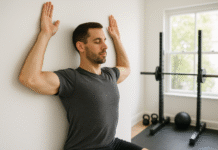
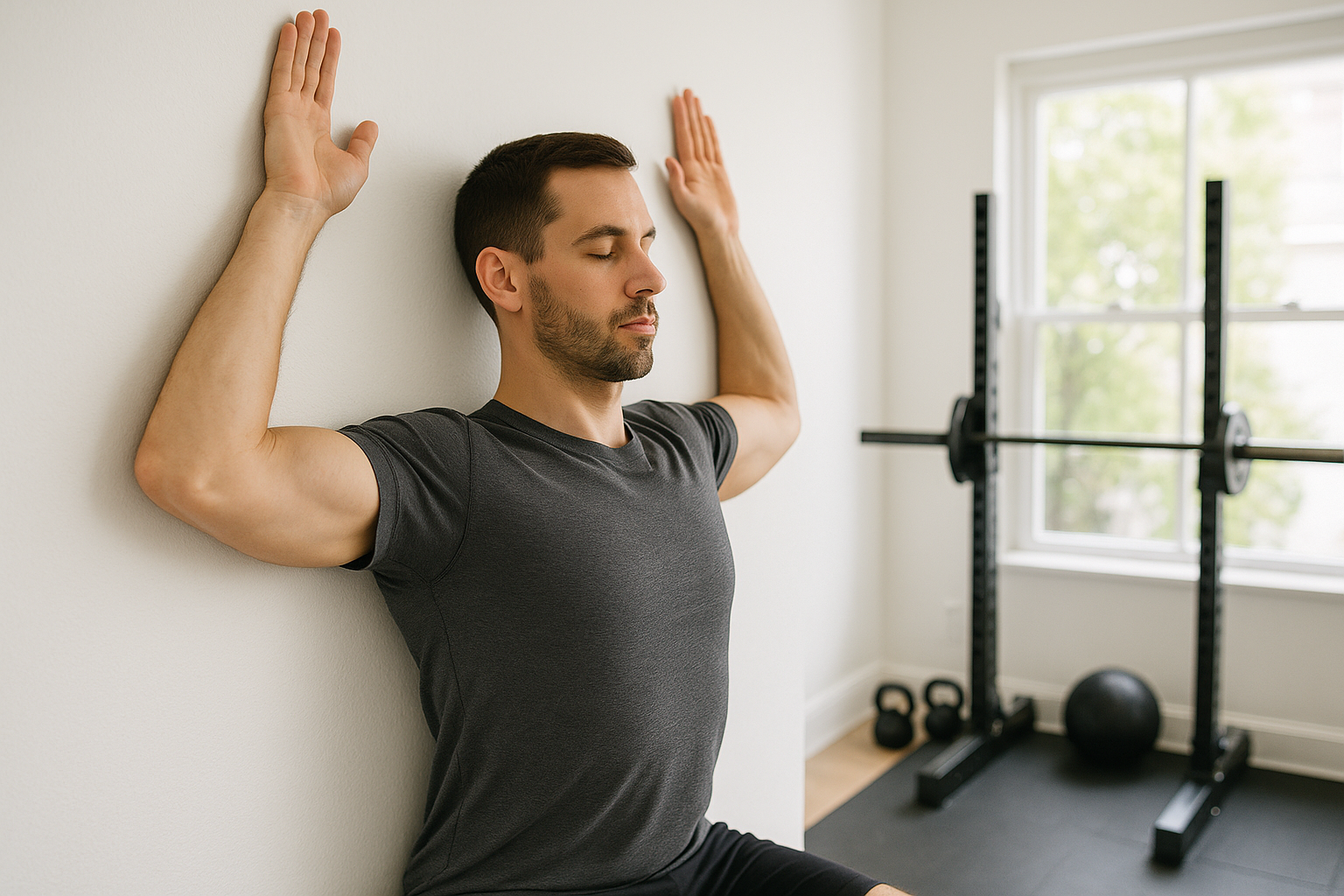
5. Wall Slides with Serratus Reach (“W-to-Y”)
Wall slides train the upward rotation and posterior tilt of the scapula that you need for painless overhead motion. The “serratus reach” portion teaches your ribcage and shoulder blade to coordinate, preventing the common fault of rib flaring and lumbar arching. You’ll feel under-arm muscles (serratus) and mid-back (lower traps), not neck strain. Done well, this drill doubles as mobility and motor control—range plus the skill to use it.
5.1 How to do it
- Stand with back and head gently on a wall, feet 10–15 cm forward, ribs down.
- Form a “W”: elbows ~45–60° below shoulders, forearms/wrists on wall.
- Slide into a “Y” overhead while reaching the forearms forward (protraction) without shrugging.
- Pause, breathe, and slide back to “W.”
- Option: band around forearms to cue outward pressure.
5.2 Numbers & guardrails
- Reps: 8–12.
- Sets: 2–3.
- Frequency: 3–5×/week.
- Keep low ribs flush; if they flare, reduce height and slow down.
5.3 Common mistakes
- Pressing the low back hard into the wall (compensation).
- Neck jutting forward.
- Elbows drifting behind the torso.
Over time, your overhead path feels “smoother,” and pressing or handstands feel more supported.
6. Doorway Pec Stretch (Pec Minor/Major Bias)
Tight anterior chest tissue pulls the shoulder forward and down, narrowing the subacromial space and provoking pinches. The doorway stretch opens the front line and complements scapular drills. Two angles target different fibers: elbow below shoulder line biasing pec major, and elbow at/above shoulder line biasing pec minor. Keep it gentle—nerves run through this area; the goal is a mild, melting stretch, not arm numbness.
6.1 How to do it
- Stand in a doorway; place forearm on the frame with elbow at 90°.
- Step through until you feel a mild chest/shoulder stretch; keep ribs down.
- Turn the torso slightly away to increase the line of pull.
- Repeat at a higher elbow angle to bias pec minor if needed.
6.2 Numbers & guardrails
- Holds: 20–30 seconds.
- Reps/Sets: 2–3 holds per angle.
- Frequency: 3–5×/week or post-training.
- If you feel tingling or numbness, reduce intensity or skip.
6.3 Mini-checklist
- Gentle pressure; never jam the shoulder.
- Neck stays long; no shrug.
- Breathe slowly to let tissue yield.
Opening the front allows the shoulder blade to upwardly rotate and posteriorly tilt, clearing the overhead arc.
7. Cross-Body Posterior Shoulder Stretch
When the posterior capsule is stiff, the humeral head glides forward and impinges during overhead or across-body motions. The cross-body stretch is a reliable way to target this tissue without cranking on the joint. Expect a broad, deep stretch at the back of the shoulder—not sharp joint pain. Keep the shoulder blade stabilized to localize the stretch; that’s the secret to effectiveness.
7.1 How to do it
- Lie on your side or stand tall.
- Bring the working arm across your chest at shoulder height; grasp just above the elbow.
- Gently pull the arm across until you feel a posterior shoulder stretch; keep the shoulder blade “quiet.”
- Hold; breathe; ease off.
7.2 Numbers & guardrails
- Holds: 20–30 seconds.
- Sets: 2–3.
- Frequency: 3–5×/week.
- No front-of-shoulder pinching; adjust angle slightly up/down to target the back.
7.3 Common mistakes
- Letting the shoulder blade wing forward (loses the stretch).
- Cranking into sharp pain.
- Holding breath.
Consistent practice often improves internal rotation and cross-body reach (think: fastening a bra strap or reaching a seatbelt).
8. Sleeper Stretch (Gentle IR, With Precautions)
The sleeper stretch can improve internal rotation when posterior tissues are limiting, but it must be done gently to avoid anterior shoulder stress. Many people do it too aggressively, torquing the joint rather than stretching muscle and capsule. When performed sidelying with the shoulder and torso aligned and the scapula stabilized, it’s a patient, low-load dose that often eases back-of-shoulder tightness over weeks.
8.1 How to do it
- Lie on your side with the bottom shoulder and trunk in a straight line; place a folded towel under the head.
- Bottom elbow at ~90°, shoulder ~70–90° of abduction.
- Use the top hand to gently rotate the forearm toward the floor until you feel a back-of-shoulder stretch.
- Keep the shoulder blade tucked toward the spine; no front-of-shoulder pressure.
8.2 Numbers & guardrails
- Holds: 20–30 seconds.
- Sets: 2–3.
- Frequency: 3–5×/week for 4–6 weeks.
- Stop if you feel anterior joint pain; switch to the cross-body stretch (Item 7) and consult a clinician.
8.3 Mini-checklist
- Spine neutral; don’t roll forward.
- Gentle hand pressure; no bouncing.
- Posterior stretch sensation only.
Used thoughtfully, the sleeper helps regain the “behind-the-back” arc needed for dressing, swimming strokes, and pressing.
9. Lat Stretch (Child’s Pose Side-Bias or Wall Lat Opener)
Stiff lats limit overhead flexion and external rotation, forcing rib flare and shoulder impingement. Biasing a side-bent child’s pose or a wall-based lat opener lengthens the entire posterior-lateral line from pelvis to arm. You’ll feel the stretch down the side of your torso and into the back of the shoulder. Pair this with thoracic extension work (Item 3) for the biggest payoff in overhead range.
9.1 How to do it (two options)
- Child’s Pose Side-Bias: Kneel, sit back to heels, walk hands to the right 20–30 cm, sink hips, breathe into the left ribs; repeat to the other side.
- Wall Lat Opener: Kneel or stand facing a wall, elbows/forearms on wall, hands together. Sink chest toward wall while keeping ribs down and slight core tension.
9.2 Numbers & guardrails
- Holds: 20–30 seconds per side.
- Sets: 2–3.
- Frequency: 3–5×/week.
- Keep low back neutral; if you feel pinching in the front of the shoulder, reduce depth.
9.3 Common mistakes
- Letting ribs flare to “get more” range.
- Collapsing through the low back.
- Shrugging or pressing hard into the neck.
Release here often unlocks the last few degrees of comfortable overhead reach.
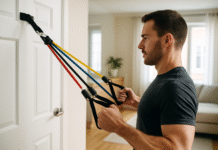
10. Banded External Rotation (Controlled End-Range)
While classed as “mobility,” end-range external rotation benefits from gentle, active loading to signal safety to the nervous system. Light band ER at 0–45° abduction builds control where people often feel tight—think back-squat grip or reaching to the top shelf. This is not a max-strength exercise; it’s a slow, end-range explore with the cuff and scapular stabilizers doing the steering.
10.1 How to do it
- Anchor a light band at elbow height; stand side-on with elbow tucked at 0–45° abduction.
- Start with forearm across your belly (neutral), then slowly rotate outward until just before compensation.
- Pause 1–2 seconds, then return under control.
- Keep ribs down; shoulder blade gently set (slight depression/retraction).
10.2 Numbers & guardrails
- Reps: 8–12 controlled.
- Sets: 2–3.
- Frequency: 3–4×/week.
- Stop before shrugging or lumbar extension; range first, then strength.
10.3 Mini-checklist
- Elbow glued to towel roll if needed.
- Smooth tempo; no band snap.
- Pain-free effort; 4–6/10 difficulty.
Better ER mobility/control reduces barbell shoulder stress, improves throwing positions, and helps with back-rack comfort.
11. Pendulum Swings (Codman’s Exercise)
Pendulums use gravity to gently traction the shoulder joint and create low-effort motion. They’re great on sore days, early in rehab phases (if cleared), or anytime you want to flush the joint without loading it. The key is letting the trunk drive the movement while the arm hangs relaxed like a rope. Think “oily,” not “effortful.”
11.1 How to do it
- Lean forward with your non-working hand on a table or chair; let the working arm hang.
- Rock your hips to create small circles, front-back and side-side motions.
- Keep the shoulder relaxed; allow 15–30 seconds per direction.
11.2 Numbers & guardrails
- Time: 1–2 minutes total per shoulder.
- Frequency: Daily as a recovery drill or during deloads.
- Keep circles small and comfy; no forcing into painful ranges.
11.3 Common mistakes
- Lifting the arm instead of letting it hang.
- Tensing the neck/upper traps.
- Moving too fast.
Use pendulums to de-stress irritated tissue and prep for more specific drills like Items 1–2 and 5.
12. Supported Passive Hang (Optional; With Instability Caution)
A gentle, supported hang can decompress the shoulder and open overhead flexion when done within comfort and without joint laxity. Emphasis on supported: feet on the ground or a box take load off, and grip width stays shoulder-width. If you have a history of dislocations, multidirectional instability, or hypermobility, skip this drill and prioritize Items 2, 5, and 10.
12.1 How to do it
- Use a sturdy bar. Stand on a box so your feet stay in contact throughout.
- Grip shoulder-width; gently “grow tall” through the arms while keeping ribs down.
- Let the shoulder blades upwardly rotate and slightly elevate; keep neck relaxed.
- Hold for short, easy bouts; step down if anything pinches.
12.2 Numbers & guardrails
- Holds: 10–20 seconds.
- Sets: 3–5 with 30–60 seconds rest.
- Frequency: 2–3×/week.
- Skip if you feel instability, sharp pain, or tingling; never force end range.
12.3 Mini-checklist
- Feet always supported.
- Grip neutral; no aggressive swinging.
- Breathe; keep ribs and pelvis stacked.
For the right person, supported hangs feel like a joint “decompress” and can complement your overhead progress.
FAQs
1) How often should I do shoulder mobility work?
Most people do well with 5–10 minutes of mobility on training days and 10–15 minutes on off days. As a baseline, perform 3–5 drills (e.g., Items 1, 2, 5, 6, and 9) three to five times per week. For static stretches (Items 6–9), holds of 20–30 seconds for 2–3 sets align with general flexibility guidelines. If you’re sore or flared up, keep intensity low and favor pendulums and breathing-based drills.
2) What’s the difference between flexibility and mobility?
Flexibility is passive range—a joint’s motion when an external force moves it. Mobility is active control through range—your muscles and nervous system move and stabilize the joint. Both matter. A doorway stretch (flexibility) may open tissue, but pairing it with wall slides or banded ER (mobility) teaches your body to use that range under control, which is what prevents pinches during real movement.
3) I feel a pinch in the front of my shoulder overhead. Which drills help most?
Focus on thoracic extension (Item 3), scapular mechanics (Items 2 and 5), and soft-tissue opening for pecs and lats (Items 6 and 9). Reduce load/intensity overhead temporarily and rebuild with pain-free ranges. If pinching persists despite good form, consult a clinician to screen for rotator cuff tendinopathy, biceps issues, or capsular stiffness.
4) How long until I notice improvement?
For many, range feels better immediately after a session due to neural effects. Durable change typically takes 4–6 weeks of consistent, low-to-moderate intensity work, especially for capsular stiffness. Track progress with simple checks: wall-slide height without rib flare, behind-the-back reach, or smoothness of your Shoulder CARs.
5) Are static stretches bad for strength or performance?
Long, intense static stretches immediately before maximal efforts can transiently reduce peak force. However, short holds (20–30 seconds) in a warm-up combined with dynamic drills generally do not harm performance and may reduce pinchy end-range sensations. Save longer holds for after training or separate sessions.
6) What if my shoulder clicks?
Painless clicking is common and often benign—think tendons moving over bony grooves. Clicking with pain, catching, or a sense of slipping warrants evaluation. Scale ranges, slow tempos, and favor control drills (CARs, wall slides). Avoid forcing positions that reproduce sharp pain.
7) Can I do these if I’ve had a previous dislocation?
Proceed cautiously and prioritize scapular control (Items 2 and 5), cuff control (Item 10), and thoracic mobility (Items 3–4). Skip the passive hang (Item 12) unless cleared and supervised. Your goal is controlled, pain-free arcs—no end-range yanking. A clinician can tailor ranges and progressions to your stability profile.
8) Do I need equipment?
A foam roller or towel, a light exercise band, a wall, and a doorway cover almost everything. Optional additions: a pull-up bar for supported hangs and a yoga block for kneeling comfort. Lack equipment? Substitute with towels and doorframes; focus on Items 1, 2, 4, 5, 7, and 9.
9) How should I breathe during mobility work?
Use slow nasal inhales and long exhales, especially at end ranges. Exhaling reduces protective muscle tone and often unlocks the last few degrees without force. Pair breath with motion cues—exhale into deeper rotation (Thread-the-Needle), inhale to lengthen in thoracic extensions.
10) What’s the best warm-up sequence before upper-body lifting?
Try: 1–2 minutes pendulums → 3 CARs each direction → 6–8 scapular clocks → 8–10 wall slides with serratus reach → 6–8 thoracic extensions → 8–12 banded ER. Then do 2–3 lighter sets of your first lift to “groove” the pattern. Total: ~8–12 minutes.
11) Are nerve glides necessary for shoulder mobility?
Not typically for healthy shoulders. If you experience radiating symptoms or nerve tension signs, seek an assessment before adding nerve-specific drills. Most people improve with the combination of thoracic mobility, scapular control, and selective soft-tissue stretching presented here.
12) How do I progress these drills?
Increase range first, then volume (more reps/holds), then complexity (e.g., add a band to wall slides, move to half-kneeling for more core challenge). Keep the “no pain, good form” rule. Retest a functional task—such as an overhead reach—weekly to confirm progress.
Conclusion
Shoulder mobility thrives on consistency, not intensity. When you blend joint-centering control (CARs, banded ER), scapular freedom (clocks, wall slides), and thoracic motion (extensions, Thread-the-Needle) with strategic soft-tissue opening (pecs, lats, posterior shoulder), range tends to return—and stay. Keep sessions short, frequent, and specific to the motions you need most in life and sport. Use breathing to down-regulate tension and respect guardrails: no sharp pain, no forced end ranges, and no shruggy compensations. Track a few function tests—overhead reach without rib flare, behind-the-back reach, and smooth CARs—to see progress clearly. If you hit a plateau or symptoms escalate, bring your notes to a licensed clinician for a personalized plan.
Start today: pick 3 drills from Items 1, 2, 5, 6, and 9, and do them for 8 minutes—your shoulders will thank you.
References
- ACSM’s Guidelines for Exercise Testing and Prescription (Flexibility Recommendations), American College of Sports Medicine, 2021. https://www.acsm.org/education-resources/books/guidelines-exercise-testing-prescription
- Shoulder Pain: Clinical Practice Guidelines (Adhesive Capsulitis, 2021 Update), Journal of Orthopaedic & Sports Physical Therapy / Orthopaedic Section of the APTA, 2021. https://www.jospt.org/doi/10.2519/jospt.2021.0301
- Clinical Implications of Scapular Dyskinesis in Shoulder Injury, British Journal of Sports Medicine, 2013. https://bjsm.bmj.com/content/47/14/877
- Effectiveness of the Sleeper Stretch in Subjects With Posterior Shoulder Tightness, Journal of Orthopaedic & Sports Physical Therapy, 2007. https://www.jospt.org/doi/10.2519/jospt.2007.2327
- Thoracic Spine Posture and Shoulder Range of Motion, Clinical Biomechanics, 1999. https://www.sciencedirect.com/science/article/pii/S0268003399000293
- Pectoralis Minor Tightness and Scapular Kinematics: A Systematic Review, Journal of Bodywork & Movement Therapies, 2017. https://www.sciencedirect.com/science/article/pii/S1360859216301895
- Pendulum (Codman) Exercise—Patient Information, NHS Inform, 2023. https://www.nhsinform.scot/tests-and-treatments/muscle-bone-and-joints/exercises/shoulder-exercises
- Thoracic Mobility for Shoulder Function, Hospital for Special Surgery (HSS), 2022. https://www.hss.edu/article_thoracic-mobility.asp
- Rotator Cuff and Shoulder Conditioning Program, American Academy of Orthopaedic Surgeons (AAOS), 2021. https://orthoinfo.aaos.org/en/recovery/rotator-cuff-and-shoulder-conditioning-program
- Scapular Stabilization and Serratus Anterior Function, Journal of Athletic Training, 2008. https://www.ncbi.nlm.nih.gov/pmc/articles/PMC2564292/