




























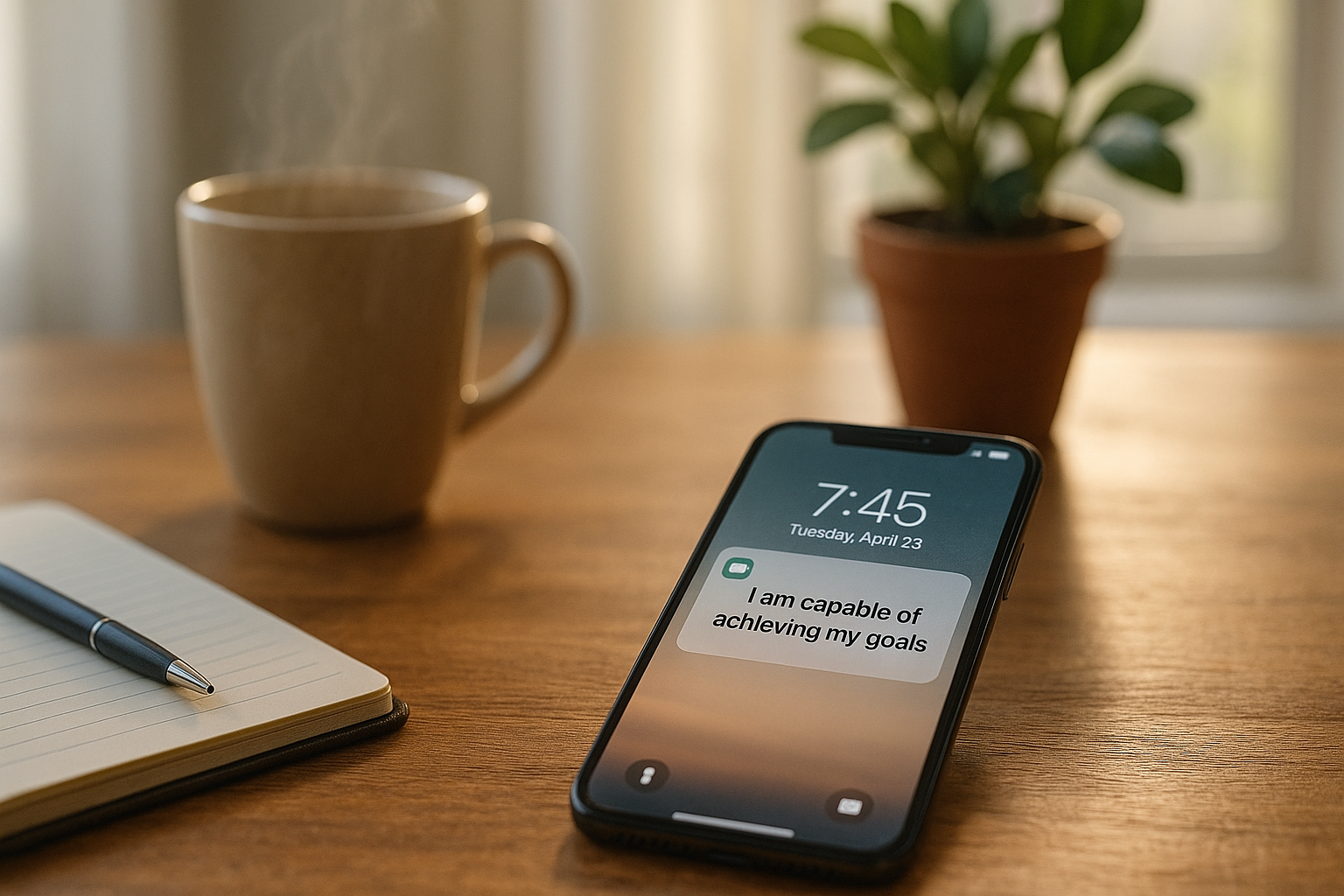
Motivational reminders are short cues—pop-ups, alarms, messages, or visuals—that prompt the mindset and behavior you want at the right moment. When you pair those reminders with well-crafted mantras and affirmations, you get a simple system to steer attention, reduce friction, and sustain drive throughout the day. This guide shows you 12 evidence-grounded ways to set reminders that actually work, with practical setup steps, examples, and guardrails. It’s for anyone who wants their daily quotes and alerts to reinforce positivity—without turning into background noise. This article is educational and not medical advice.
Quick-start (skim this, then dive in): pick one meaningful mantra, tie it to an “if-then” trigger, stack it onto an existing routine, schedule reminders with smart spacing, and measure what changes over the next two weeks.
1. Anchor Your Mantra to Your Core Values
Start by writing a mantra that affirms a value you truly hold (e.g., learning, contribution, family, courage). Value-anchored statements are more resilient than vague positivity because they remind you who you are, not just what you wish were true. Self-affirmation theory shows that reflecting on important personal values can buffer stress and defensiveness and support adaptive behavior. In other words, a reminder that connects to “the kind of person I am and aim to be” lands deeper than a generic compliment. Keep the language clear and present-tense: “I act with courage when the work matters,” or “I learn by showing up today.” The test is simple: when you read it, do you feel steadier and more focused rather than hyped and hollow? If yes, you’ve likely hit the right note. Research on self-affirmation suggests that affirming personally important values can reduce threat and open you to useful feedback and action.
How to do it
- List 3–5 values that have guided good decisions in your life.
- For each value, write one short mantra (max 12 words) in present tense.
- Pick one mantra to use for the next 14 days; store the rest.
Tools/Examples
- Notes app template: “Value → Mantra → When/Where I’ll see it.”
- Example: Value = Growth → Mantra = “I practice before I perform.”
Synthesis: Value-anchored mantras make every reminder feel like a return to self, not a pep-talk you have to believe.
2. Make Affirmations Believable (So They Don’t Backfire)
Affirmations work best when they’re credible to you. Overly grand statements can trigger resistance—especially if you’re struggling with self-esteem—so adjust wording to be specific and attainable. Studies find that “positive self-statements” such as “I am lovable” can backfire for some people, lowering mood when they conflict with current self-views. The fix isn’t to ditch affirmations; it’s to scale them to truth and progress. Use phrasing like “I’m learning to…,” “I’m the kind of person who…,” or add “yet” (“I don’t have it, yet”). Tie the sentence to an observable behavior: “I submit the draft today,” not “I am a genius writer.” This subtle shift keeps your brain from arguing with the message and turns the reminder into a cue for action.
Checklist (credibility test)
- Specific: Mentions the behavior or situation.
- Present-focused: “Today/now,” not only future.
- Evidence-friendly: You can point to a small action that fits.
- Calm tone: Encouraging, not exaggerated.
Mini-case
- Before: “I’m unstoppable.” → Eye-roll and avoidance.
- After: “I take the next step now—send the email.” → Email sent.
Synthesis: Believability converts affirmations from wishful thinking into practical prompts you’ll follow.
3. Use “If–Then” Plans to Trigger Reminders at the Right Moment
Tie each mantra to a concrete if–then cue: If X happens, then I see/say Y. This method—known as implementation intentions—reliably increases goal follow-through by linking situations to pre-decided responses. For reminders, that means scheduling messages to hit at the exact context where you’re likely to need them (e.g., five minutes before a recurring meeting, or when you arrive at the gym). Write your plan as a sentence you could hand to your phone: “If it’s 7:10 a.m. on weekdays, then show: ‘One small win before 8.’” Meta-analytic evidence shows robust effects of implementation intentions on initiating and protecting goal pursuit across behaviors.
How to do it
- Identify your “slippery” moments (e.g., 3 p.m. slump, commute).
- For each, write one if–then mapping and set the digital trigger.
- Keep the text short (≤12 words) and action-ready.
Tools/Examples
- iOS Shortcuts / Android Routines: time, location, Wi-Fi, or app-open triggers (features may vary by OS as of August 2025).
- Calendar alerts with custom 2–3 word titles (e.g., “Breathe 4-7-8”).
Synthesis: If–then plans make reminders surgical—arriving when they’re most likely to change what you do next.
4. Stack Reminders onto Habits You Already Do
Attach your mantra to an existing routine so the cue fires naturally—what habit scientists call habit stacking. For instance, after you brush your teeth at night, your watch buzzes with “Slow the scroll—read 2 pages.” Or when you place your coffee mug, your phone displays “Plan the first task.” Real-world research on habit formation shows automaticity grows with consistent repetition in the same context; in one study, the median time to reach near-automatic performance was 66 days, with wide individual ranges (18–254 days). That’s a cue to be patient and consistent rather than expecting instant change.
How to do it
- Pick one reliable anchor (wake-up, commute start, lunch).
- Add a micro-action mantra to follow that anchor.
- Repeat daily for 8–10 weeks; tolerate missed days without quitting.
Numbers & guardrails
- Expect a ramp-up over ~2–3 months on average.
- Keep the action <2 minutes at first; scale later.
- Use the same place/time to strengthen the cue.
Synthesis: Stacking puts your motivational reminders on rails—piggybacking on routines you already keep.
5. Schedule with Smart Spacing to Avoid “Reminder Fatigue”
If every hour pings, your brain tunes out. Borrow from the spacing effect: information and cues are more effective when spread out and timed to just before you’d forget or drift. For motivational reminders, that means fewer, better-timed prompts (e.g., mid-morning, mid-afternoon, evening wind-down) rather than constant nudges. Meta-analyses show spaced practice improves retention versus massed repetitions, with timing (intervals and lags) shaping outcomes. Apply the same idea to reminders—space them to keep salience high. Rotate wording weekly to restore novelty without changing intent. Augmenting Cognition
Mini-plan (7-day)
- Week 1: 10:30 a.m., 3:30 p.m., 9:00 p.m.
- Week 2: Same times, fresh phrasing of the same mantra.
- Week 3: Keep two times, drop one that feels redundant.
Common mistakes
- Massed alerts every 30 minutes (leads to mute).
- Long gaps with no cues (intent weakens).
- Constantly changing goals (no repetition to anchor).
Synthesis: Spacing trades noise for well-timed nudges your attention still notices and respects.
6. Deliver Your Mantras Across Multiple Channels (Without Clutter)
Meet yourself where attention lives: lock screen, watch face, widgets, wallpapers, desktop sticky notes, and in-app banners. Use one primary channel (e.g., calendar alerts) and one passive channel (e.g., a home-screen widget) so you’re covered even when notifications are off. Keep copy consistent across channels to reinforce the same mental hook. As of August 2025, both major mobile platforms let you tune Focus/Do Not Disturb settings and schedule time-bound modes—use them to whitelist only your motivational alerts during key windows, then silence everything else. The goal is presence without pressure: your mantra is visible when you look, and audible only when it truly matters.
Design mini-rules
- Title ≤4 words; body ≤12 words.
- Start with a verb (“Stand, breathe now”).
- One emoji max for salience (optional).
Example setup
- Primary: Calendar alert (workdays 3:30 p.m.): “Take the next easy step.”
- Passive: Widget that cycles three mantras daily.
Synthesis: Multi-channel delivery gives you gentle omnipresence—seen when you glance, heard when you need it.
7. Make Reminders Context-Aware (Time, Place, and Activity)
Context beats willpower. Trigger mantras by location (arriving at the gym), connectivity (joining office Wi-Fi), or activity (opening social media). Pair each context with the smallest next step: “Put shoes on and start 5 minutes,” or “Set 10-minute timer before scrolling.” If you share devices, keep private mantras behind Focus modes. For high-stakes moments (presentations, check-ins), schedule a reminder 15 minutes prior with a task-specific mantra: “Lead with the outcome,” “Ask two questions first.” Over time you’ll learn which contexts need a nudge and which don’t—prune alerts that rarely change behavior.
Tools/Examples
- Geofenced reminders: “When I arrive at the park → ‘Walk 10 minutes first.’”
- App-open automation: “On opening shopping app → ‘Check list—do I need this?’”
- Bluetooth pairing trigger: “Car connects → ‘Podcast queue > random radio.’”
Common mistakes
- Using vague contexts (“when stressed”) you can’t detect.
- Over-using location (battery drain); keep geofences few and precise.
- Forgetting quiet hours; set them so rest remains sacred.
Synthesis: When your environment triggers the cue, you save decision energy for action instead of remembering.
8. Pair Brief Mantra Meditation with Your Alerts
Use a 60–180 second micro-practice when an alert fires: inhale, silently repeat your mantra on the exhale, and visualize the immediate action you’ll take. Evidence reviews suggest meditation, including mantra-based approaches, can help with stress and mood for many people, though effects vary and study quality differs; treat it as a supportive practice, not a cure-all. Keep sessions tiny and frequent to fit real days—standing at the sink or on the train counts. If you already practice a longer meditation, add your mantra in the first or last minute to connect state with behavior. MDPI
How to do it
- Set one daily alert labeled “Mantra minute.”
- Breathe in 4, hold 2, exhale 6; repeat your phrase on the exhale.
- Immediately take the smallest next step your mantra points to.
Numbers & guardrails
- Start with 1 minute; cap at 3 on busy days.
- If dizziness or distress occurs, stop and breathe normally.
Synthesis: A micro-dose of attention plus a cueing phrase helps your reminder land in the body, not just the screen.
9. Use SMS or Accountability Pings for High-stakes Habits
For commitments where forgetting has real costs (meds, appointments, key deadlines), a text message can be powerful. Meta-analysis shows SMS reminders roughly double the odds of medication adherence (e.g., from ~50% to ~68% in pooled trials); similar reviews find improved attendance and follow-through across various health services. For your goals, co-opt that same simplicity: schedule self-texts or use a buddy system where you exchange one line at set times (“Gym check-in?” → “Done”). Frequency and timing vary by context—there isn’t a universal best schedule—so test 1–2 texts around the critical window rather than flooding your phone. PubMed
Setup ideas
- Use calendar → “Send SMS” automation (where available).
- Create a group with one friend; pin it; keep messages templated.
- For privacy, use code words you both understand.
Guardrails
- Keep texts low-pressure; ask, don’t nag.
- Opt out on weekends or rest days.
- Review every 2 weeks and adjust timing.
Synthesis: The humble text cuts through clutter when stakes are high, but works best when sparse and agreed upon.
10. Track What Changes (And Trim the Rest)
What gets measured, improves—and what’s not helping, you’ll trim. Track a tiny outcome linked to each reminder (1 = did it, 0 = didn’t; or time spent; or reps). After 14 days, ask: Which alerts led to visible action? Keep the winners, rewrite or delete the rest. Expect a mix: some messages spark a flurry at first then fade (novelty effect), others grow as they become part of a routine. Remember the habit formation curve: automaticity increases over weeks, not days, so give promising alerts at least two weeks before judging.
Mini-dashboard (paper or app)
- Reminder: “Send the draft by 4.”
- Outcome: Draft sent? (Y/N)
- Notes: Barrier spotted? (e.g., needed a template)
Common mistakes
- Tracking too many metrics—stick to one signal per reminder.
- Changing phrasing daily—no stable test.
- Ignoring context—was it a holiday, travel week, or sick day?
Synthesis: Measure tiny outcomes to separate useful cues from mere noise—and simplify as you learn.
11. Rotate Words, Keep the Meaning (Novelty with Consistency)
Your brain habituates to identical wording. Preserve the intent of your mantra while rotating phrases weekly. For example, “One small win before 8” → “Start tiny, start now” → “Two minutes beats zero.” Use the spacing principle to schedule changes at predictable intervals (e.g., every Monday), not daily, so you still get repetition benefits. Keep a single “north-star” meaning (e.g., begin small) to avoid scattering your focus. Over time, you’ll build a small library of phrases that all point to the same behavior, each fresh enough to catch your eye.
How to do it
- Pick one intent (e.g., begin small).
- Write 5 variants; schedule weekly swaps for the next month.
- Archive the best-performing phrasing for reuse later.
Pitfalls
- Constant novelty (daily rewrites) → no repetition memory.
- Changing the goal instead of the words.
Synthesis: Rotate the wrapper, not the message—fresh language, same behavior anchor.
12. Close the Day with a “Reset Mantra” (And Sleep on It)
End your day with a gentle reset: one reminder that closes loops and sets tomorrow’s first move. Examples: “Done is better than perfect—log one win,” or “Park on a downhill—prep first task.” Pair the alert with a two-minute action: jot a single win, set clothes out, pin the draft. Closing rituals reduce rumination and prime next-day performance. To keep it restorative, run this reminder before your device’s bedtime mode so it doesn’t intrude on sleep hygiene. If you like, finish with a one-minute mantra meditation—evidence suggests these practices can help many people manage stress and support mood, though results vary.
Mini-checklist
- 2 minutes to wrap the day.
- One sentence: “Tomorrow at 9, send the deck.”
- Bedtime mode on; phone out of reach.
Synthesis: A consistent evening cue clears the runway—so tomorrow’s first step is already decided.
FAQs
1) What’s the difference between a mantra and an affirmation?
A mantra is a short phrase repeated to focus attention (often during meditation), while an affirmation is a statement you want to internalize about yourself or your behavior. In practice, both can serve as cues; mantras tend to be rhythmical tools for attention, affirmations descriptive statements you aim to make true through action. Evidence suggests mantra-based and other meditation practices can support stress management for many people, though effects vary.
2) How many reminders per day is ideal?
There’s no universal number, but 2–4 well-timed alerts usually beat constant nudging. Spacing research indicates that distributed (not massed) repetitions improve memory and responsiveness; translate that into fewer, strategically placed cues. Review and refine every two weeks.
3) Do affirmations actually work?
They can—when they’re believable and tied to behavior. Overly grand positive self-statements can backfire for some people with low self-esteem. Keep language grounded (“I send one email now”) and connect it to an if–then trigger to increase follow-through. PubMed
4) How long until a reminder-driven habit feels automatic?
In one real-world study, the median time to reach near-automaticity was about 66 days, with a range from 18 to 254 days depending on the person, behavior, and context. Plan for 2–3 months of consistent cues.
5) Should I use text messages or app notifications?
Use texts for high-stakes tasks; meta-analysis shows SMS can substantially improve adherence in healthcare settings. For everyday habits, in-app or calendar alerts may be enough. Test both and choose the least intrusive option that still changes behavior.
6) What if reminders start to annoy me?
You’re probably over-notifying. Cut frequency, rotate wording weekly, and re-anchor to a meaningful value. Use Focus/Do Not Disturb and schedule silence blocks so reminders live inside supportive boundaries—never at bedtime or during deep work unless essential. Spacing research supports fewer, better-timed cues.
7) Can mantra meditation help with motivation?
It can help by reducing stress reactivity and improving focus, which indirectly supports motivation. Reviews find minimal to moderate benefits for mental health in general populations; treat it as a supportive tool alongside clear goals and good sleep, not a standalone fix.
8) Is there a best time of day for motivational reminders?
No universal best—choose times tied to your “slippery” moments (mid-morning slump, post-lunch dip, commute). Evidence from SMS adherence work shows schedules vary and should match the context; pilot 1–2 slots and adjust.
9) How do I write a mantra if I’m skeptical of affirmations?
Use value-based phrasing and behavior verbs: “Act with care—call one client,” or “Practice before performing.” Self-affirmation based on personal values can reduce defensiveness and support adaptive choices without requiring you to believe exaggerated claims.
10) What’s one change that delivers an outsized payoff?
Tie a single mantra to an if–then plan and stack it onto a strong existing routine (e.g., post-coffee). That trio—value anchor, if–then trigger, habit stack—creates timing, meaning, and repetition in one move, with solid evidence behind each piece.
Conclusion
Motivational reminders work when they are meaningful, well-timed, and measured. Start with one value-anchored mantra that genuinely steadies you. Map it to an if–then trigger that fires in the precise moments you wobble. Stack it onto a routine you already keep, and schedule with smart spacing so you notice it without resenting it. Use a couple of delivery channels, keep copy short and action-ready, and rotate the words weekly while preserving the intent. For high-stakes habits, let a sparse SMS or buddy ping cut through the noise; for daily steadiness, add a one-minute mantra meditation to land the cue in your body. Track tiny outcomes, prune anything that doesn’t help, and give promising reminders a fair two-to-three-month runway. In time, your best cues will fade into the background—not because you’ve tuned them out, but because they’ve become you.
CTA: Pick one mantra, set one if–then reminder, and test it for 14 days—starting now.
References
- Steele, C. M. The Psychology of Self-Affirmation: Sustaining the Integrity of the Self. Advances in Experimental Social Psychology (1988). ScienceDirect
- Sherman, D. K., & Cohen, G. L. The Psychology of Self-Defense: Self-Affirmation Theory. Advances in Experimental Social Psychology (2006). ScienceDirect
- Wood, J. V., Perunovic, W. Q. E., & Lee, J. W. Positive Self-Statements: Power for Some, Peril for Others. Psychological Science (2009). SAGE Journals
- Gollwitzer, P. M., & Sheeran, P. Implementation Intentions and Goal Achievement: A Meta-Analysis of Effects and Processes. Advances in Experimental Social Psychology (2006). ScienceDirect
- Lally, P., van Jaarsveld, C. H. M., Potts, H. W. W., & Wardle, J. How are habits formed in the real world? Modelling habit formation in everyday life. European Journal of Social Psychology (2010). Wiley Online Library
- Cepeda, N. J., Pashler, H., Vul, E., Wixted, J. T., & Rohrer, D. Distributed Practice in Verbal Recall Tasks: A Review and Quantitative Synthesis. Psychological Bulletin (2006). PubMed
- National Center for Complementary and Integrative Health (NCCIH). Meditation and Mindfulness: Effectiveness and Safety. (June 3, 2022). NCCIH
- Lynch, J., Prihodova, L., Dunne, P. J., et al. Mantra meditation for mental health in the general population: A systematic review. European Journal of Integrative Medicine (2018). ScienceDirect
- Thakkar, J., Kurup, R., Laba, T. L., et al. Mobile Telephone Text Messaging for Medication Adherence: Meta-analysis. JAMA Internal Medicine (2016). JAMA Network
- Schwebel, F. J., & Larimer, M. E. Using text message reminders in health care services: A narrative literature review. Patient Preference and Adherence (2018). PMC
- Dawson, C., Kabagenyi, A., et al. Text message reminders for visit adherence among non-communicable disease patients in Uganda: A randomized controlled trial. PLOS Global Public Health (2025). PLOS