



























Life rarely gives you a clean calendar. Flights get delayed, kids get sick, deadlines stack up, and motivation dips without warning. That’s why staying consistent with your goals isn’t about willpower as much as it’s about having flexible systems you can trust when life goes sideways. In this guide, you’ll learn nine practical ways to keep momentum—whether you’re traveling, under the weather, or navigating big life changes. At a glance: overcoming obstacles and adjusting goals means keeping your purpose the same while flexing your plan, pace, and metrics so progress continues without burnout. Quick answer: reduce the target, protect the habit, and review on a schedule.
Fast start checklist (when the week collapses):
- Shrink the plan to a 10–20% “minimum viable” version for 3–7 days.
- Set one “if–then” rule for the biggest obstacle (e.g., “If I miss my workout, then I’ll walk 15 minutes after dinner”).
- Timebox one slot you can control (e.g., 7:30–7:50 a.m.).
- Pick one keystone habit (sleep, steps, or protein) to anchor the week.
- Book a 15-minute review on the nearest weekend to recalibrate.
1. Build a Minimum Viable Routine (MVR) to Protect Momentum
When life gets messy, the first goal is not optimization—it’s preservation of the habit loop. A Minimum Viable Routine (MVR) is the smallest version of your plan that still signals “I’m the person who does this.” Start by defining a floor (non-negotiable tiny action) and a ceiling (your normal plan) so you can slide on a spectrum rather than flip between “on” and “off.” For example, your floor might be 10 minutes of movement or 5,000 steps, while your ceiling remains 45 minutes or 10,000 steps. This keeps identity and continuity intact, which matters more for long-term results than any single session. Use an MVR during travel, illness recovery, new-parent weeks, exams, or product launches; it converts chaos into a controlled deload rather than a derailment.
1.1 How to set your MVR
- Pick one anchor behavior: steps, mobility, push–pull–squat triad, or a brisk walk.
- Define your floor: 10 minutes, 5,000 steps, or 1 set per movement.
- Define your ceiling: your usual full plan (e.g., 45 minutes, 10,000 steps, 4–5 sets).
- Choose a trigger and timebox: immediately after coffee, 7:30–7:45 a.m.
- Track visibly: use a paper calendar, Apple Health/Google Fit, or a habit app.
1.2 Numbers & guardrails
- Duration: 7–21 days; extend if stressors persist.
- Progression back up: add 10–20% volume per week until at ceiling.
- Minimum for maintenance: 2 strength sessions/week or 150 minutes of moderate cardio/week is a realistic baseline for many adults.
Synthesis: With an MVR, you’re never off the plan—you’re just at the “floor,” which keeps streaks alive and motivation from eroding.
2. Use If–Then Planning (Implementation Intentions) to Pre-Solve Roadblocks
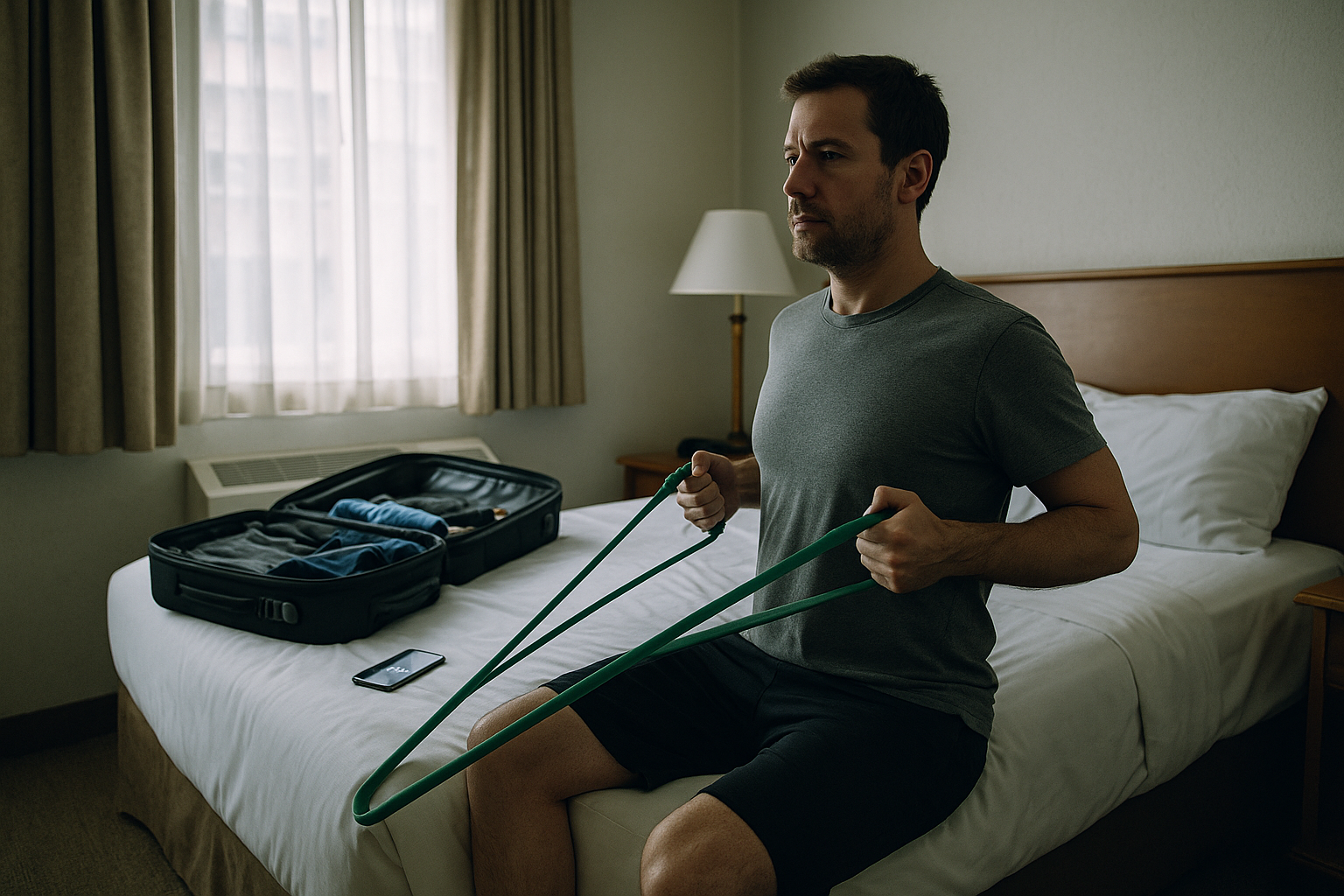
You don’t need more motivation; you need pre-decisions. Implementation intentions translate obstacles into triggers for an automatic response: “If it’s 7:30 a.m. in the hotel, then I do 10 band rows, 10 push-ups, and 30 seconds of lunges for 3 rounds.” These simple rules work because they remove deliberation in the moment you’re most likely to hesitate. Tie each rule to time, place, or cue—your suitcase, your desk, your child’s nap—so the plan snaps into place. Use one rule per top obstacle: missed mornings, long commutes, weather, or late meetings. Over a hectic week, consistent “good-enough” actions compound faster than one perfect workout that never happens.
2.1 Templates you can copy
- Travel: If I reach the hotel, then I walk for 15 minutes before dinner.
- Late meetings: If it’s after 7 p.m., then I perform a 12-minute EMOM (Every Minute On the Minute).
- Family logistics: If the baby naps, then I do 2 circuits: squats, rows, dead bugs.
- Weather backup: If it rains, then I do a stair workout in my building.
2.2 Common mistakes (and fixes)
- Vague actions: Specify reps, time, and movements.
- Too many rules: Start with one; add a second after a week.
- No visible cue: Put bands by the kettle; shoes by the door; mat next to the bed.
Synthesis: If–then rules are friction-killers; they convert weekly chaos into predictable cues that keep you moving.
3. Autoregulate Training Load with RPE/RIR and Planned Deloads
On busy, under-slept, or high-stress days, autoregulation prevents overreach and injury while preserving training quality. Use RPE (Rate of Perceived Exertion) or RIR (Reps In Reserve) to match today’s effort to today’s capacity. For example, if squats at 60 kg felt like RPE 8 last week but feel like RPE 9 today, reduce to 55 kg and hit your rep target. Pair this with planned deloads every 4–8 weeks or whenever life imposes one (travel, deadlines). Deloads drop volume or intensity by ~30–50% for 5–10 days to let fatigue dissipate. The result: you maintain skill and drive recovery without losing the groove.
3.1 How to autoregulate (simple)
- Choose a scale: RPE 1–10 or RIR 0–5.
- Set a target: e.g., RIR 1–2 on compound lifts, RIR 2–3 on accessories.
- Adjust load in-session: If RPE feels high, drop weight 2.5–10% or cut a set.
- Track: Note RPE/RIR in your app; look for trends with sleep and stress.
3.2 Deload recipe
- Frequency: Every 4–8 weeks or after 2–3 weeks of high life stress.
- Method: Reduce sets by ~40% or load by ~10–15%; keep technique sharp.
- Duration: 5–10 days; longer if returning from illness.
Synthesis: Autoregulation protects progress when capacity dips; deloads make inconsistency less punishing and more strategic.
4. Travel-Proof Your Fitness with “Exercise Snacks,” Timeboxing, and Easy Nutrition Wins
Travel disrupts your environment, schedule, and sleep—so shrink your goals, switch to exercise snacks (3–10 minute bouts), and timebox predictable windows. Aim for two 10–20 minute movement sessions or five 3–6 minute snacks across the day. Use stairs, bands, a jump rope, or a doorframe for isometrics. For cardio, brisk airport walks or hotel-bike intervals work well. Nutrition-wise: prioritize protein at each meal (palm-sized), water every flight hour, and a fiber add-on (salad, fruit). For jet lag, expose yourself to morning light at destination time and keep caffeine to the first half of the day.
4.1 Sample 20-minute hotel plan
- Warm-up (3 min): marching, arm circles, hip hinges.
- Circuit (12 min, 40/20 work-rest x 3): band rows, push-ups/elevated, split squats, dead bugs.
- Finisher (3–5 min): stair sprints or jump rope intervals (20/20 x 5–7).
4.2 Packing & planning list
- Gear: light bands, mini-band, jump rope, collapsible water bottle.
- Apps: Tabata timer, Streaks/Habitica, Apple Health/Google Fit.
- Food strategy: order a protein + veg plate; add a side of fruit; carry nuts or jerky.
Synthesis: Travel success is rhythm over rigor—short, predictable sessions and simple food rules beat elaborate plans that don’t fit your day.
5. Navigate Illness and Injury with a Conservative, Timed Ramp-Up
When sick or managing minor injury, the goal is to avoid setbacks and protect overall health. Follow a conservative ramp: complete rest if you have a fever, chest symptoms, vomiting, or full-body fatigue; otherwise consider light movement (e.g., walking, mobility) if symptoms are mild and above the neck. After symptoms resolve, ramp intensity by 50% of usual in week 1, 70–80% in week 2, and reassess by week 3. Pain is information—use it to modify range of motion, tempo, or exercise choice. If you’re unsure, talk to a qualified clinician and prioritize sleep, hydration, and calories. The fastest way forward is usually the safest.
5.1 Mini-checklist
- Red flags (rest): fever, chest pain, shortness of breath, dizziness, GI distress.
- Green lights (light only): nasal congestion, mild sore throat, low energy without fever.
- Return plan: week 1 at 50% volume/intensity, week 2 at 70–80%, week 3 reassess.
5.2 Practical swaps
- Replace running with brisk walking or cycling.
- Use machines or bands if free weights irritate a joint.
- Slow tempo (3–4s eccentric) to keep stimulus while reducing load.
Synthesis: Treat illness and injury as temporary phases with a clear re-entry; patience here is compound interest for future performance.
6. Handle Big Life Changes with Maintenance Phases and Keystone Habits
New baby, caregiving, relocation, a promotion, or grief—big transitions shift bandwidth and priorities. Instead of abandoning goals, downshift into a maintenance phase with explicit metrics (e.g., 2 short strength sessions/week, 150 minutes of moderate cardio, 7,000 steps). Pair this with keystone habits that stabilize everything else: consistent sleep window, a default grocery list, or a Sunday 30-minute plan. Define what “good enough” looks like for 4–12 weeks, then schedule a recalibration. This reframes success as continuity rather than personal bests, keeping identity and health intact.
6.1 Maintenance toolkit
- Time audit: Capture one week; find two protected 20-minute slots.
- Keystone habit picks: sleep window (e.g., 11 p.m.–6 a.m.), daily walk, protein at breakfast.
- Boundary phrases: “I can do 20 minutes today,” “I’m in maintenance this month.”
6.2 Mini case
- Scenario: New parent, sleeping 5–6 hours/night.
- Plan: 2×/week 20-minute full-body circuits; daily stroller walk; meal-prep eggs + fruit.
- Outcome: Weight stable, energy improving; ready to ramp after 8 weeks.
Synthesis: Maintenance is not mediocrity; it’s professional pacing—so you can accelerate later without rebuilding from zero.
7. Train on Tight Budgets or Limited Space with Smart Progressions
No gym? No problem. You can progress with bodyweight and bands by manipulating leverage, tempo, and volume. Use step-ups, split squats, hip hinges, push-ups (incline/decline), rows (door-anchor band), dips on chairs, and core anti-rotation holds. For cardio, stack brisk walks, stairs, shadow boxing, or jump rope. Track reps-to-failure as a proxy for intensity; aim to finish sets with 1–3 reps in reserve. Rotate movements weekly and progress by adding reps, sets, or time-under-tension. This is scalable in small apartments, dorms, or hotels—no excuses required.
7.1 Low-cost progression ideas
- Leverage: elevate feet for push-ups; single-leg variations for squats.
- Tempo: 3–4s down, 1–2s hold, 1s up.
- Density: keep total work the same but do it in less time (EMOM/AMRAP formats).
- Range: partials to full range as joints allow.
7.2 Micro-cycle example (3 days/week)
- Day A: split squats, push-ups, plank.
- Day B: step-ups, band rows, dead bugs.
- Day C: hip hinge (band RDL), overhead press (band), side plank.
Synthesis: Constraints fuel creativity; progress comes from progression, not price tags.
8. Defuse Mental Roadblocks: Perfectionism, All-or-Nothing Thinking, and Slumps
Many detours start in the mind. Perfectionism tells you not to start unless it’s ideal; all-or-nothing thinking tells you to quit after one miss. Replace both with “minimum wins” and self-compassionate resets. Minimum wins mean you can always score a point—10 minutes counts. Self-compassion treats a miss as data, not a verdict, which preserves motivation. Use a streak-with-grace rule (e.g., you can miss once but not twice) and a “rule of one set” (do a single set to stay in motion). Create friction for quitting: lay out clothes, set reminders, recruit a buddy. Momentum favors the prepared.
8.1 Mental tools that work
- Don’t-break-the-chain: mark any day you do the floor.
- Two-minute rule: start with 2 minutes; keep going if it feels good.
- Reframe slips: “I’m learning to train through messy weeks.”
- Implementation questions: “What would make this 10% easier?”
8.2 Scripting difficult moments
- After a late night: “Today is MVR-only; tomorrow I’ll reassess.”
- After a missed week: “One walk, one set, one protein-forward meal—today.”
- Under stress: “I’m choosing maintenance to protect long-term progress.”
Synthesis: You can’t control every variable, but you can manage your mind—small wins plus kind self-talk keep the engine running.
9. Review and Recalibrate Monthly with a 30-Minute Debrief
Adjustment without review is guesswork. Book a 30-minute monthly debrief to examine trends, not days. Look at training logs, step counts, resting heart rate, subjective stress, and sleep. Ask: What actually happened? What helped? What blocked me? Then adjust one variable for the next month: volume, frequency, timing, or goal metrics. Convert changes into SMART phrasing and add one new if–then rule. Treat this like steering a ship—small, regular corrections beat dramatic overhauls. Schedule a quarterly vision check to align habits with life seasons (e.g., exam periods, travel-heavy quarters, caregiving phases).
9.1 Debrief template
- Facts: sessions completed, steps/day average, sleep hours, weight/waist trend.
- Signals: energy, mood, cravings, soreness, schedule friction.
- Decisions: keep/stop/start; one change only.
- Plan: write the new SMART goal + one if–then.
- Next review: date and time booked.
9.2 Example adjustment
- Observation: averaged 2.1 sessions/week; late meetings killed Wednesdays.
- Decision: move sessions to Sat/Mon mornings; add if–then for Wed (“If meeting runs late, then 15-min walk + 1 set push/pull”).
- Metric: 3 sessions/week for 4 weeks; reassess.
Synthesis: Regular reviews turn life’s unpredictability into a feedback loop—so your plan evolves as fast as your circumstances.
FAQs
1) What’s the fastest way to adjust goals when a crisis hits?
Shrink to your Minimum Viable Routine for 3–7 days, pick one keystone habit (sleep, steps, or protein), and add a single if–then rule for your biggest obstacle. This protects identity and continuity while you absorb the shock. When the crisis eases, review what worked and ramp back by 10–20% per week until you’re at your normal ceiling.
2) How do I know if I should rest completely when I’m sick?
Rest if you have fever, chest symptoms, severe fatigue, vomiting/diarrhea, dizziness, or shortness of breath. If symptoms are mild and above the neck, light movement such as walking or mobility may be acceptable. Hydrate, prioritize sleep, and return gradually over 2–3 weeks. When in doubt or if symptoms persist/worsen, consult a qualified clinician.
3) Can short “exercise snacks” really maintain fitness during travel?
Yes—multiple brief bouts (3–10 minutes) across the day can cumulatively support cardiovascular health and muscular endurance. Combine simple movements (squats, push-ups, rows, stair climbs) and aim for two 10–20 minute sessions or five 3–6 minute snacks. Consistency and daily steps matter more than any single long workout while you’re away.
4) What should I do if work regularly overruns my planned training time?
Timebox smaller sessions at the edges of your day (morning or lunch) and create a meeting-overrun rule: “If it’s past 7 p.m., then I do a 12-minute EMOM at home.” Protect two short, recurring slots (e.g., Mon/Sat mornings). Over a month, consistent 20-minute sessions beat repeatedly canceled 60-minute ones.
5) How do I maintain strength with only bands and bodyweight?
Progress by changing leverage (elevate feet, single-leg work), tempo (3–4-second lowering), and density (same work in less time). Finish sets with 1–3 reps in reserve to ensure sufficient effort. Rotate 6–8 staple movements and track reps each session. Expect a brief adaptation phase, then steady progress as you push closer to technical failure.
6) How often should I schedule a deload?
Plan a deload every 4–8 weeks or after periods of high stress, poor sleep, or travel. Reduce volume by ~40% or load by ~10–15% for 5–10 days while keeping movement patterns sharp. You’ll likely return fresher, with better performance and lower injury risk compared to grinding through fatigue.
7) I’m a new parent—what’s realistic for 8–12 weeks?
Adopt a maintenance phase: two 20-minute full-body circuits weekly, a daily stroller walk, and protein at breakfast. Treat sleep as the primary lever and use if–then rules tied to nap windows. Put intensity goals on pause; aim for energy and mood stability. Reassess after 8–12 weeks and add volume slowly.
8) What metrics should I track when life is unpredictable?
Keep it simple: sessions completed, daily steps, sleep duration, and a 1–5 energy/mood score. If you like data, add resting heart rate or “reps in reserve” notes. Review monthly—trends beat single days. Adjust one variable at a time so you can see what actually works.
9) How do I restart after a two-week break?
Begin with your MVR for one week (e.g., 10–20 minutes/day), then add 10–20% volume weekly. Expect some soreness; prioritize sleep and hydration. Write one if–then rule to handle the trigger that knocked you off track. After 2–3 weeks, you’ll typically feel normal again.
10) What’s the best way to stay motivated during long travel?
Shift the goal from performance to continuity: two short sessions/day or a step target you can hit in airports and city walks. Book activities at destination that require movement (walking tours, parks), pack bands, and pre-commit with a travel partner. Celebrate completion, not only intensity—momentum is the win on the road.
Conclusion
Life doesn’t pause for perfectly periodized plans. The difference between those who sustain results and those who yo-yo is not discipline in ideal weeks; it’s skill at adapting in messy ones. You’ve now got nine tools that work together: an MVR to protect identity, if–then rules to remove friction, autoregulation and deloads to match effort to capacity, travel playbooks to squeeze wins from airports and hotels, conservative returns from illness or injury, maintenance phases and keystone habits for big transitions, budget-friendly progressions for tight environments, mindset scripts to defeat perfectionism, and a monthly review to keep steering. Pick one tool to deploy this week—preferably the one that makes everything else easier (sleep, steps, or a 10-minute floor). Then book your 30-minute debrief. Small, deliberate adjustments, repeated consistently, are how you keep moving forward when life happens.
Your next move: Choose your MVR for the next 14 days and write one if–then rule you’ll use tomorrow.
References
- Physical Activity Guidelines for Americans, 2nd edition. U.S. Department of Health and Human Services, 2018. https://health.gov/sites/default/files/2019-09/Physical_Activity_Guidelines_2nd_edition.pdf
- WHO Guidelines on Physical Activity and Sedentary Behaviour. World Health Organization, 2020. https://www.who.int/publications/i/item/9789240015128
- How Much Physical Activity Do Adults Need? Centers for Disease Control and Prevention, updated 2024. https://www.cdc.gov/physicalactivity/basics/adults/index.htm
- Exercise if you’re unwell. National Health Service (NHS), last reviewed 2023. https://www.nhs.uk/live-well/exercise/exercise-if-youre-unwell/
- Jet lag. National Health Service (NHS), last reviewed 2023. https://www.nhs.uk/conditions/jet-lag/
- Borg RPE Scale: Rating of Perceived Exertion. Cleveland Clinic, 2023. https://health.clevelandclinic.org/rpe-scale
- Gollwitzer, P. M. Implementation intentions: Strong effects of simple plans. American Psychologist, 1999. https://doi.org/10.1037/0003-066X.54.7.493
- Selecting a Periodization Model for Strength Training. National Strength and Conditioning Association (NSCA), 2020. https://www.nsca.com/education/articles/kinetic/selecting-a-periodization-model-for-strength-training/
- The Fogg Behavior Model. Behavior Design Lab (Stanford University), accessed 2025. https://behaviormodel.org/