

















If your mind feels scattered, photography and nature-watching offer a simple reset: look closely, listen fully, and compose with intention. At their best, these practices slow the day down and turn “going outside” into a mindful ritual. In this guide you’ll learn 12 concrete ways to use a camera (any camera, including a phone) and basic fieldcraft to sharpen attention, regulate stress, and soak up real beauty without getting lost in gear talk. In short: photography and nature-watching boost mindfulness by directing attention to the present—light, lines, textures, calls, and movement—while the act of framing a shot gives your awareness a purposeful anchor. To try it today, carry the lightest camera you own, pick a small patch of nature (a park corner counts), and commit to noticing more than you capture.
1. Practice “Slow Looking” Before You Shoot
Mindfulness starts with deliberate attention; “slow looking” gives you a reliable way to get there. In the first 1–2 minutes of any outing, pause and decide to see, not shoot. Breathe, soften your gaze, and let your eyes move from big shapes to tiny details—sky, canopy, mid-ground, ground, then micro textures. This simple scan prevents the mind from chasing the “perfect shot” and anchors you in what’s actually present: the way the light grazes bark, the direction of the wind, the hush between bird calls. The paradox is that slowing down this way makes better photos too; when you see more, you compose more cleanly and press the shutter fewer times with more intention. Start each stop with slow looking and you’ll notice your pulse settle and your compositions improve within the same 2–3 minutes.
1.1 How to do it
- Set a 2-minute timer and don’t raise the camera until it ends.
- Run a “top to bottom” scan: sky → horizon → mid-ground → foreground → micro.
- Name (silently) 3 textures, 3 colors, 3 lines you see.
- Decide on a single subject (light pattern, leaf vein, water ripple).
- Only then, compose 1–3 frames from that subject; move on.
1.2 Mini-checklist
- Breath: 4-second inhale, 6-second exhale × 5 cycles.
- Posture: unlock knees, drop shoulders.
- Intention: “One subject, three frames.”
Close each stop by asking, “What did I miss?” The question keeps you curious—the emotional tone of mindfulness—and prevents rushing into the next shot.
2. Turn Bird Listening Into a Mindful “Sit Spot”
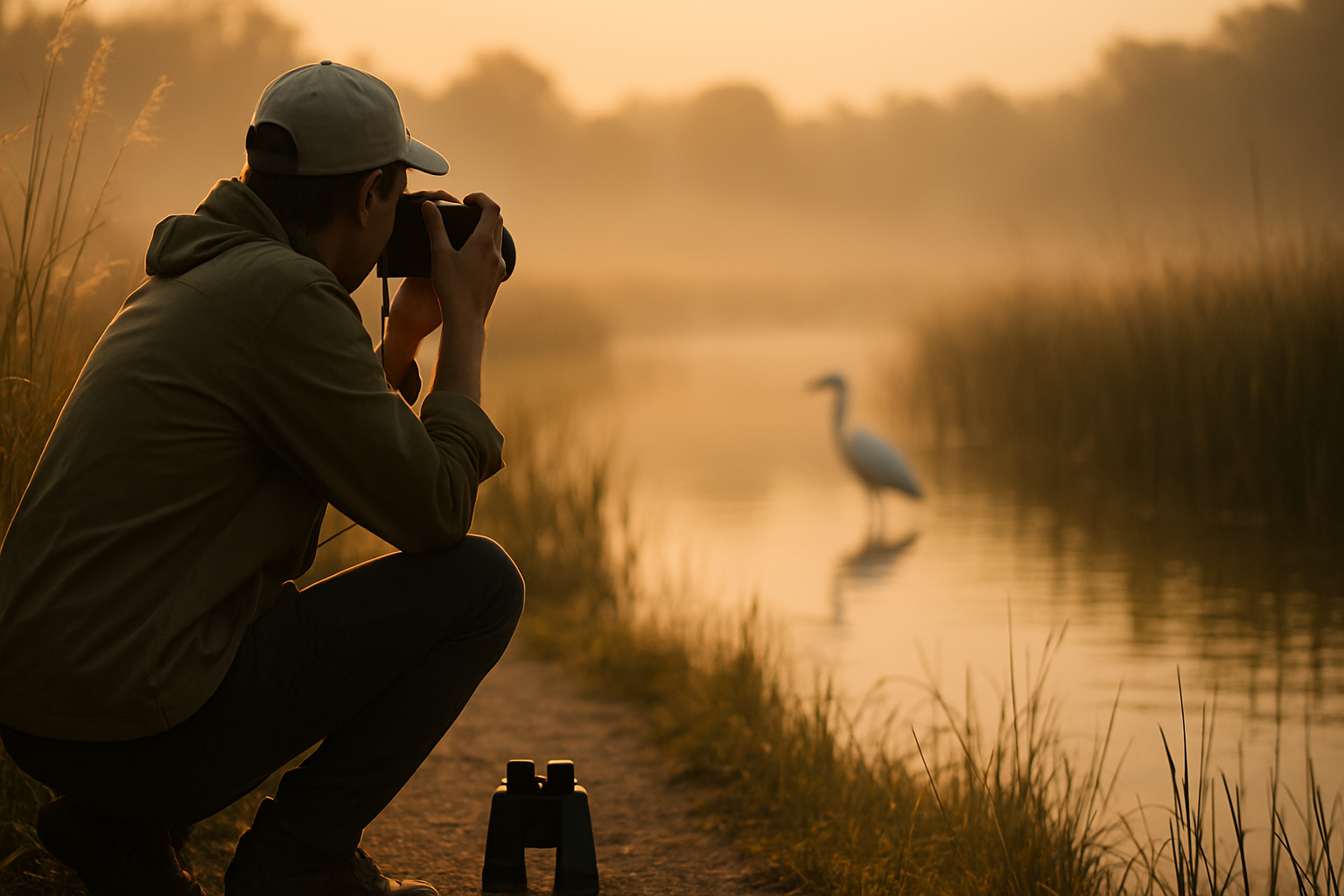
A sit spot is a 10–20 minute pause in the same place to observe and listen; framing it around birds accelerates presence. The direct benefit is attention training: distinguishing a chiffchaff’s high “hweet” from a bulbul’s liquid notes forces you to parse sound layers and stay with them. Start with listening, then lift the camera only if a respectful, steady shot is possible without disturbing the birds. The aim is not a trophy image but an attentive mind and a short note of what you heard and felt. Over a week of sit spots, most people notice less restlessness, more patience, and surprisingly better timing for action shots because you start anticipating behavior—perches, flight paths, returns.
2.1 Tools & tips
- Use a bird ID app with sound (e.g., Merlin Bird ID) for quick confirmations after the moment.
- Keep volume low or use one earbud to stay connected to the soundscape.
- Choose early morning (first 90 minutes after sunrise) when vocal activity peaks.
- Sit with your back to a tree or wall to reduce visual noise behind you.
- Practice a 10-minute “no camera” rule before shooting.
2.2 Ethics guardrails
- Avoid playback in breeding season; it can stress birds.
- Keep distance from nests (well over 50 m; if the bird alarms, back off).
- Let the bird choose the encounter length.
The sit-spot mindset retrains you to accept the pace of the living world. That patience spills into everyday life, a signature of mindfulness that persists after you pack up.
3. Go Macro to Enter the Present Moment
Macro photography is a shortcut to “now” because it shrinks your world to a leaf edge, a raindrop, or an insect eye. The technical requirements—steady hands, precise focus, shallow depth—demand quiet concentration and controlled breath, which is practically mindfulness with the camera as a biofeedback device. Even with a phone and a clip-on macro lens, you’ll see structures (stomata lines, pollen grains, wing venation) that your brain normally filters out. That act of discovering overlooked complexity changes how you feel: more curious, less hurried, and newly appreciative of ordinary corners of a park or balcony.
3.1 Numbers & guardrails
- Target 1:1 magnification if you have a macro lens; with phones, get within 2–5 cm.
- Shutter speed: start around 1/200 s; raise ISO modestly to keep things crisp.
- Focus: use manual focus or touch-to-focus; rock your body slightly to fine-tune.
- Stability: brace elbows on knees; consider a beanbag or mini tripod.
- Ethics: don’t freeze or spray insects; shoot subjects as you found them.
3.2 Mini case
Pick a 1 m² patch of ground and commit to 15 minutes. Photograph one lichen, one seed, one insect, one water bead. Note in a journal what surprised you (e.g., “Seed hairs refracted sky”). This micro-assignment routes your attention through sight, touch (texture), and even smell (wet soil), producing a multi-sensory imprint—exactly what mindfulness is built on.
When you regularly “zoom in” on small subjects, your ability to notice pattern and detail everywhere else gets stronger too.
4. Use a Constraint: One Lens, One Walk
Limits sharpen attention. Choosing a single prime lens (or a fixed focal length on your phone) for a full walk forces you to move your feet, pre-visualize frames, and live within one perspective. It’s a friendly constraint that reduces decision fatigue—no constant zooming or gear swapping—and channels your awareness into light, timing, and gesture. With fewer variables, you stay in the present instead of fiddling. The outcome is a clearer visual voice and less “spray and pray,” which both lowers stress and increases satisfaction with your images.
4.1 How to set it up
- Pick one focal length for the week: 35 mm (environmental) or 50 mm (natural perspective).
- On a phone, use the 1× or 2× lens only; disable digital zoom.
- Shoot 24 frames max per outing; chimping allowed only at the end.
- Work in manual or shutter priority to make one exposure decision and stick with it.
- Compose edge-to-edge: check all four borders before pressing the shutter.
4.2 Why it works
- Fewer choices = more presence.
- Repetition builds intuition for that focal length’s “look.”
- The mind learns to search for compositions that suit the constraint.
By the third outing, you’ll recognize scenes your chosen focal length loves—and you’ll walk calmer because your attention is tuned to find them.
5. Learn Light: Golden Hour, Overcast, and Direction
Mindfulness is sensory literacy, and light is the photographer’s main sense. When you learn to name light—soft/harsh, backlit/sidelit, warm/cool—you build a habit of noticing that anchors you in the moment. Golden hour (roughly the first and last hour of sunlight) is often flattering for landscapes and wildlife, but overcast light can be gentler for macro and forest scenes. Backlight reveals translucence; sidelight brings out texture; front light flattens but can simplify. As you practice labeling light and choosing your position relative to the sun, you’ll find yourself arriving earlier, moving quieter, and shooting less but better—a mindful flow shaped by photons.
5.1 Practical numbers
- Start ISO at 100–400 in daylight, 800–1600 near dawn/dusk.
- Handheld shutter speeds: keep at or above 1/(2× focal length) for moving subjects.
- Use your camera’s spot meter on bright highlights when backlit; dial exposure compensation (-0.3 to -1.0 EV) to protect glow.
- Track sun position with a planner app so you can anticipate angles without rushing.
5.2 Field habits
- Arrive 20–30 minutes before your chosen light window.
- Walk with the sun at different angles; shoot the same subject backlit and sidelit.
- On overcast days, hunt for color and shape; consider black-and-white to emphasize form.
By giving light your attention before everything else, you create an immediate, embodied check-in—“What is the light doing?”—that keeps you here, now.
6. Pair Photos with a Nature Journal
Writing cements attention. A tiny journal paired with your photos turns seeing into understanding and gives your mind a second anchor beyond the viewfinder. The point isn’t prose; it’s naming what you noticed: smells after rain, the exact green of a reed bed, how your breath changed when a heron lifted. The act of describing sensations builds recall and gratitude, two reliable mood regulators. Add one or two small sketches or a quick map of your route and you’ll also remember context, which helps you return to the same spot with a clearer plan and a calmer mind.
6.1 Simple workflow
- After each outing, select 3 images that best represent the experience.
- For each, write 3 sentences: subject, light, feeling.
- Add one observation you missed in the image (sound, temperature, breeze).
- Close with one “next time” note (e.g., “Arrive 15 min earlier to catch backlight”).
- Glue a 4×6 in. or 10×15 cm print into the journal weekly.
6.2 Prompts that work
- “What changed in the last 10 minutes?”
- “What did I smell/hear that I didn’t photograph?”
- “How did my posture/breathing shift from start to finish?”
Over time, the journal becomes a map of your attention—a private record of being present—that’s as valuable as the photos themselves.
7. Follow Ethical Fieldcraft to Calm the Mind
Respectful behavior in nature isn’t just “good practice”; it’s a form of mindfulness that places your actions in a web of life. When you keep distance from nests, avoid chasing wildlife, and step lightly off-trail, you must notice more: wind direction, animal body language, the ground underfoot. That observational stance keeps your nervous system steady, which helps with both sharp images and a steady mood. Ethics also prevent the restless, compulsive side of photography (“get the shot at any cost”) from hijacking your outing.
7.1 Guidelines to internalize
- Distance: if an animal changes behavior, you’re too close—back off immediately.
- Nests and dens: avoid; never disclose sensitive locations publicly.
- Playback/lures: skip them, especially in breeding seasons.
- Trails: stick to them in fragile habitats; step on durable surfaces if you must leave.
- Group etiquette: share space, rotate vantage points, keep voices low.
7.2 Region notes
- In hot or monsoon climates, carry extra water, sun protection, and a small towel for gear/hands.
- Sand, salt, and humidity call for simple weather sealing (rain cover, dry bag, microfibre).
- Know local protected-area rules; some parks restrict tripods or flash.
Ethics are mindfulness applied to others; practice them consistently and your photography will feel cleaner and calmer.
8. Try “Nearby Nature” Micro-Adventures
You don’t need a mountain to find presence; you need a plan to notice what’s nearby. A micro-adventure is a one-hour, low-planning outing within a short walk or transit ride that focuses on a single theme: reflections after rain, street trees and birds, insects on balcony plants. Setting a compact goal shrinks indecision and frees attention for sensory detail. You’ll be surprised how much beauty hides in a block you’ve walked a hundred times. The habit also builds consistency, which matters more for mindfulness than intensity.
8.1 60-minute template
- 0–5 min: slow-looking scan; choose a theme.
- 5–25 min: explore one side of the street/park; 6–12 deliberate frames.
- 25–40 min: sit spot; listen, breathe, jot one note.
- 40–55 min: walk back on the other side; look for a complementary subject.
- 55–60 min: one reflective selfie or shadow shot to mark the mood.
8.2 Track your mind, not just your steps
- Before: rate stress from 1–10; after: rate again and note the change.
- Keep a monthly tally: number of outings, prints made, journal pages filled.
- Reward consistency, not likes; your metric is “calmer and clearer,” not “viral.”
These small adventures stack. After a month, mindfulness feels less like a practice you “do” and more like a way you “walk.”
9. Contribute to Citizen Science Without Losing Presence
Logging birds on eBird or plants on iNaturalist can deepen mindfulness by giving your observation a purpose—place, time, ID, count. The structure nudges you to pay attention to field marks, calls, and locations you’d otherwise gloss over. The key is sequencing: observe first, note later. If you avoid live posting and batch your entries at home, you’ll keep your attention in the field where it belongs and still add value to the community.
9.1 Mindful workflow
- Observe → photograph → jot a quick field note (species/feature) → enjoy → log later.
- Use offline mode so you’re not tempted to scroll in the field.
- Photograph habitat/context, not just the subject; future you will thank you.
- Add one sentence to your journal about the encounter, not just the ID.
9.2 Benefits beyond the list
- Better ID skills sharpen attention to shape, behavior, and sound.
- Contributing builds a sense of place and gratitude.
- Your data helps conservation without costing your presence in the moment.
Done well, citizen science is mindfulness with a side of public good.
10. Do a 12-Frame “Zen Roll” Assignment
Artificial scarcity breeds care. Limit yourself to exactly 12 frames in a session—like a tiny roll of film—and you’ll look harder, decide slower, and feel more satisfied by the end. Because every click “costs,” you’ll breathe before you press the shutter, review edges, and wait for cleaner moments. This changes the sensory texture of your walk: less darting, more settling; less FOMO, more trust. It’s a training drill and a calming ritual in one.
10.1 Rules that bite (in a good way)
- Set your counter: 12 photos only; delete nothing in the field.
- Make a contact sheet afterward and sequence the 12 frames.
- Title the series (e.g., “Two Bridges, One Hour”).
- Print your favorite 2–3 as small cards and write a note on the back.
10.2 Mini case
Choose a waterfront path at dusk. Frame one wide establishing shot, two light-on-water abstracts, one silhouette, two close textures (rope, rust, reeds), two birds in flight, one reflection, one person interacting with nature, one final “good-bye” frame. That’s 12. You’ll end the hour feeling complete because the assignment gave your attention a spine.
When every frame matters, every moment does too—and that is mindfulness by design.
11. Breathe and Stabilize: Body Mechanics as Meditation
Your body is your first stabilizer. Good stance and breath translate directly into sharp photos and calmer nerves, which is why many wildlife shooters learn a breathing rhythm that doubles as meditation. The technique is simple: settle your feet shoulder-width apart, tuck elbows lightly to ribs, relax your jaw, and exhale slowly as you press the shutter. Pair this with practical shutter speeds and you’ll get more keepers and fewer spikes of frustration—exactly the emotional stability mindfulness is supposed to foster.
11.1 Numbers to memorize
- Handheld baseline: 1/(2× focal length) seconds; at 200 mm, aim for ~1/400 s.
- Continuous burst for action: short 3–5 frame bursts timed with your breath.
- Image stabilization helps, but breathing and stance help more than you think.
- For panning (birds in flight), start around 1/60–1/125 s and follow through.
11.2 Quick checklist
- Feet planted, knees soft, spine tall.
- Gentle exhale on the press.
- Two-point contact: camera to face + left hand under lens for support.
- Pause to notice body tension; shake it out if needed.
Treat each exposure as a mini breath practice. The camera rewards it with sharpness; your mind rewards it with steadiness.
12. Reflect, Curate, and Print to Anchor the Habit
Mindfulness grows when experiences are processed, not just collected. Reflection and curation turn pixels into meaning and set the stage for your next calm outing. Give yourself a simple workflow: pick a small number of favorites, write one-line captions in plain language, and print a few. Prints change your relationship with the work—they slow you down and invite repeated, gentle attention. A monthly mini-portfolio becomes a tactile record of how you see and feel in nature, which in turn motivates you to go back outside with intention instead of scrolling.
12.1 The 3-2-1 ritual
- Select your top 3 images from the week (trust your gut).
- Write 2 one-line captions that say what you noticed and why it matters.
- Make 1 small print (10×15 cm or 4×6 in.) and tape it into your journal.
12.2 Closing the loop
- Ask: “What kind of light and subject gave me the calmest feeling?”
- Plan one outing next week to repeat that recipe.
- Consider sharing a print with a friend; generosity deepens meaning.
Reflection isn’t a luxury step; it’s the moment your practice becomes sustainable—and mindfulness becomes part of your identity.
FAQs
1) Can I do mindful nature photography with only a phone?
Yes. Use the native wide or 2× lens, avoid digital zoom, and lean into strengths: close-ups, patterns, reflections, silhouettes. Steady your phone against a tree or railing, tap-to-focus, and lower exposure slightly for richer color. Pair the photos with a journal note and a 10-minute sit spot and you’ll get the same mindfulness benefits without carrying extra gear.
2) What’s the best time of day for mindful outings?
Early morning offers calm air, softer light, and higher bird activity, which makes it easier to notice details without harsh glare or crowds. If mornings aren’t possible, overcast afternoons are excellent for color and macro; evenings work for silhouettes and water reflections. The key is choosing a consistent window so your mind learns the rhythm.
3) Will taking photos pull me out of the moment?
It can—if you shoot compulsively. The antidote is sequencing: observe first, then shoot a few planned frames, then put the camera down and reflect. Use constraints like the 12-frame assignment, sit spots without the camera for 10 minutes, and post-processing later. These boundaries keep attention in the field instead of on screens.
4) Do I need a long telephoto for birds?
Not at first. Start with behavior and light, not feathers filling the frame. Wider, environmental bird photos can be more mindful and tell richer stories. If you later add a telephoto (e.g., 300–400 mm equivalent), practice ethical distance and breathing techniques to keep both sharpness and serenity.
5) How do I avoid disturbing wildlife?
Watch body language: alarm calls, tail flicks, frozen postures, or repeated look-backs mean you’re too close. Step back, lower your profile, and reduce time spent near sensitive spots. Skip playback (especially in breeding seasons) and never disclose nest locations. Mindfulness includes restraint; it feels better in the long run.
6) What if I live in a dense city with little “wild” nature?
Use “nearby nature”: street trees, pocket parks, canals, courtyards, balconies, even rooflines with gulls or kites. Micro-adventures and macro work thrive in cities. Seek textures (bark, moss), light patterns (shadows, reflections), and common birds. Presence comes from attention, not remoteness.
7) How can I measure whether this is helping my stress?
Track a simple before/after mood score (1–10) for each outing and note your sleep and focus that day. Look at trends monthly. Many people see a 2–3 point drop in stress after even short green-time; your journal will show patterns (e.g., “water scenes help most”).
8) What basic settings should I start with?
Daylight walk: aperture priority at f/5.6–f/8 (or your phone’s default), auto ISO capped at 1600, exposure compensation −0.3 EV. Moving subjects: shutter priority around 1/500–1/1000 s. Macro: manual focus and 1/200 s or faster. These are starting points—adjust for light and subject.
9) How do I keep outings mindful when I’m with friends or kids?
Make presence a shared game: a 5-minute “sound hunt,” a “find three textures” challenge, or a “12-frame roll” everyone does together. Keep gear minimal, pick short loops with a snack stop, and celebrate noticing over “good photos.” Group mindfulness is fun and more resilient.
10) What affordable gear actually helps?
A light cross-body bag, a small blower/cloth, a clip-on phone macro, a compact tripod or beanbag, and a simple rain cover. For comfort: a water bottle, sun hat, insect repellent. Apps that help presence (sun position, bird ID) are useful; avoid anything that invites scrolling in the field.
11) Should I shoot RAW or JPEG for mindful practice?
Either is fine. RAW gives more editing latitude but can feed perfectionism. If you find yourself glued to screens, shoot JPEG or RAW+JPEG and edit lightly. Remember: the point is how you felt and what you noticed; technical polish can come later.
12) How often should I go out?
Consistency beats duration. Two or three 45–60 minute sessions per week will likely change your baseline stress and attention within a month. If that’s too much, start with one reliable weekend hour and add a weekday micro-adventure. Treat it like brushing your teeth for your mind.
Conclusion
Photography and nature-watching aren’t just hobbies; they’re a portable practice for training attention and easing stress. When you commit to slow looking, ethical fieldcraft, and small constraints like a single lens or a 12-frame roll, you trade jittery scanning for calm, purposeful seeing. Listening to birds at a sit spot, noticing how light changes a familiar path, and reflecting afterward in a journal build a rhythm that steadily rewires how you relate to your world. Prints and small projects keep the loop satisfying and sustainable, while citizen science lets your presence serve something bigger than you. Start small: pick a patch, breathe for a minute, and make one intentional frame. Then go again. Your photos will improve, yes—but more importantly, your days will feel clearer and kinder.
Ready to begin? Schedule a one-hour micro-adventure this week and try the 12-frame assignment—then print your favorite image and write one line about how it made you feel.
References
- The Cognitive Benefits of Interacting With Nature, Psychological Science, 2008. https://doi.org/10.1111/j.1467-9280.2008.02225.x
- View Through a Window May Influence Recovery from Surgery, Science, 1984. https://doi.org/10.1126/science.6143402
- The Health Benefits of the Great Outdoors: A Systematic Review and Meta-Analysis of Greenspace Exposure and Health Outcomes, Environmental Research, 2018. https://doi.org/10.1016/j.envres.2018.06.030
- Spending at Least 120 Minutes a Week in Nature Is Associated With Good Health and Wellbeing, Scientific Reports, 2019. https://doi.org/10.1038/s41598-019-44097-3
- Doses of Neighborhood Nature: The Benefits for Mental Health of Living With Nature, BioScience, 2017. https://doi.org/10.1093/biosci/bix001
- Merlin Bird ID (Sound ID and Field Guide), Cornell Lab of Ornithology, n.d. https://merlin.allaboutbirds.org/
- eBird: Global Birding, Cornell Lab of Ornithology, n.d. https://ebird.org/
- iNaturalist: A Community for Naturalists, California Academy of Sciences & National Geographic, n.d. https://www.inaturalist.org/
- Leave No Trace Seven Principles, Leave No Trace Center for Outdoor Ethics, n.d. https://lnt.org/why/7-principles/
- Forest Bathing and Its Impact on Health: A Review, International Journal of Biometeorology, 2019. https://doi.org/10.1007/s00484-019-01717-x