




















Progressive muscle relaxation (PMR) is a simple, evidence-based technique where you deliberately tense and then release muscle groups in a set order to trigger the body’s relaxation response. In practice, PMR reduces physical tension and helps calm a racing mind, making it useful for stress relief, anxiety management, and better sleep.
Quick-start overview (the “at-a-glance” version): 1) Set up and safety check, 2) Choose position, 3) Switch on diaphragmatic breathing, 4) Prime attention with a brief body scan, 5) Feet & calves, 6) Thighs, glutes & hips, 7) Abdomen & lower back, 8) Chest & upper back, 9) Hands, forearms & upper arms, 10) Shoulders, neck & jaw, 11) Eyes, cheeks & forehead, 12) Full-body release and wrap-up. Hold each tension for ~5 seconds, release for ~10–20 seconds, then move on; a full round usually takes 10–20 minutes.
Friendly disclaimer: This guide is educational and not a substitute for personal medical advice. Avoid PMR or use a passive version if you have recent serious injuries, muscle spasms, or back problems, and talk with a clinician if you live with epilepsy, significant psychiatric conditions, or a trauma history.
1. Set Up Your Space and Do a Safety Check
Start by preparing a quiet, comfortable environment and confirming PMR is appropriate for you today. The aim is to reduce sensory load so your brain can notice the contrast between tension and ease. Dim the lights, silence notifications, and set room temperature to whatever feels “neutral” (often ~20–22°C / 68–72°F). Have a light blanket if you tend to cool down at rest. If you’re practicing before bed, treat the room like a mini sleep sanctuary—dark, cool, and uncluttered. Finally, skim the safety note: if you’re dealing with acute musculoskeletal injury, frequent muscle spasms, or severe back pain, use gentler “passive” relaxation (no active tensing) or skip affected areas; if you have epilepsy or a significant trauma history, check in with your clinician.
Mini-checklist
- Phone on silent and out of reach
- Comfortable surface (bed, sofa, or mat)
- Loose clothing; remove tight belts or jewelry
- Optional: thin pillow under knees (lying) or lower back (seated)
- A timer set for 15 minutes (so you don’t clock-watch)
1.1 Why it matters
Reducing noise and visual clutter helps the parasympathetic (“rest-and-digest”) system dominate, which lowers heart rate, eases muscle tone, and primes PMR to work efficiently. Even a 10–20 minute PMR session can shift you out of a stress state; having the right setup amplifies that effect.
Synthesis: A calm, safe setup isn’t a luxury—it’s the foundation that makes every subsequent step feel easier and more effective.
2. Get Into a Supportive Position
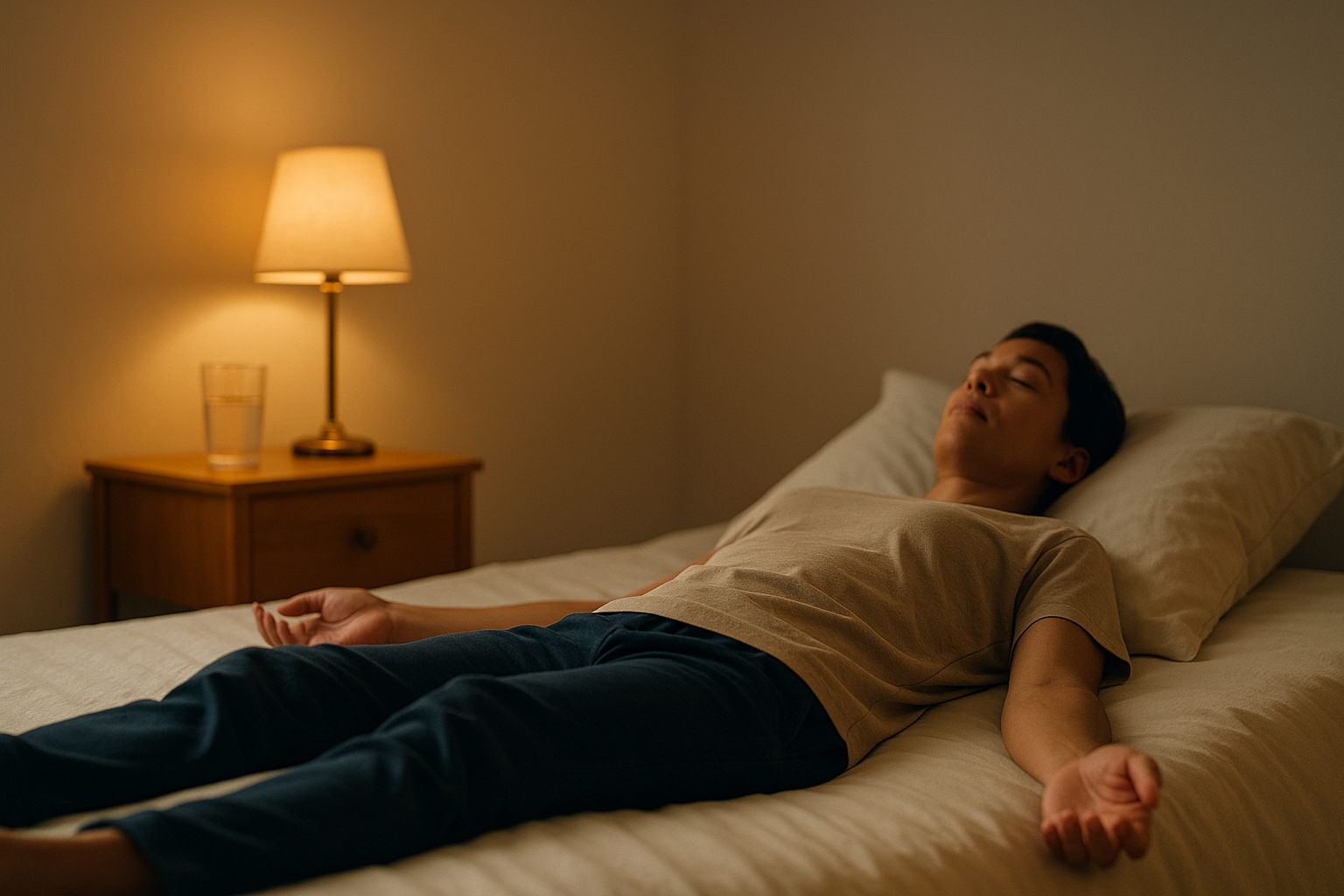
Choose lying on your back or a supported chair position where your spine feels neutral and your joints aren’t straining. Lying down is often best for sleep or full-body work; place a pillow under your knees to unload your lower back and keep arms slightly away from your sides, palms up. Seated practice is better for midday breaks: use a chair with a back, place both feet flat on the floor, and keep your head balanced over your shoulders. The non-negotiable is comfort; if you’re bracing anywhere, you’ll fight the technique rather than ride it.
Position pointers (pick one):
- Lying: Head pillow as needed; knees supported; ankles free to move.
- Seated: Hips back in the chair, feet grounded, hands resting on thighs.
- Side-lying (if supine is uncomfortable): Use a pillow between knees; keep neck neutral.
2.1 Numbers & guardrails
PMR is typically practiced for 10–20 minutes per round, but beginners may start with 6–8 minutes and build up. Stop tensing any area that causes pain; skip it and continue. Move deliberately between groups—jerky transitions can re-activate tension.
2.2 Common mistakes
Holding your breath during tensing, clenching too hard, or craning your neck are common pitfalls. If you catch one, reset your posture and ease up on the contraction strength to “medium-firm,” never painful.
Synthesis: A neutral, supported position frees up attention for the key learning: how tension and relaxation actually feel in your body.
3. Switch On Diaphragmatic Breathing
Before the first muscle squeeze, establish slow, diaphragmatic (“belly”) breathing. Inhale through your nose so your abdomen expands under your hand while your chest stays relatively still; exhale gently through your mouth or nose. This primes the vagus nerve and aligns the breath with your muscle work. If breath holds make you uncomfortable, skip them; consistency beats complexity.
How to do it (1–2 minutes):
- Hand on belly, hand on chest
- Inhale for ~4–5 seconds, feel belly rise
- Exhale for ~5–6 seconds, feel belly fall
- Repeat without strain; aim for smoothness over length
3.1 Why it matters
Synchronizing breath with tensing/releasing helps prevent breath-holding spikes and enhances the relaxation phase. Many protocols cue inhale as you tense and exhale as you release—a rhythm that your nervous system quickly associates with “letting go.”
3.2 Numbers & guardrails
If you like structure, you can try 4-7-8 breathing once comfortable, but it’s optional. The main goal is steady, comfortable exhales paired with releases.
Synthesis: A calm breath is the metronome of PMR—keep it easy and everything else follows.
4. Prime Attention With a Micro Body Scan and a Cue Word
Give yourself 20–30 seconds to sweep attention from toes to scalp and simply notice any “hot spots” of tension. Then choose a short cue word—many people use “RELAX”—to silently say on every release. This pairing reinforces the relaxation response and improves your ability to shift state quickly the next time you practice.
Mini-checklist
- One slow attention sweep (toes → head)
- Choose your cue word
- Commit to repeating it on every release
4.1 Tools/Examples
Clinicians who teach PMR often combine it with a cue word to strengthen conditioning. You can even whisper the word the first 1–2 rounds and then keep it internal.
4.2 Common mistakes
Skipping the scan because you’re “in a hurry” or changing the cue each time weakens the learning. Keep it simple and consistent.
Synthesis: A 30-second scan and a single cue word turn a list of steps into a reliable skill loop.
5. Feet and Calves
Begin at the bottom: tense your toes and feet (curl toes, gently point or flex ankles), hold ~5 seconds, then exhale and release for 10–20 seconds. Repeat once if you like. Then tense calves by pointing toes away or pulling them toward you (don’t cramp), hold 5, release for 10–20. While releasing, feel the difference between effort and ease; that contrast is the “lesson” of PMR.
How to do it (sequence):
- Toes/feet: curl and/or point → hold 5 → release 10–20
- Calves: point or dorsiflex → hold 5 → release 10–20
- Optional repeat with milder contractions
5.1 Numbers & guardrails
Most reputable protocols land in the 5-second tension and 10–20-second relaxation range, with total session time around 10–20 minutes. If you’re prone to leg cramps, go lighter on intensity and shorter on holds.
5.2 Common mistakes
Over-pointing the toes (calf cramps), holding your breath, or rushing the release period. The release window is where the benefit lives—don’t shortchange it.
Synthesis: Starting at the feet gives you quick wins; it’s easy to feel tension drain and warmth spread upward.
6. Thighs, Glutes, and Hips
Next, tense your thighs by gently pressing heels into the surface or lifting them a centimeter if seated; hold ~5 seconds; release 10–20. Then tighten glutes—firm, not straining—hold 5; release 10–20. Finish with a gentle hip squeeze by imagining drawing your outer hips inward; hold 5; release 10–20. Keep breathing: inhale on the squeeze, exhale on the release.
Mini-checklist
- Thighs: press/lift → hold 5 → release 10–20
- Glutes: firm squeeze → hold 5 → release 10–20
- Hips: gentle inward draw → hold 5 → release 10–20
6.1 Common mistakes
Over-lifting legs (which recruits the lower back) or clenching glutes so hard you hold your breath. Moderate effort is enough to teach the contrast.
6.2 Region-specific notes
If floor practice isn’t culturally or practically comfortable, a sturdy chair works perfectly. Keep both feet flat and imagine “grounding” through your soles between rounds.
Synthesis: Strong leg groups store lots of stress; releasing them early makes everything above feel easier.
7. Abdomen and Lower Back
Now move to your abdomen: draw your navel slightly toward your spine (a gentle brace), hold 5, release 10–20. For the lower back, if lying, lightly press your mid-back into the surface; if seated, imagine spreading your lower back wide; hold 5, release 10–20. Keep contractions pain-free and modest—this region is sensitive.
How to do it safely
- Gentle abdominal brace only; no breath-holding
- For lower back: micro-press, not an arch
- Skip this section if you have acute back pain or spasms
7.1 Why it matters
The trunk is a stress barometer; bracing here can be so automatic you don’t notice it. Gentle, controlled tensing followed by complete release retrains your baseline tone and helps decouple “worry” from “body clamp.”
7.2 Numbers & guardrails
Some guides suggest longer relaxation windows (up to ~30 seconds) in the trunk for big sensations—use what feels calming rather than forced.
Synthesis: When your center softens, your nervous system gets a clear signal: “We’re safe now.”
8. Chest and Upper Back
With chest and breathing muscles, the rule is never to hold your breath. Take a smooth inhale as you gently expand the chest (as if widening your collarbones), hold 5 without blocking the throat, then exhale and release 10–20 as your chest drops. For the upper back, imagine drawing your shoulder blades slightly together and down (light squeeze), hold 5, release. Keep your jaw soft.
Mini-checklist
- Chest: expand without breath-holding → hold 5 → release 10–20
- Upper back: gentle shoulder-blade squeeze → hold 5 → release 10–20
- Keep breathing continuous
8.1 Common mistakes
Over-lifting the rib cage and trapping air, or shrugging the shoulders toward your ears. Think “wide” rather than “high.”
8.2 Numbers & guardrails
Pairing inhale/tension and exhale/release is a classic cue set that reduces sympathetic arousal and helps sleep onset when used near bedtime.
Synthesis: Coordinating breath with chest and upper-back releases turns PMR into a full-system “calm switch.”
9. Hands, Forearms, and Upper Arms
Make two gentle fists—thumbs outside fingers—hold 5, release 10–20. Then flex your biceps (elbows bent), hold 5, release 10–20. Finally, engage triceps (elbows gently straighten), hold 5, release 10–20. Keep the jaw unhinged and shoulders relaxed; imagine tension draining through your fingertips as you release.
How to do it (arm circuit):
- Fists → Biceps → Triceps (each: 5-second hold, 10–20-second release)
- Optional second round with softer contractions
9.1 Tools/Examples
This order mirrors many clinical handouts; repeating the sequence with diminishing intensity deepens the relaxation learning.
9.2 Common mistakes
Over-clenching fists (wrist strain) or shrugging through the effort. Keep wrists neutral and shoulders heavy.
Synthesis: Releasing grip muscles is symbolically—and literally—about letting go.
10. Shoulders, Neck, and Jaw
Shoulders: shrug them toward your ears just a little, hold 5, release 10–20 as they melt downward.
Neck: gently press the head back into the pillow or headrest (no strain), hold 5, release; then nod slightly forward and release.
Jaw: softly bring teeth toward each other without grinding, hold 5, release; rest your tongue on the roof of your mouth behind your front teeth.
Mini-checklist
- Shoulders: micro-shrug → hold 5 → release 10–20
- Neck: press back / nod forward (very gentle)
- Jaw: soft contact only; tongue resting behind teeth
10.1 Why it matters
Shoulder/neck/jaw tension is a hallmark of stress and contributes to tension-type headaches and TMJ discomfort. PMR and related relaxation strategies are commonly recommended to help prevent and reduce headache frequency, and they pair well with biofeedback.
10.2 Guardrails
Never force neck range; skip anything that reproduces pain, and avoid jaw clenching. If you live with TMJ disorder, keep jaw contractions ultra-light or skip to the release cue only.
Synthesis: Loosening the “collar zone” often delivers an outsized sense of relief—and clearer breathing.
11. Eyes, Cheeks, and Forehead
Eyes: squeeze lids gently, hold 5, release 10–20; then imagine your gaze widening behind closed lids.
Cheeks/lips: purse lips together softly, hold 5, release; notice warmth.
Forehead: frown slightly to gather tension, hold 5, then release and imagine smoothing the skin across your brow and scalp.
Mini-checklist
- Eyes → Lips/cheeks → Forehead/scalp
- Keep the throat relaxed and breathing soft
- Use your cue word on every release
11.1 Why it matters
Facial muscles are small but expressive; releasing them sends powerful “all clear” signals via the trigeminal and facial pathways to the rest of your system. Many people report a wave of heaviness and warmth here that signals the onset of sleepiness.
11.2 Common mistakes
Over-squeezing (which can feel stressful) or rushing the release because it’s “just the face.” Take your time; the contrast is often dramatic.
Synthesis: A softened face is like a green light to the whole nervous system: coast.
12. Full-Body Release, Abbreviations, and Practice Plan
Finish with a full-body sweep: inhale and lightly tense everything at once (10–20% effort), hold 5, then exhale and release from head to toes while silently repeating your cue word. Notice the global drop in tone, the heaviness of limbs, and the ease of breath. Lie or sit in this relaxed state for another 30–60 seconds before moving. If you’re in bed, let yourself drift. If you’re at your desk, stand up slowly to avoid light-headedness.
Abbreviated versions (for busy days):
- Hands + shoulders + face only (1–2 minutes)
- Feet + thighs + abdomen (1–2 minutes)
- One trouble spot (30–60 seconds; e.g., jaw or calves)
12.1 Practice plan
Most people build skill with daily practice for 1–2 weeks, then move to 3–5 times per week or “as needed.” Many clinicians recommend coupling PMR with CBT-I strategies for sleep (stimulus control, regular schedule).
12.2 Tools & timing
Hold ~5 seconds for tension and 10–20 seconds for release; adjust if you’re cramp-prone or fatigued. Expect a full body round to take 10–20 minutes at first; you’ll get faster as you learn.
Synthesis: The full-body release closes the loop—and the practice plan turns today’s calm into a repeatable habit.
FAQs
1) What exactly is progressive muscle relaxation—and how is it different from a body scan?
PMR alternates deliberate tension and release in specific muscle groups to teach the contrast between effort and ease. A body scan is typically passive—observing sensations without tensing. Both reduce arousal, but PMR’s active contractions provide a stronger “contrast lesson,” which can speed learning for people who struggle to notice subtle sensations. Many protocols blend them (brief scan, then PMR, then passive rest).
2) How long should a full PMR session take?
Most people land between 10 and 20 minutes, depending on how many groups you include and how long you rest after each release. Beginners often start at the longer end and naturally shorten as they get efficient. For sleep, a slower pace can be soothing; for work breaks, use shorter holds and quick releases.
3) Is PMR safe for everyone?
It’s safe for most people, but avoid tensing if you have recent serious injuries, active muscle spasms, or significant back issues; use passive relaxation instead. If you live with epilepsy, certain psychiatric conditions, or a trauma history, consult your clinician before starting. Always stop if a movement causes pain.
4) What if I cramp during the leg or foot steps?
Cramps usually mean the contraction was too strong or the ankle was pointed sharply. Reduce intensity to 10–20% effort, keep your ankle in a mid-range position, and shorten the hold to 3 seconds for that area before returning to the usual timing. Hydration and gentle calf stretches outside PMR may also help.
5) Can PMR really help with sleep—or should I focus on other methods?
PMR is one of several relaxation therapies endorsed within behavioral treatments for insomnia. It’s effective for reducing pre-sleep arousal and pairs well with CBT-I basics like stimulus control and a consistent schedule. If insomnia is chronic, consider a structured CBT-I program and use PMR as a nightly wind-down tool.
6) I get headaches from clenching—should I skip jaw steps?
Yes—keep jaw work ultra-gentle or skip active jaw tensing and use the release cue only. PMR and related strategies are often recommended for tension-type headaches and can be combined with biofeedback; the key is gentle, pain-free practice.
7) How hard should I squeeze each muscle?
Think of a moderate contraction: firm enough to feel, never painful or breath-holding. Over-squeezing recruits neighboring muscles and raises arousal—the opposite of what you want. If you’re unsure, start at 10–20% effort and increase slightly if needed.
8) What’s the best order of muscle groups?
Many people go feet-to-head because it feels intuitive and lines up with sleep routines, but head-to-feet also works. Some clinical handouts list 12–14 groups; others cluster them. Consistency matters more than the exact order—pick a sequence and repeat it so your brain recognizes the pattern.
9) Can I combine PMR with breathing or guided imagery?
Absolutely. PMR often works better when paired with diaphragmatic breathing and, optionally, a brief visualization (like warmth spreading through muscles). These combinations deepen parasympathetic activation and can reduce anxiety faster than any single technique alone.
10) Will I see benefits right away, or does it take weeks?
Most people feel noticeably calmer after the first full session because the contrast is immediate. Skill improves with practice, though; doing PMR daily for 1–2 weeks usually makes the steps feel natural, and the relaxation response becomes easier to trigger on demand.
Conclusion
Progressive muscle relaxation is one of the most practical ways to unwind tension you can’t think your way out of. By teaching your body the tangible difference between effort and ease, it gives your nervous system a reliable route back to calm—whether you’re preparing for sleep, cooling down after a stressful commute, or resetting before a big presentation. The structure is simple: comfortable setup, steady breathing, brief but deliberate squeezes, and patient releases. Within a week or two of regular practice, most people find they can trigger relaxation quickly, even with shortened “abbreviated” rounds. Pair PMR with good sleep habits and, if needed, a CBT-I plan to address stubborn insomnia. Your next step is straightforward: set a 15-minute timer tonight, follow the 12 steps above, and notice exactly where your body softens. Try one round this evening and repeat tomorrow—calm is a skill you can practice.
References
- Relaxation Techniques — StatPearls (Norelli SK, Long A, Krepps JM). StatPearls Publishing; updated Aug 28, 2023; 2025 edition. https://www.ncbi.nlm.nih.gov/books/NBK513238/
- Everything You Need to Know About Progressive Muscle Relaxation — Cleveland Clinic Health Essentials. Nov 10, 2022. https://health.clevelandclinic.org/progressive-muscle-relaxation-pmr
- Relaxation Exercises to Help Fall Asleep (section: Progressive Muscle Relaxation) — Sleep Foundation. Updated July 24, 2025. https://www.sleepfoundation.org/sleep-hygiene/relaxation-exercises-to-help-fall-asleep
- Progressive Muscle Relaxation — Whole Health Library — U.S. Department of Veterans Affairs. Last updated May 1, 2024. https://www.va.gov/WHOLEHEALTHLIBRARY/tools/progressive-muscle-relaxation.asp
- Try this: Progressive muscle relaxation for sleep — Harvard Health Publishing. Dec 1, 2023. https://www.health.harvard.edu/staying-healthy/try-this-progressive-muscle-relaxation-for-sleep
- Behavioral and psychological treatments for chronic insomnia disorder in adults: An AASM clinical practice guideline — Edinger JD et al., Journal of Clinical Sleep Medicine. 2021;17(2):255–262. https://pmc.ncbi.nlm.nih.gov/articles/PMC7853203/
- Relaxation techniques: Try these steps to lower stress — Mayo Clinic. Jan 24, 2024. https://www.mayoclinic.org/healthy-lifestyle/stress-management/in-depth/relaxation-technique/art-20045368
- Effectiveness of progressive muscle relaxation, deep breathing, and guided imagery in promoting psychological and physiological states of relaxation — Toussaint L. et al., Evidence-Based Complementary and Alternative Medicine. 2021. https://pubmed.ncbi.nlm.nih.gov/34306146/
- Progressive Muscle Relaxation (PDF patient handout) — VA Office of Patient Centered Care and Cultural Transformation. 2023. https://www.va.gov/WHOLEHEALTHLIBRARY/docs/Progressive-Muscle-Relaxation.pdf
- New guideline supports behavioral, psychological treatments for insomnia — American Academy of Sleep Medicine news release. Dec 16, 2020. https://aasm.org/new-guideline-supports-behavioral-psychological-treatments-for-insomnia/