



























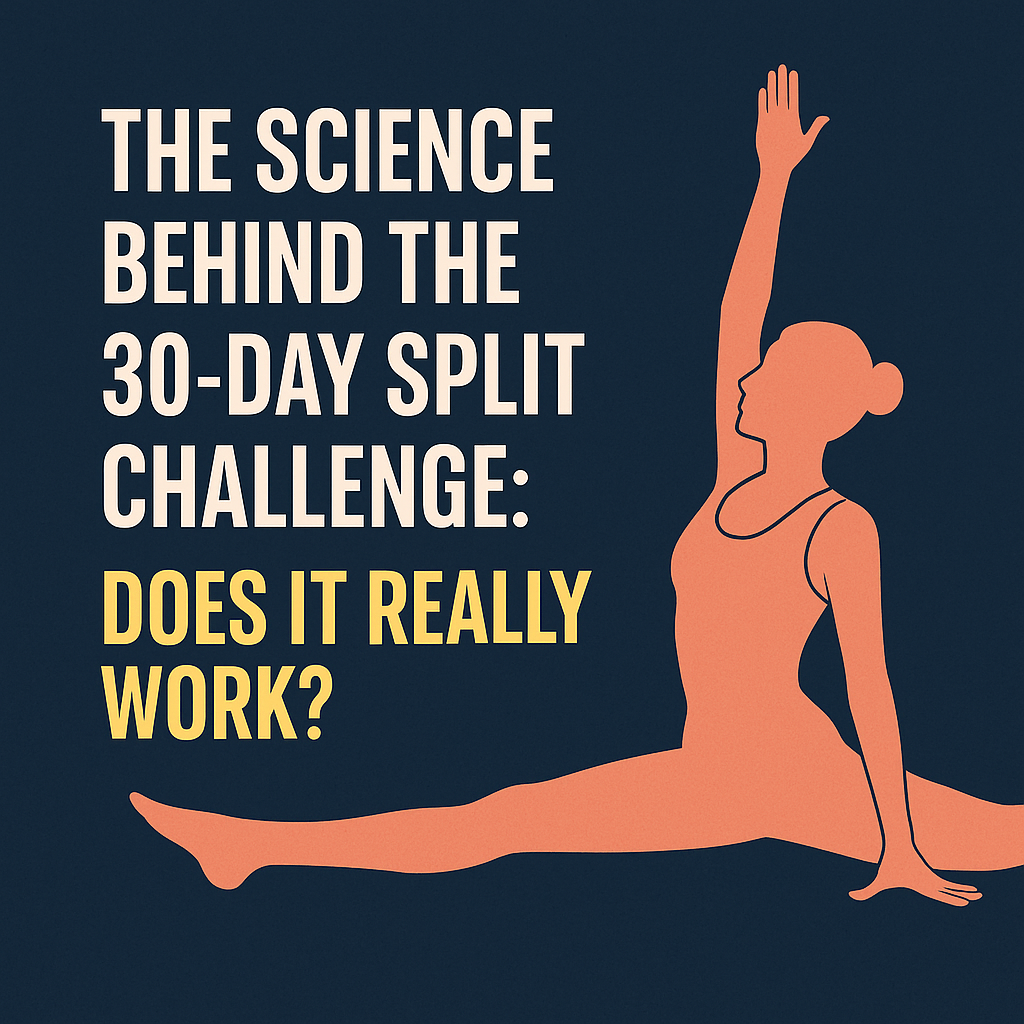
Being flexible is good for your health since it influences everything from how well you play sports to how comfortable you are every day. The 30-Day Split Challenge is one of several programs that say they will work right away. A lot of people are talking about it on fitness blogs and social media. It is promoted as a structured regimen that can help you accomplish front and side splits in just one month. People that desire to move more freely, like dancers, gymnasts, martial artists, and others, prefer it better. But is it possible to use science to figure this out? This long essay will cover the anatomy and physiology of flexibility, the rules for split challenges, peer-reviewed research, potential benefits and risks, and evidence-based remedies. There are also answers to common questions (FAQs), a conclusion that sums up the important themes, and a good list of sources to back up what we say.
What is the challenge of splitting up for 30 days?
The 30-Day Split Challenge normally contains daily stretching exercises that become more difficult as the weeks go by. The calendar shows people when to execute particular stretches for their hip flexors, hamstrings, quadriceps, and adductors, with pauses in between. Most of the time, exercises take between 10 and 30 minutes and employ static, dynamic, and PNF (proprioceptive neuromuscular facilitation) approaches.
Important parts:
- When you conduct static stretching, you hold a stretch for 20 to 60 seconds at the end of its range.
- When you conduct dynamic stretching, you move through the whole range of motion in a controlled fashion.
- PNF stretching is like when you contract and relax: you tighten a muscle before stretching it even further.
Most 30-Day Split programs start with simple moves and then progress on to deeper holds as the muscles get used to them. This is how they grow stronger over time.
Muscle and connective tissue: The science of being flexible
There are both muscular and non-muscular variables that impact flexibility:
- Muscles and tendons need to stretch when they are under tension.
- Fascia is the tissue that connects muscles to each other. Because it is both viscous and elastic, it bends in diverse ways.
- Capsules and ligaments that protect joints are helpful, but if they are too rigid, they can make it hard to move.
What happens in the brain
- Stretch reflex: a natural response that keeps you from stretching too soon. You can learn how to deal with it through training.
- Pain-Threshold Adaptation: Stretching the same region over and over again makes nociceptors less sensitive, so you can go deeper without feeling pain.
Changes in plastic and elastic
Elastic deformation occurs when anything expands out for a short time and then goes back to its original length.
When you pull something too far past its elastic limit, it stays that way. This is known as plastic deformation. This is where split difficulties come in.
Looking at the Evidence: Static Stretching and Range of Motion
Behm et al. (2016) conducted a meta-analysis demonstrating that extended static stretching (≥10 weeks) markedly improves joint flexibility, but shorter durations produce no benefits (Behm et al., 2016).
Stretching with PNF
PNF stretching has demonstrated superior short-term advantages compared to static stretching alone, perhaps due to isometric contraction’s role in enhancing neural inhibition (Sharman et al., 2006).
The Length of Flexibility Changes
Research indicates that neuronal adaptations lead to initial range expansions within a few days, whereas structural modifications, such as elongated fascicles, need weeks to months (Weppler & Magnusson, 2010). It could take more than 30 days for the muscle to develop a lot longer.
Is the 30-Day Timeline Still Good?
Common Range Improvements
Researchers have found that stretching for a short time (2–4 weeks) can make your joints move more freely by 5–15%. Getting a full front or side split, which normally requires 70 to 180 degrees of hip abduction or extension, usually takes longer, especially for beginners.
People are different.
- Baseline Flexibility: People who are more flexible in the start get to splits faster.
- Age and Gender: Women and younger people are usually more flexible, which can vary the schedule.
- How often and how hard you work has a big effect on the results.
It can be dangerous for you if you extend too much.
If you push yourself too hard too quickly, you could have microtears, too much swelling, or even a sprained ligament. You need to make sure that you grow evenly and get adequate sleep.
Conducting an Evidence-Based Evaluation of the 30-Day Split Protocol
- Use a goniometer to find the baseline range.
- Check for muscle imbalances, as when your hamstrings are tighter than your hip flexors.
Weeks 1–2
To assist your nerves get used to the new motions, do some light static and dynamic stretches for 20 to 30 seconds.
Weeks 3 and 4
Add PNF days (contract-relax) and static holds that last up to 60 seconds.
Recovery
Two days a week of rest or active recovery to give the tissues time to mend.
Form and Style
- Don’t have to make up for things by keeping your pelvis in line and your core taut.
- To modify the stretch reflex, breathe steadily.
More Options
- Heat Therapy: Before you stretch, warm up your muscles first.
- Foam rolling can assist relax myofascial tissue that is too tight.
- Strength Training: To make your muscles longer and stronger, work on the muscles on the other side of them.
More than just splits
- Staying injury-free: Being more flexible makes sports and everyday tasks less stressful (Simic et al., 2013).
- Posture and Mobility: Moving your hips and spine better will assist your posture and how well you move around in your daily life.
- Athletic Performance: A greater range of motion may help you kick, take longer steps, and do gymnastics.
Possible Problems and Safety Concerns
- Find out how to discern the difference between pain that is a warning sign and pain that you can deal with.
- Don’t push yourself too hard; be aware of what your body can manage.
- Rest and Recovery: To help your body heal, make sure you get enough sleep, drink enough water, and eat the correct meals.
What the Experts Say
“Changes in the brain are what make muscles and tendons more flexible quickly; real muscle-tendon unit lengthening takes months of hard work.”
— Dr. Lisa Moreno, who got her PhD in Exercise Physiology from the University of California, San Diego
“A 30-day program can help you get started with flexibility, but you need to keep practicing to keep your splits.”
— James Lee, a CSCS (Certified Strength and Conditioning Specialist)
Questions that are asked a lot (FAQs)
Q1: Is it possible for anyone to do a full split in 30 days?
A1: Age, sex, baseline flexibility, and consistency are all very essential. Some people may be able to entirely split, but most may just notice subtle changes and require more time.
Q2: How often should I stretch each group of muscles?
A2: You should work out three to four times a week for each muscle group. Try to work out for lesser amounts of time every day if you can. Find a nice balance between how hard you work and how long you take breaks.
Q3: What sets PNF, static, and dynamic stretching apart from each other?
A3: Dynamic stretches move your joints to warm them up, static stretches hold end-range postures, and PNF adds a period of isometric contraction to help you develop stronger.
Q4: Is it better to stretch before or after your workout?
A4: Dynamic stretches are the best technique to warm up before a workout. Static and PNF stretching work best when the muscles are warm, such after a workout or during a specific flexibility exercise.
Q5: How can I know if I’m stretching too much?
A5: If you feel sharp pain, soreness that lasts longer than 48 hours, or your joints feel unstable, you are extending too much. Stop and turn down the heat.
Q6: Should I do strength training to help me be more flexible?
A6: Yes, working out muscles that are opposite each other helps maintain joints stable and keeps flexibility gains.
Q7: What are some signals that I should take a break?
A7: If you’re usually fatigued, not doing well, and not sleeping well, you need longer days to heal.
The End
The 30-Day Split Challenge is a terrific approach to start a regular routine to help your body become more flexible. It can help you move around more effortlessly, especially in the first two weeks while your body is getting adjusted to the new method of movement. To acquire and retain a complete split, though, you normally need to focus on it for longer, undertake individualized programming, and pay attention to the appropriate technique, recovery, and strength training that helps. When people follow a research-based regimen that combines static, dynamic, and PNF stretching, balancing rest with activity, and other things like heat therapy and foam rolling, they have the best chance of improvement and the least likelihood of getting hurt. Remember that it takes time to becoming more flexible. The first step to making a habit stick is the 30-day challenge.
References
- Behm, D.G., Blazevich, A.J., Kay, A.D., & McHugh, M. (2016). Acute effects of muscle stretching on physical performance, range of motion, and injury incidence in healthy active individuals: a systematic review. Applied Physiology, Nutrition, and Metabolism, 41(1), 1–11. https://doi.org/10.1139/apnm-2015-0235
- Sharman, M.J., Cresswell, A.G., & Riek, S. (2006). Proprioceptive neuromuscular facilitation stretching: mechanisms and clinical implications. Sports Medicine, 36(11), 929–939. https://doi.org/10.2165/00007256-200636110-00002
- Weppler, C.H., & Magnusson, S.P. (2010). Increasing muscle length: a matter of increasing length or modifying sensation? Physical Therapy, 90(3), 438–449. https://doi.org/10.2522/ptj.20090035
- Simic, L., Sarabon, N., & Markovic, G. (2013). Does pre-exercise static stretching inhibit maximal muscular performance? A meta-analytical review. Scandinavian Journal of Medicine & Science in Sports, 23(2), 131–148. https://doi.org/10.1111/j.1600-0838.2011.01344.x