




















Working nights flips your body clock and often steals sleep, alertness, and mood. This guide is for anyone on permanent nights or rotating schedules who wants a practical, evidence-based plan to sleep better, feel sharper, and stay safe. In brief: sleep hygiene for night shifts means shaping light, sleep timing, naps, caffeine, meals, and your environment so your dayside sleep is longer and deeper while your on-shift alertness is steadier. Below is a fast skim list: anchor a repeatable daytime sleep window, use bright light early in the shift and dim light late, front-load caffeine, take short strategic naps, time meals wisely, and protect your commute. (Medical note: this article is educational, not medical care; if sleepiness endangers safety or persists >2–3 weeks, see a sleep clinician, especially to rule out shift work disorder or sleep apnea.)
1. Lock an “anchor” daytime sleep window you can keep—even on days off
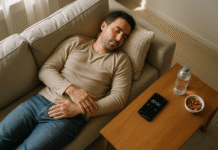
Your first priority is a repeatable block of sleep that overlaps by 3–4 hours every 24 hours, even when your shift pattern changes. This “anchor” stabilizes your circadian timing enough to make both work and days off survivable. On workdays, aim to sleep as soon as you get home and extend as long as possible; on days off, delay bedtime to the middle of the night and sleep to late morning or early afternoon to keep overlap with your post-shift sleep. This compromise schedule reduces circadian whiplash, preserves social time, and still protects a core dose of sleep. Most adults need ≥7 hours per 24 hours; if you can’t get it in one piece, use planned naps to top up.
1.1 How to do it
- Pick a fixed anchor (e.g., 08:30–12:30) that you keep daily; add 1–2 hours before or after on workdays.
- On days off, stay up to ~03:00–04:00 and sleep to noon–13:00 so some hours match post-shift sleep.
- Protect the anchor with phone silencing, door signs, and household agreements.
1.2 Numbers & guardrails
- Adults: target 7–9 h per 24 h (as of Aug 2025). If you average <7 h for a week, your risk of errors and crashes rises.
Wrap-up: a defendable anchor sleep window is the single habit that makes every other tactic work better.
2. Shape light like a pro: bright early in the shift, dim late, dark for the commute home
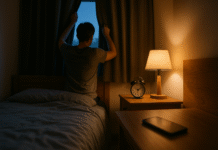
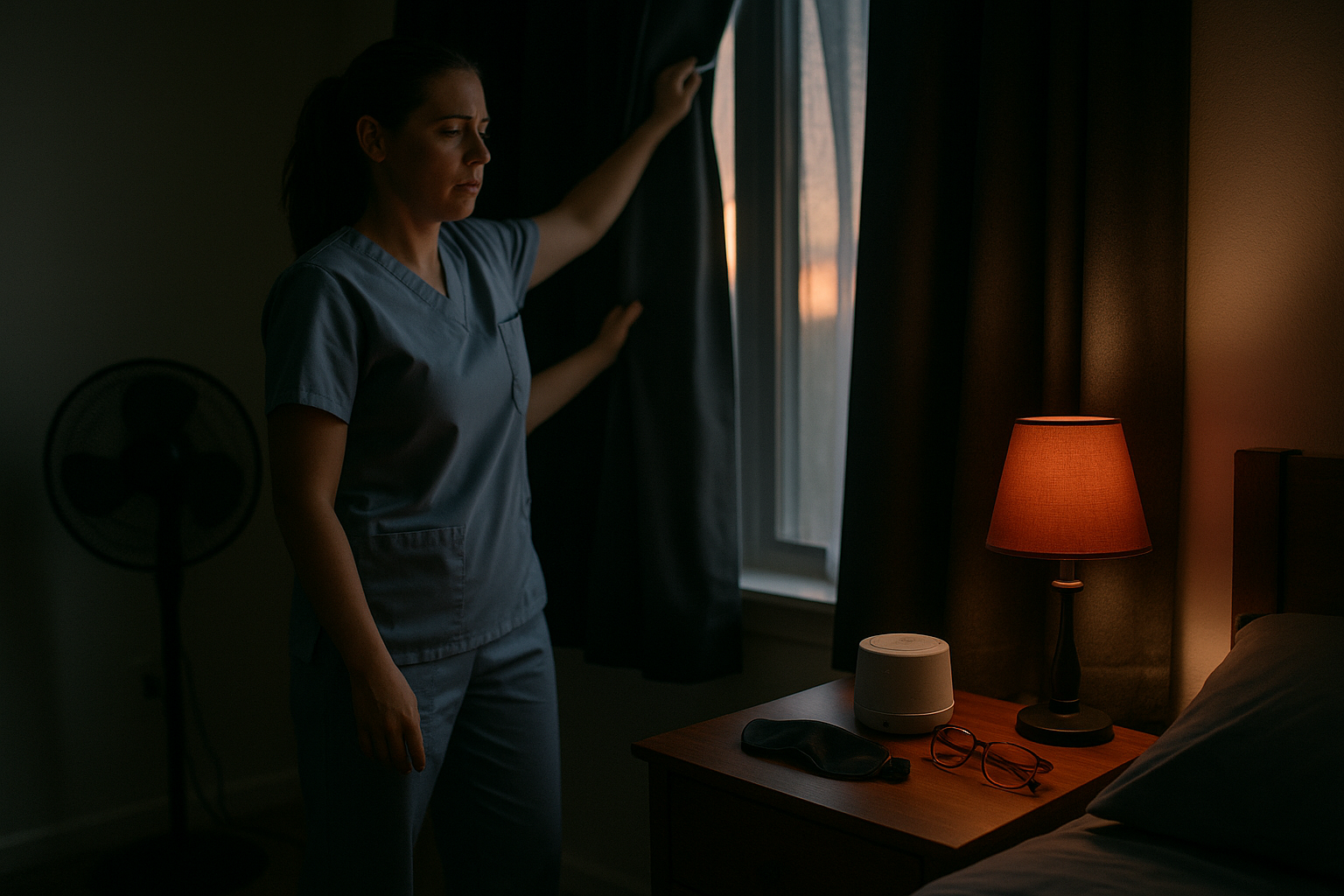
Light is your strongest circadian lever. To stay alert at work yet still sleep after sunrise, flood yourself with bright light in the first half of the shift, then dim exposure in the second half so your brain is ready for daytime sleep. Use bright overhead lighting or, if approved by your employer, a 7,000–10,000-lux light box for ~20–30 minutes early in the shift; then reduce brightness, switch to warmer/redder light late in the shift, and wear very dark sunglasses outside—especially on the commute home. At home, blackout curtains plus a dim red bedside lamp support melatonin and make falling asleep in daylight easier. PMCCDC Blogs
2.1 Why it matters
- Early-shift bright light boosts alertness; late-shift dim/red light avoids delaying your sleep once you clock out. Timed bright light is a standard therapy for circadian misalignment, including night work.
2.2 Tools & setup
- Workplace lighting: sit/stand in brighter zones first half; move to dimmer areas second half.
- Light box: typical research protocols use 7,000–10,000 lux for 20–30 minutes, positioned ~18–24 inches away. Consult your clinician if you have eye conditions or bipolar disorder.
- Commute: wraparound dark sunglasses; avoid direct morning sun exposure until you’re indoors.
Bottom line: treat light like a drug—dose early for alertness, taper late for sleep.
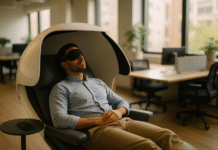
3. Use strategic naps as performance insurance
Short, well-timed naps are the safest way to blunt night-shift sleepiness without wrecking post-shift sleep. A 10–20 minute nap before or during a shift can lift alertness fast with minimal “sleep inertia” (that groggy hangover feeling). If your workplace allows, a proactive “NASA nap” of ~20–30 minutes mid-shift can meaningfully improve reaction time and vigilance; in flight crews, a planned 26-minute nap boosted alertness by ~54% and performance by ~34%. Keep naps short late in the shift to protect sleep when you get home; if you need a longer 90-minute nap, take it earlier and expect transient grogginess on waking.
3.1 Mini-checklist
- Pre-shift: 10–20 minutes 60–90 minutes before clock-in.
- Mid-shift: 10–30 minutes in a quiet, dark space; set two alarms.
- Post-shift: avoid long naps within 4–6 hours of your main sleep.
3.2 The “coffee nap” (optional)
Drink a small coffee, then nap 15–20 minutes so caffeine peaks as you wake; skip this if caffeine worsens anxiety or heartburn.
Takeaway: napping is a skill; short and early beats long and late.
4. Front-load caffeine—and stop 6 hours before your main sleep
Caffeine is a useful tool early in a night shift but a sleep-killer if mistimed. Evidence shows that 400 mg consumed even 6 hours before bedtime can reduce total sleep by over an hour; practical guidance is to concentrate caffeine in the first half of the shift and cease 6 hours before your intended sleep. Replace late-shift caffeine with cold water, light movement, bright light (briefly), or a 10-minute nap. Track your total daily dose (aim ≤300–400 mg unless your clinician says otherwise).
4.1 Quick rules
- Start: one cup near shift start; optional small top-ups hourly for first 3–4 hours.
- Stop: hard cutoff 6 hours before sleep.
- Avoid “hidden” caffeine (energy drinks, pre-workouts) late in the shift. Sleep Foundation
Synthesis: caffeine helps only if it doesn’t follow you into bed—control the clock.
5. Eat on a daytime rhythm and keep pre-sleep meals light
Night-shift eating can worsen blood sugar control and make sleep shallow. Aim to keep most calories in daylight hours and avoid large meals between midnight and 06:00 when possible. Finish your last meal 2–4 hours before sleep; if hungry sooner, choose a small, bland snack (e.g., yogurt, banana, toast). During the shift, graze on high-quality foods—fruit, vegetables, whole-grain sandwiches, soup—and hydrate. Emerging research suggests “daytime eating” may blunt some circadian-misalignment cardiometabolic risks during night work; while not a cure-all, the timing pattern helps many workers feel steadier.
5.1 On-shift food plan (example)
- Start of shift: balanced meal (protein + complex carbs + veg).
- Midnight–06:00: light snacks only; avoid heavy/fatty foods.
- End of shift: small, sleep-friendly bite if needed; then bed.
5.2 Guardrails
- Keep dinner 2–3 hours before sleep; irregular eating schedules can destabilize circadian rhythms. National Sleep FoundationSleep Foundation
Bottom line: time your calories to support deep sleep and stable energy.
6. Build a daytime sleep cave: dark, cool, quiet, and boring
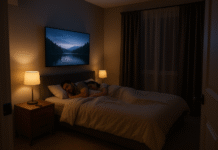
Your sleep environment has to overpower daytime noise and light. Make your room “night”: blackout curtains that truly seal the window edges, a cool temperature around 17–19°C (63–66°F), a steady fan or white-noise machine, and an eye mask plus comfortable earplugs. Remove or silence phones and doorbells. If family or housemates are home, agree on quiet hours, and use a “Do Not Disturb—Sleeping Days” sign to reduce interruptions. Small investments in insulation and soft furnishings (thick rug, door sweep) can further cut noise.
6.1 Mini-checklist
- Blackout + eye mask; door sweep/weather-strip gaps.
- White noise (fan or machine); phone on “Focus/Do Not Disturb.”
- Cool room; avoid heat-trapping bedding.
6.2 Region tip
In hot, bright climates (e.g., after an 08:00–10:00 commute under strong sun), sunglasses plus a direct route to your “sleep cave” prevent a second alertness spike. PMC
Takeaway: engineer the room so sleep wins even at noon.
7. Make your commute the safest part of your shift
The end of a night shift is peak biological sleepiness (roughly 02:00–05:00), and driving drowsy is common and deadly. If you feel sleepy, nap before driving, carpool, use public transport, or arrange a pickup. Recent U.S. data estimate ~17.6% of fatal crashes (2017–2021) involved a drowsy driver; newer analyses suggest under-reporting. Do not rely on hacks like loud music or cold air; they don’t restore alertness. If you catch yourself “micro-sleeping,” pull over immediately. AAA Newsroom
7.1 Crash-risk checklist
- Pre-drive nap 10–20 minutes if sleepy.
- Sunglasses and direct route home; avoid errands.
- If you’re nodding off: stop—nap—then reassess. Sleep Foundation
Synthesis: treat the drive like a safety-critical task; plan as carefully as your shift.
8. Design smarter schedules: when you can influence rosters
You can’t always choose your shifts, but when you can, prefer patterns that reduce circadian strain. Evidence-informed guidance from sleep societies urges employers to assess fatigue risk, limit excessively long shifts, allow recovery time between blocks, and consider forward-rotating schedules (days → evenings → nights) when rotation is necessary. As a rule of thumb, 24 hours off after a block of nights helps recovery; longer blocks may demand more time off. Keep days-off sleep partially aligned with your anchor. AASMNRSPP Australia
8.1 Practical asks
- Request predictable blocks (e.g., 3–4 consecutive nights) with 24+ hours recovery.
- Avoid frequent quick turnarounds; protect 12–16 hours between shifts where possible.
- Coordinate with teammates to preserve your anchor sleep window.
Bottom line: small scheduling wins add up to fewer errors and better health.
9. Consider melatonin and, if needed, prescription wake-promoters—under medical guidance
Low-dose melatonin (often 0.5–3 mg) taken several hours before your planned daytime sleep can modestly lengthen sleep and shift circadian timing; however, it doesn’t reliably improve on-shift alertness. A Cochrane review found daytime sleep after nights increased by ~24 minutes with melatonin; effect sizes vary. For persistent excessive sleepiness consistent with shift work disorder, clinicians sometimes prescribe modafinil or armodafinil to improve wakefulness; both are FDA-approved for SWD. These medicines do not replace sleep and have risks and interactions, so take only under supervision. AASM
9.1 How to deploy (with a clinician)
- Melatonin trial: start low (≈0.5–1 mg) 3–5 hours before planned sleep; adjust timing with guidance. AASM
- If severe on-shift sleepiness persists after optimizing basics, ask about SWD evaluation and treatment options.
Takeaway: supplements and prescriptions can fill gaps, but the foundation is timing light, sleep, and behavior.
10. Align your household and life admin with your sleep
Great sleep hygiene fails if family, deliveries, and group chats wake you. Set shared rules for quiet hours during your anchor sleep; use door signs, delivery instructions (“Leave at door—day sleeper”), and shared calendars. Park noisy chores (vacuuming, blender, laundry) outside your core sleep block. If you’re a caregiver, plan coverage during the anchor window and use naps to patch unavoidable disruptions. White noise and earplugs help if total quiet isn’t realistic. Sleep Health Foundation
10.1 Mini-checklist
- Household agreement on “sleep hours”; mute group chats.
- Delivery notes set to “no doorbell.”
- Batch errands/social time to align with your non-sleep hours.
Synthesis: protect your sleep like a meeting with your future, safer self.
11. Move your body—at the right times
Exercise supports sleep depth and mood, but timing matters. Light movement during a shift (short walks, gentle mobility) fights sleepiness. Save vigorous workouts for non-sleep times and avoid intense exercise right before your daytime sleep, which can raise core temperature and delay sleep onset. A simple pre-sleep wind-down—wash up, dim lights, stretch—helps your brain shift gears from work mode to sleep mode.
11.1 A quick on-shift routine
- Every 60–90 minutes: 3–5 minutes of walking + shoulder/hip mobility.
- Late shift: switch to gentler movement and dimmer light to prep for sleep.
Wrap-up: exercise is a sleep ally—just don’t park it on your pillow’s doorstep.
12. Plan your “reset” after a block of nights
Switching back to days is easier with a plan. After your final night, take a short morning nap (60–90 minutes) to get home safely, then use bright midday/afternoon light and an earlier-than-usual bedtime to start re-anchoring. On days off, aim for that compromise schedule: stay up to the middle of the night and sleep to noon–13:00 so some hours overlap with your workday sleep; then gradually shift earlier. Keep meals on a daytime rhythm as you transition.
12.1 Reset checklist
- Post-shift: safety nap → sunlight exposure → light, early dinner → early bedtime.
- Next day: wake at your target daytime hour; get outdoor light; no late caffeine.
- Maintain partial overlap with your anchor until you’re fully back on days.
Bottom line: a deliberate reset protects both safety and social life.
FAQs
1) What is “shift work disorder,” and how is it different from normal tiredness?
Shift work disorder (SWD) is a circadian rhythm sleep-wake disorder marked by insomnia and/or excessive sleepiness tied specifically to a work schedule that overlaps usual sleep time. If you’re persistently sleepy at work despite good sleep hygiene, or you average <7 h despite trying, talk to a clinician; treatments may include timed light, behavioral strategies, melatonin, and, when needed, wake-promoting medications.
2) I rotate every week. Should I still keep an anchor sleep window?
Yes. Even 3–4 hours of overlapping sleep daily stabilizes your rhythm enough to reduce fatigue and make transitions less brutal. Pair that anchor with early-shift bright light, late-shift dimming, and consistent meal timing to keep your system from spinning.
3) Are 10,000-lux light boxes safe?
Light therapy is an established treatment for circadian disorders when properly timed. Typical devices deliver ~10,000 lux at a set distance; avoid direct staring at the lamp, and review contraindications (retinal disease, photosensitizing meds, bipolar disorder) with a clinician. At work, even brighter ambient lighting early in the shift and dimmer/redder lighting late can help.
4) Do blue-blocking glasses actually help night workers sleep?
Evidence is mixed. Some studies and reviews suggest evening blue-blocking glasses can reduce sleep onset latency and improve subjective sleep, but standardization varies. More robust support exists for shaping light exposure (bright early, dim late) and blackout environments. If you try glasses, treat them as an add-on, not a substitute. PubMedHarvard Health
5) What caffeine plan works best on nights?
Front-load caffeine early (first half of the shift), then stop at least 6 hours before your main sleep. Even a single 400 mg dose 6 hours pre-bed can cut more than an hour of sleep. Use water, movement, timely light, and short naps instead late in the shift.
6) Is melatonin worth trying?
For some night workers, low-dose melatonin taken several hours before daytime sleep adds ~20–30 minutes of sleep and can help shift the body clock; it doesn’t reliably improve on-shift alertness. Start low and talk to a clinician, especially if you take other medications.
7) I’m always starving at 03:00. What should I eat?
Keep it small and simple: yogurt, fruit, whole-grain toast, or soup. Avoid heavy, fatty meals that lead to a “food coma,” and try to keep most calories in daylight hours. Finish your last proper meal 2–4 hours before sleep to reduce reflux and enable deeper sleep. CDC
8) How much sleep do adults actually need?
Most adults need at least 7 hours per 24 hours; many feel best at 7–9. If you’re consistently short, expect more errors, slower reaction times, and worse mood—and your crash risk climbs, especially after nights. PMC
9) Is drowsy-driving risk really that high after nights?
Yes. Analyses of U.S. fatal crashes estimate around 17% involve a drowsy driver, and many incidents go unreported. If you’re nodding off, don’t drive—nap, share a ride, or use public transport.
10) How should I transition back to days after a run of nights?
Use a short post-shift nap for safety, then lots of daytime light and an earlier bedtime. Keep some overlap with your anchor sleep for a day or two, then step earlier. Don’t binge caffeine late in the day; keep meals on a daytime clock as you shift. CDCSleep Foundation
11) Does exercise help me sleep after nights?
Yes—regular activity improves sleep quality and mood. Just avoid vigorous exercise right before your daytime sleep; instead, use a brief wind-down routine (wash up, dim lights, light stretch) to lower arousal and body temperature. CDC
12) What if I’ve optimized everything and I’m still exhausted?
It may be time for a formal evaluation for SWD or another sleep disorder (e.g., obstructive sleep apnea). A sleep clinician can tailor light timing, trial melatonin, screen for apnea, and consider prescription wake-promoters if appropriate. Safety comes first—especially if you drive or operate machinery.
Conclusion
Night shifts don’t have to cost your health or safety, but they do demand structure. Lock a defendable anchor sleep window; treat light like a drug—high early, low late; nap with intent; front-load caffeine; time meals on a daytime rhythm; and engineer a bedroom that beats noon. Protect your commute, shape schedules when you can, and get clinical support if sleepiness or insomnia persist—especially if your job is safety-critical. The plan is iterative: pick two strategies to implement this week (e.g., light timing + caffeine cutoff), measure your sleep time and alertness, then add a new step every few days. With consistent practice, most night workers can recover more sleep, feel sharper on shift, and reclaim their days.
CTA: Choose two strategies from above and block 20 minutes today to set them up—your next shift will feel different.
References
- Module 9: Coping with the Night and Evening Shifts (Light & Sleep Schedule), CDC/NIOSH, updated 2024. https://www.cdc.gov/niosh/work-hour-training-for-nurses/longhours/mod9/03.html and /06.html
- Bright Light Therapy (Patient Page), Sleep Education by the American Academy of Sleep Medicine, May 6, 2021. https://sleepeducation.org/patients/bright-light-therapy/
- Huang LB et al. The Effectiveness of Light/Dark Exposure to Treat Insomnia in Shift Workers, Journal of Clinical Sleep Medicine, 2013. https://jcsm.aasm.org/doi/10.5664/jcsm.2824
- Drake C et al. Caffeine effects on sleep taken 0, 3, or 6 hours before bedtime, J Clin Sleep Med, 2013. https://pubmed.ncbi.nlm.nih.gov/24235903/ and https://pmc.ncbi.nlm.nih.gov/articles/PMC3805807/
- Liira J et al. Pharmacological interventions for sleepiness and sleep disturbances caused by shift work, Cochrane Review, 2014. https://www.cochranelibrary.com/cdsr/doi/10.1002/14651858.CD009776.pub2/pdf/full
- Best Sleep Schedule for Night Shift Workers, Sleep Foundation, 2023–2024 (updated). https://www.sleepfoundation.org/circadian-rhythm/best-sleep-schedule-night-shift-workers
- Hilditch CJ. The benefits of napping for safety (NASA/FAA fatigue materials), 2019. https://ntrs.nasa.gov/api/citations/20190033981/downloads/20190033981.pdf
- Drowsy Driving in Fatal Crashes, United States 2017–2021, AAA Foundation for Traffic Safety, 2024. https://aaafoundation.org/drowsy-driving-in-fatal-crashes-united-states-2017-2021/
- About Sleep—How Much Sleep Do I Need?, CDC, May 15, 2024. https://www.cdc.gov/sleep/about/index.html
- Circadian Adaptation to Shift Work (Provider Fact Sheet), American Academy of Sleep Medicine, 2022. https://aasm.org/wp-content/uploads/2022/07/ProviderFS-ShiftWork.pdf
- Treatments for Shift Work Disorder, Sleep Foundation, 2025. https://www.sleepfoundation.org/shift-work-disorder/treatment
- Study finds daytime meals may reduce health risks linked to night shift work, NIH News Release, Dec 3, 2021 (and related 2025 translational data). https://www.nih.gov/news-events/news-releases/study-finds-daytime-meals-may-reduce-health-risks-linked-night-shift-work
- PROVIGIL® (modafinil) label and NUVIGIL® (armodafinil) label, FDA, latest labels referenced 2015–2017. https://www.accessdata.fda.gov/drugsatfda_docs/label/2015/020717s037s038lbl.pdf and https://www.accessdata.fda.gov/drugsatfda_docs/label/2017/021875s023lbl.pdf
- Healthy Sleep Practices for Shift Workers, Sleep Health Foundation (Australia), 2025. https://www.sleephealthfoundation.org.au/sleep-topics/healthy-sleep-practices-for-shift-workers