




















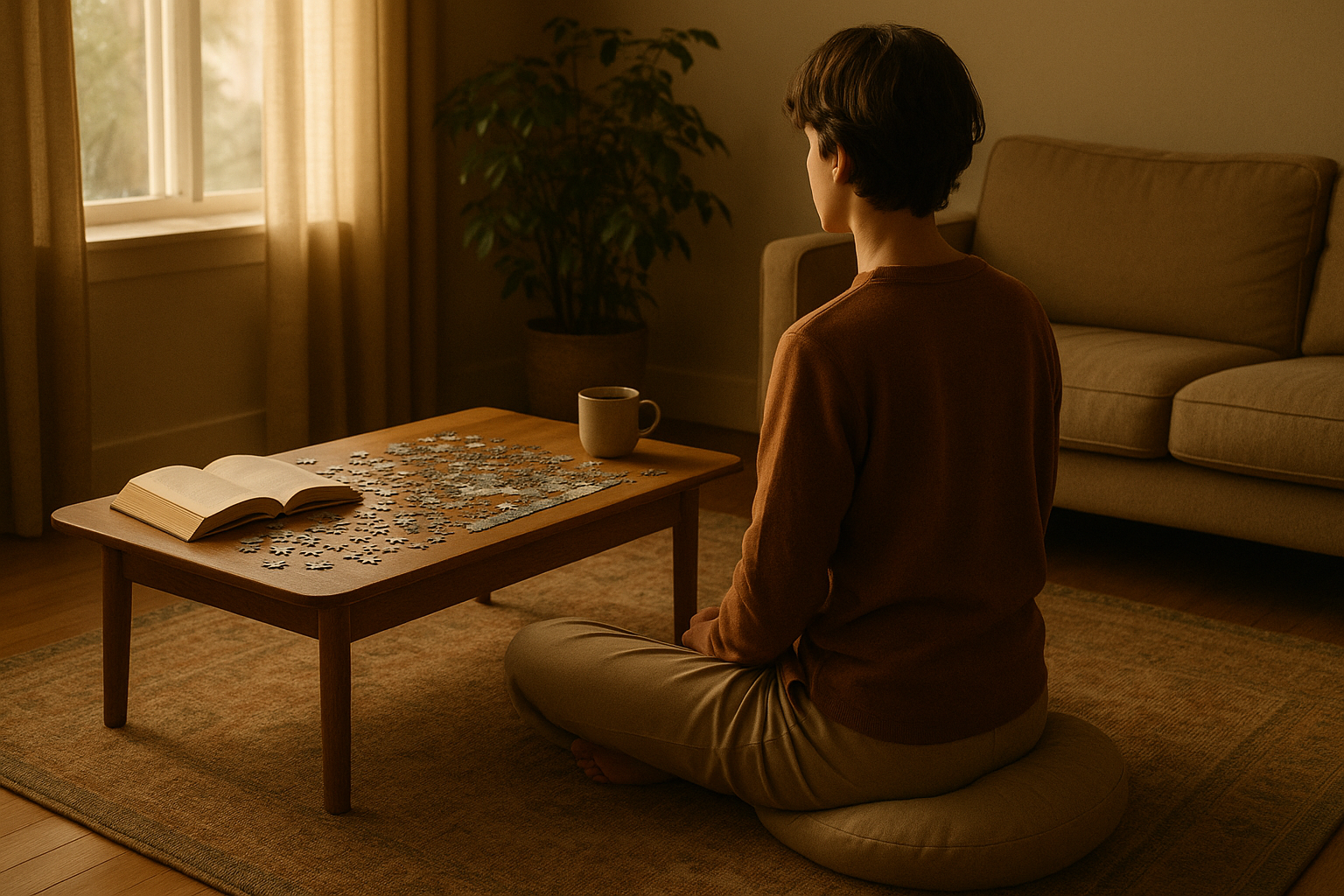
If you’re an introvert, the right solo hobbies don’t just fill time—they refill energy. This guide shows how to build a sustainable practice around three introvert-friendly pillars: reading, puzzles, and meditation. You’ll get concrete how-tos, tools, and numbers (like session lengths and difficulty levels) so you can start today without the noise. Quick note: This article is informational and not medical advice—if you’re managing a health condition, consult a qualified professional.
Quick answer: The best solo hobbies for introverts are quiet, self-paced, and restorative. Reading, puzzles, and meditation check all three boxes: they create focused immersion, reduce overstimulation, and support long-term well-being. Try 10–20 minutes per day to begin, pick one practice from the list below, and increase gradually as it becomes rewarding.
Fast start checklist (optional):
- Pick one practice below and schedule 15 minutes daily.
- Track mood/energy before vs. after on a 1–5 scale for 2 weeks.
- Nudge difficulty up slowly (harder book, puzzle, or longer sit).
- Keep tools visible: a book by the kettle, a puzzle on a board, a mat out.
- Reduce friction: silent phone mode, one tab, timer set.
1. Build a Deep-Reading Ritual (20–30 Minutes a Day)
A deep-reading ritual is the simplest, most reliable way for introverts to recharge because it gives your mind privacy and structure. Start by choosing a consistent time (mornings before messages or nights before bed), a repeatable place (armchair, balcony), and a narrow gate on inputs (one book, one device if you must). Read at a comfortable pace—no pressure to finish a chapter every session. The aim is to place your attention in one rewarding thread long enough to downshift arousal and invite absorption. Over weeks, this repeated context becomes a cue: sit, open, breathe, read. You’ll find your focus lengthening, your scrolling urge softening, and your sleep pressure improving on reading nights.
1.1 Why it works
Deep reading recruits attention, language, memory, and imagination in one flow, which is ideal for quiet engagement. Unlike social feeds, there’s no push-based interruption, which reduces cognitive switching and leaves you less overstimulated at the end.
1.2 How to do it
- Set the container: 20–30 minutes, same time daily, phone in another room.
- Prime immersion: 3 slow breaths; read a page you loved last time to re-enter.
- Choose formats wisely: Paper for fewer distractions; e-ink if space is tight.
- Stop while it’s good: End mid-scene to make tomorrow’s return effortless.
Close: A small daily ritual compounds into a dependable off-ramp from noise, especially for introverts who gather energy in solitude.
2. Annotate and Keep a Commonplace Notebook
For many introverts, the delight isn’t just reading—it’s capturing sparks without having to perform for anyone. A commonplace system lets you underline passages, jot questions, and store quotes or insights in one place. This deepens attention (because you’re reading to notice) and keeps ideas available for later projects, decisions, or creative work. The goal isn’t perfect notes; it’s building a gentle loop where reading leads to reflection and reflection feeds the next book.
2.1 Tools & examples
- Analog: Pencil + margins; sticky tabs for themes; an A5 notebook for quotes.
- Digital: Readwise Reader, Obsidian, Notion, or Apple Notes with simple tags.
- Light structure: Date → Book → 3 quotes → 1 question → 1 application.
2.2 Mini-checklist
- Tag entries with topics (focus, sleep, career, relationships).
- Revisit weekly for 5 minutes and star anything to act on.
- Keep one system; avoid migrating every month.
Close: A commonplace notebook makes quiet reading “stickier” and more satisfying—perfect for introverts who value depth over volume.
3. Curate a Personal Reading Pipeline (TBR, Devices, Apps)
Decision fatigue ruins reading time. A lightweight pipeline—discovery → queue → currently reading → finished—keeps you in flow with zero hunting. Maintain a short “to-be-read” list (no more than 12 titles), balance one challenging and one comfort read, and store samples (first chapters) to test fit. In South Asia (and elsewhere), low-cost paperbacks and e-books make it easy to keep options handy; libraries and used-book shops can stretch budgets.
3.1 Numbers & guardrails
- Queue size: 8–12 books max; archive the rest to avoid overwhelm.
- Cadence: 20–30 minutes on weekdays; 60–90 minutes on weekends.
- Diversity: Alternate fiction/nonfiction or heavy/light to prevent burnout.
3.2 Common mistakes
- Over-queuing (50+ titles you’ll never start).
- Treating reading as a should; pick books that pull.
- Keeping the phone within reach; use airplane mode or e-ink.
Close: A simple pipeline frees your attention to read—not to manage reading.
4. Crossword Training for Working Memory & Recall
Crosswords are a focused, non-social way to exercise retrieval, pattern recognition, and flexible thinking. They’re especially fitting for introverts because you can work quietly in short bursts and feel tangible progress as the grid fills. Evidence suggests crossword training can improve cognitive outcomes in some older adults relative to other digital games; while research continues to evolve, many find crosswords satisfying precisely because the challenge ramps predictably.
4.1 How to do it
- Leveling: Start with “easy” daily puzzles; aim to complete in 10–20 minutes.
- Schedule: 1–3 puzzles per week; advance difficulty as average time drops.
- Technique: Fill the grid with short entries first; pencil in likely crosses.
- Platforms: Print books; The New York Times, Guardian, or local-language apps.
4.2 Mini case
Beginner finishes Monday grids in ~20 minutes, moves to Tuesday after 2 weeks, and starts finishing midsize themed puzzles by week 6—reporting less aimless phone time in the evenings.
Close: Crosswords turn idle minutes into a satisfying, brain-engaging ritual—ideal for quiet recharge.
5. Jigsaw Puzzles for Flow and Stress Relief
Jigsaw puzzling offers tactile focus and visual calm. Spreading pieces on a board invites a single-task environment where your hands guide attention and your eyes find patterns—not notifications. Many puzzlers report a pleasant sense of flow, and research indicates jigsaw puzzling engages multiple cognitive abilities; long-term practice may be linked to cognitive benefits even if short-term gains are modest. For introverts, a puzzle can live on a table for days, ready for five peaceful minutes whenever you need them.
5.1 How to do it
- Setup: Use a board you can slide away; sort edges and color groups first.
- Sizing: 500 pieces for evenings; 1,000 pieces for weekend flow.
- Lighting: Soft, even light to reduce eye strain; store pieces in trays.
- Theme: Pick calming artwork—landscapes, botanicals, abstract gradients.
5.2 Pitfalls to avoid
- Overly dark images for your first 1,000-piece attempt.
- Working when fatigued; stop while traction is high.
- Crowding the board; give yourself visual breathing room.
Close: Jigsaws create a screen-free pocket of attention that introverts can enter and exit on their own terms.
6. Logic Puzzles (Sudoku, KenKen, Nonograms) for Problem-Solving
Logic puzzles build quiet grit: you sit with a constrained problem until it yields. That patience and methodical attention generalize to focused work. While claims about permanent IQ boosts are overstated, logic puzzles do train skills you use immediately—working memory, inhibition (don’t guess prematurely), and systematic strategy.
6.1 Tools & strategies
- Sudoku: Start with easy/medium; use pencil marks; ban wild guesses.
- KenKen/Killer: Practice arithmetic cages to strengthen mental math.
- Nonograms/Picross: Solve rows with definite counts before inferences.
- Cadence: 10–15 minutes daily; raise difficulty only when error rate <5%.
6.2 Mini-checklist
- Keep a puzzle streak calendar.
- Note one technique learned per session (e.g., X-Wing, hidden single).
- Switch puzzle types weekly to avoid plateauing.
Close: Logic puzzles give you a quiet laboratory for thinking—perfect for introverts who enjoy structure without small talk.
7. Spatial & Mechanical Puzzles (Cubes, Burrs) for Tactile Focus
Mechanical puzzles (Rubik’s-style cubes, twisty puzzles, wooden burrs) are a beautiful marriage of hands and mind. They provide kinesthetic focus and a visible path from chaos to order—turns, algorithms, click. Unlike passive relaxation, these puzzles reward deliberate practice: learn a beginner method, time a solve, shave seconds. For introverts who like self-directed mastery, this is catnip.
7.1 How to do it
- Start small: 3×3 cube with a beginner CFOP variant; goal: sub-2-minute solve.
- Habits: 10 turns slow, 10 turns fast; repeat for 10 minutes to groove.
- Wooden burrs: Begin with 6-piece notched burrs; observe piece symmetry.
- Maintenance: Store lubricants and a cloth; log solves to see improvement.
7.2 Common mistakes
- Memorizing algorithms without understanding cube state.
- Jumping to 4×4+ too soon; build confidence on 3×3 first.
- Forcing pieces; mechanical puzzles reward gentle precision.
Close: Tactile puzzles deliver silent, absorbing progress—a satisfying recharge loop for solitary minds.
8. Solo Strategy “Puzzles” (Chess Puzzles, Solitaire Variants)
Strategy puzzles let you practice decision-making without an opponent. Chess tactics trainers, Go life-and-death problems, or nuanced solitaire variants (Spider, FreeCell) give you closed-loop feedback: you try an idea, the position answers. Because they’re time-boxed and self-paced, introverts can enjoy strategic depth without social energy costs.
8.1 Tools & numbers
- Chess: Daily tactics sets of 10–20 positions; aim for 80–90% accuracy.
- Go: 10–15 tsumego problems; reattempt misses after 24 hours.
- Solitaire: Track win % and average moves; raise difficulty once win % >70.
8.2 How to improve
- Pattern library: Name motifs (pin, fork, ladder, snapback) to encode memory.
- Review misses: Spend more time on errors than on easy wins.
- Short sessions: 15 minutes before work as a clean mental warm-up.
Close: Strategy puzzles give you competitive depth with none of the crowd—just the kind of focused solitude introverts prefer.
9. Mindfulness Breath Meditation (5–10 Minutes at ~6 Breaths/Min)
Breath meditation is a low-friction, high-return practice: sit, feel the breath, notice attention wander, return. As a daily habit, it can reduce stress reactivity and improve sleep quality for some people. A practical cue: guide your breathing toward about 5–7 breaths per minute (roughly a 5–6 second inhale and exhale) if it feels comfortable—this rate is often associated with higher heart-rate variability (a marker of flexible, calm physiology). If slower breathing feels uncomfortable, return to natural breath and simply observe.
9.1 How to do it
- Setup: 5–10 minutes, upright on a cushion or chair, eyes soft or closed.
- Anchor: Feel air at nostrils or belly movement; silently label “in, out.”
- When distracted: Note “thinking” or “hearing,” then gently return.
- Guardrails: If you feel dizzy or air-hungry, stop slowing the breath.
9.2 Mini-checklist
- Practice at the same time daily.
- Pair with a cue (boiling kettle, brushing teeth).
- Track 1–10 calmness before/after for 2 weeks to see trends.
Close: Breath meditation is the introvert’s reset button—no gear, no audience, just a quiet nervous system tune-up.
10. Walking Meditation for Calm Focus
Walking meditation blends gentle movement with attention training—great if you find sitting difficult or restless. You walk slowly in a private space (hallway, balcony, garden), synchronizing steps with breath or silent labels (“lift, move, place”). Small studies suggest mindful walking can reduce stress symptoms and improve mood; even 10 minutes can help. For introverts, it’s a way to steady the mind without sitting still or facing a crowd.
10.1 How to do it
- Path: 5–10 meters; walk back and forth; eyes soft; shoulders relaxed.
- Cadence: Natural pace; if anxious, slow slightly to feel footfall details.
- Attention: Notice heel-to-toe roll, weight shift, air on skin.
- Timing: 10–15 minutes at lunch or as an evening transition.
10.2 Tips & pitfalls
- Start indoors if self-conscious outdoors.
- Avoid multitasking (no podcasts); this is attention practice.
- If rumination spikes, whisper a simple cue word (“here”).
Close: Walking meditation gives you a portable, private practice to settle the mind anywhere.
11. Loving-Kindness (Metta) to Soften Self-Talk
Loving-kindness meditation (LKM) involves repeating kind phrases toward yourself and others (“May I be safe, healthy, peaceful”). For many introverts—especially those sensitive to overstimulation and self-criticism—this shifts inner tone from evaluative to friendly. Meta-analyses indicate LKM can increase positive emotions and self-compassion over time, though outcomes vary by person and practice dose.
11.1 How to do it
- Structure (10–15 minutes): Self → a friend → a neutral person → all beings.
- Phrases: Keep them simple; repeat slowly with feeling.
- Obstacles: If warmth feels forced, begin with neutral goodwill (ease, steadiness).
11.2 Mini-checklist
- Choose one phrase set for a month.
- Pair LKM after breath meditation; start with 5 minutes.
- Notice spillover: kinder self-talk, easier recovery from mistakes.
Close: LKM replaces harsh inner commentary with a gentle baseline—quiet resilience for introverted nervous systems.
12. Body Scan & Yoga Nidra to Prepare for Sleep
Body scan and yoga nidra are guided practices that rotate attention through the body, cueing muscles and the mind to disengage. RCTs and reviews suggest mindfulness-based approaches can improve sleep quality for some people, and early trials of yoga nidra show promise for insomnia. As a nightly wind-down, a 15–30 minute audio can be the difference between stuck-awake rumination and a smooth descent into sleep.
12.1 How to do it
- Setup: Dim lights; lie down or recline; blanket for warmth.
- Guide: Use a reputable recording; keep volume low, phone on Do Not Disturb.
- Pacing: If sleepy, choose short tracks; if wired, try 20–30 minutes.
- Consistency: 4–5 nights per week for 3–4 weeks before judging.
12.2 Mini-checklist
- Avoid screens 30–60 minutes before practice.
- If you wake at night, run a short body scan instead of scrolling.
- Keep notes on sleep onset and night awakenings to see patterns.
Close: A calming somatic routine gives introverts a private, repeatable way to slide out of the day and into rest.
FAQs
1) What makes a hobby especially good for introverts?
The best options are quiet, self-paced, and restorative. They minimize unpredictable social input, reduce cognitive switching, and provide a sense of progress. Reading, puzzles, and meditation all offer clear start/stop points, adjustable difficulty, and the safety of solitude—key ingredients when you recharge alone.
2) How long should I practice each day to feel a difference?
Start with 10–20 minutes for any one practice and hold that for two weeks. If you feel calmer or more focused afterward on most days, extend by 5 minutes. Consistency beats intensity; a short daily session outperforms a long, irregular binge.
3) Is e-reading worse than paper for deep focus?
Paper usually has fewer distractions, but e-ink readers are excellent if you keep notifications off. If you read on a phone/tablet, use airplane mode and a single reading app. The best format is the one that keeps you reading without alerts.
4) Do puzzles actually improve brain health?
They reliably exercise attention, memory, and problem-solving during practice. Some studies in older adults suggest benefits for certain outcomes (e.g., crosswords vs. some games), but results vary and don’t guarantee disease prevention. Treat puzzles as mental fitness, not a cure-all.
5) I get anxious sitting still—should I skip meditation?
Try walking meditation or brief breath-focused sits of 3–5 minutes. You can also do body scans while lying down. If discomfort spikes, shorten sessions and return to natural breathing. Seek professional guidance if anxiety persists or worsens.
6) What breathing rate should I use in meditation?
If you’re using a paced-breathing practice, 5–7 breaths per minute (about 6 seconds in, 6 seconds out) is often associated with higher heart-rate variability, but comfort comes first. If slower breathing feels uncomfortable, observe your natural breath instead.
7) How do I pick puzzle difficulty without burning out?
Use a 70–85% success window. If you’re breezing through, increase difficulty; if you’re stuck more than half the time, step down a level. Track solve times weekly to make adjustments.
8) Can these hobbies help with sleep?
A calm evening read (non-thriller), gentle breathing, or a body scan/yoga nidra can support sleep for many people. Evidence suggests mindfulness-based programs can improve sleep quality for some groups. Keep screens off and keep sessions relaxing, not stimulating.
9) How do I stay consistent when life gets busy?
Attach your practice to a fixed cue (boiling kettle → read 5 pages; lunch → walk meditation; evening tea → 10 puzzle minutes). Keep tools visible and sessions short. Missed a day? Resume tomorrow—no backlog.
10) Are there budget-friendly ways to do all this?
Yes: libraries, used books, free puzzle apps, print-at-home logic grids, and countless free guided meditations. A notebook and pencil can serve as your commonplace system for years.
Conclusion
Introverts thrive on quality of attention. Reading, puzzles, and meditation offer repeatable containers for that attention—safe spaces where you choose the input and the pace. Start with one practice for 10–20 minutes a day and protect it like an appointment. Let your system tell you what works: more calm after breath practice, more focus after crosswords, better sleep after body scans. Increase difficulty or time slowly, keep tools visible, and track small wins so progress stays obvious. Over months, these quiet routines become a foundation for energy, clarity, and steadiness—even on crowded days.
Pick one practice from the list and start a 14-day, 15-minutes-a-day experiment—your future, better-rested self will thank you.
References
- Introversion — APA Dictionary of Psychology, American Psychological Association, Apr 19, 2018. https://dictionary.apa.org/introversion
- Meditation and Mindfulness: Effectiveness and Safety, National Center for Complementary and Integrative Health (NCCIH), Jun 3, 2022. https://www.nccih.nih.gov/health/meditation-and-mindfulness-effectiveness-and-safety
- Goyal M. et al. “Meditation Programs for Psychological Stress and Well-being,” JAMA Internal Medicine, 2014. https://jamanetwork.com/journals/jamainternalmedicine/fullarticle/1809754
- Devanand D.P. et al. “Computerized Games versus Crosswords Training in Mild Cognitive Impairment,” NEJM Evidence, 2022. https://evidence.nejm.org/doi/full/10.1056/EVIDoa2200121
- Fissler P. et al. “Jigsaw Puzzling Taps Multiple Cognitive Abilities and Is a Potential Protective Factor for Cognitive Aging,” Frontiers in Aging Neuroscience, 2018. https://www.frontiersin.org/journals/aging-neuroscience/articles/10.3389/fnagi.2018.00299/full
- Soer R. et al. “Influence of Respiration Frequency on Heart Rate Variability and Stress,” Applied Psychophysiology and Biofeedback, 2021. https://pubmed.ncbi.nlm.nih.gov/34024811/
- Steffen P.R. et al. “Integrating Breathing Techniques Into Psychotherapy,” Frontiers in Psychology, 2021. https://www.frontiersin.org/journals/psychology/articles/10.3389/fpsyg.2021.624254/full
- Teut M. et al. “Mindful Walking in Psychologically Distressed Individuals,” Evidence-Based Complementary and Alternative Medicine, 2013. https://pmc.ncbi.nlm.nih.gov/articles/PMC3747483/
- Edwards M.K. et al. “Experimental Effects of Brief, Single Bouts of Walking and Meditation on Mood,” Mindfulness, 2018. https://pmc.ncbi.nlm.nih.gov/articles/PMC6064756/
- Black D.S. et al. “Mindfulness Meditation and Improvement in Sleep Quality and Daytime Impairment,” JAMA Internal Medicine, 2015. https://jamanetwork.com/journals/jamainternalmedicine/fullarticle/2110998
- Rusch H.L. et al. “The Effect of Mindfulness Meditation on Sleep Quality,” Annals of the New York Academy of Sciences, 2018. https://pmc.ncbi.nlm.nih.gov/articles/PMC6557693/
- Hofmann S.G. et al. “Loving-Kindness and Compassion Meditation,” Social and Personality Psychology Compass, 2011. https://pmc.ncbi.nlm.nih.gov/articles/PMC3176989/
- Zeng X. et al. “The Effect of Loving-Kindness Meditation on Positive Emotions,” Journal of Positive Psychology, 2015. https://pmc.ncbi.nlm.nih.gov/articles/PMC4630307/
- Petrovic J. et al. “Effects of Loving-Kindness Interventions on Positive and Negative Affect: Meta-Analysis,” Clinical Psychology Review, 2024. https://www.sciencedirect.com/science/article/pii/S0272735824000540