




























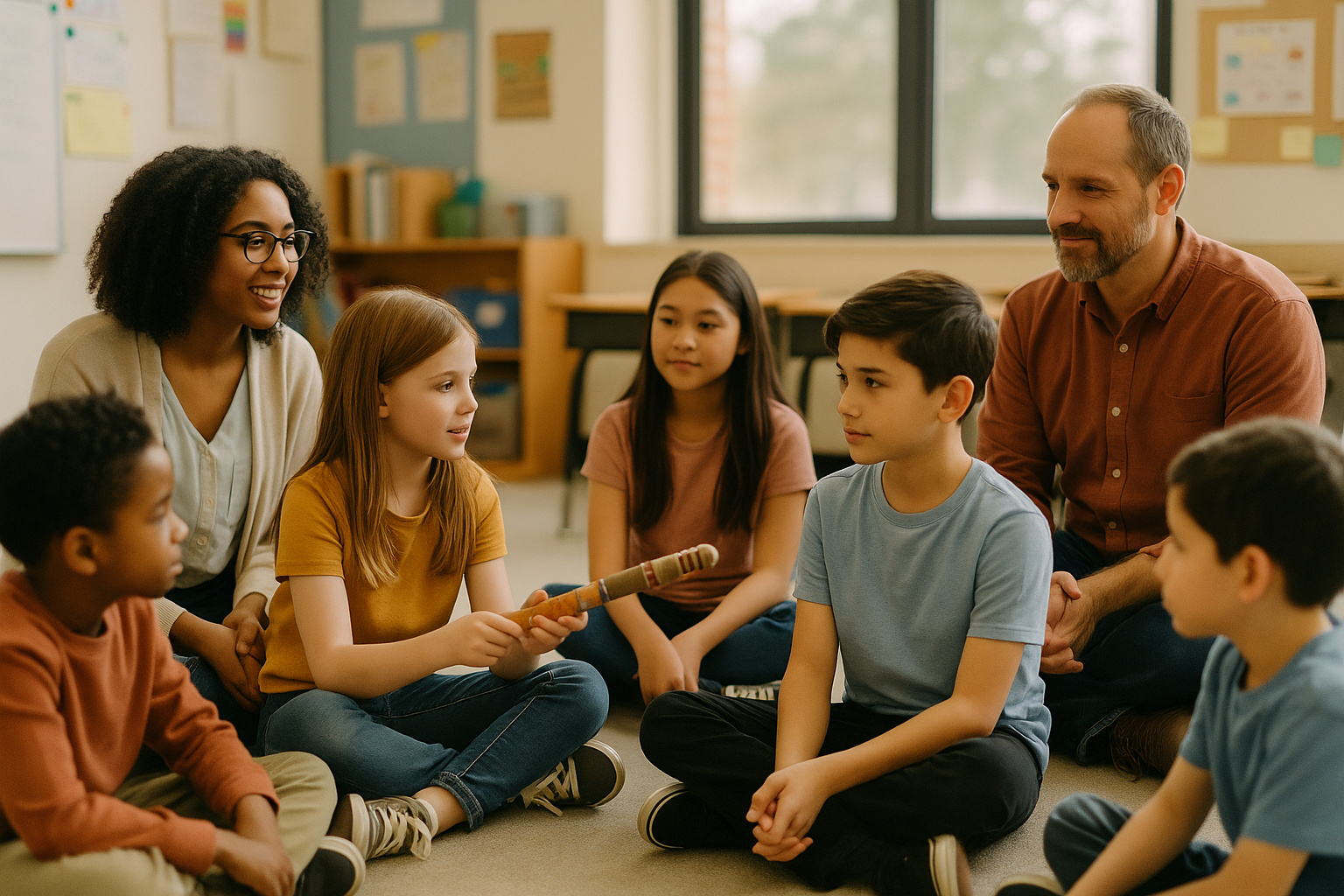
Empathy is the capacity to understand and share another person’s feelings and point of view; it includes both recognizing what someone else feels and caring enough to respond helpfully. That capacity develops with guidance and practice, not just good intentions. In homes and classrooms, you can teach empathy by modeling it, naming feelings, creating structured chances to practice perspective-taking, and repairing harm after conflict. Well-designed social-emotional learning (SEL) programs that nurture empathy are linked with better behavior and academic gains—on average, an 11-percentile boost in performance across 213 school-based studies.
Quick-start steps: Model empathy out loud, coach feeling words, give daily “listening turns,” use restorative conversations after conflict, pair students for service or buddy work, and coach digital empathy before kids go online.
This article is educational and not a substitute for professional mental-health care or legal guidance.
1. Model Everyday Empathy—Out Loud and Often
Empathy teaching starts with adults demonstrating it in real time. When caregivers and teachers consistently narrate how they notice, name, and respond to emotions, children internalize those patterns. The more kids receive empathy themselves, the more likely they are to adopt empathic responses with peers. Harvard’s Making Caring Common project emphasizes that children learn empathy by watching us and by experiencing our empathy toward them; secure, trusting relationships make them more receptive to our values and modeling. In practice, that means slowing down, reflecting feelings (“You look disappointed about the group assignment”), and pairing compassion with boundaries (“I hear you’re upset; let’s find a fair next step”). UNICEF’s guidance for communicating with adolescents also underlines presence and attentive body language to convey care. UNICEF
How to do it
- Narrate noticing: “I’m seeing furrowed brows—this might feel frustrating. Let’s pause.”
- Name and normalize: Briefly label emotions and share a personal regulation strategy you’re using.
- Micro-repair: If you snapped, apologize quickly and state how you’ll reset.
- Spotlight kindness: Catch and name peer empathy moments (“I heard you check on Ali—nice”).
- Make it routine: Start class or dinner with a 60-second “feelings check-in.”
Common mistakes
- Only praising outcomes (“You got an A!”) while neglecting caring acts.
- Dismissing “small” feelings (“No big deal”) which teaches kids to hide emotions.
Close: Children mirror the emotional climate around them—so consistent, audible empathy from adults is your most reliable teaching tool. Making Caring Common
2. Coach Feeling Words and Validation (Emotion Coaching)
Emotion coaching gives children language and skills to notice, name, and regulate feelings—an essential foundation for empathic responses. Longitudinal research shows that parents who coach emotions buffer preschoolers from negative stress effects and support better self-regulation; emotion-coached children demonstrate stronger attention and adaptive behavior. PMC Studies on parental meta-emotion philosophy—their beliefs about feelings—link warm, validating responses with healthier child outcomes. John Gottman
How to do it
- Five steps: (1) Notice emotional cues; (2) See feelings as teachable; (3) Label the feeling; (4) Validate; (5) Problem-solve together.
- Use simple scripts: “It sounds like you’re angry because the game ended. That makes sense. Let’s breathe, then pick a next step.”
- Create a feelings menu: Post a wheel with nuanced words (annoyed, worried, disappointed).
- Practice “do-overs”: Revisit moments after calm returns to plan a kinder response next time.
Numbers & guardrails
- Keep validations short (5–20 seconds) before moving to solutions.
- Offer 2–3 choices for next steps to reduce overwhelm.
Close: Naming and validating feelings lowers arousal so kids can consider others; it’s empathy’s on-ramp. PMC
3. Build Self-Regulation and Executive Function for Empathic Control
Kids can’t respond kindly if their “brakes” (self-control) fail under strong emotion. Executive function (EF)—working memory, inhibitory control, cognitive flexibility—supports pausing, shifting perspective, and choosing prosocial actions. Harvard’s Center on the Developing Child offers age-specific games that strengthen EF from infancy through adolescence (e.g., Red Light/Green Light, card-sorting, strategy board games).
Tools & examples
- K–5 games: Freeze Dance, Simon Says, cooperative puzzles.
- Tweens/teens: Debate club with role rotation; strategy games that require planning and perspective shifts; timed “teach-back” summaries.
- Mini routines: Three deep breaths before responding; “Stop-Think-Try-Reflect” cards on desks.
Why it matters
EF enables the pause between feeling and action—the moment in which empathy can steer behavior. Over time, better regulation means fewer impulsive jabs and more deliberate caring choices.
Close: Practice small EF workouts daily; you’re installing the cognitive scaffolding empathy needs to work on schedule. Harvard Child Development Center
4. Teach Perspective-Taking with Stories, Role-Play, and Guided Reflection
Perspective-taking—imagining another’s thoughts and feelings—improves through structured practice. In adolescence, brain networks linked to mentalizing (medial prefrontal cortex, temporoparietal junction) are especially engaged by tasks that require empathic accuracy, suggesting targeted exercises can help. Randomized studies also show that both writing and reading short narratives about stigmatized behaviors increase empathic concern and perspective-taking. Frontiers Classic experiments found that reading literary fiction can temporarily boost theory-of-mind performance—one reason story clubs and read-alouds can be empathy labs.
How to do it
- Role-swap circles: In pairs, students retell a story from the other person’s viewpoint.
- Fiction quick-reads: Choose 2–4 page literary passages with complex characters; debrief with “What might ___ be thinking/feeling?”
- Two-column journals: “What I felt” vs. “What they might have felt,” then compare.
Mini case
A 9th-grade class spends 10 minutes reading a first-person vignette about a new student. A guided prompt asks, “List three pressures this person could be facing.” Students share and then plan one small welcome action.
Close: Perspective-taking turns abstract empathy into specific, observable acts students can rehearse and repeat.
5. Use Active Listening and Nonviolent Communication (NVC)
Active listening plus NVC’s four-part structure—Observation, Feeling, Need, Request—gives children and teens a simple script for respectful dialogue. It reduces blaming, sharpens emotional literacy, and makes it easier to ask for repair. PuddleDancer PressNVC Academy
How to do it
- Teach the pattern: “When I see/hear ___ (observation), I feel ___ (feeling) because I need ___ (need). Would you be willing to ___ (request)?”
- Practice with low-stakes topics: Lunch seating, group roles, or music in class.
- Add listening roles: Speaker, Paraphraser (“So you’re saying…”), Clarifier (questions only).
Common mistakes
- Sneaking in judgments (“When you’re rude…”)—rewrite as neutral observation (“When you interrupted me…”).
- Over-explaining feelings; keep it concise.
Close: A shared communication template lowers defensiveness so empathy can land and lead to solutions. University of California
6. Repair Harm with Restorative Conversations and Circles
Conflict is inevitable; how you repair it teaches empathy. Restorative practices use structured dialogues to help those who were harmed and those who caused harm hear one another, take responsibility, and plan amends. Research and school case studies indicate restorative approaches can reduce misbehavior and strengthen community.
How to do it
- Use simple prompts: “What happened? Who was affected? What needs to be done to make things right?”
- Circle basics: Sit in a circle, use a talking piece, agree on respectful norms, keep turns concise.
- Timing: Don’t rush; allow cooling-off if emotions run high.
Mini-checklist
- All voices heard?
- Harm named and acknowledged?
- Specific repair steps recorded and revisited?
Close: Restorative practices transform conflict from a win-lose contest into an empathy workout with accountability. IIRP Graduate School
7. Create Service-Learning With Built-In Reflection
Service without reflection is charity; with reflection, it’s empathy training. Meta-analyses find that well-designed service-learning improves understanding of social issues, personal insight, and civic engagement—and several reviews connect it to growth in empathy. Academy of Management JournalsScienceDirect
How to do it
- Start local: Litter audit, peer tutoring, reading buddies, neighborhood mapping of needs.
- Add structure: Before–During–After reflections (“What surprised you? Whose voice is missing?”).
- Ensure reciprocity: Partner with community orgs; ask what help is actually useful.
Numbers & guardrails
- Aim for 6–10 hours per project with three guided reflections to deepen learning.
- Rotate roles (logistics, communications, storyteller) so every student practices different empathy skills.
Close: When students serve with community members and reflect on impact, their “circle of concern” naturally expands. TAMIU
8. Leverage Reading and Storytelling as Daily Empathy Labs
Short, thoughtfully chosen stories offer safe rehearsal space for complex emotions and ethical choices. Experimental and correlational research links reading—especially literary fiction—to improved theory of mind and empathy-related social cognition.
How to do it
- Daily 10: Read a 2–5 page story or excerpt; debrief with two questions: “What might they feel?” “What could help?”
- Story swaps: Invite students to write brief narratives about a time they needed help, then exchange and annotate with supportive responses.
- Family ritual: “Rose, Thorn, Bud” at dinner (one highlight, one challenge, one thing you’re looking forward to).
Tools/Examples
- Use class anthologies of short fiction, graphic novels with nuanced characters, or multilingual storybanks.
Close: Story-rich routines build empathic imagination—no lecture required. Edinburgh Research
9. Teach Digital Empathy and Media Savvy (Including Deepfakes)
Empathy must travel online. As of August 2025, Common Sense Education has re-imagined its K–8 Digital Literacy and Well-Being curriculum with 147 short, 20-minute lessons, including topics like deepfakes and parasocial relationships, alongside family conversation tools. It’s free for schools and designed for quick adoption. States and districts also point educators to Common Sense’s K–12 digital citizenship lessons and integrations. Teaching kids how AI-generated media can mislead—and how to verify—matters: recent research suggests targeted digital-literacy interventions can boost deepfake detection accuracy by up to 13 percentage points while maintaining trust in real images.
How to do it
- Weekly micro-lesson: 15–20 minutes on empathy online, comment etiquette, doxxing, dogpiling, and “pause-before-post.”
- Verification routine: Reverse image search, check original source date, and look for corroboration.
- Family tie-in: Send home one conversation starter per week.
Region notes
Policies and e-safety guidance vary by country; align lessons with your local standards and school tech policies.
Close: When kids can spot manipulation and practice kindness online, their empathy becomes both safer and more credible. CT.gov
10. Train Bystanders to Become Upstanders
Empathy should move peers to protect one another. Studies link adolescents’ empathy with bystander defending in bullying situations—an actionable pathway to safer schools.
How to do it
- Three-step script: (1) Name the behavior (“That’s not OK here”), (2) Support the target (“Come sit with me”), (3) Report when needed.
- Role-plays: Practice specific lines for text threads, group chats, hallways, and gaming lobbies.
- Anonymous reporting: Provide a friction-less channel; reassure about anti-retaliation policies.
Mini-checklist
- Do students know what to say and how to seek help?
- Are there visible adult allies (badges or posters) in each hallway/grade?
Close: Upstander training turns empathy into visible protection for vulnerable classmates.
11. Pair Mindfulness With SEL to Prime Compassionate Action
Mindfulness practices (brief attention and breathing routines) help students notice emotions without being hijacked by them, making empathic choices easier. A school-based, mindfulness-infused SEL program (MindUP) improved prosocial behavior and empathy in randomized studies, with larger benefits for students who practiced consistently. Systematic reviews report small-to-moderate benefits of school mindfulness programs on stress and social-emotional skills, though effects vary by program quality and fidelity. PMC
How to do it
- 2–3 minutes, 2–3× daily: Focused breathing or sound-listening at transitions.
- Kindness reps: One specific act of kindness per day; reflect briefly.
- Teacher first: Adults practice too—teacher regulation predicts classroom climate.
Tools & guardrails
- Use evidence-based curricula (e.g., programs with CASEL “SELect” designation). pg.casel.org
- Keep it secular and opt-in where required; avoid over-promising outcomes.
Close: Short, regular practices reduce noise in the nervous system so empathy has room to act.
12. Teach Empathy Developmentally (Ages and Stages Matter)
Children’s empathic capacities expand over time. Many toddlers show affective empathy (comforting a crying peer), while theory of mind—understanding that others can hold different beliefs—usually consolidates around ages 4–5 and continues refining through adolescence. That maturation supports more nuanced perspective-taking in middle school and high school. UNICEF’s review likewise maps a broadening range of empathic skills across childhood and adolescence, reinforcing the need for age-appropriate approaches.
How to do it
- Early years: Label feelings with pictures; practice turn-taking and helping routines.
- Primary: Use stories and simple role-plays; praise specific caring actions.
- Tweens/teens: Add dilemmas, debate multiple viewpoints, and build repair plans after conflict.
Numbers & guardrails
- Keep role-plays 3–5 minutes for younger kids; extend to 10–12 minutes for teens with debriefs.
- Avoid moral lectures; focus on concrete choices and consequences.
Close: Matching strategies to developmental readiness makes empathy teaching feel doable—not abstract—and ultimately more durable.
FAQs
1) What’s the fastest way to start teaching empathy at home?
Narrate your own empathy in daily life—notice a feeling, name it, and respond kindly in front of your child. Combine that with a 60-second check-in at dinner (“high/low/next”) and one micro-repair when conflict happens. This models the whole empathy loop and requires no materials. Over a week, you’ll establish language and predictability, making deeper strategies easier to add. Making Caring Common
2) What if my teen rolls their eyes at “feelings talk”?
Skip long lectures and invite brief, choice-based inputs: “On a scale of 1–5, how charged are you?” Use active listening in 20–30-second bursts and negotiate next steps. Many adolescents prefer problem-solving frames and privacy; respect both while keeping empathy visible in your tone and body language. Brain research suggests perspective-taking skills are still maturing in adolescence—practice helps.
3) How do I handle online meanness and deepfakes with kids?
Teach a weekly 15–20 minute micro-lesson on kindness online and basic verification steps (reverse image search; check date/source). Use updated curricula that cover AI and deepfakes so students can spot manipulation without becoming cynical. Structured interventions have improved deepfake detection accuracy in research settings.
4) Is empathy teachable in classrooms under time pressure?
Yes—many strategies fit into short windows (entry routines, 2-minute breathing, 5-minute circle go-arounds). Large meta-analyses of SEL show not only behavioral benefits but also academic gains, suggesting time spent on empathy skills can pay back instructional minutes.
5) How do restorative circles differ from punishment?
Punishment focuses on rule-breaking; restorative circles focus on harm and repair. Students hear how actions affected others, take responsibility, and co-create amends. Over time, schools report stronger belonging and fewer repeat incidents because students experience accountability and empathy. RESTORATIVE RESOURCESIIRP Graduate School
6) Which books build empathy best—nonfiction or fiction?
Both can help, but experiments show short literary fiction passages—stories with complex, nuanced characters—can temporarily enhance theory-of-mind test performance. Use diverse stories and always debrief with perspective-taking questions to transfer insights into behavior. Nature
7) Do mindfulness programs really increase kindness?
Effects vary by program and implementation quality, but several studies (including randomized trials) show improvements in prosocial behavior and empathy when mindfulness is paired with explicit SEL. Start small (2–3 minutes, 2–3 times daily) and avoid one-size-fits-all promises.
8) My child laughs when someone gets hurt. Should I worry?
Younger children often misread cues; it’s a teaching moment. Label the hurt person’s likely feeling, ask what might help, and practice a repair action. If a pattern continues alongside aggression or lack of remorse, consult a pediatric mental-health professional for a fuller assessment.
9) How can we measure empathy growth without invasive tests?
Track behavioral indicators: frequency of unprompted helping, quality of apologies, upstander actions, and reflective statements (“I think she felt…”). Short student or family reflection logs work well. For schools, simple pre/post surveys on perspective-taking and classroom climate provide directional data aligned to SEL frameworks. CASEL
10) What’s developmentally realistic for a 5-year-old vs. a 15-year-old?
Around ages 4–5 many kids grasp that others can hold different beliefs; empathic nuance grows through adolescence. Expect young children to mimic simple caring acts with prompts; expect teens to debate complex dilemmas, practice digital empathy, and lead repairs—if you give them structure and voice. FrontiersPMC
Conclusion
Empathy isn’t a single trait; it’s a cluster of skills—emotion awareness, perspective-taking, regulation, communication, and repair—that grow through practice. You don’t need a perfect program to start. Narrate empathy out loud, validate feelings, and build short, repeatable routines: a minute of listening here, a two-minute breathing reset there, a five-minute circle after a conflict. Add weekly literacy and service-learning to stretch perspective, and coach digital empathy before kids click “send.” Over time you’ll see more unprompted kindness, stronger peer support, and fewer conflicts that spiral.
For schools and families, the most important move is consistency: small, daily reps in real moments. Choose two strategies from this guide to implement this week, gather quick feedback from kids, and iterate. Empathy grows where it is practiced—start now, adjust often, and let caring become your community’s default setting.
Call to action: Pick one strategy, schedule it daily for two weeks, and watch what changes.
References
- Empathy – APA Dictionary of Psychology. American Psychological Association. Accessed 2025. APA Dictionary
- What Does the Research Say? CASEL. Accessed 2025. CASEL
- The Impact of Enhancing Students’ Social and Emotional Learning: A Meta-Analysis of School-Based Universal Interventions. Durlak et al., Child Development, 2011. SRCD Online Library
- Activities Guide: Enhancing and Practicing Executive Function Skills. Center on the Developing Child at Harvard University, May 6, 2014. Harvard Child Development Center
- How Empathizing Develops and Affects Well-Being in Childhood. UNICEF Office of Research – Innocenti, 2021. UNICEF
- Neural Correlates of Empathic Accuracy in Adolescence. Kral et al., Social Cognitive and Affective Neuroscience, 2017. PMC
- Reading Literary Fiction Improves Theory of Mind. Kidd & Castano, Science, 2013. Science
- Is Reading Fiction Associated with a Higher Mind in the Eyes Test Score? Takahashi et al., PLOS ONE, 2023. PMC
- Common Sense Media Launches New K–8 Digital Literacy and Well-Being Curriculum. Parents.com, Aug 19, 2025. Parents
- Digital Literacy Interventions Can Boost Humans in Discerning Deepfakes. Geissler et al., arXiv preprint, Jul 31, 2025. arXiv
- Adolescent Empathy Influences Bystander Defending in Bullying. Deng et al., Frontiers in Psychology, 2021. PMC
- Enhancing Cognitive and Social–Emotional Development Through a Mindfulness-Based School Program (MindUP). Schonert-Reichl et al., Child Development, 2015. PMC