










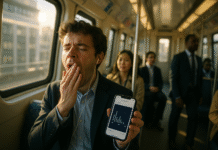

Nighttime screen use doesn’t just “feel” stimulating—it can biologically delay sleep. In short: light from screens, especially short-wavelength (blue-enriched) light, activates special retinal cells that signal your brain’s master clock and acutely suppress melatonin, the hormone that helps you fall asleep. How strong that effect is depends on the light’s spectrum, brightness, timing, duration, and how close the screen is to your eyes.
Medical note: This article is educational and not a substitute for personal medical advice. If you have persistent sleep problems, consult a qualified clinician.
1. Melatonin Is Your “Darkness Signal,” and Light Switches It Off
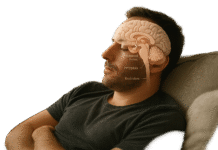
Your body produces melatonin in the evening as darkness falls; light at the eyes quickly suppresses its release from the pineal gland. That’s why bright rooms—and not just screens—can delay your natural sleep window. The mechanism sits upstream of sleep itself: retinal photoreceptors relay light information to the suprachiasmatic nucleus (SCN), which tunes circadian timing and, in turn, melatonin rhythms. Practically speaking, a brightly lit living room late at night can flatten melatonin as effectively (or more) than a single phone, which is why overall lighting counts. NCBI
1.1 Why it matters
- Evening room light around ~100–200 lux suppresses melatonin and shortens its duration, which can delay sleep and reduce biological night length.
- The same physiology also explains why morning light helps you wake: light is the strongest “zeitgeber” (time-giver) for your clock.
1.2 Mini-checklist
- Keep evening household light levels as low as comfortable.
- Aim for warm, dim task lighting near you, not bright overheads.
Bottom line: Light is a powerful dial on melatonin. Before blaming your phone, tame ambient lighting first.
2. Wavelength Counts: Blue-Enriched Light Hits the Melanopsin System Hardest
Short-wavelength light (blue-cyan) most strongly triggers intrinsically photosensitive retinal ganglion cells (ipRGCs) containing melanopsin, with peak sensitivity around ~480 nm. When this pathway is activated at night, melatonin suppression is stronger, and the circadian clock tends to delay. Many LED screens and bulbs are blue-enriched by design, which increases potency per unit of brightness compared with warmer spectra.
2.1 Numbers & guardrails
- Melanopsin peak ≈480 nm; circadian responses are more sensitive to this band than to longer wavelengths at equal photopic lux.
- The CIE S 026:2018 standard defines melanopic metrics (e.g., melanopic equivalent daylight illuminance, M-EDI) to gauge this effect across spectra—useful for comparing lights beyond “lux.” PubMed
2.2 Practical tips
- Prefer warmer displays/lighting (lower CCT) at night.
- If you must use a screen, combine warmer color with reduced brightness.
Bottom line: Blue-enriched spectra are more circadian-active; warming the color helps—but brightness still matters (see next section).
3. Brightness (Lux) Drives a Dose Response: Dim Wins After Dark
For melatonin, intensity is a major lever. Studies show a clear dose-response: brighter evening light suppresses more melatonin. Typical indoor “room light” (~100–200 lux at the eye) can strongly blunt melatonin, whereas very dim environments (<10 lux) have far less effect. Screens often contribute dozens of lux at close range—less than ceiling lights, but still meaningful.
3.1 Numbers & guardrails
- Evening room light (~150 lux) before bed significantly suppresses melatonin and shortens its duration.
- A conservative residential target proposed by researchers: keep pre-bed “white light” at the eyes ≤30 lux for ~30 minutes to minimize suppression.
3.2 Mini-checklist
- Dim overheads; use shaded, low-output lamps.
- Turn device brightness down as far as comfortable.
- Sit farther from large bright TVs.
Bottom line: After dark, aim for dim—on both room lights and screen brightness—to protect melatonin.
4. Duration Compounds the Effect: More Minutes, More Suppression
Even if brightness is moderate, longer exposures accumulate. Experiments with self-luminous tablets show that one hour may yield minimal suppression at certain settings, while two hours crosses a threshold into clear, significant melatonin reduction. With blue-enriched light, the curve climbs faster. In practice, that means a long scrolling session near bedtime has outsized impact compared with a brief check earlier in the evening.
4.1 Evidence snapshot
- Tablet/light studies: melatonin suppression becomes reliably significant at two hours versus one hour at equal brightness/spectrum.
- Computer screen exposure (LED-backlit) for five hours reduced evening melatonin and alertness measures compared with non-LED spectra of the same luminance. PubMed
4.2 Mini-checklist
- Keep the last 60 minutes pre-bed as “low-light, low-screen” time.
- If you must use a device, set a 15–20 minute boundary.
Bottom line: The clock runs against you—cut exposure duration at night to limit the total “dose.”
5. Timing Shapes the Outcome: Evening Light Delays, Morning Light Advances
Light’s effect depends on when you get it. The human phase-response curve (PRC) shows that light in the late evening/early night tends to delay the circadian clock (later sleep/wake), while light in the late night/early morning advances it (earlier sleep/wake). In other words, the very same photons can help or hinder depending on timing.
5.1 How to use it
- Seek bright outdoor light soon after waking to anchor timing.
- Avoid bright/blue light in the 1–2 hours before bed to prevent delays.
5.2 Example
- Late-evening exposure to e-readers vs. print delayed circadian timing by ~1.5 hours after several nights. PubMed
Bottom line: Evening screens push your clock later; morning light pulls it earlier—use both strategically. PubMed
6. Distance and Viewing Angle Affect Retinal Dose (and Your Risk)
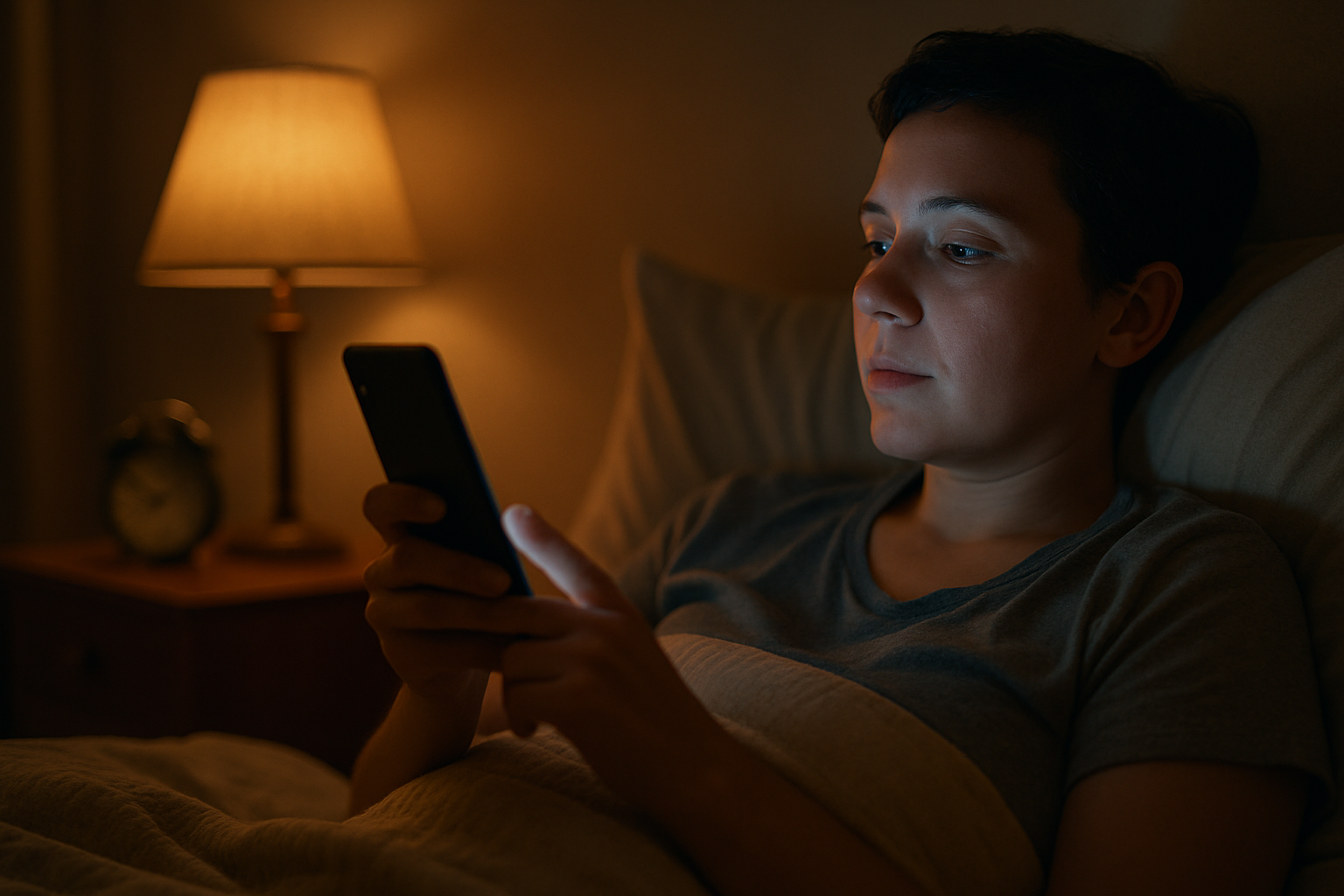
Retinal illuminance drops with distance and angle. Holding a bright phone 20 cm from your eyes delivers far more light to the retina than the same device at 40 cm. Studies using tablets and phones suggest that closer, on-axis viewing boosts melatonin suppression, while off-axis or farther viewing reduces it. Position and posture matter: lying in bed with a phone close to your face is the highest-risk setup.
6.1 Practical steps
- Increase distance: hold phones at arm’s length; view larger screens from farther away.
- Keep devices slightly off-axis (not directly in line with gaze) when feasible.
- Avoid using phones while lying on your side with the screen inches from one eye.
6.2 Mini case
- A lab report on tablets noted that eye-to-screen distance, together with exposure time, drove melatonin outcomes—closer distance increased effective retinal dose. LRC
Bottom line: How you use a screen changes the biology—more distance and off-axis viewing reduce melatonin suppression.
7. Device Settings Help—But Brightness Still Rules (Night Shift Isn’t Magic)
Warming the screen (Night Shift/Night Light) reduces blue content, but at typical high brightness the melatonin impact can persist. Controlled experiments testing iPad Night Shift at full brightness found no significant reduction in acute melatonin suppression between “warmer” and “less warm” settings; brightness and duration still dominated. In adolescents and adults reading on backlit devices, melatonin dropped and circadian timing delayed compared with print—even when color was adjusted.
7.1 What actually helps
- Turn brightness way down (first), then warm the color temperature.
- Use system-wide dark mode and reduce white backgrounds.
- Enable automatic sunset schedules so you don’t forget.
7.2 Guardrails
- Aim for the dimmest readable brightness.
- Combine settings with room-light dimming for best effect.
Bottom line: Use Night Shift/Night Light as a supplement—not a shield—and prioritize low brightness to protect melatonin.
8. Blue-Blocking Glasses: Promising for Some, Mixed Evidence Overall
Amber/blue-blocking lenses can meaningfully cut short-wavelength light, and small trials in people with insomnia report improved sleep when worn in the hours before bed. However, high-quality systematic reviews find low-certainty evidence for broad benefits, and blue-filter spectacle lenses marketed for “eyestrain” or general sleep have not shown consistent advantages over standard lenses. If you try them, pair with brightness reduction and dimmer rooms.
8.1 What the evidence says
- RCTs in insomnia: wearing amber lenses before bed improved subjective sleep in some participants.
- Cochrane review (2023): blue-filter lenses show little to no benefit for eyestrain or sleep versus non-filter lenses in the general population.
8.2 How to use (if you do)
- Choose amber/orange lenses with high blue attenuation.
- Start 2–3 hours before target bedtime, alongside dim lighting.
Bottom line: Blue-blocking glasses can help in specific cases, but they’re not a cure-all; fundamentals (dim light, shorter exposure) matter more.
9. Content and Arousal Also Matter: It’s Not Just the Photons
Light is one side of the coin; engagement is the other. Interactive or emotionally charged content elevates arousal and can prolong wakefulness independent of melatonin. That’s why some reports find minimal average delays from “screen light” alone, while individuals still sleep worse after stimulating activities. To separate the two, keep pre-bed content boring and familiar, and avoid late-night doomscrolling or competitive gaming.
9.1 Tips
- Prefer passive, calming content (e.g., low-stakes shows, audiobooks).
- Avoid intense work, news, or fast-paced games near bedtime.
- Set app limits or use “focus” modes after a cutoff time.
9.2 Mini example
- In e-reader studies, participants reading on lit devices showed reduced evening sleepiness and altered EEG patterns even at modest illuminance—light and engagement both contributed.
Bottom line: What you do on a screen can keep you up even in dim light—tame the content, not just the color temperature.
10. Children and Teens Are Often More Sensitive to Evening Light
Young eyes transmit more short-wavelength light, and developing circadian systems can be highly responsive. Preschoolers showed large evening melatonin suppression from common light levels, and adolescents often demonstrate greater sensitivity at equivalent exposures than adults. That means “a little light” late at night can have an outsized impact on bedtimes in kids and teens.
10.1 Guardrails for families
- Establish screen-off and lights-down routines 60–90 minutes before sleep.
- Use warm, low-output bedside lamps for reading.
- Keep devices out of bedrooms overnight.
10.2 Data points
- Preschoolers: robust melatonin suppression from evening light exposure.
- Adolescents: increased circadian sensitivity to evening light relative to older teens/adults.
Bottom line: Younger users aren’t just “small adults”—their melatonin is easier to suppress, so protect their evenings more aggressively.
11. Daytime Light Exposure Buffers Nighttime Sensitivity
Ironically, more light by day can help you sleep at night. Robust daytime (especially morning) light strengthens circadian amplitude and can reduce the relative impact of evening light. Blue-enriched exposure earlier supports alertness and timing, while avoiding high evening doses prevents delays. For shift workers or jet lag, timed light remains a core therapy alongside melatonin.
11.1 How to implement
- Get outside within an hour of waking for 20–30 minutes (no sunglasses if safe).
- Keep indoor workplaces bright by day; dim the home in the evening.
- For shifts/time-zone changes, follow clinician-guided light/melatonin timing.
11.2 Numbers & notes
- Light is the most powerful entraining signal; timed light and melatonin are standard circadian treatments in clinical guidelines.
Bottom line: Seek light early, avoid it late—the simplest, most effective circadian play.
12. A Practical, Melatonin-Friendly Night Routine (Screens Included)
You don’t need to quit screens to sleep better—you need to manage spectrum, brightness, duration, timing, and distance. Combine the levers you’ve learned into a simple protocol you can actually follow most nights.
12.1 Mini-checklist (15 minutes to lights-out)
- T-60 to T-30: Dim room lights to ≤30–50 lux at the eye (use a lux app or “just bright enough to read comfortably”).
- T-45: If using a screen, set minimum comfortable brightness, enable warm color/Night Shift/Night Light, and switch to dark mode.
- T-30: Increase viewing distance (arm’s length for phones; ≥2–3 m for TVs) and keep the screen slightly off-axis.
- T-20: Choose calming, low-engagement content or switch to audio.
- T-10: Power down screens; read print or meditate in dim, warm light.
12.2 Tools & examples
- System settings: iOS Night Shift/Reduce White Point; Android Night Light/Bedtime Mode; Windows Night Light; macOS Night Shift.
- Environment: warm LED bulbs (≤2700 K), shaded lamps, smart dimmers.
Bottom line: Stack the small wins—dim, warm, brief, earlier, farther—and your melatonin (and sleep) will thank you.
FAQs
1) Do screens always suppress melatonin enough to ruin sleep?
Not always; effects vary by spectrum, brightness, timing, duration, distance, and arousal. A briefly checked, very dim, warm-tinted screen at 8 pm in a dim room is far less disruptive than a bright, blue-heavy phone inches from your face at 11:30 pm. Still, studies show room light and extended device use near bedtime can significantly suppress melatonin and delay sleep. Keep nights dim and short on screens.
2) Is blue light the only culprit?
No. Blue-enriched spectra are more potent per lux via melanopsin, but total brightness and duration also matter. Warming color helps, yet at high brightness melatonin suppression can persist. Managing brightness and time is as crucial as shifting spectrum.
3) Do “Night Shift/Night Light” modes fix the problem?
They help, but they’re not a free pass. Lab data show that at full brightness, changing color temperature alone didn’t significantly lessen acute melatonin suppression. Use these modes alongside aggressive brightness reduction and shorter sessions.
4) Are blue-blocking glasses worth it?
They can help certain people (e.g., insomnia) when worn before bed in dim rooms, but broad, high-quality evidence is mixed, and general blue-filter spectacle lenses haven’t consistently improved sleep or eyestrain versus standard lenses. Try them if you like—just don’t skip the basics. PMC
5) What about kids and teens?
Children and adolescents tend to be more sensitive to evening light exposure, with larger melatonin suppression at common household levels. Give them extra buffer: earlier dimming, warmer lights, and screen curfews.
6) Does morning light really help at night?
Yes. Morning/early-day light strengthens circadian signals and can reduce the relative impact of evening light, supporting earlier sleep timing and better sleep health. Get outside soon after waking whenever possible. PMC
7) Is TV better or worse than phones for melatonin?
It depends. TVs are farther away (good) but often much brighter and viewed for longer (not good). Keep TVs dim, increase distance, and cap duration—especially in the last hour before bed. Evidence shows dose (lux × time) is what matters.
8) How soon before bedtime should I stop screens?
If sleep is fragile, aim for 60 minutes. Otherwise, keep the last 20–30 minutes screen-free and lights very dim. The longer you stay in low light before bed, the less melatonin is suppressed and the easier sleep should arrive. PMC
9) Do OLED or “eye-comfort” displays solve the issue?
Spectrum and brightness—not panel type—drive melatonin effects. Some modes cut blue emissions, but at high luminance melatonin suppression can remain. Treat the mode as a helper, not a cure; dim the screen and shorten use.
10) Can content alone keep me awake, even with dim screens?
Yes. Stimulating or stress-inducing content elevates arousal and can delay sleep independently of light dose. Keep pre-bed content calm and familiar, or switch to audio.
11) Is there a simple metric I can use at home?
Lux isn’t perfect for circadian light, but it’s practical. As a conservative target, keep pre-bed eye-level illuminance around 30–50 lux or less. Apps are imperfect, but useful for relative changes (dimmer vs. brighter).
12) I work shifts—what should I do with screens?
Prioritize strategic light: bright light during your “day,” blue-reduced/dim during your “night,” and carefully timed melatonin under clinical guidance. Avoid bright screens right before planned sleep, and use warm, dim interfaces if you must.
Conclusion
If you take one idea from the science, take this: light after dark is information, and your brain reads it through melanopsin-driven pathways that can suppress melatonin and shift your clock. Screens amplify that information when they’re blue-enriched, bright, close, late, and used for long stretches—especially in already bright rooms. But the solution isn’t to abandon technology; it’s to stack small, consistent wins. Dim your environment. Lower screen brightness first, then warm the color. Keep screens farther away and off-axis. Use them earlier in the evening for shorter periods and switch to low-engagement content as bedtime approaches. Get robust morning light to anchor your day. For families, add stricter buffers: kids and teens are more sensitive to the same light. Over a week or two, these habits compound into earlier, easier sleep and steadier energy the next day. Start tonight: choose dim, warm, brief, and earlier—and notice how your sleep responds.
CTA: Tonight, set a 30-minute “dim & wind-down” alarm and try the checklist in Fact 12—then keep what works.
References
- Exposure to Room Light before Bedtime Suppresses Melatonin Onset and Shortens Melatonin Duration in Humans, Journal of Clinical Endocrinology & Metabolism, 2011. PubMed
- Evening Use of Light-Emitting eReaders Negatively Affects Sleep, Circadian Timing, and Next-Morning Alertness, PNAS, 2015. PNAS
- A Phase Response Curve to Single Bright Light Pulses in Human Subjects, Journal of Physiology, 2003. Physiological Society Online
- Melatonin Suppression by Melanopsin-Weighted Light in Humans, Journal of Pineal Research, 2019. PMC
- The Lighting Environment, Its Metrology, and Non-visual Effects in Humans, Sleep Medicine Reviews, 2021. PMC
- Does the iPad Night Shift Mode Reduce Melatonin Suppression?, Lighting Research & Technology, 2019. https://pmc.ncbi.nlm.nih.gov/articles/PMC6561503/ PMC
- Light Level and Duration of Exposure Determine the Impact of Self-Luminous Tablets on Melatonin Suppression, Applied Ergonomics, 2013. PubMed
- Evening Exposure to an LED-Backlit Computer Screen Affects Circadian Physiology and Cognitive Performance, Journal of Applied Physiology, 2011. Physiology Journals
- Sensitivity of the Circadian System to Evening Bright Light in Preschool-Age Children, Physiological Reports, 2018. PMC
- Increased Sensitivity of the Circadian System to Light in Adolescents, Journal of Clinical Endocrinology & Metabolism, 2015. PubMed
- High Sensitivity of Melatonin Suppression Response to Evening Light in Adults, Clocks & Sleep / PLoS-linked preprint summary, 2022. PMC
- Measuring and Using Light in the Melanopsin Age, Trends in Neurosciences, 2014.
- CIE S 026:2018 (System for Metrology of Optical Radiation for ipRGC-Influenced Responses to Light) – Tutorial/Guide, CIE, 2019–2024. ; https://cie.co.at/news/cie-s-0262018-tutorial CIE Files
- Effects of Evening Smartphone Use on Sleep and Declarative Memory in Adolescents and Young Adults, Brain Communications, 2024. Oxford Academic
- Blue-Light Filtering Spectacle Lenses for Visual Performance, Sleep and Macular Health in Adults, Cochrane Database of Systematic Reviews, 2023. Cochrane Library
- Home Lighting Before Bedtime Impacts Circadian Timing, Sleep Health, 2014. PMC
- Measuring Melanopic Illuminance and Melanopic Irradiance (Lab Resource Summary), University of Manchester (Lucas Group), accessed 2025. Lucas Group
- Spatial Sensitivity of Human Circadian Response: On-Axis vs. Para-foveal Stimuli, Current Research in Physiology / Elsevier database listing, 2021. ScienceDirect
- Clinical Practice Guideline for Intrinsic Circadian Rhythm Sleep-Wake Disorders (AASM), 2015. AASM
- Blue-Enriched Evening Light from Personal Devices Suppresses Melatonin at ~30 lux, Scientific Reports predictive framework, 2020. Nature
- Blue Light Exposure: Performance and Sleep Trade-offs (Review), Sports Medicine – Open, 2022. PMC
- Smartphones May Affect Sleep—but Content Matters (overview citing emerging evidence), Wall Street Journal, 2024. Wall Street Journal
- Measuring and Using Light in the Melanopsin Age (Oxford/Jefferson access copy), 2014. PMC
- Evening Light Exposure and Melatonin in Children (field/lab study context), Journal of Biological Rhythms, 2023–2025 insights. PMC