
















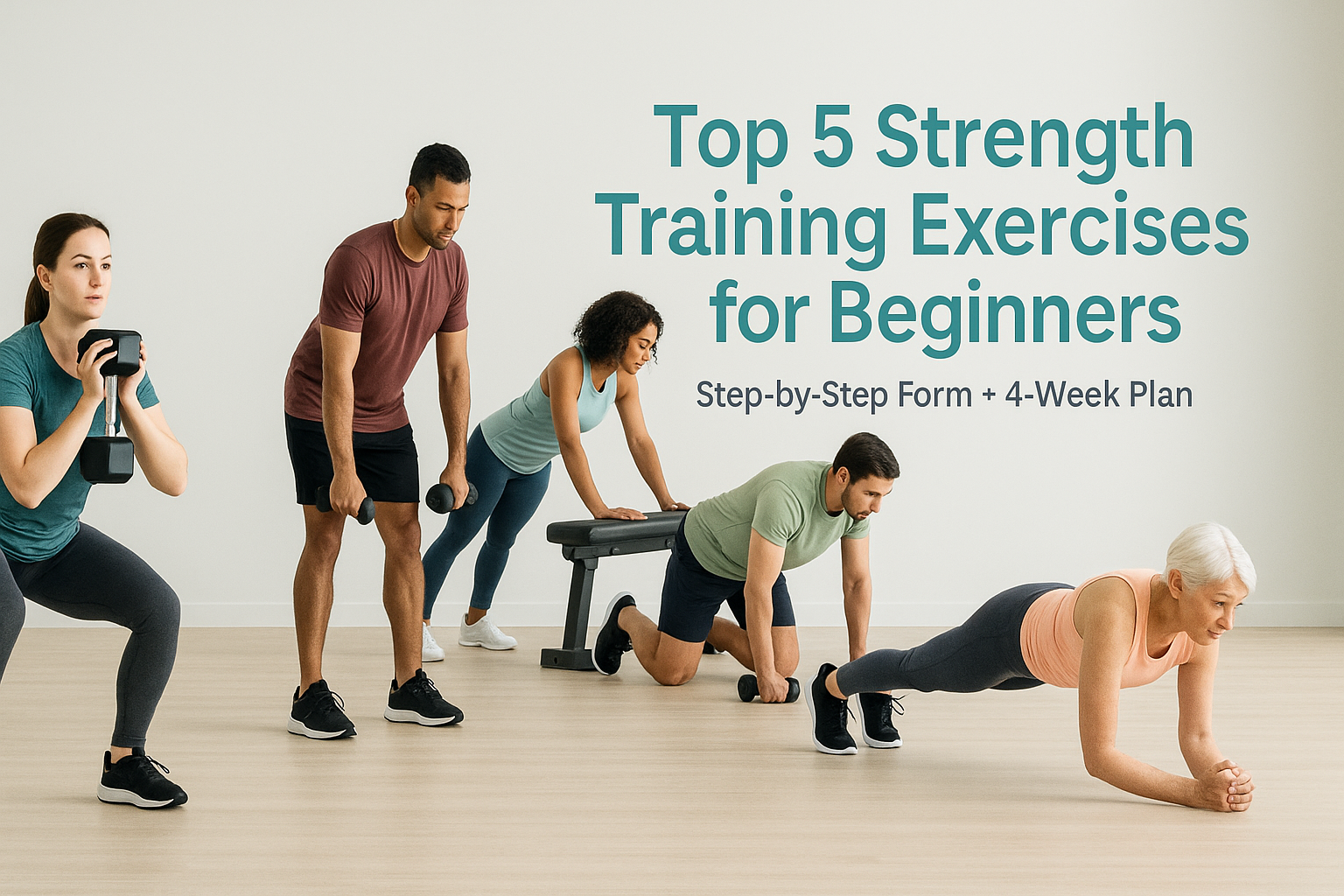
Starting strength training can feel intimidating, but it doesn’t have to be complicated. The five movements below are the safest, most efficient strength training exercises for beginners because they build whole-body strength with minimal equipment and a clear learning curve. By the end, you’ll know exactly how to do each exercise step by step, how to scale up or simplify, how often to train, and how to avoid the most common mistakes—all wrapped into a simple four-week plan you can start today.
Medical disclaimer: The guidance here is general and educational. If you have a health condition, are pregnant, have a recent injury, or take medications that affect blood pressure, talk with a qualified healthcare professional before starting or modifying your exercise program.
Key takeaways
- Master five movement patterns. Squat, hinge, push, pull, and brace cover nearly every daily activity and build balanced strength fast.
- Start light, focus on form, progress gradually. Add small amounts of reps, time, or load once a set feels strong and controlled.
- Train two to three non-consecutive days per week. Give worked muscles at least 48 hours before repeating the same lifts.
- Warm up and breathe. Five to ten minutes of easy movement and steady breathing make training safer and more effective.
- Track the basics. Record exercises, sets, reps, and how challenging it felt; progress by adding a rep, a few seconds, or a small weight each week.
1) Bodyweight (or Goblet) Squat
What it is & why it’s great
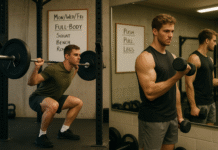
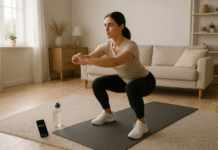
The squat is a fundamental lower-body movement that strengthens your quads, glutes, and hamstrings while reinforcing balance and mobility at the ankles and hips. It’s “real-life strength”—standing up from chairs, climbing stairs, and picking things up all get easier. For beginners, a bodyweight squat teaches alignment; holding a dumbbell or kettlebell at the chest (a “goblet” squat) adds manageable resistance without complicated technique.
Requirements & low-cost alternatives
- Equipment: None for bodyweight. For goblet squats, one dumbbell or kettlebell (5–15 kg for most beginners).
- Space: A square meter of floor space.
- Alternative: Filled backpack hugged to the chest; water jugs; a sturdy book bag.
Step-by-step form
- Set your stance. Feet roughly shoulder-width, toes slightly out.
- Brace. Take a breath, lightly tighten your midsection as if preparing for a gentle poke.
- Sit between your hips. Push your hips back slightly while bending your knees. Keep your chest tall and heels down.
- Depth. Lower until your thighs are roughly parallel to the floor (or as low as comfortable without pain or collapsing posture).
- Stand. Drive the floor away, stand tall, and finish by squeezing your glutes—don’t hyperextend your back.
- Goblet option. Hold the weight close to your sternum, elbows pointing down, and keep it touching your chest throughout.
Beginner modifications & progressions
- If balance is tricky: Hold a doorframe or squat to a box/bench and stand back up.
- If ankles or hips feel stiff: Use a slightly wider stance or place thin plates under heels temporarily as you work on ankle mobility.
- Progress when ready: Move from box squats → bodyweight parallel squats → goblet squats → slower descents (3 seconds down) → additional load in small jumps.
Recommended frequency, sets & reps
- Beginner template: 2–3 sessions per week; 2–3 sets of 6–12 reps, resting 60–90 seconds between sets.
- Effort target: Finish sets feeling like you could do 1–2 more reps with good form.
Safety, caveats & common mistakes
- Knees caving in. Think “push the floor apart” and keep knees tracking over the middle of your feet.
- Heels lifting. Reduce depth to where heels stay down; work on ankle mobility and keep the weight close to your body.
- Going too heavy too soon. Prioritize smooth reps and consistent depth; add load only when all reps are crisp.
Mini-plan (quick practice)
- 2 sets x 8 bodyweight squats to a chair.
- Rest ~60 seconds between sets.
- Add a third set next session if your form holds.
2) Hip Hinge (Dumbbell Romanian Deadlift)
What it is & why it’s great
The hip hinge teaches you to bend at the hips with a neutral spine—vital for strong hamstrings, glutes, and a resilient lower back. The Romanian deadlift (RDL) variation starts from standing and emphasizes control on the way down, making it beginner-friendly and extremely effective for posterior-chain strength and posture.
Requirements & low-cost alternatives
- Equipment: A pair of dumbbells (or one kettlebell).
- Alternative: One heavy backpack held with both hands; two grocery bags with evenly distributed weight.
Step-by-step form
- Set up tall. Stand with feet hip-width, dumbbells held in front of thighs, shoulders down and back.
- Hinge back. Push hips behind you as if closing a car door with your glutes. Knees stay soft, shins mostly vertical.
- Lower with control. Slide the weights close to your legs; stop when you feel a strong hamstring stretch while keeping your back flat (often mid-shin height).
- Stand by pushing the floor. Drive hips forward and stand tall—don’t lean back.
- Breathe. Inhale before lowering, exhale as you return to standing with control.
Beginner modifications & progressions
- Range of motion limiter: Start by hinging to just below your knees; increase depth as hamstrings allow while keeping your spine neutral.
- Tempo: Use a 2–3-second descent to groove control.
- Progression path: Bodyweight hip hinges → light dumbbells → moderate dumbbells → add a pause just above the bottom → single-leg RDL once stable.
Recommended frequency, sets & reps
- Beginner template: 2–3 sessions per week; 2–3 sets of 6–10 reps, 60–120 seconds rest.
- Effort target: Leave 1–2 reps in reserve; the last reps should feel challenging but never jerky.
Safety, caveats & common mistakes
- Rounding the back. Stop the descent earlier, keep ribs down, and maintain the weights close to your legs.
- Squatting the hinge. Knees should bend slightly, but most movement comes from the hips traveling back.
- Neck position. Keep a long neck and neutral gaze (about a meter ahead on the floor), not craned up.
Mini-plan (quick practice)
- 3 sets x 8 dumbbell RDLs with a slow 3-second lower.
- Rest ~90 seconds between sets.
- Add 1–2 kg per dumbbell next session if form stays perfect.
3) Incline Push-Up (to Floor Push-Up)
What it is & why it’s great
Push-ups strengthen the chest, shoulders, arms, and core while teaching full-body tension—no equipment required. Starting on an incline (hands on a bench, sturdy table, or wall) lets you nail technique and steadily move toward floor push-ups.
Requirements & low-cost alternatives
- Equipment: Sturdy surface at chest height for incline variations; the lower the surface, the harder the rep.
- Alternative: Wall push-ups to begin; kitchen counter for a moderate incline; back-of-sofa if stable.
Step-by-step form
- Set your base. Hands slightly wider than shoulders, fingers spread; body in a straight line from head to heels.
- Lower under control. Bend elbows about 45° from your torso as your chest moves toward the surface.
- Tap, then press. Lightly touch your chest (or get within a few centimeters), then press the floor/bench away while keeping your body rigid.
- Stay aligned. Squeeze glutes and thighs; don’t let hips sag or pike.
Beginner modifications & progressions
- Start high. Wall push-ups → counter push-ups → bench push-ups → floor push-ups.
- Knee push-ups? If they help you keep alignment, fine—but inclines usually translate better to full push-ups.
- Progression ideas: Slow 3-second lowers; brief pause at the bottom; then add a backpack or weight plate on the upper back once floor reps are strong.
Recommended frequency, sets & reps
- Beginner template: 2–3 sessions per week; 3 sets of 6–12 reps, 60–90 seconds rest.
- Effort target: Last rep should be challenging, but you could do one more with good form.
Safety, caveats & common mistakes
- Elbows flaring out. Tuck to roughly 30–45° from your torso to protect your shoulders.
- Neck reaching first. Lead with your chest, not your chin.
- Sagging midsection. Brace lightly and squeeze your glutes—your body should move as one piece.
Mini-plan (quick practice)
- 3 sets x 8 incline push-ups at a challenging height.
- When you can do 3×12 with control, lower the hands to a slightly lower surface next session.
- Repeat until you reach the floor.
4) One-Arm Dumbbell (or Band) Row
What it is & why it’s great
Rows train the big pulling muscles of your back (lats, rhomboids), the rear shoulders, and your arms. They counterbalance pressing movements, support healthy posture, and improve shoulder stability—key for desk workers and anyone who wants to move and look better.
Requirements & low-cost alternatives
- Equipment: One dumbbell and a bench or sturdy chair to support the non-working hand and knee.
- Alternative: A looped resistance band anchored under your foot or around a sturdy post; a water jug with a handle.
Step-by-step form
- Set the hinge. Place one knee and hand on a bench, other foot planted. Spine neutral and long, torso roughly parallel to the floor.
- Let the arm hang. Hold the weight with a neutral grip; allow the shoulder blade to protract slightly.
- Row to your pocket. Drive the elbow back toward your hip, bringing the weight toward your lower ribs. Keep the shoulder down and back at the top.
- Lower smoothly. Let the shoulder blade glide forward at the bottom without rotating your torso.
Beginner modifications & progressions
- If your back gets tired: Use a slightly higher bench so your torso is more supported.
- Band row: Step on a band with the working-side foot; hinge and row by pulling the band handle to your lower ribs.
- Progression path: Light dumbbell rows → slower negatives → heavier bells; later add chest-supported dumbbell rows for variety.
Recommended frequency, sets & reps
- Beginner template: 2–3 sessions per week; 3 sets of 8–12 reps each side, 60–90 seconds rest.
- Effort target: Controlled reps that don’t twist your torso; finish with 1–2 reps “left in the tank.”
Safety, caveats & common mistakes
- Shrugging. Keep shoulders away from ears.
- Torso rotation. Hips and ribs square; imagine a glass of water on your back that you don’t want to spill.
- Yanking the weight. Smooth pull, brief squeeze, smooth lower—no momentum.
Mini-plan (quick practice)
- 3 sets x 10 reps per side, slow 2-second lower.
- If all sets feel crisp, add 1–2 kg next time or add two reps per set.
5) Forearm Plank (Anti-Extension Core)
What it is & why it’s great
The plank strengthens the deep core muscles that stabilize your spine, helping every other lift (and daily life) feel more solid. It teaches you to resist movement—especially lower-back extension—while breathing steadily.
Requirements & low-cost alternatives
- Equipment: Floor and a mat or soft surface.
- Alternative: Hands-elevated plank on a bench; wall plank for beginners; side plank for lateral core strength once basics are solid.
Step-by-step form
- Set your base. Elbows under shoulders, forearms on the floor, legs straight, toes tucked.
- Create tension. Gently squeeze glutes and quads, draw ribs down, and imagine pulling your elbows toward your toes.
- Hold and breathe. Keep a straight line from head to heels. Breathe calmly through the nose or nose-and-mouth, keeping your jaw relaxed.
- Finish strong. Stop the set when your lower back starts to sag or your breath gets choppy.
Beginner modifications & progressions
- Easier: Elevate your elbows on a bench, or hold a high plank on straight arms.
- Harder: Add a knee-tap without shifting hips, extend one arm briefly, or progress to side planks.
- Time progression: Build from 15–20 seconds to 45–60 seconds with perfect form; add sets before adding much time beyond a minute.
Recommended frequency, sets & reps
- Beginner template: 2–3 sessions per week; 2–3 sets of 20–60 seconds, 45–60 seconds rest.
- Effort target: Stop before form breaks; quality beats longer holds.
Safety, caveats & common mistakes
- Sagging hips or arched back. Squeeze glutes and think “zip up” your front; stop the set if you can’t maintain position.
- Holding your breath. Maintain a steady rhythm; breath-holding can spike blood pressure.
- Neck strain. Keep gaze slightly ahead of your hands, not tucked under or craned up.
Mini-plan (quick practice)
- 3 × 30-second forearm planks with calm breathing.
- Add 5–10 seconds per set next time, or add a fourth set.
Quick-Start Warm-Up (5–10 minutes)
A brief warm-up reduces stiffness and helps you learn the movement patterns faster. Try this sequence before each session:
- Easy cardio (2–3 minutes): Brisk walk, cycling, or marching in place.
- Mobility (2–3 minutes):
- Ankles: calf rocks against a wall × 10/side.
- Hips: standing hip circles × 8 each way.
- T-spine/shoulders: arm swings and shoulder circles × 10.
- Movement prep (2–3 minutes):
- Squat to a chair × 8 slow reps.
- Hip hinge with a broomstick along head/upper back/tailbone × 8.
- Incline push-up holds: 2 × 10 seconds with perfect body line.
- Light band rows × 10.
- 15- to 20-second plank.
Tip: Warm up exactly the movement you plan to train that day—one or two lighter sets before working sets is enough.
How to Measure Progress
Use a simple logbook. Write down the date, exercises, sets, reps, hold times, and the weight used (or the incline height for push-ups). Add a quick note on how it felt (easy, solid, tough).
Progress one variable at a time.
- Reps: If your plan says 3×8–10 and you hit 10 on all sets with good form, move up in load next time.
- Load: Increase by the smallest practical amount (often 1–2 kg per dumbbell or a slightly heavier kettlebell).
- Time: For planks, add 5–10 seconds per set once you own the current duration.
- Leverage: Lower the push-up incline or squat a bit deeper while maintaining form.
Form is your KPI. Smooth, controlled reps with consistent depth and no gasping or breath-holding are the best signs you’re ready to progress.
Troubleshooting & Common Pitfalls
“My knees hurt when I squat.”
- Check depth and foot angle; a slight toe-out and sitting “between” your hips (not just straight down) usually helps.
- Start with box squats to a comfortable height; strengthen glutes and hamstrings with RDLs.
“My lower back feels it during RDLs.”
- You may be going too low, or the weight is drifting forward. Keep the weights close to your thighs and stop the descent when your back position changes.
- Practice hip hinges with a broomstick against head, upper back, and tailbone to learn a neutral spine.
“Push-ups are too hard.”
- Raise your hands to a higher surface and own perfect reps. Lower the surface only when you can do 3×10–12 clean reps.
“Rows feel like biceps only.”
- Initiate by “pulling your shoulder blade into your back pocket,” then bend the elbow. Think elbow to hip, not hand to chest.
“Planks wreck my shoulders.”
- Stack elbows directly under shoulders, press the floor away gently, and reduce set length to the point where you maintain perfect alignment.
“I’m always sore.”
- Start with fewer sets, add only one small change per week, and prioritize sleep and nutrition. Soreness is not required to make progress.
“I lose my breath and get lightheaded.”
- Slow down between sets and maintain steady breathing during each rep. Avoid breath-holding during lifts unless you are experienced and have medical clearance.
A Simple 4-Week Starter Plan
Schedule: Train three non-consecutive days per week (e.g., Monday, Wednesday, Friday). Each session: warm-up (5–10 minutes) → main lifts → optional finisher → cool-down.
Effort guidance: Choose loads and leverage that let you complete all reps with 1–2 reps in reserve. If you finish sets with more than 2–3 reps in reserve, progress sooner.
Week 1 — Learn the patterns
- Squat: 2 sets × 8 (bodyweight to chair).
- RDL: 2 sets × 8 (very light dumbbells).
- Incline Push-Up: 3 sets × 6–8 (high bench).
- One-Arm Row: 2 sets × 10/side (light dumbbell or band).
- Plank: 2 × 20–30 seconds.
- Rest between sets: 60–90 seconds.
- Walk or cycle 10–20 minutes on at least one non-lifting day.
Week 2 — Add a little volume
- Squat: 3 × 8 (bodyweight or light goblet).
- RDL: 3 × 8 (light load, 3-second lowers).
- Incline Push-Up: 3 × 8–10 (slightly lower surface if last week was easy).
- One-Arm Row: 3 × 10/side.
- Plank: 3 × 25–35 seconds.
- Optional finisher: Farmer carry with two dumbbells or heavy grocery bags—3 trips of 20–30 meters with tall posture.
Week 3 — Earn a small progression
- Squat (Goblet if ready): 3 × 10.
- RDL: 3 × 8–10 (add a little load if form is perfect).
- Push-Up: 3 × 8–12 (lower the incline another notch if you hit 12s).
- Row: 3 × 10–12/side (pause 1 second at the top).
- Plank: 3 × 30–45 seconds (or 2 sets of 20–30 seconds side plank per side if ready).
- Rest: Up to 90 seconds between sets as needed.
Week 4 — Consolidate & assess
- Squat: 3 × 10–12 (add a little weight or go a bit deeper).
- RDL: 3 × 10 (maintain slow, controlled lowers).
- Push-Up: 3 × 10–12 (work toward floor push-ups if ready).
- Row: 3 × 12/side (smooth tempo).
- Plank: 3 × 40–60 seconds (quality first).
- Assessment notes: Compare your log to Week 1. You should see more reps, more time, or a bit more weight with equal or better form. Celebrate that.
After Week 4: Keep the same movements, cycle reps back to 6–8, and add a small amount of load. Or swap in variations (split squats for squats, chest-supported rows, knee-elevated push-ups) while keeping the same structure.
Frequently Asked Questions
1) How many days per week should a beginner lift?
Two to three non-consecutive days per week is a sweet spot for learning technique, recovering well, and building momentum without burning out.
2) How long should a workout take?
Forty to sixty minutes including warm-up is plenty for the five movements and short rests.
3) How do I choose the right weight?
Pick a load that lets you finish the final set with 1–2 clean reps in reserve. If you could do many more, it’s time to nudge the weight or reps up.
4) Do I need a gym to start?
No. You can do all five movements at home with bodyweight, a backpack, or resistance bands. Dumbbells help you progress smoothly, but they’re optional at first.
5) What if I can’t do a floor push-up yet?
Start on a high surface like a wall or countertop and lower the surface over time. This keeps the movement pattern the same while matching your current strength.
6) Is soreness required for progress?
No. Occasional mild soreness can happen, but consistent, controlled reps and small progressions matter far more than chasing soreness.
7) How long should I rest between sets?
About 60–90 seconds works well for most beginners. If a set feels sloppy, rest a bit longer so you can perform cleanly.
8) Is it okay to hold my breath during heavy reps?
Beginners are safer using steady breathing—exhale as you stand or press, inhale on the way down. Breath-holding can spike blood pressure and isn’t necessary for learning the basics.
9) Can I add cardio?
Yes. Walking, cycling, or other low-impact cardio on non-lifting days supports recovery, heart health, and overall energy.
10) When should I increase the weight?
When you hit the top of your target rep range across all sets with rock-solid form for two consecutive sessions, add a small amount of load next time.
11) What if my wrists or shoulders bother me in push-ups or planks?
Try neutral-grip handles or dumbbells under your hands, widen your hand placement slightly, and focus on stacking joints (wrists under shoulders, elbows tracking about 45°).
12) Should I stretch before or after lifting?
Warm up first with easy movement and dynamic prep. Save longer static stretches for after training or separate sessions.
Conclusion
Getting strong doesn’t require a complicated program—just five smart exercises, practiced consistently and progressed patiently. Start where you are, keep your reps clean, breathe steadily, and record your wins. In a month, you’ll feel—and move—like a stronger version of yourself.
Your next step: Pick two non-consecutive days this week and run Week 1 as written—then open your calendar and book Weeks 2–4. Show up, keep it simple, get strong.
References
- Physical activity — World Health Organization — June 26, 2024 — https://www.who.int/news-room/fact-sheets/detail/physical-activity
- Adult Activity: An Overview — Centers for Disease Control and Prevention — December 20, 2023 — https://www.cdc.gov/physical-activity-basics/guidelines/adults.html
- Physical Activity Guidelines for Americans, 2nd edition (PDF) — U.S. Department of Health and Human Services — 2018 — https://health.gov/sites/default/files/2019-09/Physical_Activity_Guidelines_2nd_edition.pdf
- American College of Sports Medicine position stand. Progression models in resistance training for healthy adults. — Medicine & Science in Sports & Exercise — March 2009 — https://pubmed.ncbi.nlm.nih.gov/19204579/
- American College of Sports Medicine position stand. Quantity and quality of exercise for developing and maintaining cardiorespiratory, musculoskeletal, and neuromotor fitness in apparently healthy adults. — Medicine & Science in Sports & Exercise — 2011 — https://pubmed.ncbi.nlm.nih.gov/21694556/
- Exercise 101: Don’t skip the warm-up or cool-down — Harvard Health Publishing — July 20, 2020 — https://www.health.harvard.edu/staying-healthy/exercise-101-dont-skip-the-warm-up-or-cool-down
- 8 tips for safe and effective strength training — Harvard Health Publishing — February 20, 2024 — https://www.health.harvard.edu/staying-healthy/8-tips-for-safe-and-effective-strength-training
- Strength training and blood pressure — Harvard Health Publishing — August 1, 2021 — https://www.health.harvard.edu/heart-health/strength-training-and-blood-pressure
- Effects of Resistance Exercise on Bone Health — Endocrinology and Metabolism (open access via PubMed Central) — 2018 — https://pmc.ncbi.nlm.nih.gov/articles/PMC6279907/