


























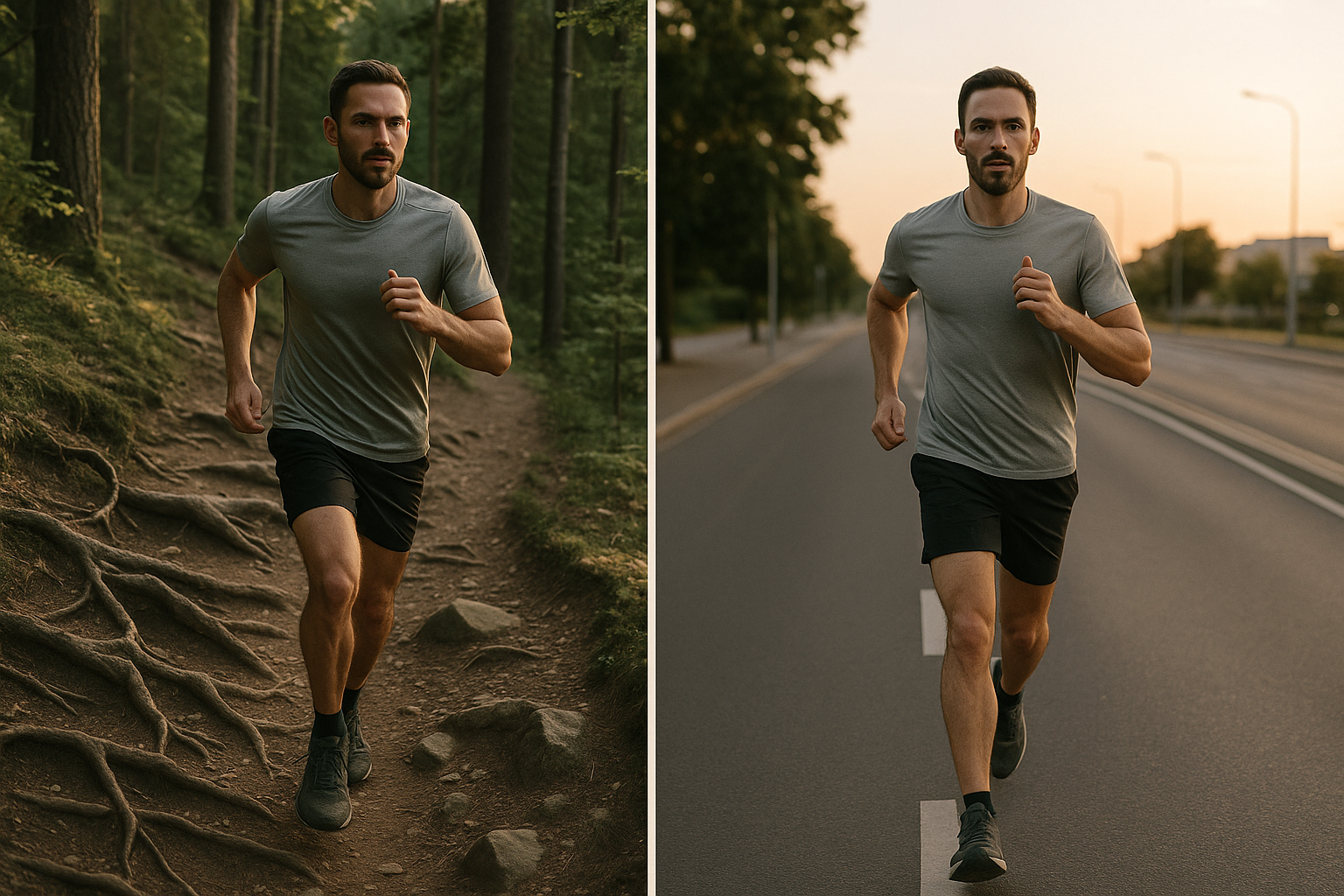
Trail running means running off-road on natural surfaces (dirt, grass, rock), while road running happens on paved asphalt or concrete. The key differences show up in impact forces, pacing, gear, safety, and environment. In short: trails trade speed and predictability for variety, scenery, and agility; roads trade variability for efficiency, accessibility, and consistent metrics.
Quick chooser: If you want predictable pacing and PRs, pick roads. If you want technical skills, scenery, and strength, pick trails. When in doubt, rotate both.
Friendly disclaimer: training advice here is general education—not medical care. If you have pain, injury, or a health condition, talk to a qualified clinician first.
1. Effort on Hills & Uneven Ground: Trails Feel Harder at the Same Pace
Trail running typically requires more energy at a given pace because of elevation changes, softer surfaces, and constant micro-adjustments; uphill grades further increase aerobic demand. Road running is smoother and lets you hold steady pace at lower perceived effort. As a rule, pace on trails underestimates your true effort—use effort, heart rate, or grade-adjusted metrics instead.
1.1 Why it matters
On trails, the same “minutes per km” can mask vastly different workloads due to climbing, footing, and braking on descents. Uphill running increases energy expenditure and step frequency while often lowering peak ground reaction forces compared to flat ground, which changes how fatigue builds. Roads minimize these variables, making workouts more repeatable and data-friendly.
1.2 How to manage effort (as of August 2025)
- Use Grade Adjusted Pace (GAP) in your app to compare hilly and flat efforts.
- Anchor workouts by heart rate zones or perceived exertion rather than strict pace on trails. PMC
- Expect ~30–120 sec/km slower on technical trails at the same aerobic effort; confirm via GAP after the run (varies by grade and surface).
1.3 Numbers & guardrails
GAP tools estimate “flat-equivalent” pace by modeling grade vs. energy cost; Strava’s current model (updated 2025) explicitly corrects for uphills and downhills so you can compare sessions more fairly. Use it to set effort on hill repeats and long runs, then log notes on surface technicality.
Bottom line: Roads simplify pacing; trails demand effort-driven training and smart use of GAP to keep workloads honest.
2. Impact Forces & Joint Loading: Surfaces Behave Differently—and So Do You
Impact characteristics differ across surfaces; softer, uneven terrain can reduce repetitive peak loading but add lateral and rotational demands, while uniform pavement keeps loading consistent and often higher in the vertical axis. Cadence tweaks meaningfully reduce peak forces in either setting.
2.1 Why it matters
High, unvaried impacts can contribute to overuse issues on roads; by contrast, trails can disperse loading but increase the demand on stabilizers and proprioception with frequent direction changes. Reviews show measurable differences in accelerations and peak impacts across surfaces and speeds.
2.2 Practical tips
- Nudge cadence up ~5–8% to lower peak forces without forcing form.
- Alternate surfaces during higher-mileage weeks to vary loading.
- On trails, look 2–3 steps ahead and stay light on your feet to manage uneven ground.
2.3 Mini case
Starting at 165 spm on city asphalt, one runner increases cadence to ~176 spm and reports less “thudding.” On weekend trails, the same cadence shift plus softer ground leaves them feeling fresher despite slower pace—metrics confirm reduced peak force spikes.
Bottom line: You adapt to the surface. Use cadence and surface rotation to manage load; trails trade vertical impact for more multi-planar stress.
3. Injury Patterns & Risk: Mixed Evidence, Different Problems
Overall injury rates appear similar across running, but patterns differ: roads skew toward overuse of knees/achilles due to repetitive loading; trails add more traumatic ankle sprains and downhill-related muscle damage, especially in technical terrain. Evidence in trail running is still developing; systematic reviews highlight limited but growing data.
3.1 What the research says
A living systematic review (2022) catalogs intrinsic and extrinsic risk factors in trail running but notes gaps in high-quality evidence. Comparative work suggests trail runners face more ankle/foot trauma; road studies dominate overuse epidemiology. Recent analyses continue to explore these distinctions. Physical Activity and Health
3.2 Guardrails & habits
- Strength twice weekly: calves, peroneals, hips; add balance drills to stabilize ankles.
- Build downhills gradually; eccentric load spikes soreness and risk.
- Match shoes to terrain for traction and protection (see Section 5).
3.3 Region note (South Asia & hot climates)
Monsoon-wet trails boost slip/sprain risk; asphalt heat raises dehydration and soft-tissue strain—adjust volume and hydration accordingly.
Bottom line: Injury risks differ by terrain; build strength, progress downhills, and choose appropriate shoes to stack the odds in your favor.
4. Pacing, Data Quality & Metrics: Roads Win Consistency; Trails Need Better Tools
Roads make steady pacing and splits straightforward. Trails introduce GPS drift under canopy, heavy grade swings, and footing variability—so raw pace is noisy. Use GAP, heart rate, and running power (footpods) to quantify effort on variable terrain.
4.1 Why accuracy varies
Dense canopy and terrain obstruct satellite signals, causing measurable GPS error and reduced update frequency; this inflates or deflates pace and distance metrics. On roads with open sky, GPS behaves better. UW Faculty
4.2 Tools & tactics
- Enable GAP and pace zones in your training app (Strava explains how it works).
- Consider a footpod for consistent pace/power on twisty trails; Stryd shows good reliability for some metrics (GCT, cadence), though absolute power can be underestimated. PubMed
- Calibrate expectations: effort first, pace second on trails.
4.3 Mini checklist
- Tree cover? Expect noisy GPS—lean on HR and power.
- Steep grades? Use GAP to compare workouts.
Bottom line: Road data is cleaner; trails require effort-based metrics and (optionally) a footpod to make training comparable.
5. Footwear & Gear: Trail Shoes Prioritize Grip/Protection; Road Shoes Maximize Speed
Trail shoes use deeper lugs, stickier rubber, protective rock plates, and reinforced uppers for security on uneven ground. Road shoes emphasize smooth-rolling midsoles and, increasingly, carbon-plated “super shoes” to improve running economy and speed on paved surfaces.
5.1 How they differ
REI’s expert guidance: trail models add traction, softer rubber for wet rock, and underfoot plates to blunt sharp stones; road models keep outsoles smoother for efficiency. Choose lug depth by terrain: shallow for hardpack, aggressive for mud.
5.2 Super-shoe note
Peer-reviewed lab work shows carbon-plated, PEBA-foam road racers can improve running economy versus traditional flats, particularly on level ground (that’s why PRs keep falling). They’re race tools, not mandatory daily trainers. University of Colorado Boulder
5.3 Buying checklist
- Trails: fit secure heel, adequate toe room, lug pattern matched to terrain, consider rock plate.
- Roads: match stack height and rocker to your gait; save plates for hard workouts/races.
- Wet seasons: prioritize rubber compounds tuned for slick surfaces. Brooks Running
Bottom line: Equip for the surface. Trails reward grip and protection; roads reward efficiency—with economy gains from modern super shoes on flat courses.
6. Speed, PRs & Muscle Soreness: Roads Are Faster; Trails Build Eccentric Strength
Roads are fastest for time trials and PR attempts because surfaces and grades are uniform. Trails, especially with steep descents, tax eccentric control in the quads and calves—great for strength but a driver of post-run soreness (DOMS) and temporary performance dips.
6.1 What to expect
Downhill running increases markers of muscle damage and can transiently impair maximal voluntary force, even in trained athletes. Newer trail runners should approach descents progressively; the eccentric load is where most people get surprised.
6.2 Training ideas
- Early season: road tempos to groove economy; gentle trail descents for skill.
- Mid season: structured hill reps (up & down), spacing hard descents by 48–72 hours.
- Before a trail race: taper in technical downhill practice at controlled effort.
6.3 Mini example
Two runners with identical VO₂maxes: the road-focused athlete runs a faster 10K PR; the trail-focused athlete climbs better and descends with less braking, finishing stronger in hilly races—both wins align with their terrains.
Bottom line: Roads optimize speed metrics and PRs; trails deliver eccentric strength and skill—especially on descents—if you progress wisely.
7. Safety & Navigation: Different Hazards, Different Prep
Road hazards revolve around traffic, visibility, and surface camber; trail hazards include footing, wildlife, remoteness, and navigation. Plan accordingly: reflective gear and route rules on roads; route knowledge, signaling, and Leave No Trace on trails.
7.1 Essentials
- Roads: follow local crossing rules, stay visible, and avoid two-abreast in narrow paths.
- Trails: carry basics (hydration, layer, whistle, small first aid), know your route, and respect other users and wildlife. ITRA
7.2 Etiquette snippets
- Alert when passing; stay on designated trails; don’t cut switchbacks; pack out all waste.
7.3 Region notes
- Monsoon & heat: trails can flood and get slick; roads can reflect heat. Adjust start times (pre-sunrise), carry more fluids, and shorten routes.
- Wildlife zones: learn specific guidance (bears, dogs, livestock) before you go. Running Insight
Bottom line: Road safety is about visibility and traffic; trail safety is about preparation and sharing the space responsibly.
8. Accessibility, Convenience & Air Quality: Roads Are Easy; Trails Are a Trip
Roads are everywhere—you can step outside and run. Trails require transport and time but reward you with scenery and (often) cleaner air. That said, urban roads can come with air pollution that measurably slows marathon performance even within “moderate” AQI ranges; planning around air quality pays off.
8.1 What the data shows
Large-scale analyses link higher PM₂.₅ to slower marathon finish times; effects were seen even below strict regulatory thresholds. If your city’s AQI spikes (wildfire season, traffic), shifting to parks, trails, or treadmills can protect health and performance.
8.2 Practical planning
- Check AQI before road sessions; favor green spaces or indoor options on bad days.
- Time of day: earlier runs often mean lower heat and pollution.
- Trail logistics: carry water; tell someone your route; download offline maps where cell service is spotty.
8.3 Mental health angle
Outdoor exercise in natural environments is associated with better psychological outcomes versus urban exercise, though study quality varies; enjoy it but keep expectations realistic.
Bottom line: Roads win for convenience; trails can offer cleaner air and mood boosts—schedule intelligently around weather and AQI.
9. Environmental Impact & Etiquette: Be a Good Steward (Especially on Trails)
Road running has minimal direct trail impact; trail running can widen tracks, compact soils, and accelerate erosion if users stray off-route, particularly after big events or in wet conditions. Following Leave No Trace keeps trails healthy for everyone.
9.1 Why stewardship matters
Research on footpath erosion shows trail width expansion, incision, and compaction as common impacts—often preventable with user behavior and good trail design/maintenance. Avoiding muddy detours and social trails reduces damage and habitat fragmentation. ScienceDirect
9.2 Do’s & don’ts
- Do stay on the trail—even through puddles—to prevent widening. Leave No Trace
- Do yield courteously; keep pets under control.
- Don’t shortcut switchbacks or run on closed trails; respect seasonal closures.
9.3 Mini checklist
- Pack out all trash (yes, gels).
- Learn local rules for protected areas; avoid sensitive habitats. americantrails.org
Bottom line: Your choices affect the landscape; small etiquette moves make a big difference in trail health.
10. Training Transfer & Variety: Mixing Both Makes You a Better Runner
You don’t have to choose forever. A randomized study in novices found both trail and road training improved endurance and neuromuscular performance, with terrain-specific benefits. Blend surfaces to spread load, sharpen skills, and keep training fun. Use HR or HRV to monitor recovery and training load across both.
10.1 How to blend (simple template)
- Base (4–8 weeks): 2–3 easy road runs + 1 easy trail run weekly.
- Build (6–8 weeks): add one structured road workout (tempo/intervals) + one trail hill session (up & down).
- Race-specific (4–6 weeks): skew surface to match your event; maintain 1 complementary run to preserve variety.
10.2 Tools/Examples
- Monitor acute:chronic load and recovery signals to avoid spikes when you add descents or volume.
- Use GAP to keep hill workouts consistent across routes; consider a footpod for trail pacing.
10.3 Synthesis
Road consistency plus trail variability builds a durable, versatile runner who can handle speedwork and technical terrain alike.
FAQs
1) Is trail running better for your knees than road running?
Not categorically. Softer, variable terrain may lower repetitive vertical impact, but trails introduce lateral stresses and require more stabilization—great for some runners, risky for ankles. Individual history, strength, and volume matter more than the surface alone. Consider alternating surfaces and building strength.
2) Why is my trail pace so much slower?
Grades, footing, and constant micro-adjustments inflate effort. Use GAP to compare hilly runs with flat efforts and judge workouts by effort or heart rate rather than raw pace.
3) Do carbon-plated shoes help on trails?
They’re designed for roads and shine on flatter, smoother courses by improving running economy; benefits on technical trails are inconsistent due to traction and stability demands. Many trail races disallow overly thick stacks; always check rules.
4) Are roads more dangerous than trails?
Different hazards: roads involve traffic and low-light visibility; trails involve footing, remoteness, and navigation. Prepare accordingly—reflective gear for roads; route knowledge, essentials, and etiquette for trails.
5) How should I gauge intensity on trails without accurate pace?
Anchor by heart rate, RPE, and, if you like, running power from a footpod (reliable for some metrics). Expect GPS drift under canopy; pace is a rough guide, not a target.
6) Will air pollution affect my road workouts?
Yes. Studies link higher PM₂.₅ to slower marathon times, even within “moderate” AQI ranges. Check AQI and consider parks/trails or indoor options on poor-air days. PMCPubMed
7) What shoes should I buy first if I plan to do both?
Start with a daily road trainer for consistency and a light-to-moderate lug trail shoe for grip and protection. Match lug depth and rubber to your terrain and weather.
8) Why do downhills hurt my quads so much?
Downhill running emphasizes eccentric muscle work, which increases soreness and transient strength loss. Progress volume and grade gradually, and space hard descents 48–72 hours apart.
9) Is trail running slower but better for balance and agility?
Usually. Trails challenge proprioception and dynamic stability—skills that can transfer to road running economy and resilience—though you’ll run slower at the same effort. PMC
10) Which surface is “safer” for beginners?
Either—if you progress wisely. Start on forgiving surfaces (smooth paths or non-technical trails), keep easy pace, and cap volume increases at conservative levels while you build strength.
11) How can I compare a hilly trail long run to a flat road long run?
Log both with GAP enabled, note vertical gain, and compare by time-in-zone (HR) rather than pace. Over weeks, you’ll see equivalent “flat effort” despite different paces.
12) Do I need special etiquette for trails?
Yes: stay on trail, don’t shortcut switchbacks, yield appropriately, and pack out all trash. These simple habits prevent erosion and keep access open.
Conclusion
Choosing between trail and road running isn’t an either–or—it’s a tool selection. Roads offer consistency, accurate data, and a clear path to speed; they’re ideal for PRs and structured workouts. Trails offer variety, skill development, scenery, and whole-body stability; they train agility and eccentric strength you’ll never get from flat asphalt alone. If your calendar points toward a road race, keep one trail session weekly for variety and resilience. If you’re targeting a hilly trail event, maintain one steady road workout to lock in economy and rhythm. Monitor loads with heart rate (or HRV), use GAP to compare apples with apples, and let shoes match the surface—grip and protection for dirt, efficiency for pavement. Most importantly, respect the space you run through: share roads safely and apply Leave No Trace on trails. Your best running life likely includes both surfaces, on purpose. Pick your next run based on the goal—and enjoy the miles.
Call to action: This week, log one road workout and one easy trail run; compare them with GAP and note how your body feels—then plan next week accordingly.
References
- Drum SN et al. “Effects of Trail Running versus Road Running—Effects on Neuromuscular and Endurance Performance—A Two Arm Randomized Controlled Study.” Sports (2023). PMC
- Padulo J et al. “A Paradigm of Uphill Running.” Journal of Strength and Conditioning Research (2013). PMC
- Ferro-Sánchez A et al. “An Analysis of Running Impact on Different Surfaces.” Applied Sciences (2023). PMC
- Musgjerd T et al. “Effect of Increasing Running Cadence on Peak Impact Forces.” Sports Health (2021). PMC
- Hamill J et al. “The Prevalence of Injuries in Trail Running.” International Journal of Athletic Therapy & Training (2022). Taylor & Francis Online
- Viljoen CT et al. “Trail Running Injury Risk Factors: A Living Systematic Review.” BMJ Open Sport & Exercise Medicine (2022). PubMed
- Coratella G et al. “Downhill Running Increases Markers of Muscle Damage…” Biology of Sport (2024). PMC
- Bontemps B et al. “Downhill Running: Effects and How We Can Adapt.” Sports Medicine – Open (2020). PMC
- Strava Support. “Grade Adjusted Pace (GAP).” (May 20, 2025). Strava Support
- DeCesare NJ et al. “Effect of Forest Canopy on GPS-Based Movement Data.” USDA Forest Service Research (2005). US Forest Service R&D
- REI Co-op Expert Advice. “Trail-Running Shoes Buying Guide.” (July 11, 2025). REI
- REI Co-op Expert Advice. “Road vs. Trail Running Shoes: What’s the Difference?” (n.d.). REI
- Hébert-Losier K et al. “Nike Vaporfly 4%…Improved Running Economy.” Journal of Sport and Health Science (2022). ScienceDirect
- Cusick M et al. “Impact of Air Pollution on Running Performance.” Scientific Reports (2023). Nature
- Leave No Trace Center for Outdoor Ethics. “The 7 Principles.” (Accessed 2025). Leave No Trace
- National Park Service. “Leave No Trace Seven Principles.” (June 16, 2022). National Park Service
- RRCA. “Multi-Use and Single Track Trail Tips.” (Accessed 2025). Road Runners Club of America
- Imbach F et al. “Validity of the Stryd Power Meter in Measuring Running Biomechanics.” Sensors (2020). PMC
- Paquette MR et al. “Optimizing Quantification of Training Load in Runners.” JOSPT (2020). JOSPT
- Wicks C et al. “Psychological Benefits of Outdoor Physical Activity.” International Journal of Environmental Research and Public Health (2022). PMC
- Royal Botanical Gardens. “Trail Running Impacts.” (Apr 1, 2021). Royal Botanical Gardens
- Dragovich D. “Managing Trail Erosion with LAC.” Sustainability (2022). MDPI