






















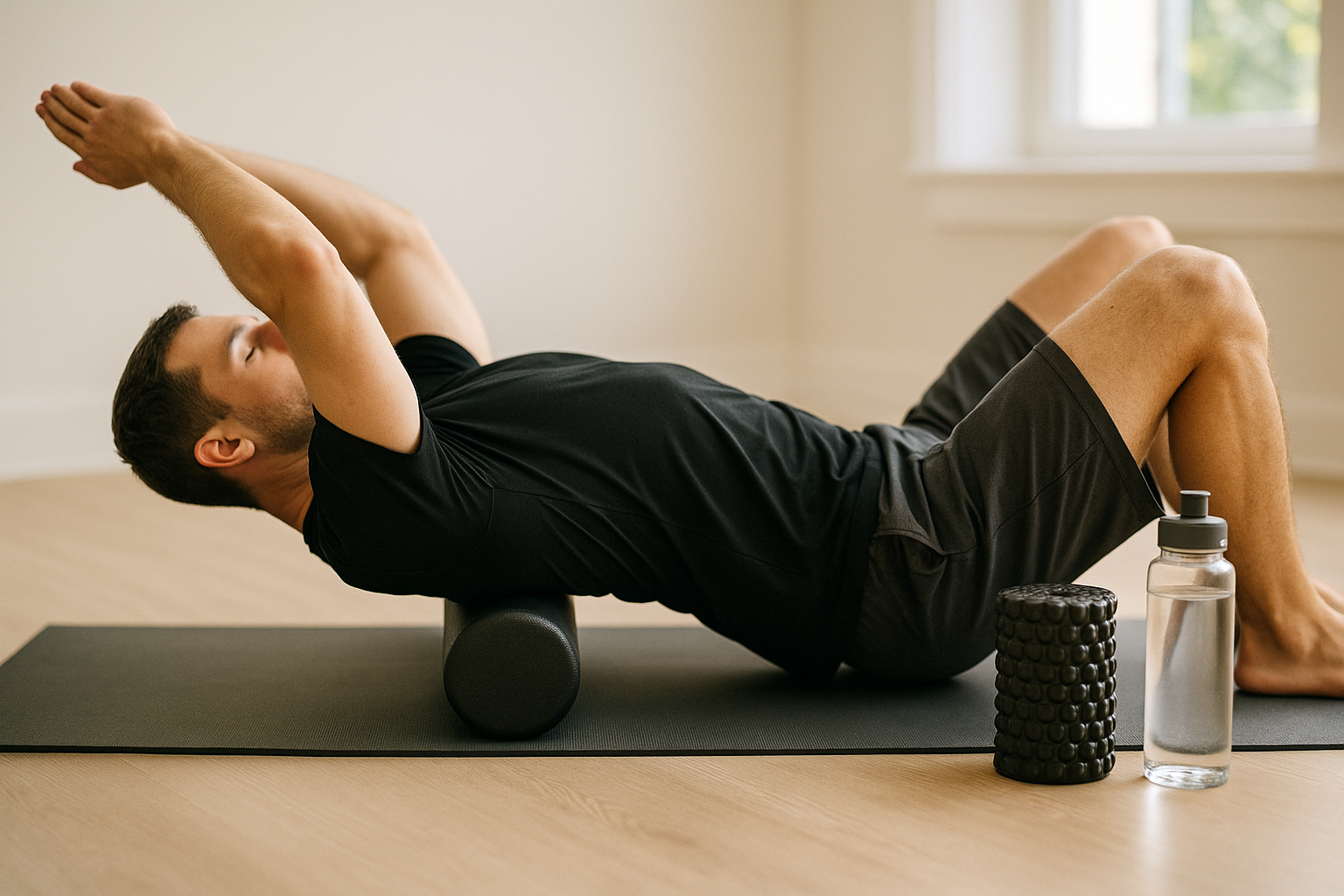
Foam rolling can be a fast, low-tech way to move better—if you use it with the right technique, timing, and dosage. This guide distills evidence and real-world coaching into 12 clear tips so you can safely improve comfortable range of motion (ROM) around key joints like the shoulders, hips, and ankles. A quick medical note: if you have an acute injury, circulatory issues, uncontrolled pain, or recent surgery, talk to a clinician first. In simple terms, foam rolling (a form of self-myofascial release) uses your bodyweight on a cylinder to apply pressure to muscle and connective tissues, which can acutely increase joint ROM without impairing strength and often reduces soreness after training.
Quick start: For mobility, roll a target area for 30–90 seconds, pause on 1–2 tender spots for 10–20 seconds each while breathing slowly, then follow with an active movement that uses the new range (e.g., ankle dorsiflexion lifts after calf rolling). As of August 2025, meta-analyses consistently show small-to-moderate acute ROM gains from foam rolling; chronic gains are most likely when you pair rolling with active mobility over several weeks.
1. Roll Before You Move: Use Short Bouts to Open Up ROM
Do a brief rolling sequence before your dynamic warm-up to unlock stiff areas without blunting performance. The aim isn’t to “mash” tissue for minutes; it’s to create a fast, nervous-system-driven window of easier motion you then cement with active drills and your workout. Most people feel better ROM in 2–3 minutes total per region (for example, calves + quads + mid-back). Keep the pressure tolerable, breathe, and think “prepare,” not “punish.” This approach works well for squats (ankles/hips), pressing or pull-ups (thoracic spine/lats), and running (calves/quads/glutes). It’s especially helpful on days you feel “tight but not injured.”
1.1 Why it matters
Acute rolling reliably increases ROM for ~10–20 minutes without reducing strength or power, making it ideal before lifting, sprinting, or sport skills. That short-term window lets you practice quality reps at better joint angles, which—over time—builds movement capacity.
1.2 Numbers & guardrails
- Time per region: 30–90 seconds, 1–2 passes.
- Tender spots: 10–20 seconds, ease in and out.
- Order: Roll → dynamic mobility → specific warm-up sets.
- Stop if: Sharp pain, tingling, or symptoms beyond mild tenderness.
Finish this section by pairing your roll with the exact motion you need (e.g., ankle rocks after calf rolling) so the nervous system “remembers” the new range.
2. Get the Dose Right: 30–90 Seconds, 1–3 Sets, 3–5 Days/Week
The most common mistake is either doing too little to create change or too much and getting sore. For mobility goals, use 30–90 seconds per muscle group for 1–3 sets, adjusting pressure so discomfort stays around 4–6/10 (never “white-knuckle” pain). Practice this 3–5 days per week around training, and expect the best lasting changes when you consistently pair rolling with active mobility or loaded end-range work. If you’re approaching hard sessions (max lifting or sprints), stay on the lower end of volume and focus on rhythm and breath.
2.1 What the research suggests
Systematic reviews show small-to-moderate acute ROM gains after single rolling bouts; for chronic improvements, programs longer than 4 weeks tend to produce better results, especially for hamstrings and quads. Don’t be surprised if ankles are slower to change without additional joint-specific work.
2.2 Mini-checklist
- Set a 2–6 minute rolling “budget” per session.
- Keep the pain dial at 4–6/10; back off if you tense up.
- Always follow with movement that uses the new ROM.
- Track one metric (e.g., knee-to-wall dorsiflexion distance) weekly.
Think of dosage like seasoning: enough to bring out flavor, never so much that it overwhelms the dish.
3. Lead With Breath: Slow Exhales to Relax Guarding and Gain Motion
The first 10–20 seconds on the roller often feel guarded as your body “tests” the pressure. Slow 5–6 second exhales with relaxed jaws and shoulders reduce bracing and make pressure more comfortable. Aim to let the muscle melt around the roller rather than pressing harder. If a spot spikes your tension, pause, take 3–4 slow breaths, and only increase pressure if your body allows it. This simple breathing strategy turns foam rolling from a fight into a conversation with your nervous system.
3.1 How to do it
- Inhale through the nose for 3–4 seconds, exhale through the mouth for 5–6 seconds.
- On the exhale, soften the area you’re rolling and unclench your hands and jaw.
- Re-scan tension after 2–3 breaths; if the muscle lets go, move on.
3.2 Common mistakes
- Holding your breath and bearing down.
- “Chasing pain” beyond 6/10 and making tissues guard.
- Rushing past tender spots instead of pausing and breathing.
Close by remembering: the roller is a pressure + breathing tool; both matter for mobility carryover.
4. Respect Red Flags: Avoid Joints and Bony Spots; Modulate Pressure
Foam rollers are for soft tissues, not joints or bones. Rolling directly over knees, elbows, ankles, or the front of the hip (bony ASIS) can irritate tendons and ligaments. Likewise, very hard pressure over ribs or spinous processes is unnecessary and can be painful. Use body positioning to dial pressure up or down: support with hands/feet to de-load, cross a leg to increase, and choose softer rollers if you bruise easily. If you feel numbness, tingling, or sharp pain, stop and reassess technique or the target.
4.1 Guardrails & examples
- Do: Upper back (thoracic spine musculature), quads, calves, glutes, adductors, lats.
- Don’t: Roll directly over patella, anterior ankle, elbow tip, or bony hip points.
- De-load: Put more weight through hands/feet; switch to a smooth roller.
- Upgrade: Use a ball against a wall for small areas (pec minor, rotator cuff).
Mainstream medical sources echo these cautions and emphasize avoiding bony areas and joints; keep your focus on muscles. HFE
5. Mobilize the Mid-Back: Thoracic Extensions to Free the Shoulders
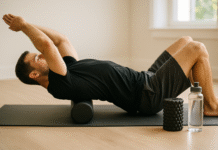
If overhead positions feel stiff, start by rolling the thoracic spine (mid-back). Lie with the roller under your upper back, support your head, and gently extend over the roller at 2–3 points between the shoulder blades. Follow with reaches (e.g., foam-roller snow angels) or your pressing/pulling warm-ups. Many lifters and desk-bound athletes find that freeing thoracic motion unlocks shoulder elevation and reduces compensations like lumbar over-extension. Keep your ribs stacked over pelvis as you extend to avoid hinging in the lower back.
5.1 How to do it
- Set: Roller perpendicular to spine; hands support head and neck.
- Extend: 3–5 gentle extensions at each segment, exhaling as you go.
- Roll: 30–60 seconds through upper-back muscles.
- Use it: Overhead stick slides or scapular circles immediately after.
5.2 Numbers & guardrails
- Stay on upper/mid-back; avoid direct rolling on the low back.
- If you feel sharp rib pressure, de-load or move to a softer roller.
- Aim for 1–2 minutes total before shoulder work.
While thoracic extension over a roller is a practice-based intervention, it fits with the broader evidence that targeted rolling can acutely increase ROM and prep tissues for movement.
6. Chase Better Ankles: Calf and Soleus Rolling for Dorsiflexion
Limited ankle dorsiflexion makes squats tip you forward and reduces running efficiency. Roll the gastrocnemius (upper calf) and soleus (lower calf) with slow passes, then add active ankle pumps or knee-to-wall rocks between sets. Many people notice a short-term bump in dorsiflexion after rolling; longer-term changes tend to be better when foam rolling is paired with calf stretching or loaded ankle work. If ankles remain stubborn, add heel-elevated squats while you build dorsiflexion capacity.
6.1 How to do it
- Roll: 45–60 seconds each on gastrocnemius and soleus.
- Pin & flex: Pause mid-calf, dorsiflex/plantarflex the ankle 5–8 reps.
- Superset: 10–12 knee-to-wall rocks after each rolling set.
- Progress: Add loaded ankle work (slant board raises, split squats).
6.2 Numbers & notes
Acute improvements in ankle dorsiflexion are documented for at least 10–20 minutes; evidence for sustained gains is mixed and often requires two or more weeks with complementary mobility work. Expect individual responses—ankles can be stubborn. Frontiers
Finish by testing your knee-to-wall distance before/after; track weekly to see what actually sticks for you.
7. Unlock Hip Extension: Quad and Hip-Flexor Rolling for Better Squats and Stride
Tight quads and hip flexors limit hip extension, making running and split squats feel cramped and pushing your torso forward in back squats. Use a roller on rectus femoris (front thigh) and the upper quads with slow, tolerable pressure. Pause near the top of the thigh where sitting shortens tissue all day. Follow with active hip-extension drills (glute bridges, half-kneeling hip-flexor stretch with posterior pelvic tilt) to anchor the new range. When done consistently, rolling these tissues helps knees track better and reduces anterior hip pinching sensations.
7.1 How to do it
- Time: 60–90 seconds per thigh, 1–2 sets.
- Contract-relax: Press into the roller for 5 seconds, relax for 10, repeat 2–3 times.
- Anchor: 8–12 glute bridges or split-squat isometrics afterward.
- Check: Re-test a lunge or squat pattern for depth symmetry.
7.2 Common mistakes
- Arching the low back during hip-flexor stretching (keep ribs “down”).
- Pressing so hard that the quads guard and tighten.
- Skipping the posterior pelvic tilt and missing the target.
The research base supports acute ROM improvements from rolling quads and no decrement in strength, which is exactly what most trainees want before squatting or running.
8. Target the Lateral Hip (Not the IT Band): Glutes, TFL, and Vastus Lateralis
Many people instinctively attack the IT band with a roller, but the IT band is a tough, fibrous structure that likely doesn’t “loosen” under typical rolling forces. Instead, target tissues that influence tension on it: glute med/min, tensor fasciae latae (TFL), and vastus lateralis along the outer quad. Use a foam roller for the lateral quad and a ball for TFL/upper glute areas. This approach often reduces the “ropey” lateral thigh sensation while improving hip adduction/abduction control in squats and running.
8.1 Why it matters
Anatomical work shows the IT band is tightly integrated with the lateral intermuscular septum and line of tension across the thigh; it doesn’t slide freely like a rope. Addressing muscular contributors around it is more sensible than trying to “roll it loose.”
8.2 How to do it
- Roll: 60 seconds on vastus lateralis (outer quad) with small side-to-side sweeps.
- Ball: 30–45 seconds on TFL (front-outer hip) against a wall.
- Activate: 8–12 side-lying hip abductions or band walks to finish.
- Guardrail: Skip direct, aggressive IT band smashing—focus on muscles.
Close by noting: better hip control plus calmer lateral tissues usually beats IT band “attacks” for durable mobility.
9. Free Overhead Motion: Lats and Posterior Cuff for Shoulder Elevation
Limited shoulder elevation often stems from stiff lats and posterior-shoulder tissues. Roll the lats by lying on your side with the roller under the outer ribcage, then sweep slowly toward the armpit while keeping the shoulder relaxed. For smaller posterior-cuff spots, a lacrosse or tennis ball against the wall gives more precision. Immediately follow with overhead reaches or wall slides to train the new end range with good rib position. Keep pressure moderate near the ribs to avoid discomfort.
9.1 How to do it
- Lats: 60–90 seconds per side, pausing near the axilla.
- Posterior cuff: 30–45 seconds with a ball on the back of shoulder blade.
- Anchor: 10 wall slides or lift-offs, keeping ribs stacked.
- Check: Overhead stick test before/after.
9.2 Numbers & guardrails
Evidence supports acute ROM gains from rolling without impairing strength—ideal before pressing or pull-ups. Stay clear of bony edges of the scapula; use a ball for precision rather than grinding the joint line.
Finish by noticing how lat rolling often reduces the urge to arch the low back to “fake” overhead motion.
10. Don’t Skip the Adductors: Inner-Thigh Rolling for Hip Depth and Knee Tracking
Stiff adductors (inner thigh) can tug knees inward and block deep hip flexion. Place one leg out to the side with the inner thigh on the roller and sweep from knee to groin, stopping short of sensitive areas. This often improves squat depth and comfort in lateral movements. Pair rolling with Cossack squats or adductor rock-backs to build active control. If your knees collapse inward under load, include adductor work 2–3 times per week to balance the lateral-hip focus.
10.1 How to do it
- Roll: 60–90 seconds per side; keep pelvis square to the floor.
- Pin & move: Pause mid-thigh; flex and extend the knee 5–8 times.
- Anchor: 8–10 Cossack squats or lateral lunges per side.
- Guardrail: Avoid direct pressure near the groin crease.
10.2 Mini-case
After two weeks of twice-weekly adductor rolling + Cossacks, many lifters report smoother descent and more even knee tracking. That fits the broader literature showing foam rolling paired with active mobility changes how you move, not just how tissues feel.
Wrap by noting: adductors are often the “missing link” when hips feel blocked at the bottom of a squat.
11. Choose the Right Tool: Density, Texture, and Vibration (When to Use What)
Tool choice affects comfort and compliance. Smooth, medium-density rollers suit most people and reduce bruising risk. Textured or hollow-core rollers increase pressure with less effort; handy for large muscle groups if you tolerate them. Vibration rollers may feel good, but current evidence suggests they’re not consistently superior to standard rollers for ROM—choose them for comfort or preference, not because they’re magic. For small areas (pecs, posterior shoulder, foot), use a massage ball and a wall for precision.
11.1 Selection checklist
- New to rolling or sensitive? Smooth, softer roller.
- Large areas (quads, hamstrings)? Hollow-core or firm roller.
- Small/precise areas? Ball vs. roller.
- Vibration? Optional; use if it helps you relax.
11.2 Evidence snapshot
Systematic reviews indicate no clear advantage of vibration over standard rollers for ROM; pick the tool that helps you relax and be consistent.
The best tool is the one you’ll actually use—comfort and control beat hype.
12. Make Gains Stick: Pair Rolling With Active Mobility and Training
Foam rolling is a means, not an end. To turn short-term ROM bumps into durable mobility, always pair rolling with active end-range work (isometrics, lift-offs, controlled articular rotations) and then load that range in your training. For ankles, that might be slant-board calf raises and split squats; for shoulders, wall slides and overhead carries; for hips, deep split squats or tempo goblet squats. Over weeks, this combination teaches your nervous system that the new range is safe and useful.
12.1 Practical template
- Roll target (30–90s).
- Active mobility in that range (8–12 reps).
- Lift/move using the new range (2–4 sets).
- Repeat 3–5 days/week for 4+ weeks; reassess ROM monthly.
12.2 Evidence ties
Meta-analyses and reviews consistently show foam rolling increases ROM without harming performance and may reduce soreness; combining it with dynamic movement is a sensible, lower-risk way to translate those gains onto the field or into your lifts.
Think of rolling as opening the door; active movement and loading invite you to walk through it and stay.
FAQs
1) Is foam rolling better than stretching for mobility?
They’re complementary. Foam rolling tends to produce small-to-moderate acute ROM gains without impairing strength, similar to dynamic stretching. Many athletes use both: roll briefly to reduce tone, then do dynamic mobility before training and static stretching after. If you only want one, pick the one you’ll do consistently and that leaves you moving well. Frontiers
2) How long do the mobility benefits last after a session?
The acute ROM window commonly lasts 10–20 minutes, sometimes longer, which is why you should follow rolling with active drills and then train in that range. For sustained changes, aim for 4+ weeks of consistent practice, adjusting exercises and load as your range improves.
3) Does foam rolling reduce soreness (DOMS)?
Yes—several studies show reduced perceived soreness and improved movement quality after rolling, especially when used after hard sessions and on following days. Keep pressure moderate and volume reasonable to avoid irritating already-tender tissues. PubMed
4) Should I roll the IT band directly?
In general, prioritize surrounding muscles (TFL, gluteal complex, vastus lateralis) rather than aggressively smashing the IT band itself. Anatomical studies suggest the IT band is structurally robust and unlikely to “loosen” with typical rolling pressures. Target the muscular drivers and then reinforce with hip-strength work.
5) Will vibration rollers improve results?
They can feel good and sometimes help relaxation, but current evidence doesn’t show consistent ROM advantages over standard rollers. Choose based on comfort and compliance; consistent practice matters more than vibration.
6) Can foam rolling hurt my performance if I do it before lifting?
Not when dosed appropriately. Reviews indicate rolling doesn’t impair strength or power and may even help performance by improving comfort and movement quality. Keep sessions brief (a few minutes total) and follow with active warm-ups.
7) What density roller should I buy?
If you’re new or sensitive, start with a medium-density smooth roller. Firmer, textured, or hollow-core rollers increase pressure with less effort—use them as tolerated for large muscle groups. For precision spots (pecs, posterior cuff, foot), a ball against a wall is better. These choices are about comfort and control, not “harder is better.”
8) Is it safe to roll my lower back or neck?
Avoid direct rolling on the lower back and be cautious around the neck; focus on the muscles above and below (glutes, upper back, lats) and use a ball against a wall for the neck/shoulder complex if needed. Never press on the front of the neck or over the spine’s bony bumps. If symptoms radiate or you feel numbness, stop. Cleveland Clinic
9) How do I know if I’m pressing too hard?
Use a 4–6/10 discomfort scale, keep breathing smoothly, and watch for guarding (muscle tensing). If your breath gets choppy or you clench your jaw, lighten up or switch to a softer tool. Bruising, sharp pain, or joint pain are signs to stop and reassess technique. SELF
10) Where does foam rolling fit on recovery days?
It’s a great match with active recovery: brief rolling to calm hotspots, easy mobility, then a short walk or cycle. Keep pressure light to moderate and favor rhythm and breath over intensity. The goal is to feel looser leaving than when you arrived. WebMD
Conclusion
Foam rolling is simple, scalable, and—when used with intent—remarkably effective for unlocking comfortable range of motion around stiff joints. The 12 tips above converge on a few themes: roll briefly to create a window, breathe to reduce guarding, respect red flags (soft tissue, not joints), and always follow with active mobility and loading to make changes stick. Tool choice matters for comfort but not nearly as much as consistency and smart pairing with movement. Track one or two metrics that matter to you (ankle knee-to-wall distance, overhead reach, squat depth) and adjust dosage by feel within the guardrails. Over several weeks, you’ll likely notice not just looser tissues but cleaner, stronger movement patterns. Ready to move better? Pick one joint, apply the template, and do your first 5-minute roll-and-move session today.
References
- The Effects of Self-Myofascial Release Using a Foam Roller on Performance and Recovery: A Systematic Review — International Journal of Sports Physical Therapy (Cheatham SW et al.), 2015. https://pmc.ncbi.nlm.nih.gov/articles/PMC4637917/
- Acute Effects of Foam Rolling on Range of Motion in Healthy Adults: A Systematic Review — Journal of Bodywork & Movement Therapies (Wilke J et al.), 2020. https://pubmed.ncbi.nlm.nih.gov/31628662/
- A Meta-Analysis of the Effects of Foam Rolling on Performance and Recovery — Frontiers in Physiology (Wiewelhove T et al.), 2019. https://pmc.ncbi.nlm.nih.gov/articles/PMC6465761/
- Foam Rolling for Delayed-Onset Muscle Soreness and Recovery of Dynamic Performance Measures — Journal of Athletic Training (Pearcey GEP et al.), 2015. https://pmc.ncbi.nlm.nih.gov/articles/PMC4299735/
- Specific and Cross-Over Effects of Foam Rolling on Ankle Dorsiflexion — Journal of Bodywork & Movement Therapies (Kelly S et al.), 2016. https://pmc.ncbi.nlm.nih.gov/articles/PMC4970845/
- Foam Rolling Training Effects on Range of Motion: A Systematic Review — Sports Medicine (Konrad A et al.), 2022. https://link.springer.com/article/10.1007/s40279-022-01699-8
- The Functional Anatomy of the Iliotibial Band: Implications for IT Band Syndrome — Journal of Anatomy (Fairclough J et al.), 2006. https://pmc.ncbi.nlm.nih.gov/articles/PMC2100245/
- The Tensile Behaviors of the Iliotibial Band — European PMC (Seeber GH et al.), 2020. https://europepmc.org/article/pmc/7296993
- Effect of Vibration Foam Rolling on the Range of Motion in the Lower Extremity — Journal of Exercise Rehabilitation (Park SJ et al.), 2021. https://e-jer.org/journal/view.php
- Should You Try Foam Rolling? — Cleveland Clinic, Jan 20, 2023. https://health.clevelandclinic.org/foam-rolling