


























Zen meditation, or zazen, is the seated discipline at the heart of Zen. In its simplest form, you sit upright, breathe naturally, and meet each moment as it is. The essentials are surprisingly concrete: stable posture, a relaxed breath, soft open eyes, and a clear way to relate to thoughts. In Soto traditions this often means “just sitting” (shikantaza); in Rinzai, zazen may be paired with structured kōan inquiry. Either way, the practice trains a steady, embodied presence you can carry into daily life. Brief note: meditation is generally safe but not a substitute for medical or mental-health care; if you have a condition or experience distress during practice, consult a qualified clinician.
Quick start (60–90 seconds): place a cushion (zafu) on a mat (zabuton) or sit on a chair. Sit tall, hands in cosmic mudra, eyes softly open and downcast. Exhale fully once (kanki-issoku), then breathe through your nose. Let thoughts come and go; if you lose track, simply notice and return to posture and breath. Sit 5–10 minutes to begin; over weeks, build toward 20–30 minutes.
1. Build a Stable Posture (Zafu, Zabuton, or Chair)
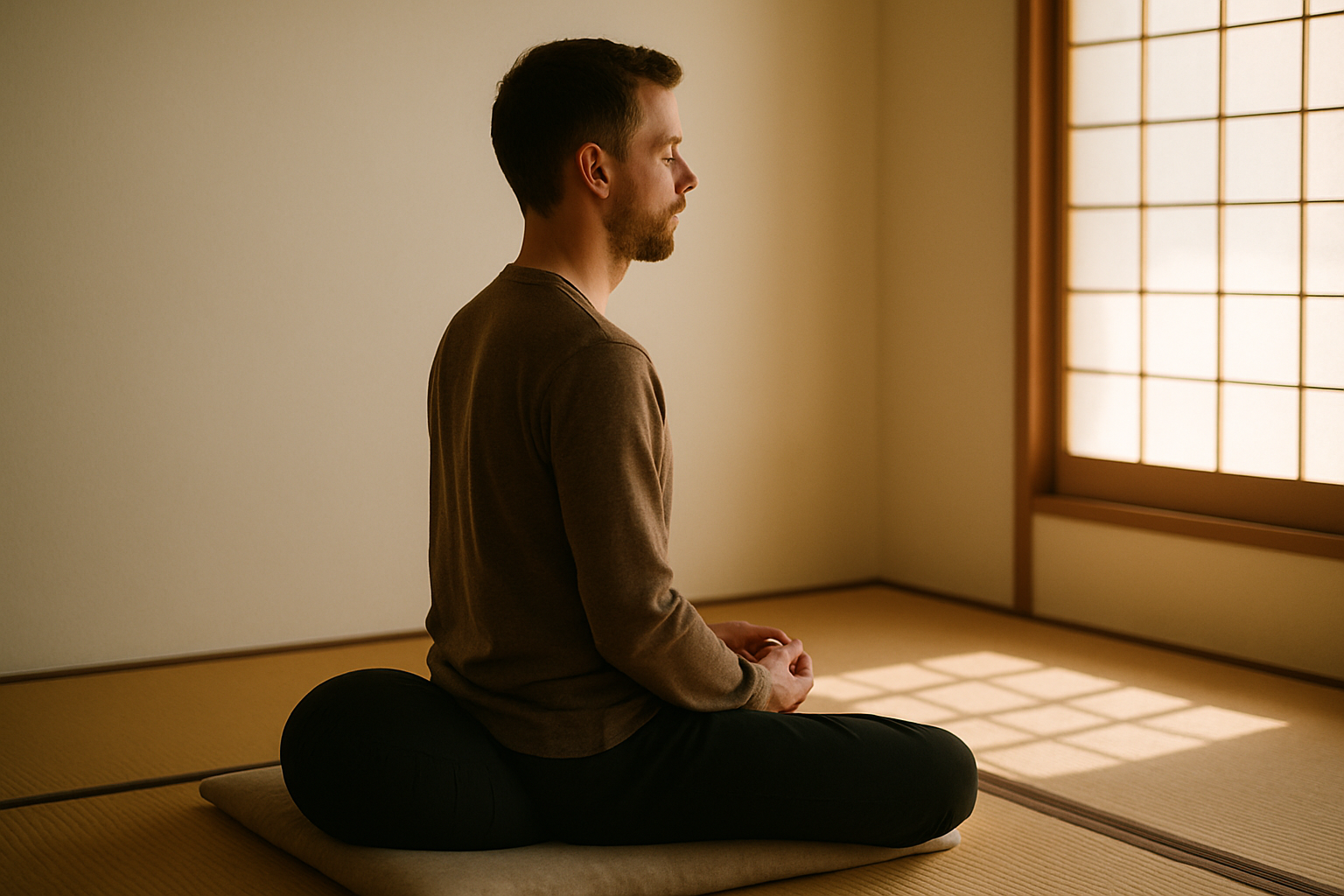
A stable, balanced seat is the foundation of zazen because it lets the body be alert without strain and the breath settle naturally. On a cushion, form a tripod with knees and sitting bones; on a chair, sit upright without leaning back, feet supported. Keep the spine long, chin slightly tucked, shoulders relaxed, and hands in the cosmic mudra (right hand under left, thumbs lightly touching) resting near the lower belly. Posture comes first; a relaxed mind follows. In classical instructions, ears align with shoulders and the nose with the navel; the tongue rests against the palate with lips closed. These alignments are simple, repeatable cues you can check in seconds whenever you drift.
1.1 How to do it
- Place a zafu on a zabuton; sit on the front third so hips tilt forward slightly.
- Choose full-lotus, half-lotus, Burmese, seiza bench, or a chair—whichever lets your knees/feet ground comfortably.
- Let knees and seat form an equilateral triangle; lift the sternum gently to lengthen the spine.
- Hands: cosmic mudra in the lap; elbows slightly away from the ribs so the chest stays open.
- Mouth closed; tongue lightly on the roof of the mouth; breathe through the nose.
1.2 Common mistakes
- Slumping or over-arching: both strain the back. Re-establish your tripod and lengthen the spine.
- Tense shoulders/locked jaw: on each exhale, soften shoulders and jaw.
- Unsupported feet on chairs: add a small cushion or book so thighs are level.
Mini-checklist: tripod grounded; spine long; jaw soft; hands quiet; chair or cushion adjusted. Prioritizing posture reduces fidgeting and mental turbulence, making every other principle easier to apply.
2. Regulate Breath Gently (Kanki-Issoku & Natural Nasal Breathing)
Breath in zazen is quiet and unforced, helping the nervous system settle while the mind becomes clear. Begin by exhaling completely once—a traditional cue called kanki-issoku—then allow the breath to resume through the nose. Let long breaths be long and short be short; rather than controlling rhythm, you simply notice the body breathing itself. If attention scatters, return to the sensation of the breath at the belly or nostrils. With time, the breath grows subtle; your job is only to stay present without pushing or slumping. This gentle approach harmonizes body and mind and reduces the tendency to chase or suppress thoughts.
2.1 Why it matters
- A quiet nasal breath stabilizes posture and reduces mouth dryness.
- One deliberate full exhale at the start clarifies the shift from “doing” to “sitting.”
- Allowing breath to self-regulate prevents strain and supports longer sits.
2.2 Numbers & guardrails
- Start with 5–10 minutes; increase by 2–5 minutes weekly until you reach 20–30 minutes comfortably.
- If you notice breath-holding, ease the spine and soften the belly.
- If you feel dizzy, open the mouth briefly and return to easy nasal breathing.
Synthesis: a single complete exhale followed by natural nasal breathing is enough. Let the breath do the work; you keep the posture and attention.
3. Keep the Eyes Softly Open (45-Degree Downcast Gaze)
Zen is famously practiced with the eyes open, which helps alertness and integrates awareness with the ordinary world. Rest your gaze down at roughly a 45-degree angle, without focusing on any object. Closing the eyes invites drowsiness or drifting into daydreams; wide staring causes tension. The middle way is a soft, unfocused gaze that includes the whole field of vision while attention rests with posture and breath. You’re not “looking for” anything; you’re present to what’s already here. This small detail dramatically reduces nodding off and supports a calm, wakeful clarity throughout the sit.
3.1 How to do it
- Angle the gaze down to the floor/wall about one meter ahead.
- Notice any urge to visually latch onto patterns; soften focus until the scene is “background.”
- If your eyes dry, blink naturally; avoid squeezing shut.
3.2 Common mistakes
- Eyes closed: often leads to dullness; reopen gently and re-lengthen the spine.
- Laser focus on a speck: breeds tension; let focus widen again.
- Head tipped too far down: strains the neck; re-align ears with shoulders.
Synthesis: soft-open eyes, downcast gaze, and upright spine keep the mind both calm and alert—an understated but defining feature of zazen.
4. Relate Wisely to Thoughts (Non-Thinking and “Just Sitting”)
Thoughts will arise; the practice is to not get caught. In Soto Zen, Dōgen’s guidance is to “think of not-thinking—how? Non-thinking.” Practically, that means you neither chase thoughts nor wage war on them. Maintain posture and breath; when you notice you’re entangled, release the storyline and return to sitting. This is shikantaza—“just sitting”—where posture, breath, and awareness are already complete and nothing extra is added. Over time, this trains a humane, nondiscriminating attention that can meet each moment without grasping or aversion.
4.1 How to do it
- Anchor attention in posture and breath, not in thought content.
- When a thought stream is noticed, gently label “thinking,” and return.
- Let clarity and dullness both be known; resist the urge to fix or judge.
4.2 Numbers & guardrails
- Expect many returns per minute at first—this is normal.
- If mind races, shorten your session and emphasize the complete exhale at the start.
- If you feel persistently numb/dull, brighten posture and open the gaze.
Synthesis: the art is neither suppressing nor indulging thoughts. “Non-thinking” is a living, embodied attention that meets whatever appears and returns to simple sitting.
5. Count or Follow the Breath (Susokukan) When Helpful
Many beginners steady attention by counting the breath from one to ten, then returning to one—an approach used widely across Zen training. Count on the end of each inhalation or exhalation, staying with sensations rather than numbers themselves. If you lose count, start again at one without criticism. As stability develops, you can shift from counting to following the breath without numbers, or to shikantaza. Breath counting isn’t “lesser” practice—it’s a pragmatic tool that builds continuity of attention and reduces rumination.
5.1 How to do it
- Choose one pattern and keep it simple: count in-breaths (1–10) or out-breaths (1–10).
- If you hit ten clearly, begin again at one; if you forget the count, begin again at one.
- Keep posture and open-eye gaze consistent while counting.
5.2 Common mistakes
- Chasing perfect tens: turns practice into a contest; let “starting again” be part of the method.
- Counting too fast: ride the whole inhalation or exhalation; don’t rush.
- Treating counting as forever: once steadier, try following the breath or shikantaza.
Synthesis: susokukan is a reliable bridge from scattered to steady attention—use it as needed, then set it down.
6. Practice Kinhin (Walking Meditation) Between Sits
Kinhin is slow, silent walking that refreshes the body and extends zazen into motion. From the waist up, your posture matches sitting; hands rest in shashu (left fingers fist at center, right hand over it). Walk clockwise around the room, taking half a step per full breath—one gentle exhale-inhale per half step—so movement and breathing harmonize. Kinhin keeps legs from numbing, teaches balance, and makes long practice days sustainable. It also trains continuity: the same attention that notices a thought in sitting notices a footfall in walking.
6.1 How to do it
- At the bell, bow, sway the torso a few times, stand, and enter the line.
- Keep eyes soft and downcast; shoulders relaxed; steps light and smooth.
- When turning corners, pivot to the right; maintain spacing and silence.
6.2 Numbers & guardrails
- Typical cycles: 25 minutes sitting + 5 minutes kinhin, repeated.
- If feet drag or hips ache, shorten stride; if you speed up, slow to match one breath per half step.
- On retreats, expect hours of alternating sitting/walking each day.
Synthesis: kinhin is moving zazen—calm, precise, and sustainable—seamlessly linking your cushion to the rest of your life.
7. Choose an Approach: Shikantaza or Kōan Study
Zen offers two complementary methods. In Soto, the emphasis is shikantaza—“just sitting”—a wholehearted, objectless presence that neither grasps nor rejects. In Rinzai, practitioners often work with kōans under a teacher’s guidance: concise cases that cut through habitual thinking to reveal direct insight. Both rely on steady sitting and ethical living; both aim at embodying wisdom and compassion in daily life. The right choice is the one supported by your teacher and community, matched to your temperament and stage of practice.
7.1 How to decide
- If you resonate with simple, objectless awareness, explore shikantaza in a Soto context.
- If you’re drawn to incisive inquiry and interviews, explore kōan practice with a Rinzai teacher.
- Visit local centers; ask how instruction and dokusan (interviews) are offered.
7.2 Notes from the traditions
- Soto characterizes just-sitting as “silent illumination”—posture and awareness as one.
- Rinzai emphasizes awakening through rigorous kōan training within monastic schedules.
- Both value zazen, work practice (samu), and integrating insight with ordinary life.
Synthesis: method is secondary to sincerity and continuity. Pick a lineage, sit regularly, and let practice clarify itself.
8. Structure Your Sessions: Timing, Bells, and Home Setup
Clear structure keeps practice consistent. Traditional periods last 25–40 minutes with short walking intervals, guided by bells; at home you can replicate this with a timer and simple cues. Prepare a quiet, tidy spot—neither too bright nor too dark—kept seasonally comfortable. Place a zafu on a zabuton near a wall if you prefer wall-facing sitting. Before sitting, avoid heavy meals and alcohol; dress in loose, clean clothing. End each period by bowing, swaying, and standing slowly so circulation returns safely to your legs. Small rituals mark the beginning and end, helping the body-mind learn, “this is practice now.”
8.1 Home checklist
- Space: quiet, uncluttered, temperate; mat/cushion or supportive chair.
- Sequence: sit → kinhin → sit (repeat as desired).
- Cues: one complete exhale to start; brief bow to close; stand up gradually.
8.2 Numbers & guardrails
- Build from 10 minutes daily to 20–30 minutes, once or twice a day.
- For longer days, use 25/5 or 30/10 sit/walk cycles.
- If legs tingle or go numb, pause, sway, and rise gradually; avoid abrupt standing.
Synthesis: structure turns good intentions into a living rhythm. Consistency beats intensity; let time and repetition do their quiet work.
9. Find Guidance, Community, and Periods of Intensive Practice
Zazen flourishes with community and qualified teachers. Group sittings add momentum; dokusan or practice interviews offer specific guidance; retreats (sesshin) deepen continuity with hours of alternating sitting and walking daily. Many temples hold sesshin ranging roughly 6–10 hours of meditation per day, often in 25-minute blocks with walking intervals, silence, and talks. Start with a day-long retreat, then try multi-day sesshin when you’re ready. Community also helps integrate practice into work, relationships, and service—Zen’s real proving ground.
9.1 How to engage
- Attend weekly group zazen; learn local etiquette and forms.
- Schedule dokusan or guidance sessions when offered.
- Try a day sit; later, register for sesshin with clear prerequisites.
9.2 Integration tips
- Choose one ordinary activity (e.g., dishwashing, walking to transit) as “moving zazen.”
- Keep one breath as an anchor before emails, meetings, or meals.
- Let practice inform ethics: patience, honesty, and care in daily choices.
Synthesis: people, place, and periodic intensity transform quiet sitting into a durable way of being—awake, grounded, and responsive.
FAQs
1) What is Zen meditation (zazen) in one sentence?
Zazen is upright, open-eyed sitting with natural breath and a non-grasping mind; in Soto it’s often “just sitting” (shikantaza), and in Rinzai it may include kōan study led by a teacher—both train clear awareness you can live in daily life.
2) Do my eyes have to stay open?
Yes in classical Zen: keep them softly open with a 45-degree downcast gaze. This small change prevents drifting and supports alert clarity; if you feel strain, soften focus and adjust posture rather than closing the eyes completely.
3) How long should I sit each day?
Begin with 5–10 minutes and build toward 20–30 minutes once or twice daily. On retreat, expect structured cycles—commonly around 25-minute sits with short walking intervals—so endurance grows gradually without forcing.
4) Is breath counting required?
No. Susokukan (counting) is a practical beginner tool; you can also follow the breath without numbers or practice shikantaza. Use what steadies you now; methods aren’t in competition, and your approach can evolve with guidance.
5) Can I practice on a chair?
Absolutely. Sit upright without leaning back; support feet if needed; keep hands in cosmic mudra and the gaze soft and downcast. The aim is a stable, alert posture with natural breathing—cushion and chair are both valid.
6) What is the role of a teacher and dokusan?
A teacher refines posture, clarifies method, and offers dokusan (private interviews) or instruction. Community schedules—especially during sesshin—often include interviews and talks that keep practice grounded and progressing. gmzc.org
7) What happens during sesshin?
You’ll sit and walk in silence for many hours daily, with formal meals, work practice, and talks. Schedules vary, but 6–10 hours of meditation per day is common; the intensity helps attention become continuous and steady.
8) Is there a “right” lineage—Soto or Rinzai?
Both share zazen’s core and aim at embodied wisdom and compassion. Soto emphasizes just sitting; Rinzai emphasizes kōan training and breakthrough insight, but both cultivate maturity in everyday life. Explore each and commit where you feel well-guided.
9) What if my legs or knees hurt?
Pain is a signal—adjust. Try Burmese or seiza, raise the zafu, or use a supportive chair. Keep the spine long and breath easy; during walking periods, loosen hips and ankles. Long-term resilience comes from comfort that allows stillness, not stoic endurance.
10) Is meditation safe for everyone?
Generally yes, but it’s not a cure-all. Research bodies note few serious risks yet limited data on harms; if you have medical or mental-health conditions or experience distress, check with a clinician and adapt your practice accordingly.
Conclusion
Zazen is wonderfully straightforward: sit upright, breathe naturally, keep the eyes softly open, and relate wisely to thoughts. These nine principles translate that simplicity into a repeatable, sustainable practice—whether you sit on a cushion or a chair, whether you count breaths or just sit, whether you train in Soto or Rinzai. Build a stable posture, let the breath settle, and meet each moment without grasping or resistance. Add walking meditation to refresh the body, a clear structure to guide your sessions, and the support of teachers and community to deepen over months and years. The payoff is not an exotic state but a reliable, embodied steadiness that brightens ordinary life—washing dishes, sending emails, listening to a friend. Start small, be consistent, and let practice teach you. Set a timer, take one full exhale, and sit today.
References
- How to do Zazen — Soto Zen International (Sotoshu), n.d. sotozen.com
- The Practice of Zazen (Leaflet, PDF) — Sotoshu Shumucho, 2014. sotozen.com
- Fukanzazengi of Eihei Dōgen (PDF) — San Francisco Zen Center, n.d. San Francisco Zen Center
- Japanese Zen Buddhist Philosophy — Stanford Encyclopedia of Philosophy, substantive revision March 7, 2024. Stanford Encyclopedia of Philosophy
- How To Meditate: Zazen Instructions — Zen Mountain Monastery, n.d. zmm.org
- Sesshin (Great Vow Zen Monastery) — Zen Community of Oregon, n.d. Zen Community of Oregon
- Myōshin-ji: Zen
To purify oneself— Myōshin-ji Rinzai Zen Headquarters, n.d. 妙心寺 - Meditation and Mindfulness: Effectiveness and Safety — National Center for Complementary and Integrative Health (NCCIH), June 3, 2022. NCCIH
- Practice: Exhale completely and take a breath (Kanki-issoku) — Soto Zen Buddhism North America (Sotozen-US), May 24, 2021. sotozen.us
- Sesshin — Dai Bosatsu Zendo Kongo-ji (Zen Studies Society), n.d. Zen Studies Society