



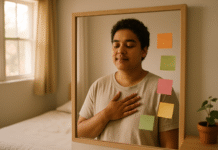

















Mindfulness isn’t a mystical add-on—it’s a trainable skill that helps athletes regulate arousal, focus attention, and execute under pressure. In practical terms, mindfulness meditation for improved sports performance means learning to place attention where it matters (this breath, this rep, this play) while letting distracting thoughts and sensations pass without struggle. In studies with athletes, mindfulness-based programs have reduced competitive anxiety and supported performance-relevant processes like attention control and recovery. In this guide, you’ll learn nine field-tested ways to fold mindfulness and breathing into training, warm-ups, and competition so you can perform with steadier confidence.
Quick definition for skimmers: Mindfulness meditation for improved sports performance is the deliberate practice of nonjudgmental, present-moment attention—often anchored to the breath—to reduce anxiety and sharpen focus so you can execute your skills more consistently.
Brief disclaimer: The strategies here support training and competition; they aren’t a substitute for medical care. If you have a mental-health condition or cardiorespiratory issue, consult a qualified professional before changing your routine.
1. Diaphragmatic Breathing at Your “Performance Pace” (Resonance)
Diaphragmatic breathing at a slow, steady cadence is a fast way to calm pre-event nerves and steady attention. The goal is to breathe low and wide, using the diaphragm (belly and lower ribs expanding on inhale) rather than upper chest. A practical cadence for many athletes is about 5–6 breaths per minute (roughly a 5–6-second inhale and 5–6-second exhale), which often aligns with “resonance” breathing that maximizes heart-rate variability (HRV)—a marker of parasympathetic (calming) activity and physiological flexibility. Start in training when you’re fresh, then deploy before competitions and in between plays to reset arousal without feeling sluggish. Expect a clearer head, steadier hands, and a more even tempo in execution.
1.1 How to do it
- Sit or stand tall; one hand on your abdomen, one on your side ribs.
- Inhale through the nose for ~5–6 seconds, feeling the belly/ribs expand; exhale gently for ~5–6 seconds.
- Continue for 3–5 minutes pre-practice; 1–2 minutes during timeouts or breaks.
- If available, use an HRV app/device (e.g., camera-based or chest strap) to identify your personal resonance rate.
1.2 Numbers & guardrails
- Cadence: 5–6 breaths/minute fits most; personalize if you feel air hunger or dizziness.
- Frequency: 5–10 minutes/day on non-game days; 2–3 minutes pre-event and between efforts.
- Cue: “Low, slow, gentle.”
Synthesis: Build this into your warm-up and you’ll have a reliable, on-demand reset that steadies both body and mind without dulling your edge.
2. The 60-Second “Breathe–See–Do” Reset Between Plays
You don’t always have time for a full meditation, but you do have 30–60 seconds between points, pitches, or possessions. A micro-routine compresses mindfulness into a repeatable loop: breathe to settle, see what’s needed now, do the next action. It reduces rumination after mistakes, reins in over-hype after wins, and restores task focus. The key is consistency—a short, scriptable pattern that becomes automatic under pressure.
2.1 How to do it
- Breathe (10–20 sec): Two to four slow diaphragmatic breaths (see Section 1).
- See (10–20 sec): Name one controllable target (“First step explosive,” “See the seam”).
- Do (10–20 sec): One tiny, technical behavior (grip check, stance set, scan pattern) that cues execution.
2.2 Common mistakes
- Making it motivational instead of technical (“Let’s go!” vs. “Hip hinge set”).
- Doing it only after errors instead of every rep break.
- Overcomplicating the script; keep the words the same.
Synthesis: A dependable between-play reset prevents emotional whiplash and makes your next action a choice, not a reaction.
3. Mindful Pre-Performance Routines (PPR) You Can Trust Under Pressure
A pre-performance routine (PPR) is a scripted sequence of thoughts and actions you perform before execution (serve, free throw, tee shot). Pairing the routine with mindful attention (feeling the breath, noticing contact points, hearing the ambient sound without judgment) stabilizes arousal and reduces noise. Research shows PPRs improve execution accuracy and consistency; when infused with mindfulness, they become even more robust because you’re training how to respond to intrusive thoughts rather than trying to prevent them.
3.1 How to build it
- Anchor: One breath cue (“Inhale set, exhale release”).
- Sensory check: Feel one physical anchor (feet pressure, fingertips on ball).
- Process cue: One technical keyword (“Elbow through,” “Loose wrist”).
- Timing: Script a consistent duration (e.g., 6–8 seconds), rehearse until automatic.
3.2 Mini-checklist
- Same order, same tempo.
- One breath + one sense + one cue.
- Abort routine if disrupted; start over rather than rushing.
Synthesis: A mindful PPR is your portable bubble of calm—repeatable, short, and entirely within your control.
4. Attention Training: Mindfulness of Breath to Sharpen Focus & Working Memory
Mindfulness of breath is the fundamental drill for attention. Sit, focus on the sensation of breathing, and when your mind wanders (it will), notice and return—no judgment. This cycle is the “rep” that builds attentional control and working-memory stability, both essential for reading the game, tracking patterns, and executing tactics late when fatigue and pressure erode focus. Even 10–15 minutes, 3–5 days per week, can make a noticeable difference in how quickly you spot distractions and re-center.
4.1 How to do it
- Posture: Upright, relaxed; eyes open or closed.
- Target: Sensations at nostrils or abdomen.
- Rep: Notice wandering → label (“thinking, planning”) → gently return to breath.
- Progression: Start at 5 minutes; add 1–2 minutes weekly up to 15–20 minutes.
4.2 Numbers & guardrails
- Frequency: 60–120 minutes per week total is a realistic ceiling for most schedules.
- Signal: Better “return speed” (seconds to refocus) during practice is a key KPI.
- Variation: Try a 1–2 minute “focus sprints” block between drills.
Synthesis: Breath-based attention training is strength work for your mind—building the stability to notice distractions fast and get back to the play.
5. Acceptance Skills for Game-Day Nerves (MAC-Style)
Fighting anxiety often backfires; acceptance-based skills teach you to make room for nerves while putting attention back on values-driven action (e.g., attacking the ball, sticking to your plan). In sport, acceptance means acknowledging sensations (butterflies, sweaty palms) without labeling them as problems and then committing to the next behavior. The Mindfulness-Acceptance-Commitment (MAC) approach operationalizes this with exercises like “urge surfing,” values clarification, and cognitive defusion (“I’m having the thought that…”). The payoff is fewer energy leaks and less time lost to internal arguments on game day.
5.1 How to do it
- Name it: “I’m noticing tightness + the thought ‘I might choke.’”
- Make room: Slow, low breath; let sensations be present.
- Choose action: Re-state a controllable (“See ball early”) and move.
5.2 Common mistakes
- Waiting until panic hits to practice; instead, rehearse during scrimmage stress.
- Confusing acceptance with passivity; it’s acceptance and committed action.
Synthesis: Acceptance skills turn nerves into background noise—present but not in charge—so you can channel energy into execution.
6. Body Scan & Interoception: Reading Your Dashboard
A body scan guides attention progressively from head to toe (or vice versa), noticing pressure, tension, and temperature without judgment. For athletes, this hones interoception—the skill of reading internal signals (tight hip, shallow breathing) early enough to adjust mechanics or pacing. Regular scans improve recovery awareness and help you differentiate helpful activation from stress overload. Integrated into cooldowns and mobility sessions, they become both a mindfulness drill and a self-monitoring tool.
6.1 How to do it
- Lie supine or sit; eyes closed.
- Move attention across small regions (e.g., toes → feet → calves…), spending ~10–20 seconds in each.
- Note sensations plainly (“warmth,” “tingle,” “tight”), breathe gently into tense zones.
- Finish with three slow diaphragmatic breaths.
6.2 Mini-checklist
- 8–12 minutes post-practice or pre-sleep.
- Pair with mobility (notice → release → re-test).
- Log one actionable finding (“Left glute late firing”).
Synthesis: A consistent body scan trains a coach’s eye for your own body—fine-tuning the link between sensation and smart adjustments.
7. Mindful Imagery: See-Feel-Breathe for Cleaner Motor Programs
Imagery is a staple in sport psychology; mindfulness strengthens it by anchoring imagery to present-moment sensation and the breath. Rather than abstract visualization, you “see-feel-breathe” the skill—camera angle from your eyes, the feel of ground force, the sound on contact—while staying nonjudgmental about imperfections that appear in the mind’s scene. This reduces overthinking and helps encode cleaner motor patterns. Used in taper weeks or the night before competition, mindful imagery can reinforce confidence without over-arousing the system.
7.1 How to do it
- Set: 1–3 minutes of slow breathing first.
- Scene: First-person perspective; add one sensory detail per breath (foot pressure, grip texture, crowd hum).
- Cue: One technical focus (“Drive knee”); exhale on the moment of release or contact.
- Reps: 5–10 high-quality run-throughs.
7.2 Common mistakes
- Rushing; if attention scatters, reset with 2 breaths.
- Over-polishing; allow small “flaws” to appear and practice staying composed.
Synthesis: Mindful imagery creates a calm, vivid blueprint so your body recognizes the moment and executes with less friction.
8. Recovery Mindfulness: Sleep, Downshifting, and HRV
Mindfulness supports recovery by easing pre-sleep arousal and improving sleep quality in people with sleep difficulties, and paced breathing can nudge HRV upward—useful for downshifting after late workouts or travel days. A simple 10–15-minute pre-bed routine combining body scan and slow breathing reduces cognitive churn; adding a brief journaling line (“three wins, one tweak”) clears task lists from the mind. Track how these practices affect subjective recovery and, if you use an HRV or sleep tracker, note trends—do 5–10 minutes of slow breathing shift your “time to fall asleep” or next-day readiness?
8.1 How to do it
- Evening wind-down (15 min): 8–10 min body scan + 3–5 min slow breathing.
- Travel nights: 2-minute breath sets every 15–20 minutes in the evening.
- Monitoring: Optional HRV/sleep tracker (avoid obsessing; look for trends, not daily perfection).
8.2 Numbers & guardrails
- Cadence: 5–6 breaths/minute remains a safe default.
- Consistency beat hacks: 4–5 nights/week > sporadic long sessions.
- Blue-light and caffeine hygiene still matter; mindfulness complements, not replaces, basics.
Synthesis: A repeatable downshift routine protects the foundation—sleep and autonomic balance—so your training shows up on game day.
9. Program It: Integrating MSPE/MAC Elements into Team Practice
Lasting impact comes from programming mindfulness like any other skill. Two well-studied frameworks—Mindful Sport Performance Enhancement (MSPE) and Mindfulness-Acceptance-Commitment (MAC)—package attention training, acceptance skills, and values-based actions into structured sessions. As of August 2025, many teams integrate 10–15 minutes of breath-anchored focus, micro-resets between drills, and brief reflection at the end of practice. Start with a six- to eight-week block, assign one champion (coach or sport psych), and keep language practical and sport-specific.
9.1 How to do it
- Weekly block: 1 classroom-style session (15–20 min) + 2 field integrations (5–10 min).
- Drill pairing: Breath resets before high-skill attempts; mindful PPRs on closed-skill reps; body scans in cooldowns.
- Measure: Choose 2–3 KPIs (e.g., free-throw % in final 5 minutes, unforced errors under pressure, “return-to-focus” latency).
- Sustain: Rotate athletes to lead the 60-second resets; normalize it as “how we prep.”
9.2 Tools/Examples
- Apps (as of Aug 2025): General mindfulness—Waking Up, Headspace; breathing—Breathwrk; HRV—Elite HRV, HRV4Training.
- Resources: MSPE and MAC manuals; team workshops with licensed sport psychologists.
Synthesis: When mindfulness is built into the fabric of practice—not tacked on—you get calmer reps, cleaner execution, and a shared language for pressure moments.
FAQs
1) What’s the fastest mindfulness technique to lower pre-game anxiety?
Slow diaphragmatic breathing at ~5–6 breaths per minute is the quickest, field-tested lever. It activates parasympathetic pathways, steadies HRV, and lowers perceived stress within a minute or two. Pair it with a brief cue (“soft jaw, long exhale”) for consistency.
2) How long before I notice performance benefits?
Many athletes report steadier focus within 2–3 weeks of 10–15 minutes/day, 3–5 days per week. Objective KPIs (e.g., accuracy late in sessions) often shift in 4–8 weeks if you integrate resets during practice and a mindful pre-performance routine.
3) Won’t mindfulness make me too calm or passive?
Done correctly, no. You’re not sedating yourself—you’re regulating arousal and directing attention. Acceptance means allowing nerves and acting on your plan, not shrinking from competition. If energy feels too low, shorten breathing sessions and add an energizing cue (“fast feet”).
4) Should I use “box breathing” or “4-7-8”?
Any pattern can work if it’s comfortable and sustainable. For performance contexts, many athletes prefer symmetrical inhalation/exhalation around 5–6 seconds each (5–6 breaths/minute). Personalize the cadence; if you feel air hunger or lightheadedness, adjust.
5) Is mindfulness better than traditional psychological skills training (PST)?
They complement each other. Mindfulness trains attention and acceptance; PST targets imagery, self-talk, goal-setting. Blended programs (e.g., MSPE, MAC) often integrate the best of both—mindfulness to manage internal experiences and PST to refine performance cues.
6) How do I measure if this is working?
Track process and outcome: (1) process—how fast you return to focus after a distraction (seconds), routine adherence (% of reps with full PPR); (2) outcome—late-game accuracy, unforced errors under fatigue, free-throw/serve consistency in final sets.
7) Can I practice mindfulness on hard training days?
Yes—especially between intervals or sets as a 30–60-second reset. Just avoid very long slow-breathing sessions immediately before high-power efforts if you feel too relaxed. After hard sessions, use body scan + breathing to accelerate downshifting.
8) What if my mind won’t stop wandering?
That’s the point—notice and return. Each “wander → return” is a rep. Keep sessions short at first (5 minutes), anchor to a clear sensation (air at the nostrils), and accept imperfection. Over time, your return speed improves and frustration drops.
9) Are there risks to slow breathing?
Most healthy people tolerate it well. If you experience dizziness, tingling, or discomfort, reduce depth, shorten the exhale, or pause. Anyone with respiratory, cardiovascular, or psychiatric conditions should consult a clinician before adopting new techniques.
10) Should teams practice together or individually?
Both. Team sessions build a shared language and normalize resets; individual practice deepens skill. A simple cadence: one short team block weekly, two micro-integrations in practice, and 10–15 minutes of individual work at home.
11) How does mindfulness help with choking under pressure?
It reduces the urge to over-control mechanics and shifts attention back to task cues. Acceptance skills keep anxiety from spiraling, and a mindful PPR provides an automatic, familiar script so you execute instead of analyze mid-movement.
12) Which apps or tools are legit?
As of August 2025, mainstream mindfulness apps (e.g., Waking Up, Headspace) plus breathing/HRV tools (Breathwrk, Elite HRV, HRV4Training) are commonly used by athletes. Pick the one you’ll actually use; consistency beats features.
Conclusion
Mindfulness in sport is not about emptying your mind—it’s about owning your attention and responding skillfully to pressure. The nine strategies above translate that idea into repeatable actions: slow, diaphragmatic breathing to regulate arousal; micro-resets between plays; mindful pre-performance routines; attention reps on the breath; acceptance skills to unhook from worry; body scans to read your internal dashboard; present-tense imagery; recovery practices for sleep and HRV; and finally, smart programming so these habits stick. Start with one or two anchors (e.g., resonance breathing + a mindful PPR), measure what matters (return-to-focus time, late-session accuracy), and review weekly. With a month of steady practice, you’ll likely feel less hijacked by nerves and more able to execute your skills when it counts. Take the first step today: script a 60-second Breathe–See–Do reset and run it in your next training session.
References
- Si, X. et al. A meta-analysis of the intervention effect of mindfulness training on athletes’ performance. Frontiers in Psychology, 2024. https://www.frontiersin.org/journals/psychology/articles/10.3389/fpsyg.2024.1375608/full
- Wang, Y. et al. Effects of Mindfulness-Based Interventions on Promoting Athletes’ Performance and Related Factors: A Meta-Analysis. Healthcare (MDPI), 2023. https://pmc.ncbi.nlm.nih.gov/articles/PMC9915077/
- Yu, M. G. et al. Effects of mindfulness intervention on competition state anxiety in sprinters. Frontiers in Psychology, 2024. https://www.frontiersin.org/journals/psychology/articles/10.3389/fpsyg.2024.1418094/full
- Lehrer, P. M., & Gevirtz, R. Heart rate variability biofeedback: how and why does it work? Frontiers in Psychology, 2014. https://www.frontiersin.org/articles/10.3389/fpsyg.2014.00756/full
- Shaffer, F. et al. A Practical Guide to Resonance Frequency Assessment for Heart Rate Variability Biofeedback. Frontiers in Neuroscience, 2020. https://pmc.ncbi.nlm.nih.gov/articles/PMC7578229/
- Rupprecht, A. G. O. et al. The effectiveness of pre-performance routines in sports: A meta-analysis. International Review of Sport and Exercise Psychology, 2021. https://www.tandfonline.com/doi/full/10.1080/1750984X.2021.1944271
- Mrazek, M. D. et al. Mindfulness training improves working memory capacity and GRE performance while reducing mind wandering. Psychological Science, 2013. https://pubmed.ncbi.nlm.nih.gov/23538911/
- Jha, A. P. et al. Mindfulness training curbs attentional lapses in military cohorts: A randomized controlled trial. PLOS ONE, 2015. https://journals.plos.org/plosone/article
- Laborde, S., Mosley, E., & Thayer, J. F. Heart Rate Variability and Cardiac Vagal Tone in Psychophysiological Research—Recommendations for Experiment Planning, Data Analysis, and Data Reporting. Frontiers in Psychology, 2017. https://pmc.ncbi.nlm.nih.gov/articles/PMC5316555/
- Black, D. S. et al. Mindfulness meditation and improvement in sleep quality and daytime impairment among older adults with sleep disturbances: A randomized clinical trial. JAMA Internal Medicine, 2015. https://jamanetwork.com/journals/jamainternalmedicine/fullarticle/2110998
- Glass, C. R. et al. Mindful Sport Performance Enhancement: Randomized Controlled Trial of a Mental Training Program with Collegiate Athletes. Journal of Clinical Sport Psychology, 2019. https://journals.humankinetics.com/downloadpdf/journals/jcsp/13/4/article-p609.pdf
- Gardner, F. L., & Moore, Z. E. A Mindfulness-Acceptance-Commitment-Based Approach to Athletic Performance Enhancement: Theoretical Considerations. Behavior Therapy, 2004. https://thehubedu-production.s3.amazonaws.com/uploads/4835/311af33f-7f26-410b-9364-96e838a22435/3.pdf