
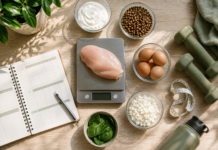
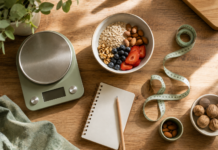








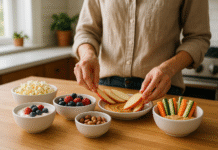














If you’ve ever hit a mid-morning energy dip, raided the pantry at 4 p.m., or found yourself overeating at dinner after a long gap between meals, you’ve felt why snack timing and composition matter. The science behind why eating 3 balanced snacks a day is important centers on appetite hormones, blood-glucose dynamics, cognitive performance, nutrient distribution, and adherence to overall diet quality. When snacks are planned and balanced—built around protein, fiber, and healthy fats—they can stabilize energy, curb cravings, and fill nutrient gaps without sabotaging total daily calories.
Medical disclaimer: The guidance below is general information and not a substitute for personalized care. If you have diabetes, kidney disease, gastrointestinal disorders, are pregnant or breastfeeding, or take medications that affect appetite or blood sugar, consult a qualified health professional before changing your eating pattern.
Key takeaways
- Balanced snacks = protein + fiber + healthy fat. This trio slows digestion, improves fullness signals, and supports steadier blood glucose.
- Three snacks strategically placed (e.g., mid-morning, mid-afternoon, early evening) help prevent large hunger swings that drive overeating at meals.
- Evidence on “more frequent eating” is mixed, but planned, nutrient-dense snacks are consistently linked with better diet quality and more stable energy.
- Smart snack timing and food order (fiber/protein before starches) can blunt glucose spikes and support focus, mood, and performance.
- Success depends on structure. Portion control, routine timing, and pre-planning beat spontaneous grazing.
- Safety first. Choose low-sugar, tooth-friendly options; tailor protein and sodium if you have medical conditions; and watch total daily calories.
What counts as a “balanced snack” (and why it works)
What it is & core benefits
A balanced snack is a small eating occasion designed to bridge 3–4-hour gaps between meals without overshooting daily energy needs. It pairs:
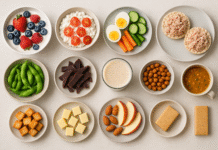
- Protein (yogurt, eggs, tofu, cottage cheese, legumes, nuts/seeds)
- Fiber-rich carbs (fruit, berries, vegetables, whole-grain crackers, oats, legumes)
- Healthy fats (nuts, seeds, olive-based dips, avocado), often naturally bundled with protein
Why it works: Protein elevates fullness signals and slightly increases diet-induced thermogenesis; soluble fibers slow gastric emptying and can raise satiety peptides in the gut; fats enhance palatability and extend satiety. Together, this trio reduces the urge to overeat at the next meal and smooths post-snack glucose curves.
Requirements & low-cost alternatives
- Kitchen access: Not required. Shelf-stable combos (fruit + nuts; roasted chickpeas; tuna pouch + whole-grain crackers) travel well.
- Budget: Choose value options—eggs, canned fish, beans, seasonal fruit, store-brand yogurt, bulk nuts/seeds.
- Storage: A small cooler pack for perishable items; zip bags or small containers for portion control.
Step-by-step: Build any snack in 3 moves
- Pick your protein (one palm or ~½ cup): Greek yogurt, cottage cheese, 2 boiled eggs, edamame, tofu cubes, tuna pouch, hummus.
- Add fiber (one fist/handful): An apple, berries, carrots/cucumber, grape tomatoes, a small whole-grain wrap, oats, or bean crisps.
- Include healthy fat (thumb-to-two thumb-sized): Nuts, seeds, nut/seed butter, olive-oil–based dip, avocado.
Mini-examples (2–3 steps)
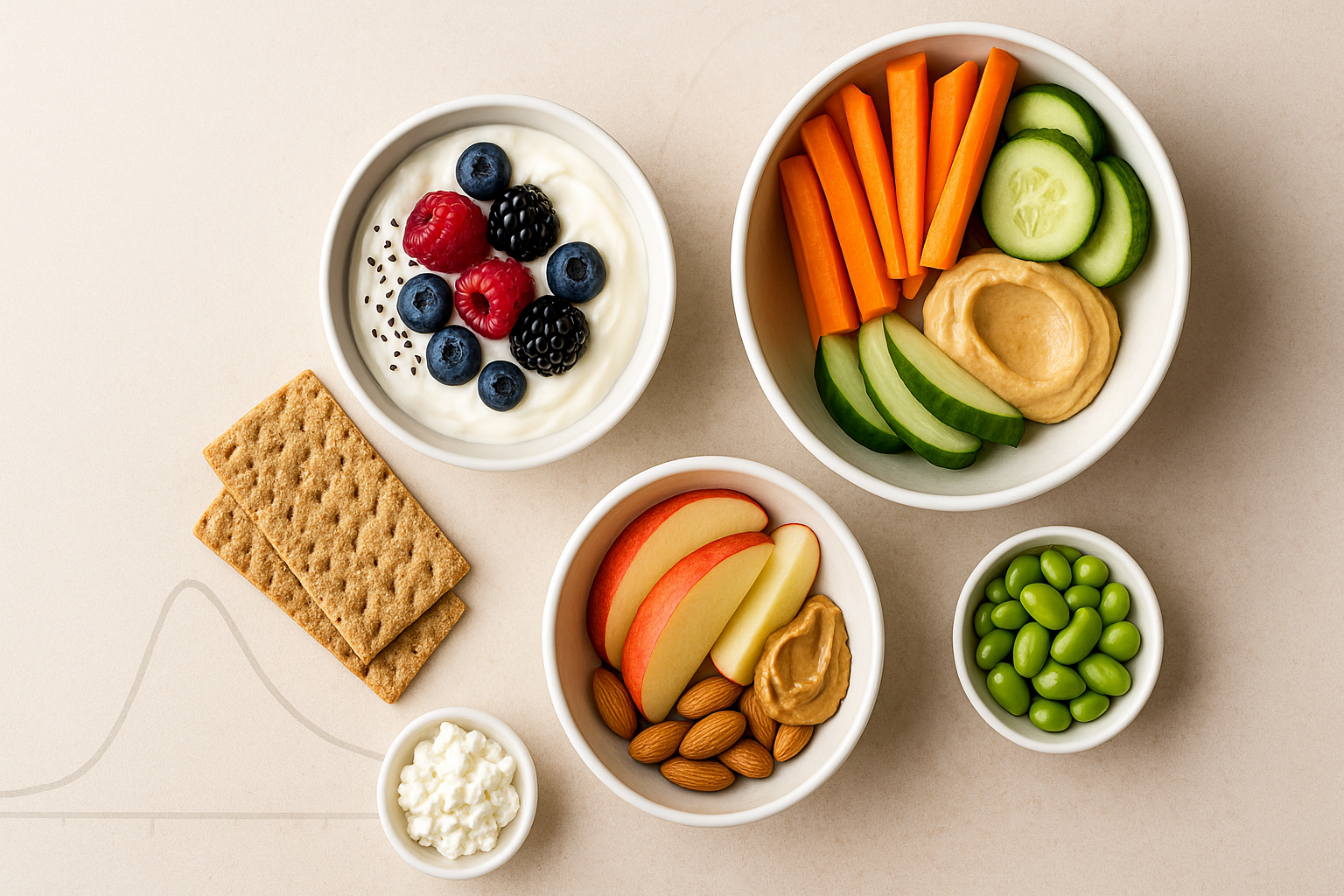
- Greek yogurt + berries + sprinkle of chia
- Apple + 1–2 tbsp peanut butter
- Veggie sticks + ¼ cup hummus + a few olives
- Whole-grain crackers + tuna pouch + cucumber slices
- Cottage cheese + pineapple + pumpkin seeds
Beginner modifications & progressions
- If you’re often not hungry for snacks: Start with 1–2 balanced snacks and add a third on longer days or around workouts.
- If you’re ravenous by dinner: Make the afternoon snack protein-forward (e.g., yogurt + nuts) and place it 2–3 hours before dinner.
- If you track glucose: Experiment with fiber/protein first, then starches (see timing section).
- For athletes or highly active days: Bump the carb portion (banana, oats, whole-grain wrap) around training.
Recommended frequency, timing & metrics
- Frequency: Up to three snacks on longer days or when meals are >4 hours apart.
- Timing: Roughly 10:30 a.m., 3:30 p.m., and early evening if dinner is late; adjust to your schedule.
- Metrics: Track hunger (0–10) before meals, energy dips, cravings, and whether dinner portions normalize.
Safety, caveats & common mistakes
- Excess calories: “Healthy” snacks can still overshoot needs—pre-portion nuts, dips, and dried fruit.
- Sugary options: Regularly choosing sweets/SSBs raises caries risk and added sugars—prefer whole foods.
- Medical conditions: Diabetes, kidney disease, IBS, pregnancy, food allergies—individualize choices and portions.
- Mindless grazing: Eating while distracted reduces satiety—plate your snack and eat it intentionally.
The physiology: how snacks talk to your hormones and brain
What it is & core benefits
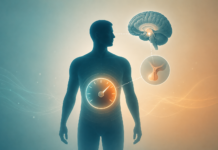
Your appetite is regulated by a gut–brain–pancreas network. After you eat, peptides like GLP-1 and PYY rise (promoting fullness) while ghrelin drops (reducing hunger). Protein and soluble fiber are especially potent at nudging these signals in your favor. The outcome: slower gastric emptying, reduced food-reward drive, steadier energy, and—when snacks are structured—less overeating at the next meal.
Requirements & low-cost alternatives
No lab gear needed—just protein + fiber sources (yogurt/eggs/legumes + fruit/veg/whole grains) and minimal added sugars.
Step-by-step: Make hormones work for you
- Front-load protein in each snack (e.g., ½–1 cup Greek yogurt, 2 eggs, ¾ cup edamame, ½ cup cottage cheese, ½ cup hummus).
- Anchor with fiber: fruit or veg first; add whole grains or legumes if you need more staying power.
- Cap with fat: a small handful of nuts/seeds or a smear of nut butter to extend satiety.
Beginner modifications & progressions
- Sensitive stomach? Start with gentler fibers (berries, oats) and moderate fats; build up slowly.
- Cravings for sweets? Pair fruit with protein (apple + cheese/yogurt) rather than eating fruit alone.
Recommended frequency/duration/metrics
- Frequency: Three balanced snacks if your day has long gaps or higher energy demands.
- Duration: Spend 5 minutes assembling; aim to finish each snack in 10–15 minutes to allow satiety cues to develop.
- Metrics: Note time to next hunger (goal: ≥2 hours), craving intensity, and evening intake (should normalize).
Safety, caveats & common mistakes
- Relying on ultra-processed snack foods may blunt satiety and add sodium/sugars.
- Skipping protein leads to quicker return of hunger.
- Overdoing fats (large nut butter scoops) can tip calories high—measure with a spoon.
Mini-plan
- Mid-morning: Edamame + mandarin
- Mid-afternoon: High-protein yogurt + crushed walnuts
- Early evening: Hummus + carrots + a few whole-grain crackers
Blood sugar, cognitive performance, and snack timing
What it is & core benefits
Large glucose swings sap energy and focus. Low-glycemic, protein-anchored snacks smooth the post-snack glucose curve, supporting attention, working memory, and mood over the next few hours. The order in which you eat foods matters, too: fiber/protein before starches blunts glucose spikes. Earlier-day eating and consistent spacing between meals/snacks also support glucose handling.
Requirements & low-cost alternatives
- Low-GI carbs: oats, legumes, whole fruit (berries, apples), whole-grain crackers.
- Protein anchor: yogurt, eggs, tofu, cottage cheese, beans; canned fish is cost-effective.
- No special devices required (a few prefer CGM for experiments, but it’s optional and not necessary for most).
Step-by-step: Snack sequencing that steadies glucose
- Eat vegetables or fruit first, then the protein/healthy fat, and finish with any starch.
- Time snacks to avoid >4–5-hour fasts between meals.
- Move a little (a short walk) after a snack or meal to further smooth glucose.
Beginner modifications & progressions
- If you struggle with afternoon slumps, make the 2–3 p.m. snack lower-GI and higher-protein (e.g., yogurt + nuts, cottage cheese + tomatoes).
- If evenings are late, insert a small early-evening snack (e.g., carrots + hummus) to prevent overeating at 9 p.m.
Recommended frequency/duration/metrics
- Frequency: Three snacks if you routinely exceed 4 hours between meals; otherwise 1–2.
- Metrics: Track post-snack alertness and desire to nap; if you still crash, re-balance toward protein/fiber.
Safety, caveats & common mistakes
- Diabetes/gestational diabetes: Work with your clinician to individualize timing and portions.
- “Naked carbs” (juice, plain crackers, candy) without protein/fiber can spike then crash energy.
Mini-plan
- 10:30 a.m.: Cottage cheese + cherry tomatoes (eat tomatoes first)
- 3:30 p.m.: Apple slices → peanut butter (1–2 tbsp) → 2–3 whole-grain crackers
- 7:00 p.m.: Veggie sticks → hummus; 10-minute walk
What research says about meal frequency (and where snacks fit)
What it is & core benefits
“Three snacks a day” is a structure, not a rule. Modern evidence on meal frequency shows mixed results for appetite and energy intake. That means frequent eating isn’t automatically better—but planned, nutrient-dense snacks can improve diet quality and help many people avoid extremes of hunger that drive overeating.
Requirements & low-cost alternatives
A repeatable schedule (calendar reminders or phone alarms), a short shopping list, and portable options for busy days.
Step-by-step: Personalize your cadence
- Map your natural hunger for 2–3 days; note time gaps >4 hours.
- Place up to three snack “bridges” where gaps exist.
- Evaluate weekly—if dinner overeating vanishes and energy stabilizes, you’ve likely found your sweet spot.
Beginner modifications & progressions
- Start with one strategic snack (usually mid-afternoon) and only add more if helpful.
- Reduce to two if three feels like “too much eating.”
Recommended frequency/duration/metrics
- Frequency: Up to three, aligned with your day.
- Metrics: Hunger ratings before meals, evening calorie drift, and craving frequency.
Safety, caveats & common mistakes
- Mistaking “snacking” for grazing. Each snack should be intentional, plated, and finished.
- Chasing frequency over quality. A structured low-sugar, protein-anchored snack beats frequent sweets every time.
Mini-plan
- Identify two largest gaps (e.g., 8 a.m.–1 p.m. and 1–7 p.m.)
- Insert snacks at 10:30 a.m. and 3:30 p.m. for one week
- Review: less dinner overeating? fewer cravings? Keep or adjust.
Snacks as nutrient insurance (filling dietary gaps)
What it is & core benefits
Many adults underconsume dietary fiber, potassium, calcium, and vitamin D. Thoughtful snacks can “top up” these nutrients of public health concern without blowing calories:
- Fiber & potassium: Fruit (bananas, oranges, berries), beans, lentils, veggies
- Calcium & protein: Yogurt, cottage cheese, fortified milks, canned fish with bones
- Vitamin D: Fortified dairy/plant milks, tinned salmon; sunlight and supplements as advised by your clinician
Requirements & low-cost alternatives
- Canned/pouched fish, store-brand dairy or fortified plant milks, frozen fruit/veg, and bulk legumes are budget-friendly.
Step-by-step: Aim a snack at a gap
- Pick one nutrient to target (e.g., calcium).
- Choose a vehicle (e.g., ¾–1 cup yogurt).
- Round it out with fiber/fat (e.g., berries + flax).
Beginner modifications & progressions
- Rotate nutrient targets by day: M/W/F = calcium; Tu/Th = fiber/potassium.
- For plant-based eaters, pair legumes + seeds (e.g., hummus + pumpkin seeds) for protein and minerals.
Recommended frequency/duration/metrics
- Frequency: 1–2 snacks per day explicitly aimed at nutrient gaps.
- Metrics: Food log check—did you include fruit/veg and a calcium source most days?
Safety, caveats & common mistakes
- Added sugars in flavored yogurts; choose unsweetened or lightly sweetened.
- Excess sodium in canned foods; rinse beans and choose lower-sodium options when possible.
Mini-plan
- Calcium day: Plain yogurt + kiwi + ground flax
- Fiber day: Roasted chickpeas + orange
- Potassium day: Cottage cheese + sliced peach + sunflower seeds
Circadian timing, training, and evening snacking
What it is & core benefits
Your metabolism follows a circadian rhythm—most people handle glucose earlier in the day more efficiently. Aligning snacks earlier (and planning rather than improvising late-night nibbling) can support glucose control and sleep. For exercisers, pre- and post-workout snacks enhance performance and recovery.
Requirements & low-cost alternatives
- Pre-workout: Easy carbs + modest protein (banana + yogurt, toast + egg).
- Post-workout: Carbs to replenish, plus protein for muscle repair (chocolate milk, tuna on whole-grain crackers, smoothie with milk and fruit).
Step-by-step
- Place a carb-protein snack 1–2 hours pre-workout if you train hungry.
- Refuel within a few hours after training—especially if you’ll train again soon.
- Keep late snacks light and not sugar-dense to support sleep and oral health.
Beginner modifications & progressions
- Sensitive stomach? Move the pre-workout snack earlier or choose lower-fiber options.
- Heavy training? Increase carb portion in pre/post snacks.
Recommended frequency/duration/metrics
- Frequency: 1 snack around workouts; one earlier-evening snack if dinner is late.
- Metrics: Workout perceived energy, time-to-fatigue, next-day soreness, and sleep quality.
Safety, caveats & common mistakes
- Very sugary evening snacks can impair sleep and dental health.
- Hydration matters—dehydration masquerades as “hunger.”
Mini-plan
- 60–90 min pre-workout: Toast + egg
- After: Milk-fruit smoothie
- If dinner is late: Veg sticks + hummus, not sweets
Quick-start checklist
- Choose 3 go-to protein bases (e.g., yogurt, eggs, hummus).
- Choose 5 fiber sides (fruits/veg/whole grains).
- Stock two healthy fats (nuts/seeds, olive-based dips).
- Pre-portion nuts/dips; buy single-serve yogurts or small containers.
- Block snack times on your calendar.
- Plate snacks—no grazing from the bag.
- Evaluate weekly: hunger, energy, dinner intake, cravings.
Troubleshooting & common pitfalls
- “I’m still starving before dinner.” Add ~10–15 g more protein or swap fruit-only snacks for protein-anchored options.
- “Snacking makes me gain weight.” Audit calorie creep (nut butters, handfuls of nuts). Keep snacks 150–250ish calories unless your total needs are higher.
- “I crave sweets after lunch.” Try fiber/protein first and a 10–15 minute walk post-meal.
- “I don’t have time.” Assemble 2-ingredient combos (apple + almonds; carrots + hummus).
- “My teeth feel more sensitive.” Reduce acidic or sugary snacks, rinse with water after eating, and prioritize tooth-friendly options (cheese, nuts, veg).
- “My stomach is gassy.” Shift from crucifers/very high-FODMAP snacks to gentler fibers (oats, berries), and build up slowly.
How to measure progress (simple, objective metrics)
- Hunger score before dinner: Aim for 4–6/10 (not 8–10/10 ravenous).
- Evening intake: Noticeably lower portions and fewer late-night snacks.
- Energy dips: Fewer post-lunch crashes; steadier focus mid-afternoon.
- Cravings: Less intense and less frequent.
- Diet quality: More fruit/veg/dairy/legumes across the week; added sugars down.
- Teeth: Fewer episodes of sweet/acid snacks; better oral comfort.
A simple 4-week starter plan
Week 1 — Build the habit
- Pick two daily snack times where your hunger spikes.
- Use 2-ingredient combos: fruit + nuts; veg + hummus; yogurt + seeds.
- Log hunger (0–10) before dinner.
Week 2 — Balance & portion
- Upgrade to 3-component snacks (protein + fiber + fat).
- Pre-portion nuts/dips; plate snacks.
- Add light activity after one snack (10-minute walk).
Week 3 — Target nutrients & timing
- Assign one snack to calcium/protein (yogurt/cottage cheese) and one to fiber/potassium (fruit/legumes/veg).
- Sequence fiber/protein before starches; avoid “naked carbs.”
- Keep the last snack earlier in the evening.
Week 4 — Personalize & sustain
- Adjust to two or three snacks based on hunger/dinner intake.
- Create grab-and-go kits: apple + almond packs; tuna pouch + crackers; roasted chickpeas.
- Review your logs: fewer crashes? Less overeating at dinner? Keep what works.
FAQs
1) Won’t eating three snacks a day make me gain weight?
Not if they’re planned, portion-controlled, and protein-anchored. Unplanned grazing adds calories; structured snacks often replace overeating later.
2) How big should a snack be?
Enough to bridge 2–4 hours—commonly 150–250ish calories for moderately active adults, but needs vary. Focus on the protein + fiber + fat trio rather than exact calories.
3) What if I’m not hungry between meals?
You don’t have to snack. The goal is stability, not eating more often. Use one strategic snack on longer days.
4) Is fruit alone a good snack?
Better than sweets, yes—but pair fruit with protein/fat (nuts, yogurt, cheese) for longer-lasting energy and steadier glucose.
5) Are protein bars okay?
They’re convenient, but check labels for added sugars and long ingredient lists. Real-food options (yogurt, eggs, nuts) usually offer better satiety.
6) What time should I place the three snacks?
Typically mid-morning, mid-afternoon, and early evening if dinner is late. Keep evening snacks small and minimally sugary.
7) I have diabetes. Can I use this approach?
Yes—with clinician guidance. Emphasize protein-anchored, high-fiber snacks and monitor responses. Food order (fiber/protein before starches) can help.
8) I’m an athlete. How should my snacks look?
Around training, include more carbohydrate plus protein. Away from training, keep the usual protein + fiber + fat structure.
9) Do I need to track macros?
Not necessarily. If hunger and energy stabilize and evening intake normalizes, your snacks are likely balanced.
10) Are late-night snacks always bad?
Not always, but late-night sweet or heavy snacks can disrupt sleep and stress dental health. Prefer light, savory options if you truly need one.
11) Can kids use this pattern?
Kids can benefit from balanced mini-meals, but portion sizes and choices should fit their needs. Limit added sugars and sticky sweets for oral health.
12) What if I follow intermittent fasting?
You can still build balanced eating occasions inside your eating window. If your window is short, snacks may be fewer but more substantial—ensure protein and fiber coverage.
Conclusion
Three balanced snacks a day aren’t a magic trick—they’re a practical structure that steadies appetite hormones, smooths glucose, supports focus, and fills critical nutrient gaps. When snacks are intentional, protein-anchored, and fiber-rich, they become the glue that holds a healthy day of eating together.
CTA: This week, pick two go-to balanced snacks, schedule them, and feel the difference by Friday.
References
- Snack Consumption by U.S. Adults (WWEIA, NHANES 2017–March 2020), USDA ARS Food Surveys Research Group, April 2024. https://www.ars.usda.gov/ARSUserFiles/80400530/pdf/DBrief/53_Snacks_Consumption_by_Adults_1720.pdf
- Snack Consumption by U.S. Adults – Data Brief (Reader View), National Center for Biotechnology Information (NCBI) Bookshelf, 2024. https://www.ncbi.nlm.nih.gov/books/NBK603801/
- Dietary Guidelines for Americans, 2020–2025, U.S. Departments of Agriculture and Health and Human Services, 2020. https://www.dietaryguidelines.gov/sites/default/files/2020-12/Dietary_Guidelines_for_Americans_2020-2025.pdf
- Executive Summary (Dietary Guidelines for Americans, 2020–2025), U.S. Departments of Agriculture and Health and Human Services, 2020. https://www.dietaryguidelines.gov/sites/default/files/2020-12/DGA_2020-2025_ExecutiveSummary_English.pdf
- Food Sources of Select Nutrients (DGA Online Materials), U.S. Departments of Agriculture and Health and Human Services, 2021. https://www.dietaryguidelines.gov/resources/2020-2025-dietary-guidelines-online-materials/food-sources-select-nutrients
- Frequency of Meals and/or Snacking and Energy Intake: A Systematic Review, Nutrition Evidence Systematic Review (NESR), 2024. https://nesr.usda.gov/sites/default/files/2024-12/Frequency-meals-snacks_energy-intake-2025DGACSystematicReview.pdf
- The Influence of Meal Frequency and Timing on Health in Humans: The Role of Fasting and Chrono-Nutrition, Nutrients, 2019. https://www.ncbi.nlm.nih.gov/pmc/articles/PMC6520689/
- Daily Eating Frequency in US Adults (NHANES 2007–2016), Nutrients, 2020. https://www.ncbi.nlm.nih.gov/pmc/articles/PMC7551388/
- Within-Person Compensation for Snack Energy by US Adults, The American Journal of Clinical Nutrition, 2019. https://www.ncbi.nlm.nih.gov/pmc/articles/PMC6462429/
- Clinical Evidence and Mechanisms of High-Protein Diet in Obesity, Journal of Obesity & Metabolic Syndrome, 2020. https://www.jomes.org/journal/view.html
- Effect of Short- and Long-Term Protein Consumption on Appetite and Gut Hormones: Meta-analysis, Physiology & Behavior, 2020. https://www.sciencedirect.com/science/article/abs/pii/S0031938420304376
- Gut Hormones and Appetite Control: Focus on PYY and GLP-1, Endocrine Development (Review), 2012. https://www.ncbi.nlm.nih.gov/pmc/articles/PMC3286726/
- High-Protein Intake Stimulates Postprandial GLP-1 and PYY (Human study), Obesity, 2013. https://onlinelibrary.wiley.com/doi/full/10.1002/oby.20154