










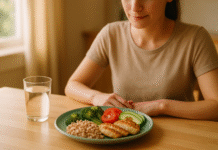














When your snacks combine smart carbs, quality protein, and healthy fats, you get steady energy, fewer cravings, and better satisfaction between meals. This guide shows you exactly how to do it with 10 flavorful, real-life pairings you can assemble in minutes—at home, at work, or on the go. It’s written for busy people who want practical choices (with portions and swaps) that still feel like food you’re excited to eat. Quick note: this is general nutrition education, not medical advice; if you manage a condition like diabetes, talk with your clinician or dietitian about how to tailor portions and timing.
Quick definition: Balanced snack pairings combine a fiber-rich carbohydrate, a protein source, and healthy fat in one small snack to smooth out digestion and support stable blood sugar and satiety. Think “fruit or whole grain + dairy/legume/egg/fish + nuts/seeds or olive oil.”
1. Apple + Peanut Butter (+ Cinnamon or Chia)
Start with crisp apple slices for fiber-rich carbs, add a smear of peanut butter for protein and healthy fats, and finish with cinnamon or a sprinkle of chia for extra fiber and texture. This trio hits the “taste + fullness” sweet spot: the apple’s water and fiber add volume, peanut butter supplies staying power, and the spice or seeds make it feel like a treat, not a compromise. It’s portable, inexpensive, and kid-friendly, and it works equally well as a late-morning tide-me-over or a pre-workout nibble when you don’t want something heavy.
1.1 Why it works
- Fiber in apples slows digestion; pairing with fat and protein helps temper rapid glucose swings.
- Peanut butter contributes protein and unsaturated fat for satiety.
- Cinnamon or chia add aroma, texture, and—in chia’s case—extra fiber and ALA omega-3s.
1.2 How to build it
- Portion guide: 1 small–medium apple (about a palm), 1 tablespoon peanut butter, optional ½–1 teaspoon cinnamon or 1 teaspoon chia.
- Smart swaps: Almond or cashew butter; pear instead of apple.
- Allergy-friendly: Use sunflower-seed butter.
Mini-checklist
- Choose nut butter with no added oil/sugar.
- Slice fruit ahead and toss with lemon to prevent browning.
- Keep a single-serve nut-butter packet in your bag.
Bottom line: simple combo, big satisfaction—great when you need something fast that still “lands.”
2. Greek Yogurt + Berries + Walnuts or Ground Flax
Thick Greek yogurt brings high-quality protein; berries add color, fiber, and natural sweetness; and walnuts or ground flax round it out with healthy fats. This cups-and-spoons snack feels like dessert but behaves like a balanced mini-meal. It’s also highly customizable: pick your yogurt type (dairy or unsweetened soy), rotate the berry, and switch the topping based on what’s in your pantry.
2.1 Numbers & guardrails
- Portion guide: ¾–1 cup plain Greek yogurt (or unsweetened soy yogurt), ½–¾ cup berries, 1 tablespoon chopped walnuts or 1 tablespoon ground flax.
- Flavor builders (choose 1–2): Vanilla extract, lemon zest, a drizzle of honey (½ teaspoon), or cardamom.
2.2 Common mistakes
- Sugary yogurt: Many flavored cups pack added sugars. Choose plain; sweeten lightly with fruit.
- Skipping the fat: A few walnuts/flax improve satisfaction so you’re not hungry again in 30 minutes.
- No crunch: Texture contrast is key for satiety—add a spoon of oats or a few whole-grain flakes if desired.
Close with purpose: this bowl travels well in a jar and doubles as a post-exercise recovery snack when you want protein without heaviness.
3. Whole-Grain Crackers + Tuna (or Chickpea “Tuna”) + Olive Oil & Lemon
This savory, crunchy combo gives you complex carbs from whole-grain crackers, lean protein from tuna (or mashed chickpeas), and olive oil for heart-healthy fat. Lemon juice (and capers if you like) makes it bright and snack-worthy. Because it’s shelf-stable, it’s a perfect desk-drawer or travel option—no fridge required for short stretches.
3.1 How to do it
- Portion guide: 6–8 small whole-grain crackers, ¼–⅓ cup tuna (drained) or chickpea mash, 1–2 teaspoons extra-virgin olive oil, squeeze of lemon, pinch of black pepper.
- Plant-based swap: Mash chickpeas with a bit of tahini or olive oil and lemon; add minced celery for crunch.
3.2 Tools/Examples
- Add-ins: Chopped dill, capers, or a tiny spoon of Greek yogurt for creaminess.
- Pack smart: Keep a can of tuna with an easy-open lid, mini olive-oil bottle, and crackers at work.
Synthesis: crunchy + creamy + bright = a snack that eats like canapés but keeps you full long after the last cracker.
4. Hummus + Raw Veggies + Whole-Wheat Pita (or Olive Drizzle)
Creamy hummus supplies protein and fat from chickpeas and tahini; veggies bring fiber and hydration; and pita adds slow-release carbs. The result is a satisfying “dip plate” with colors and crunch that feels generous without being heavy. If you don’t have pita, a teaspoon of olive oil over hummus achieves the same balance.
4.1 Numbers & guardrails
- Portions: ¼ cup hummus, 1 cup raw vegetables (carrots, cucumbers, bell peppers), ½ small whole-wheat pita (or 1 tsp olive oil if skipping pita).
- Seasonings: Za’atar, smoked paprika, or a dusting of sumac to elevate flavor.
4.2 Region-specific notes
- In South Asia or the Middle East, swap pita for ½ small roti or a few whole-grain crackers.
- Add a spoon of labneh or plain yogurt alongside for extra protein if you prefer dairy.
Wrap-up: a deli-case classic turned portion-savvy and fiber-rich—the kind of snack that feels like a mini mezze.
5. Cottage Cheese (or High-Protein Yogurt) + Pineapple/Peach + Pumpkin Seeds
Cottage cheese brings casein-rich protein that digests slowly; pineapple or peach provides juicy, high-fiber carbs; and pumpkin seeds layer in crunch plus magnesium and healthy fats. It’s a cooling option for warm days and a reliable late-afternoon snack that won’t spoil dinner.
5.1 How to build it
- Portion guide: ½–¾ cup cottage cheese (or skyr/strained yogurt), ½ cup chopped pineapple or peach, 1 tablespoon pumpkin seeds.
- Optional extras: Lime zest, mint leaves, or a very light drizzle of honey (½ teaspoon).
5.2 Common pitfalls & fixes
- Too salty: Choose lower-sodium cottage cheese if sensitive.
- Too sweet: Keep fruit portions modest; the goal is balance, not dessert.
- Texture fatigue: Add a spoon of chia or a few whole-grain flakes for extra bite.
Takeaway: creamy + juicy + crunchy gives you a slow, sustained release of energy with minimal effort.
6. Edamame + Brown Rice Cakes + Avocado
Think “DIY sushi platter” without the roll. Shelled edamame supply plant protein, brown rice cakes provide the complex carbs, and avocado offers satiating monounsaturated fats. A splash of low-sodium soy sauce or tamari plus lime wakes up the whole plate.
6.1 Numbers & guardrails
- Portions: ¾ cup shelled edamame, 1–2 plain brown rice cakes, ¼ medium avocado (thinly sliced).
- Flavor builders: Lime, chili flakes, toasted sesame seeds.
6.2 Mini case
- On the go: Pack frozen, shelled edamame; they thaw by lunch. Add travel packets of tamari and a ripe avocado you can slice at the moment.
- Lower-carb tweak: Use one rice cake and more edamame/avocado.
Synthesis: the protein + fiber from edamame and the fats from avocado make rice cakes—which on their own can feel airy—more sustaining.
7. Boiled Eggs + Whole-Grain Toast + Tomato with Olive Oil & Black Pepper
This classic is essentially a tiny Mediterranean breakfast. Eggs deliver complete protein; toast brings complex carbs; tomato adds juicy fiber and potassium; and olive oil ties it all together. It’s ideal when you want something savory and simple that holds you for hours.
7.1 How to build it
- Portion guide: 1 hard-boiled egg, 1 slice whole-grain toast, ½ medium tomato (sliced), 1 teaspoon extra-virgin olive oil, pepper, pinch of salt.
- Optional: A few basil leaves or a dab of pesto.
7.2 Region-specific notes
- In South Asia, swap toast for ½ small chapati/roti; add a spoon of mint-coriander chutney instead of olive oil if preferred.
- For higher protein, use 2 eggs and skip added salt if you’re watching sodium.
Bottom line: hearty without heaviness; perfect when you need a snack that acts like a mini-meal.
8. Overnight Oats + Milk (or Soy) + Chia
Rolled oats give you beta-glucan fiber; milk (dairy or fortified soy) adds protein; and chia seeds contribute healthy fats and extra fiber. Mix it the night before, and you’ve got a creamy, spoonable snack that works cold or warmed.
8.1 Base template
- Jar formula (single serve): ½ cup rolled oats + ½ cup milk (or unsweetened soy/pea) + 1 tablespoon chia + pinch of salt.
- Stir-ins (pick 1–2): ¼ mashed banana, ¼ cup berries, cinnamon, vanilla.
8.2 Common mistakes
- Too much sweetener: Let fruit do the work; if using honey/maple, stick to ½ teaspoon.
- Not enough liquid: Chia thickens; add a splash more milk before eating if needed.
- Skipping protein: Choose Greek yogurt + milk, or use soy/pea milk for more protein.
Close: a make-ahead snack with “breakfast bowl” benefits—fiber, protein, and fats that keep you steady.
9. DIY Trail Mix: Raisins/Dates + Roasted Chickpeas + Nuts/Seeds
Trail mix doesn’t have to be all nuts and chocolate. Pairing a little dried fruit with roasted chickpeas and a modest handful of nuts/seeds turns it into a crunchy-chewy snack that actually satisfies. It’s budget-friendly, stores well, and you can dial flavors sweet or savory.
9.1 How to build it
- Ratio: 1 part dried fruit (raisins, chopped dates/apricots) + 1 part roasted chickpeas + 2 parts mixed nuts/seeds.
- Portion guide: ¼ cup total is typically a snacky handful.
- Seasoning ideas: Cinnamon + cacao (sweet) or smoked paprika + cumin (savory).
9.2 Mini-checklist
- Choose unsalted components; add a pinch of salt yourself.
- Keep nuts to about 1 ounce (a small handful) or 2 tablespoons nut butter when you use it elsewhere.
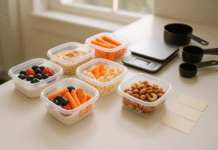
- For travel, portion into small jars or paper snack bags.
Bottom line: a pantry-powered mix that hits quick carbs + plant protein + healthy fats in one handful.
10. Lentil or Bean Salad Cup + Feta/Tofu + Olives & Herbs
A small cup of lentil or bean salad provides complex carbs and fiber, while feta (or tofu) adds protein and olives or olive oil contribute the fat. Spoon in chopped cucumber and herbs, and it becomes a fresh, savory snack that feels like a café side, not “diet food.”
10.1 Build-a-cup
- Portions: ¾ cup cooked lentils/beans (or a 4-oz ready cup, drained), 1–2 tablespoons crumbled feta or ¼ cup cubed firm tofu, 1 teaspoon olive oil or 3–4 olive halves, lemon, parsley/dill.
- Make-ahead: Toss a small batch on Sunday; portion into ½–¾-cup containers.
10.2 Why it works
- Legumes deliver fiber + protein for fullness.
- Olive oil and olives contribute monounsaturated fats and flavor, so a small amount goes a long way.
- The herb-lemon finish keeps it lively, reducing the urge to add extra salt.
Summation: a spoonable, savory option that doubles as a side at dinner if you don’t finish it.
FAQs
1) What’s the “right” macro split for a balanced snack?
There isn’t a single perfect ratio for everyone. A practical pattern is to always include fiber-rich carbs + a protein source + a bit of healthy fat. For many people, that looks like a palm of fruit or whole grain, a thumb to palm of protein (yogurt, eggs, legumes, fish), and a thumb of fat (nuts, seeds, olive oil). If you’re very active or going longer between meals, nudge carbs and protein slightly higher.
2) How many calories should a snack have?
A common rule of thumb is about 150–250 calories, enough to bridge meals without spoiling appetite. Your needs vary by body size, goals, and schedule; highly active people may want more. Rather than counting every snack, emphasize quality and portions: whole foods, fiber, and modest amounts of protein and fat help a snack feel “enough.”
3) Do these pairings work for blood-sugar steadiness?
Yes—combining fiber-rich carbs with protein and fat tends to slow digestion and can blunt sharp glucose rises. Individual responses differ, but many people find fruit + nut butter or yogurt + berries + nuts steadier than a carb-only snack. If you monitor glucose, test your response to find your best fits.
4) Are nuts and nut butters okay if I’m watching fat?
In modest portions they’re great snack fats: about 1 ounce of nuts (a small handful) or 2 tablespoons of nut butter add satiety and taste without needing a big amount. Choose unsalted nuts and nut butters with minimal added sugar or tropical oils.
5) What if I’m dairy-free?
Use fortified soy or pea yogurt/milk for comparable protein, or lean on legumes, eggs, tofu, and nuts/seeds. Almost every pairing here includes a dairy-free option—e.g., hummus plates, edamame + avocado, chickpea “tuna.”
6) Can I snack before workouts?
About 30–90 minutes before light-to-moderate exercise, a carb-forward snack with some protein works well—think banana + Greek yogurt or rice cakes + peanut butter. For very short or low-intensity sessions, you may not need to snack at all. After longer or harder efforts, include protein (roughly 20–40 g over the next meal window) to support recovery.
7) I crave sweet snacks. Which options help?
Lean sweet by pairing fruit with protein/fat: apples + nut butter, yogurt + berries + walnuts, cottage cheese + pineapple + pumpkin seeds. The protein/fat buffer helps you feel satisfied with a normal portion instead of chasing more sweetness.
8) What’s a good desk or travel snack that won’t spoil?
Keep a shelf-stable kit: whole-grain crackers, a can of tuna or chickpeas, mini olive-oil bottle, and a small bag of nuts/roasted chickpeas. Add a piece of fruit for freshness. DIY trail mix also travels perfectly.
9) How often should I snack?
There’s no universal rule. Many people feel best with 1–2 snacks per day when there are gaps of 4–6 hours between meals. If snacks routinely replace meals, check whether your meals are under-sized or lacking protein/fiber.
10) Any budget tips for balanced snacks?
Buy frozen fruit/veg, bulk oats/beans, and store-brand nuts/seeds. Prep a few base foods on the weekend (boiled eggs, roasted chickpeas, a pot of lentils). Portion snacks in advance so you’re not relying on packaged options.
11) Are “low-fat” or “low-carb” snacks better?
Neither label guarantees balance or satiety. A lower-fat snack can still combine carbs + protein (e.g., yogurt + berries), while lower-carb snacks can still include fiber and protein (e.g., eggs + tomato + olive oil). Focus on whole foods, fiber, and adequate protein.
12) How do I portion nuts, seeds, and oils without measuring?
Use visual cues: nuts = small handful; nut butter = 2 thumb-tips equals about 2 tablespoons; oil = a teaspoon-sized drizzle for snacks. Pre-portion into small containers if handfuls tend to grow.
Conclusion
Balanced snack pairings aren’t a diet trick—they’re a simple pattern: fiber-rich carbs + protein + healthy fat. That formula slows digestion, supports steadier energy, and makes a small amount feel like enough. The 10 ideas here give you a starting rotation you can riff on with what you have: swap apples for pears, tuna for chickpeas, cottage cheese for skyr or soy yogurt, pita for a roti. Keep the portions modest, build in texture and flavor, and prep one or two components ahead (a jar of overnight oats, a bag of roasted chickpeas, boiled eggs). Most importantly, choose snacks you actually like; satisfaction is part of smart nutrition. Ready to put it into practice? Pick two pairings to stock this week and set them on eye-level in your fridge—your future self will thank you.
Call to action: Save this list, stock your top two snacks today, and set a 3-minute reminder to prep tomorrow’s grab-and-go combo.
References
- The Science of Snacking. Harvard T.H. Chan School of Public Health – The Nutrition Source. (n.d.). https://nutritionsource.hsph.harvard.edu/snacking/
- Healthy Snacking with MyPlate. U.S. Department of Agriculture – MyPlate. (n.d.). https://www.myplate.gov/tip-sheet/healthy-snacking-myplate
- Healthy Snacks. American Heart Association. Last Reviewed: Aug 26, 2024. https://www.heart.org/en/healthy-living/healthy-eating/eat-smart/nutrition-basics/healthy-snacks
- Go Nuts (But Just a Little!). American Heart Association. Last Reviewed: Aug 23, 2024. https://www.heart.org/en/healthy-living/healthy-eating/eat-smart/fats/go-nuts-but-just-a-little
- Picking Healthy Proteins. American Heart Association. Last Reviewed: Aug 28, 2024. https://www.heart.org/en/healthy-living/healthy-eating/eat-smart/nutrition-basics/picking-healthy-proteins
- Fiber: Soluble and Insoluble. Mayo Clinic. Dec 11, 2024. https://www.mayoclinic.org/healthy-lifestyle/nutrition-and-healthy-eating/in-depth/fiber/art-20043983
- Dietary Guidelines for Americans, 2020–2025. U.S. Departments of Health and Human Services and Agriculture. Dec 2020. https://www.dietaryguidelines.gov/sites/default/files/2020-12/Dietary_Guidelines_for_Americans_2020-2025.pdf
- Kim, J.S., Nam, K., & Chung, S-J. Effect of nutrient composition in a mixed meal on the postprandial glycemic response in healthy people: a preliminary study. Nutrition Research and Practice. 2019. https://pubmed.ncbi.nlm.nih.gov/30984356/
- Basturk, B., et al. Evaluation of the Effect of Macronutrients Combination on Blood Sugar Levels in Healthy Individuals. Iranian Journal of Public Health. 2021. https://pubmed.ncbi.nlm.nih.gov/33747991/
- Jäger, R., et al. International Society of Sports Nutrition Position Stand: protein and exercise. Journal of the International Society of Sports Nutrition. Published June 20, 2017. https://jissn.biomedcentral.com/articles/10.1186/s12970-017-0177-8
- Effects of Carbs, Protein and Fats on Glucose Levels. Joslin Diabetes Center. July 8, 2021. https://joslin.org/news-stories/all-news-stories/education/2021/07/carbs-protein-fats
- Dietary Guidelines for Americans, 2020–2025: Executive Summary. USDA/HHS. Dec 2020. https://www.dietaryguidelines.gov/resources/2020-2025-dietary-guidelines-online-materials