























If your kitchen is where good intentions collide with overflowing plates, you’re not alone. Home portion control isn’t about deprivation; it’s about teaching everyone in the household to serve amounts that fit their bodies and goals—using simple cues, tools, and routines. In this guide, you’ll learn practical, low-fuss methods to gauge serving sizes without obsessing over calories. You’ll also see how to adapt portions for kids, teens, and elders, and how to make changes stick without arguments at the table. Quick note: this article offers general nutrition education, not medical advice. If you have a medical condition (e.g., diabetes, kidney disease), consult a qualified clinician or registered dietitian.
Quick definition: Home portion control means using consistent visual cues, tools, and habits to serve foods in amounts that match a person’s needs, preventing both over- and under-eating.
Fast-start steps (scan & try tonight):
- Use a 10-inch (25 cm) plate and fill it ½ vegetables/fruit, ¼ protein, ¼ grains/starches.
- Match protein to your palm, carbs to a cupped hand, fats to a thumb.
- Read the serving size on the label before pouring; count how many servings you’re actually taking.
- Pre-portion snacks into small bowls or bags.
- Eat slowly and pause at the halfway mark to check fullness.
1. Use the Hand Method for Everyday Meals
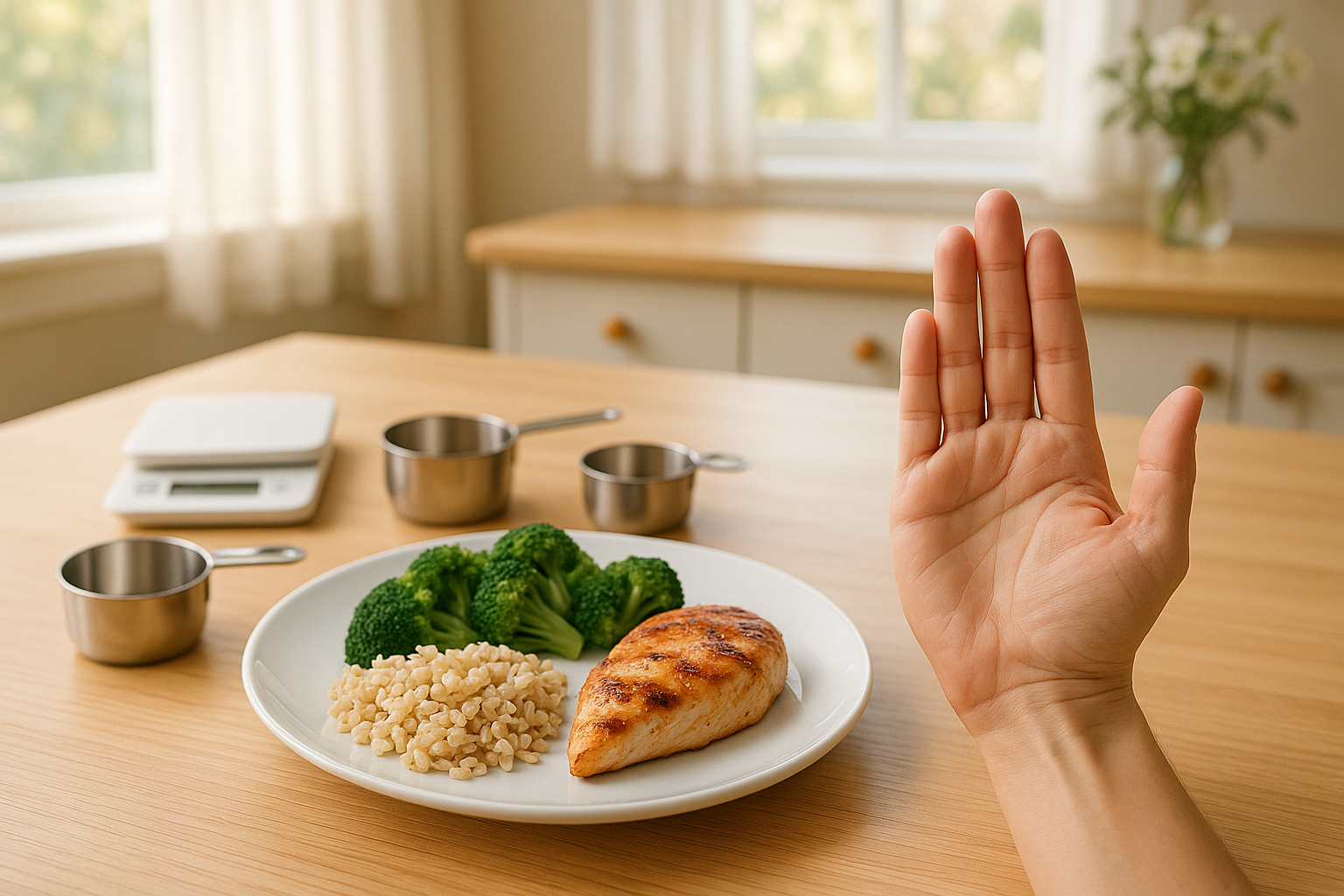
The hand method is the fastest way to teach reliable portions without measuring cups or apps, because your hand scales with your body size. In practice, you match food types to hand shapes: your palm for protein, a cupped hand for grains or starches, your fist for vegetables, and your thumb for fats. This gives every family member a personalized starting point at any meal. For example, an adult may aim for one to two palms of cooked protein (about 85–170 g), one cupped hand of cooked grains (about ½–1 cup, 90–180 g cooked), a fist of veggies (about 1 cup raw/½ cup cooked), and a thumb of fats (1 Tbsp/15 mL). The method works because it’s memorable and portable—you can use it at home, school, the office, or a restaurant. It also creates a shared language (“one palm, one cupped hand”) that reduces debates at the table.
1.1 How to do it
- Protein: 1 palm (8–12 cm long; ~20–30 g protein or 85–170 g cooked meat/fish/tofu).
- Carbs/Starches: 1 cupped hand cooked (~½–1 cup cooked rice/pasta/beans, 90–180 g).
- Vegetables/Fruit: 1 fist (~1 cup raw veg/fruit; ~½ cup cooked veg).
- Fats: 1 thumb (~1 Tbsp/15 mL oils, nut butter; ~2 Tbsp/30 mL seeds is a “two thumbs” cue).
1.2 Numbers & guardrails
- Start with 1 palm protein + 1 cupped hand carbs + 1 fist veg + 1 thumb fats per plate.
- Active adults or teens often do well with 2 palms protein and 2 fists veg.
- For energy-dense foods (e.g., cheese, nuts), keep to thumb-size portions and add slowly.
1.3 Common mistakes
- Stacking tall piles beyond the hand’s “volume.”
- Using huge hands as a license to overfill energy-dense foods.
- Forgetting that cooked vs. raw veg volumes differ.
Synthesis: The hand method gives everyone a personalized, visual “ruler” for mealtime decisions—no gadgets required.
2. Build Plates with the ½–¼–¼ Framework
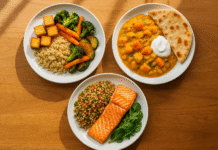
For most home dinners, the simplest plate rule is to fill ½ the plate with vegetables/fruit, ¼ with protein, and ¼ with whole grains or starchy foods. This balances fiber, protein, and energy to keep you full without overshooting calories. Using a 9–10 inch (23–25 cm) plate helps: larger plates can invite over-serving. The beauty of the ½–¼–¼ approach is flexibility—you can swap in regional staples (chapati, brown rice, corn, potatoes) or cultural favorites while keeping structure. If you prefer soups, think in bowls: half the volume should be vegetables and legumes, with protein and grains/starches sharing the remaining half. This framework plays nicely with family-style dining, because you can eyeball proportions even when everyone’s plating themselves.
2.1 How to do it
- Use a 10-inch plate and aim for ½ non-starchy veg/fruit, ¼ protein, ¼ whole grains/starches.
- If fruit is separate, keep the plate ½ vegetables, and have fruit on the side.
- For mixed dishes (stir-fries, curries), visualize the bowl: half vegetables/legumes by volume.
2.2 Numbers & guardrails
- Vegetables: ~2 cups raw (~150–200 g) or 1 cup cooked (~150–200 g) per plate.
- Protein: 1–2 palms (85–170 g cooked) provides ~20–60 g protein depending on the food.
- Starches: ½–1 cup cooked (90–180 g) to start; add more after checking fullness.
2.3 Common mistakes
- Calling potatoes and corn “vegetables” in the ½ half—count them in the starch ¼.
- Piling naan/roti/rice beyond the starch quarter “slice.”
- Using oversized plates that distort the rule.
Synthesis: The ½–¼–¼ plate is a one-glance blueprint that keeps variety high and portions honest.
3. Calibrate with a Food Scale Once a Week
A small digital food scale can train your eyes quickly—use it for a 10–15 minute “calibration session” once per week. Weighing a few common foods (rice, pasta, cereal, chicken, paneer, nuts) resets your visual memory so your weekday portions drift less. This is especially helpful with energy-dense items that hide calories (oils, nut butters, cheese). You don’t need to weigh forever; a weekly reset builds accuracy with minimal effort. When you do weigh, pair it with measuring spoons (for oils) so you link the number on the scale to a familiar visual (e.g., 15 mL looks like a thin gloss on a 10-inch salad). Over time, you’ll eyeball within ±10–20%—good enough for most goals.
3.1 Mini checklist
- Keep the scale on the counter; if it’s visible, you’ll use it.
- Calibrate 5–7 “tricky” foods (rice, pasta, nuts, cheese, cereal, oils, dressings).
- Note one visual for each: “30 g cereal equals half a bowl,” “20 g nuts fills a small ramekin.”
3.2 Quick numeric examples
- Rice (cooked): 150 g ≈ ¾ cup; 200 g ≈ 1 cup.
- Cereal (dry): 30 g varies wildly by brand—measure once to set your bowl.
- Nuts: 20–30 g fits a golf-ball-sized ramekin; count once, then eyeball.
Synthesis: A weekly weigh-in teaches your eyes to recognize realistic amounts—so you can relax the rest of the time.
4. Teach Label Literacy: Serving Size vs. Portion
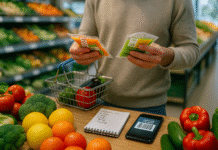
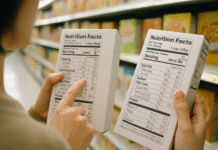
Labels list a serving size based on regulatory standards or typical consumption, but your portion is what you choose to eat. If a snack shows “Serving size 30 g (about 15 chips)” and you pour 60 g, you’ve eaten two servings—which doubles calories, sodium, and sugar. Understanding this difference prevents “label halo” mistakes (assuming the package equals one serving). Also note that serving sizes are set by category norms (e.g., “Reference Amounts Customarily Consumed”), not your personal needs. Teach your household to check the line first, then multiply the nutrition numbers by the number of servings they actually plated. This one habit trims mindless overconsumption more than any other label detail.
4.1 How to do it
- Read the serving size first (grams or mL and household measure).
- Count actual servings: portion weight ÷ serving weight (e.g., 60 g ÷ 30 g = 2 servings).
- Scan the “per serving” nutrients and multiply by your total servings.
4.2 Numbers & guardrails
- Many cereals are ~30–45 g per serving; measure once to avoid bowl creep.
- Oils are 1 Tbsp/15 mL per serving—pouring “by feel” often doubles that.
- Ice cream is commonly 2/3 cup (about 95–100 g) per serving; small bowls help.
4.3 Common mistakes
- “Per container” vs. “per serving” confusion on multi-serve packages.
- Ignoring grams/milliliters and focusing only on “pieces” or “cups.”
- Treating snack multipacks as single servings by default.
Synthesis: When everyone multiplies nutrients by actual servings eaten, labels become a tool—not a trap.
5. Standardize Home Scoops and Dishes
If the serving tools vary every night, so will portions. Create a home toolkit: a ½-cup (120 mL) scoop for rice, a 1-cup (240 mL) ladle for stews, a 2-Tbsp (30 mL) spoon for dressings, and small ramekins for nuts or dips. Keep them near the foods they serve. Consider color-coding or labeling (“rice ½-cup,” “dal 1-cup”) to make it automatic for spouses, kids, or guests. When containers are transparent, mark a fill line with tape for common items (e.g., yogurt, granola). Standardized scoops reduce both arguments and guesswork—your “usual” becomes measurable without anyone pulling out a calculator.
5.1 Tools & examples
- Rice scoop: ½ cup (120 mL) = ~90–120 g cooked rice.
- Stew ladle: 1 cup (240 mL) = ~230–280 g depending on thickness.
- Oil spoon: 1 Tbsp (15 mL) for cooking; 2 tsp (10 mL) for dressings.
- Snack ramekin: ¼ cup (60 mL) for nuts, dried fruit, or dips.
5.2 Common pitfalls
- Using deep bowls that hide volume.
- “Family scoopers” that vary by the person serving.
- Ladles that are actually 1½ cups: measure them once, label for clarity.
Synthesis: Consistent scoops and bowls transform portion control from a debate into a household default.
6. Pre-Portion High-Calorie Foods
Energy-dense foods—nuts, seeds, oils, cheese, dressings, sweets—can double a meal’s calories before you notice. The fix isn’t to ban them; it’s to pre-portion them. Make small snack bags or jars (20–30 g nuts, 30 g cheese, 1–2 Tbsp/15–30 mL dressings) and store them where you’ll look first. For sweets, choose single-serve items or cut large bars into pieces and wrap individually. This is especially effective for after-dinner snacking: the default portion becomes “one bag” or “one jar,” not “handfuls until the show ends.”
6.1 How to do it
- Buy in bulk, portion once per week, and place small units at eye level.
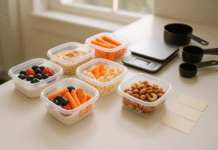
- Use clear 120–180 mL jars for nuts/dried fruit; label with grams/servings.
- Keep a dessert ramekin (½ cup/120 mL) as the “sweet bowl.”
6.2 Numbers & guardrails
- Nuts: 20–30 g (~120–180 kcal) per portion.
- Cheese: 30 g (thumb-size block) per portion.
- Chocolate: 15–25 g per portion; set 1–2 portions/week as a house baseline.
Synthesis: Pre-portioning turns “Oops, too much” into deliberate, satisfying choices you can repeat.
7. Cook Once, Portion Twice (Batching & Meal Prep)
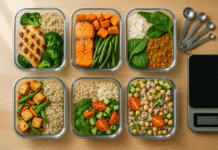
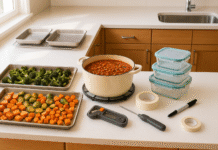
Batch-cooked meals reduce decision fatigue—and that also reduces portion errors. The trick is to portion at the source: when you finish cooking, immediately divide the pot into equal containers (e.g., four 2-cup/480 mL boxes). This locks in consistent serving sizes and makes weekday choices easier. Pair each main with a measured side (½–1 cup starch, a fist of veg) to create a reliable “set.” If your family loves variety, rotate flavors rather than volumes: curry chicken or chana masala one week, lentil bolognese the next. Consistent volume with changing taste keeps interest up and portions steady.
7.1 Mini workflow
- Choose a base recipe that scales (stews, dals, chilis, baked trays).
- Weigh or measure the finished batch; divide by intended servings.
- Add sides using standard scoops (from Section 5).
- Label containers with servings and date.
7.2 Numeric example
- You cook 2.4 kg of vegetable-lentil stew. Target 6 servings → 400 g each.
- Pair each with 150 g cooked rice and a fist of veg. Week solved.
Synthesis: Portioning immediately after cooking fixes serving sizes before hunger and habits take over.
8. Use Visual Anchors in the Kitchen
People learn by seeing. Add visual anchors that make portion decisions obvious: a plate with printed quadrants, a “portion placemat,” a fridge magnet listing hand cues, or colored scoops labeled by volume. Put a small bowl in front of family-sized snack bags, so people serve themselves rather than eating from the package. For cereals or granola, keep a measured bowl on the shelf, so the first pour aligns with the serving size. If your family enjoys rice or biryani at gatherings, place a ½-cup scoop right in the pot—no hunting required. These nudges shrink the gap between knowing and doing.
8.1 Ideas to try
- A laminated hand-guide on the fridge.
- Fill-line tape inside transparent containers (yogurt, granola).
- Color-coded scoops for rice, dal, pasta; labels face outward.
- Small dessert plates stacked on top of dinner plates to cue smaller sweets.
8.2 Region-specific notes
- For South Asian kitchens, keep chapati/roti in a smaller bread basket; limit to 1–2 per plate by default.
- For rice-based cultures, keep a ½-cup scoop in the rice cooker and a serving bowl nearby to discourage pot-to-plate piling.
- For bread-centric meals, slice loaves thinly and pre-wrap two-slice portions.
Synthesis: Visual anchors reduce friction so the right portion becomes the path of least resistance.
9. Slow the Pace: Eating Rate & Satiety Cues
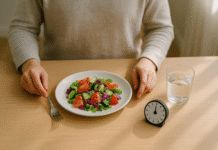
Eating more slowly can reduce total intake even when portions look the same at the start. Satiety signals lag by ~15–20 minutes, so building a natural pause helps you notice fullness before you go back for seconds. Teach a simple rhythm: serve, eat half, pause for two minutes, then decide whether to finish or add more vegetables. Sipping water or tea during the pause can enhance fullness. Another cue is bite size—smaller bites extend meal time, giving hormones like cholecystokinin and GLP-1 time to rise. This strategy is especially helpful for teens and athletes who eat quickly out of habit.
9.1 Mini-checklist
- Put forks down between bites; talk, breathe, notice flavors.
- Set a two-minute timer at the halfway point.
- If still hungry, add vegetables or protein before more starches.
- End the meal with fruit or yogurt as a signal to stop.
9.2 Numbers & guardrails
- Build a 20-minute mealtime window when possible.
- Use a salad or soup starter (~100–200 kcal, high fiber) to pace the meal.
- Reserve desserts for 2–3 nights/week, pre-portioned (see Section 6).
Synthesis: Slowing down turns portion control from willpower into physiology—fullness has time to show up.
10. Size the Environment: Plate, Glass, and Utensil Effects
The size and shape of your tableware change how much you serve and drink. Smaller plates (9–10 inches) generally reduce self-served portions; tall, narrow glasses lead to smaller pours than short, wide ones (even for pros). Serving spoons and bowls matter too—bigger gear means bigger portions. The goal is not to shrink to toy dishes but to right-size your environment so your first serve is sensible. Combine this with the ½–¼–¼ rule and you’ll see consistent results without scolding anyone about second helpings.
10.1 How to do it
- Use 9–10 inch plates for everyday meals; save larger platters for shared dishes.
- Serve juice/soda in tall, narrow glasses; water in big tumblers or bottles.
- Choose medium serving spoons and shallower bowls to reduce over-scooping.
10.2 Numbers & guardrails
- Switching from 12-inch to 10-inch plates typically trims portions by a meaningful margin.
- Use 150–200 mL glasses for juice; a 250–350 mL mug for milk/tea.
- Keep serving bowls filled with vegetables larger than starch bowls to bias choices.
Synthesis: Right-sizing plates and glasses makes reasonable portions feel normal—not restrictive.
11. Family & Culture Fit: Flexible Portions for Kids, Teens, and Elders
Good portion control respects age, activity, and culture. Kids need frequent, smaller portions with snacks that emphasize protein, fruit/veg, and calcium sources. Teens—especially active ones—often need larger palms of protein and extra cupped hands of carbs. Elders may benefit from smaller starches and prioritized protein to maintain muscle. Cultural foods belong on the plate; the key is structure (½–¼–¼, hand method) and serving tools (scoops, ramekins) that make beloved dishes fit your goals. Teach flexibility: roti with chana and salad one night, rice with fish curry and sautéed greens the next. The framework stays; flavors rotate.
11.1 Practical templates
- Kids (5–12): ½ fist protein, 1 fist veg/fruit, ½–1 cupped hand carbs, 1–2 tsp fats; offer milk or yogurt for calcium.
- Teens: 1–2 palms protein, 1–2 cupped hands carbs (training days at the higher end), 2 fists veg, 1–2 thumbs fats.
- Elders: 1–1½ palms protein, 1 cupped hand carbs, 1–2 fists veg, 1 thumb fats; add Greek yogurt/legumes for protein if appetite is low.
11.2 Region-specific notes
- South Asian staples: balance roti/chapati (¼ plate) with dal/chana (protein) and sabzi (½ plate veg).
- Middle Eastern plates: pair pita/bulgur (¼) with grilled meats/legumes (¼) and salads (½).
- East Asian bowls: use a rice bowl fill line, add protein and veg sides to hit ½–¼–¼ in total.
Synthesis: When portions flex to fit life stage and culture, the system feels respectful—and people stick with it.
FAQs
1) What’s the difference between a serving and a portion?
A serving is a standardized amount listed on a label or used in guidelines; a portion is what you actually put on your plate. If you pour 60 g of cereal and the label’s serving is 30 g, you’ve had two servings. Checking this first prevents accidental doubling of calories, sugar, or sodium.
2) Do I need to count calories for home portion control?
Not necessarily. Visual rules (hand method, ½–¼–¼), standardized scoops, and pre-portioning snacks handle most needs. If you have a specific goal (e.g., fat loss, sports performance), a temporary calorie or protein target can help, but for many households, portion routines beat daily math.
3) How much protein should I have per meal?
A common range for adults is 20–40 g per meal, roughly 1–2 palms depending on size and appetite. Active individuals or older adults often benefit from the higher end to support muscle. Spread protein across meals rather than loading it all at dinner.
4) What about desserts—how do you portion them without feeling deprived?
Use small bowls (½ cup/120 mL) and enjoy desserts 2–3 nights per week, pre-portioned. Pair sweets with fruit or yogurt to increase volume and satisfaction. Single-serve items or cutting large bars into pieces helps make enjoyment deliberate, not automatic.
5) How can I portion rice, pasta, and breads that my family loves?
Keep them in the ¼ plate lane and use ½-cup (120 mL) or 1-cup (240 mL) scoops. For rice, ½ cup cooked is ~90–120 g; start there and add after checking fullness. Balance starches with extra veg and adequate protein so meals stay satisfying.
6) What’s a smart approach to oil, ghee, butter, and dressings?
Measure fats with teaspoons/tablespoons during cooking; they’re easy to overpour. Aim for 1 Tbsp/15 mL per person in most skillet dishes, adjusting for goals. For dressings, start with 2 tsp/10 mL, toss thoroughly, then add a little if needed.
7) How do I help kids learn portions without pressure?
Use kid-friendly hand cues (half-palm protein, fist fruit/veg, half cupped hand carbs) and offer structured choices (pick 2 veggies, 1 carb). Avoid pressuring clean plates; teach them to pause mid-meal and ask, “Am I still hungry?”
8) We host big family meals. Any tips so people don’t overdo it?
Put vegetable platters and salads first in the buffet line, use smaller plates, and include labeled scoops in starch bowls. Offer pre-cut desserts and fruit for a sweet finish that doesn’t derail portions.
9) How can athletes or very active teens adapt these rules?
Keep the ½–¼–¼ structure but increase palms of protein and cupped hands of carbs around training (e.g., 2–3 cupped hands on hard days). Add a recovery snack with protein and carbs (e.g., yogurt + fruit, milk + banana) within an hour post-exercise.
10) Any guidance for Ramadan or other fasting periods?
Portion the iftar plate the same way: start with hydration and fruit, use ½ plate veg, ¼ protein, ¼ starch, and eat slowly to let fullness register. Pre-portion sweets, and during suhoor, favor protein + fiber (eggs/legumes + whole grains) for sustained energy.
11) Is the hand method accurate enough for weight loss?
For many people, yes. It’s consistent, personalized, and easy to apply. If progress stalls, add a short weigh-and-calibrate session (Section 3) to tighten estimates on energy-dense foods like oils, nuts, and cereals.
12) Are there safety concerns with strict portion control?
Avoid over-restriction, especially for children, teens, pregnant/lactating people, or those with a history of disordered eating. Focus on balanced plates, steady meals, and satisfaction. Seek individualized guidance if you have medical needs.
Conclusion
Home portion control sticks when it’s simple, visible, and shared. The hand method teaches personalized servings in seconds; the ½–¼–¼ plate keeps balance without math; weekly calibration locks your eye to reality. Standardized scoops and pre-portioned snacks make your environment do the work, while slower eating and right-sized tableware align your appetite with your plate. Most importantly, flexible templates let cultural favorites thrive—roti, rice, curries, stews—without turning dinner into a negotiation. Start with one or two changes this week (a 10-inch plate and a ½-cup rice scoop), then add a calibration session and fridge visuals. In a month, portion control won’t feel like a rule—it’ll feel like home.
Try it tonight: plate ½ vegetables, ¼ protein, ¼ starch; match portions to your hand; pause halfway and check in. Your future self will thank you.
References
- The Nutrition Facts Label: What’s New and What’s the Same, U.S. Food & Drug Administration, 2020 (and updates). https://www.fda.gov/food/nutrition-education-resources-materials/nutrition-facts-label
- Reference Amounts Customarily Consumed (RACCs), Electronic Code of Federal Regulations, Title 21 §101.12, current as accessed Aug 2025. https://www.ecfr.gov/current/title-21/part-101/section-101.12
- MyPlate: Start Simple with MyPlate, U.S. Department of Agriculture, current as accessed Aug 2025. https://www.myplate.gov/
- Healthy Eating Plate & Healthy Eating Pyramid, Harvard T.H. Chan School of Public Health (The Nutrition Source), updated page accessed Aug 2025. https://www.hsph.harvard.edu/nutritionsource/healthy-eating-plate/
- Portion, package and tableware size for changing selection and consumption of food, alcohol and tobacco, Hollands GJ et al., Cochrane Database of Systematic Reviews, 2015. https://www.cochranelibrary.com/cdsr/doi/10.1002/14651858.CD011045.pub2/full
- Healthy Diet Fact Sheet, World Health Organization, updated 2024 (accessed Aug 2025). https://www.who.int/news-room/fact-sheets/detail/healthy-diet
- Healthy Eating for a Healthy Weight, Centers for Disease Control and Prevention, updated page accessed Aug 2025. https://www.cdc.gov/healthyweight/healthy_eating/index.html
- Just Enough for You: About Food Portions, National Institute of Diabetes and Digestive and Kidney Diseases (NIH), updated page accessed Aug 2025. https://www.niddk.nih.gov/health-information/weight-management/just-enough-food-portions
- Food Portion Sizes, National Health Service (UK), updated page accessed Aug 2025. https://www.nhs.uk/live-well/eat-well/food-portions/
- Get Portion Wise, British Nutrition Foundation, updated page accessed Aug 2025. https://www.nutrition.org.uk/putting-it-into-practice/portion-wise/