























If you’re stretching to move better, feel looser, or reduce your chance of getting sidelined, the last thing you want is to discover your “prevention” routine is quietly setting you up for trouble. The good news? Most stretching injuries stem from a handful of avoidable habits. In this guide, you’ll learn the 5 common stretching mistakes to avoid to prevent injury, plus exactly what to do instead—step-by-step, beginner-friendly, and realistic for a busy week.
Disclaimer: This article offers general information for educational purposes and isn’t a substitute for personalized medical advice. If you have pain, a recent or chronic injury, hypermobility, or a medical condition, consult a qualified healthcare professional before starting or changing your routine.
Key takeaways
- Warm first, stretch second. A short, light warm-up makes stretching safer and more effective.
- Ditch the bounce. Smooth, controlled stretches protect tissues and help you actually gain range of motion.
- Tension ≠ pain. Stretch to mild–moderate tension; pain is your cue to back off.
- Time your stretches. Use dynamic moves before workouts, longer static holds after.
- Balance matters. Stretch the big movers and their opposites, and use good alignment and breathing.
Mistake 1: Stretching Cold
What it is & why it’s a problem
“Cold” stretching means dropping into deep positions without first raising tissue temperature or blood flow. Cold muscles and tendons are less pliable, so forcing range can irritate or strain them. A brief warm-up elevates temperature, wakes up the nervous system, and makes tissues more accommodating, so your stretches feel easier and stick longer.
Requirements & low-cost alternatives
- Requirements: 5–10 minutes of light movement (walk, easy bike, stair marching) and space to move.
- Low-cost alternatives: If you’re short on time or equipment, do marching in place, arm circles, and hip circles at home.
Step-by-step: A 5–7 minute “Pre-Stretch Warm-Up”
- Pulse raiser (2 minutes): Brisk walk, easy stationary bike, or march in place.
- Joint prep (2 minutes):
- Neck: slow look-left/right, nod-yes/no (5 each).
- Shoulders: 10 arm circles forward & back.
- Hips: 10 hip circles each direction.
- Movement primer (1–3 minutes):
- 10–15 bodyweight squats (comfortable depth).
- 10 reverse lunges total.
- 20 calf raises.
Beginner modifications & progressions
- Starter: Keep ranges small; think “grease the hinges,” not “push the limits.”
- Progression: Add light band pull-aparts, lateral steps, or a short incline walk.
- Advanced: Light tempo skips, high-knee marches, and controlled leg swings.
Recommended frequency & metrics
- Frequency: Before any stretching session or workout.
- Metrics: Perceived warmth (you should feel comfortably warm), breathing slightly elevated, and smoother entry into your first stretch.
Safety, caveats & common errors
- Don’t sprint the warm-up. The goal is light to moderate—not breathless.
- If you’re injured or inflamed, skip aggressive movements and follow your clinician’s advice.
Mini-plan (example)
- Step 1: 2 minutes brisk walk in place.
- Step 2: 10 arm circles + 10 hip circles each direction.
- Step 3: 10 squats + 10 calf raises.
Then begin your stretches.
Mistake 2: Bouncing (Ballistic Stretching) When You Don’t Need It
What it is & why it’s a problem
“Ballistic” stretching uses momentum—bouncing at end-range. In general fitness, bouncing can overload tissues faster than they can adapt, making strains more likely. Smooth, sustained tension gives your muscles and nervous system time to relax into a position.
(Note: Certain athletes may use carefully programmed ballistic work under professional supervision for sport-specific goals. For most people, controlled dynamic or static stretching is safer and more productive.)
Requirements & low-cost alternatives
- Requirements: None—just awareness and a willingness to slow down.
- Alternative: Replace bounces with dynamic or static techniques:
- Dynamic: Controlled leg swings, arm sweeps, walking lunges (movement-based, not held).
- Static: Ease into the end of range and hold without movement.
Step-by-step: Swap bounces for control
- Enter the stretch smoothly to a mild–moderate tension (not pain).
- Hold steady (no bouncing) for ~20–30 seconds.
- Breathe: Inhale through the nose; exhale longer than you inhale to reduce guarding.
- Release slowly and repeat once or twice.
Beginner modifications & progressions
- Starter: Use a wall, strap, or yoga blocks to control depth.
- Progression: Longer holds (30–45 seconds post-workout), or integrate PNF (contract-relax) under guidance.
Recommended frequency & metrics
- Frequency: Replace bounce-based habits immediately; use dynamic pre-workout and static post-workout.
- Metrics: Fewer “pinchy” sensations at end-range, easier relax-and-hold, and improved control entering/exiting positions.
Safety, caveats & common errors
- Don’t chase ROM with speed. Momentum masks limits and overloads tissues.
- Keep posture neutral. If your back or ribs flare to “get deeper,” you’re borrowing range from the wrong place.
Mini-plan (example)
- Step 1: Instead of bouncing hamstring reaches, try hip-hinge toe-taps: 10 slow reps each side.
- Step 2: Follow with a static hamstring stretch: 20–30 seconds, 1–2 sets each leg.
Mistake 3: Pushing Into Pain (Overstretching)
What it is & why it’s a problem
A productive stretch is tension you can breathe through. Pain—sharp, burning, tingling, or jointy—is your nervous system throwing the brakes. Forcing past it invites strains, irritated tendons, or angry joints. This is especially important if you’re hypermobile or recovering from injury.
Requirements & low-cost alternatives
- Requirements: None.
- Alternative: Use range checkpoints and props (strap, towel, yoga block) to fine-tune depth without forcing it.
Step-by-step: The “Tension, Not Pain” scaling method
- Find neutral: Tall posture, ribs down, pelvis neutral; gently brace your core at ~2/10 effort.
- Ease in until you feel mild–moderate stretch (a 4–6/10 tension scale).
- Breathe slowly; imagine exhaling into the target area.
- Adjust depth to keep tension steady; pain or tingling = back off immediately.
- Hold 20–30 seconds; repeat once or twice.
Beginner modifications & progressions
- Starter: Shorter holds (10–20 seconds) and active end-range (slight muscle engagement) to protect joints.
- Progression: Gradually extend to 30–45 seconds post-workout, add gentle contract-relax (3–5 seconds light contraction, then relax slightly deeper).
Recommended frequency & metrics
- Frequency: 2–3 sessions/week minimum for flexibility; daily gentle mobility if stiff.
- Metrics: End-range discomfort drops from, say, 6/10 to 3/10 over weeks; you can reach positions with less compensating (no rib flare/shoulder hike).
Safety, caveats & common errors
- Never stretch through sharp pain or numbness.
- Hypermobility: Prioritize strength and control near end-range; avoid hanging on ligaments.
- Acute injury, swelling, or suspected tear: Skip stretching until cleared by a pro.
Mini-plan (example)
- Step 1: Calf wall stretch to a 4–6/10 tension for 20–30 seconds, 2 sets each leg.
- Step 2: Active ankle pumps (10–15 reps) between holds to restore circulation and control.
Mistake 4: Doing Long Static Holds Right Before You Need Power or Speed
What it is & why it’s a problem
Long static holds immediately before explosive work can temporarily reduce maximal strength or power. The effect is strongest with prolonged holds; short, strategically placed holds (≤30 seconds) inside a full warm-up are usually fine. The safer rule of thumb: use dynamic stretching before, and save the longer static holds for after training or later in the day.
Requirements & low-cost alternatives
- Requirements: A simple dynamic sequence that matches your sport or workout.
- Alternative: Pair brief, targeted static holds (15–30 seconds) with dynamic moves if a specific area feels stubborn, then finish with rehearsal drills (skips, strides, lightweight sets).
Step-by-step: Pre-workout flow (8–12 minutes)
- Light cardio (2–3 minutes): Walk, cycle, or row easily.
- Dynamic mobility (3–5 minutes):
- Walking lunges with reach (6–8 each side)
- Leg swings (front/back & side-to-side, 10 each)
- Arm sweeps & band pull-aparts (10–15)
- Rehearsal (2–4 minutes): Movement patterns you’re about to do (pace pickups, empty-bar squats, light jumps).
- Optional: One or two brief static holds (15–20 seconds) for a stubborn spot—then re-activate with a dynamic drill.
Beginner modifications & progressions
- Starter: Keep ranges shallow and reps modest.
- Progression: Add tempo (slow lowering), larger ranges, or light power drills (skips, medicine-ball chest pass).
Recommended frequency & metrics
- Frequency: Before any workout requiring strength, speed, or coordination.
- Metrics: First working set feels crisp; no feeling of “dead legs” or sluggishness after warm-up.
Safety, caveats & common errors
- Don’t stuff 60–90-second holds into your warm-up. Save them for the cool-down.
- If you sit all day, a couple of brief static hip flexor or pec holds can be helpful pre-session—follow immediately with activation (glute bridges, rows).
Mini-plan (example)
- Step 1: 2 minutes brisk walk + 10 leg swings each side.
- Step 2: 8 walking lunges with reach each side + 10 band pull-aparts.
- Step 3: 2 warm-up sets of your first lift or 2 easy strides if you’re running.
Mistake 5: Skipping Balance, Alignment, and Breathing
What it is & why it’s a problem
Many people stretch only what “feels tight” (hello, hamstrings) while ignoring the opposing muscles (hip flexors), or they chase depth with sloppy alignment and breath-holding. The result: temporary relief, persistent imbalance, and sometimes cranky joints.
Requirements & low-cost alternatives
- Requirements: Minimal space; a strap or towel can help.
- Alternatives: A chair or wall for balance; yoga blocks for support.
Step-by-step: Align, balance, breathe
- Align:
- Spine: Tall and neutral, ribs stacked over pelvis.
- Joints: Hips square in hip stretches; knees track over toes in squat-based holds.
- Balance: For every stretch, consider the opposite:
- Stretch hip flexors if you also stretch hamstrings.
- Stretch chest/pecs if you also stretch upper back.
- Stretch calves if you also stretch anterior shins (gentle).
- Breathe: Inhale to lengthen tall; exhale slow (4–6 seconds) to reduce guarding and settle deeper without force.
Beginner modifications & progressions
- Starter: Two-for-one blocks: Pair a posterior chain stretch with an anterior chain stretch.
- Progression: Add end-range strength—light isometric contractions (5–10 seconds at 20–30% effort) to “own” new range.
Recommended frequency & metrics
- Frequency: 2–3 sessions/week for flexibility; brief micro-sessions daily if deskbound.
- Metrics: Posture snapshots look more symmetrical; fewer spots feel perpetually “tight.”
Safety, caveats & common errors
- Don’t chase symmetry instantly. Progress gradually; some asymmetry is normal.
- If tingling or numbness appears in positions like deep pec or hip stretches, back off and adjust angle—don’t compress nerves.
Mini-plan (example)
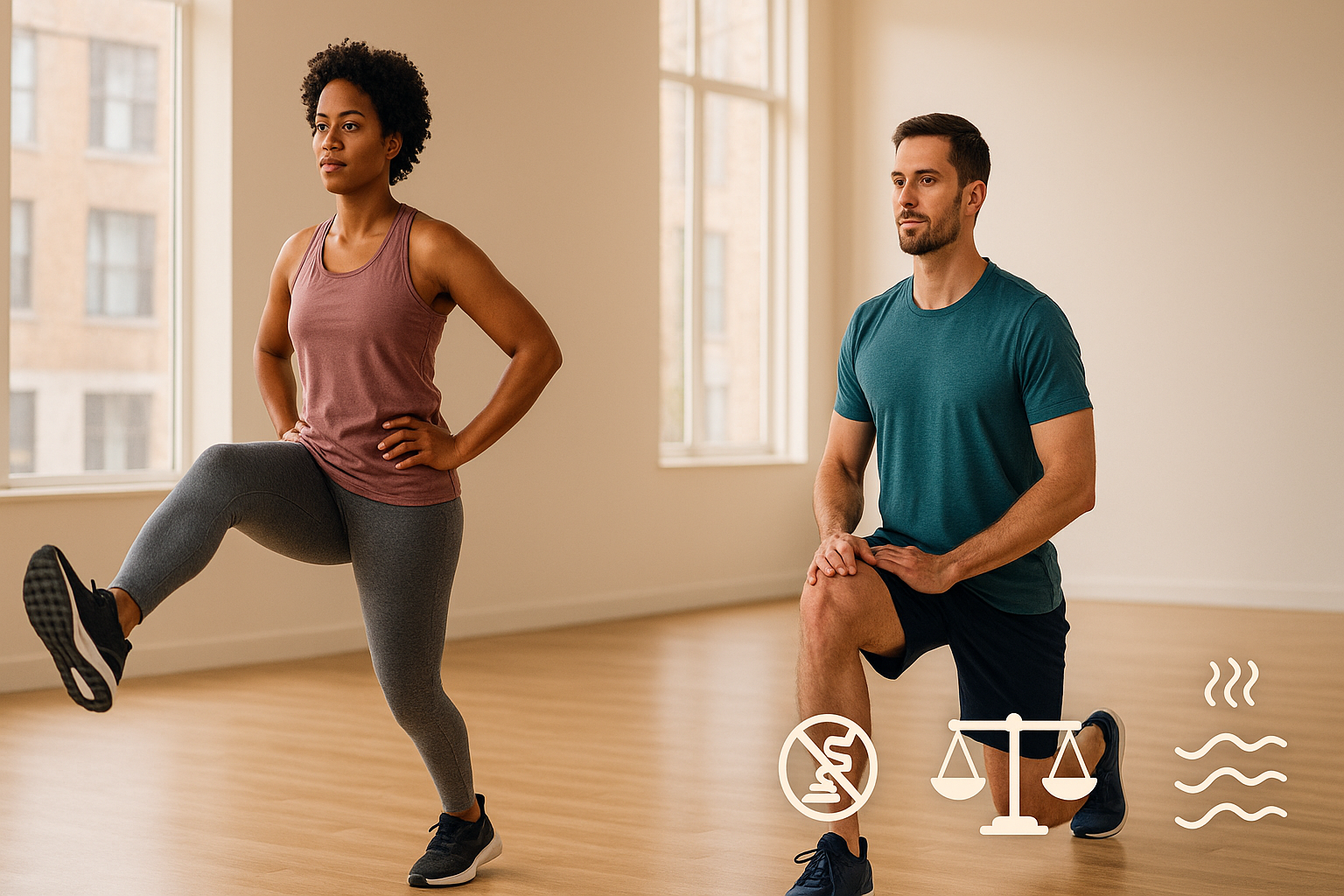
- Step 1: Hip flexor half-kneel stretch 20–30 seconds/side.
- Step 2: Hamstring hinge with heel on low bench, 20–30 seconds/side.
- Step 3: 2 sets light glute bridges (8–10 reps) to lock in range.
Quick-Start Checklist (Pin This)
- Warm up 5–10 minutes before stretching.
- Use dynamic moves before workouts; static holds after.
- Hold most static stretches ~20–30 seconds; repeat 1–2 times.
- Feel tension, not pain; stop if you feel sharp, pinching, or tingling sensations.
- Don’t bounce. Move in and out of positions smoothly.
- Balance both sides and opposing muscle groups.
- Breathe slowly; exhale as you settle into the stretch.
- If you’re hypermobile, prioritize control and light end-range strength.
- If you’re injured or swollen, get professional guidance first.
Troubleshooting & Common Pitfalls
“I never feel looser—stretching just hurts.”
You’re likely stretching cold, pushing into pain, or holding your breath. Warm up, scale back to a 4–6/10 tension, and use slow exhales.
“I stretch my hamstrings daily but they’re always tight.”
Check hip flexors and calves; many “tight” hamstrings are guarding against an anterior-tilted pelvis or stiff ankles. Add glute activation after.
“I get numbness or tingling in a deep stretch.”
That’s a red flag for nerve irritation—reduce depth, change angle, or skip that position. If it persists, see a clinician.
“Static before sprints makes me feel sluggish.”
Use dynamic drills pre-sprint and save long holds for after. If you must use a static hold for a stubborn area, keep it brief and follow with activation.
“I don’t have time.”
Do a 3-minute micro-set: 60 seconds warm-up + 2 holds for your tightest areas (20–30 seconds each), plus 10 activation reps.
How to Measure Progress (So You Know It’s Working)
- Range snapshots: Every two weeks, re-test a few positions (toe-touch, half-kneel hip flexor, doorway pec). Note depth or landmarks (e.g., “fingertips to mid-shin”).
- Ease-in time: How quickly you reach your comfortable end-range after warming up.
- Posture cues: Less rib flare, level shoulders, hips square in lunges.
- After-workout feel: Fewer “brick” calves/hips the next day.
- Activity markers: Easier squat depth, smoother stride, more comfortable overhead reach.
Tip: Keep a simple note—dates, stretches, holds, 1–10 tension, and how you felt after. Consistency beats hero sessions.
A Simple 4-Week Starter Plan (10–20 Minutes/Day)
Goal: Learn safe technique, build consistency, and reduce common tight spots without overdoing it.
Weekly rhythm:
- Mon/Wed/Fri: Dynamic pre-workout + Static post-workout (or evening).
- Tue/Thu/Sat: Short mobility snack (5–10 min).
- Sun: Optional recovery session or rest.
Week 1: Fundamentals
- Pre-workout (8–10 min): 2 min brisk walk → 10 arm circles → 10 hip circles → 10 leg swings each way → 6–8 walking lunges/side.
- Post-workout (8–10 min):
- Half-kneel hip flexor 20–30s x 2/side
- Hamstring hinge (heel on step) 20–30s x 2/side
- Calf wall 20–30s x 2/side
- Doorway pec 20–30s x 2/side
- Mobility snack (Tue/Thu/Sat): Cat-cow x 6, thoracic open-books x 6/side, deep squat hold (supported) 20–30s.
Week 2: Own Your New Range
- Pre-workout: Same as Week 1; add band pull-aparts (2×12).
- Post-workout: Keep holds the same; add end-range control (light isometric 5–10 seconds at the end of each hold).
- Mobility snack: Add ankle rockers (10/side) + 20-second supported deep squat + 10 glute bridges.
Week 3: Small Progressions
- Pre-workout: Slightly bigger ranges; add 2×10 tempo squats (3-sec down).
- Post-workout: Extend holds to 30–45s if comfortable; still 1–2 sets.
- Mobility snack: 3-minute timer on hips & shoulders: alternate 20–30s hip flexor with 20–30s pec, twice.
Week 4: Cement the Habit
- Pre-workout: Keep dynamic flow; finish with 2 rehearsal sets of your first lift or 2 steady strides.
- Post-workout: Choose your top 3 problem areas; 30–45s holds, 2 sets each, then 8–10 gentle activation reps.
- Mobility snack: 5-minute “feel good” circuit: calf → hamstring → hip flexor → pec, 20–30s each.
Graduation checks: You’re warming up automatically, stretching to tension (not pain), avoiding bounces, timing holds well, and hitting both sides/opposites. Keep going—consistency is where results happen.
FAQs
- Should stretching hurt to be effective?
No. Productive stretching feels like tension you can breathe through. Pain, pinching, or tingling are cues to back off or change angles. - How long should I hold a stretch?
For most people, about 20–30 seconds per hold works well after workouts. Older adults or very stiff areas may benefit from holds closer to 30–60 seconds. Repeat 1–2 times. - Do I need to stretch every day?
You’ll make progress with 2–3 days per week of focused flexibility work. If you sit a lot, brief daily “micro-sessions” help maintain gains. - Is static stretching bad before a workout?
It’s not “bad,” but long holds right before power or speed work can temporarily blunt performance. Use dynamic moves before and static holds after. - Does stretching prevent muscle soreness (DOMS)?
Not really. Stretching has little to no effect on next-day soreness. It can still help your mobility and make your cool-down feel better. - What if I’m hypermobile?
Prioritize control and strength at end-range. Avoid hanging on ligaments or chasing maximum stretch. Keep holds moderate and pair with activation. - Can I stretch an injured area?
If you have acute pain, swelling, or a suspected tear, don’t stretch it aggressively. Get assessed; gentle pain-free motion or rest may be more appropriate early on. - Is bouncing ever useful?
For most general fitness goals, no—controlled dynamic or static methods are safer. Certain athletes might use ballistic drills under professional supervision. - What’s the best time of day to stretch?
Any time you’re warm. Many people like post-workout or after a warm shower. Morning mobility snacks are fine—just include a brief warm-up first. - How do I know if my plan is working?
Track a couple of positions every two weeks, note smoother entry into end-range, fewer compensations, and better comfort during your main activities.
Conclusion
Stretching helps you move with less friction—but only when you do it right. Warm up first, ditch the bounce, respect your limits, time your holds wisely, and balance your routine. Nail those five habits and you’ll get more flexible, feel better, and actually reduce your risk of overuse aches that come from poor mechanics—not from the stretching itself.
Ready to upgrade your routine? Start with the Week 1 plan tonight and feel the difference tomorrow.
References
- Stretching: Focus on flexibility. Mayo Clinic. (n.d.). https://www.mayoclinic.org/healthy-lifestyle/fitness/in-depth/stretching/art-20047931
- A guide to basic stretches. Mayo Clinic. (n.d.). https://www.mayoclinic.org/healthy-lifestyle/fitness/in-depth/stretching/art-20546848
- How to warm up before exercising. NHS. (n.d.). https://www.nhs.uk/live-well/exercise/how-to-warm-up-before-exercising/
- How to stretch after exercising. NHS. (n.d.). https://www.nhs.uk/live-well/exercise/how-to-stretch-after-exercising/
- Warm Up, Cool Down. American Heart Association. (Last reviewed Jan 16, 2024). https://www.heart.org/en/healthy-living/fitness/fitness-basics/warm-up-cool-down
- Warneke, K., & Lohmann, L. H. Revisiting the stretch-induced force deficit: A systematic review with multilevel meta-analysis of acute effects. Journal of Sport and Health Science, 13(6), 805–819 (2024). https://pmc.ncbi.nlm.nih.gov/articles/PMC11336295/
- Chaabene, H., Behm, D. G., et al. Acute Effects of Static Stretching on Muscle Strength and Power: An Attempt to Clarify Recent Evidences. Frontiers in Physiology, 10:1468 (2019). https://pmc.ncbi.nlm.nih.gov/articles/PMC6895680/
- Page, P. Current Concepts in Muscle Stretching for Exercise and Rehabilitation. International Journal of Sports Physical Therapy, 7(1):109–119 (2012). https://pmc.ncbi.nlm.nih.gov/articles/PMC3273886/
- Stretching to prevent or reduce muscle soreness after exercise. Cochrane Review (updated 2022). https://www.cochrane.org/evidence/CD004577_stretching-prevent-or-reduce-muscle-soreness-after-exercise
- Dynamic vs. Static Stretching: Is One Better? Cleveland Clinic Health Essentials. (Aug 29, 2024). https://health.clevelandclinic.org/dynamic-stretching-vs-static-stretching
- Joint hypermobility syndrome. NHS. (n.d.). https://www.nhs.uk/conditions/joint-hypermobility-syndrome/
- Flexibility exercises. NHS. (n.d.). https://www.nhs.uk/live-well/exercise/flexibility-exercises/