























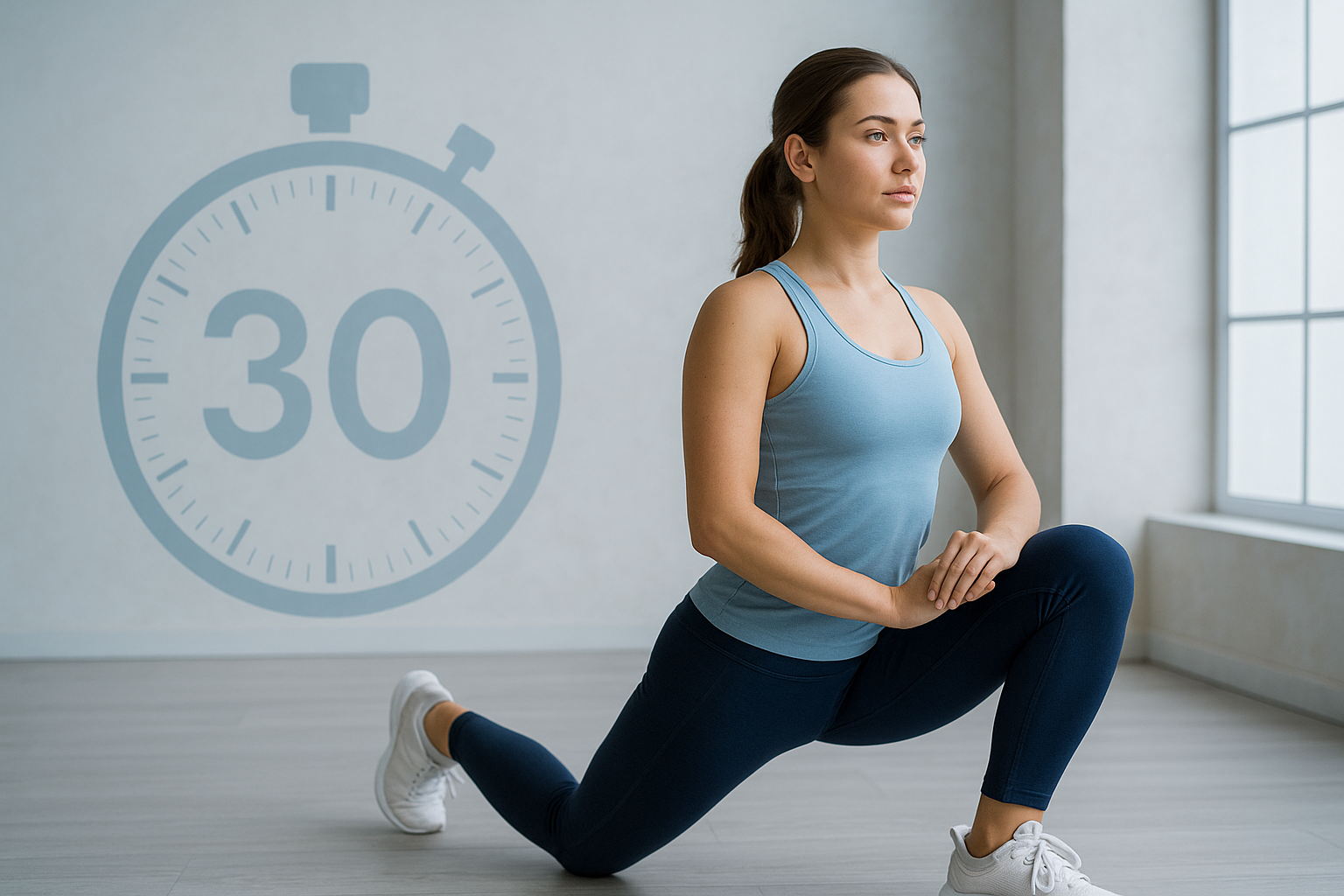
If you’ve ever wondered why coaches and therapists talk about “holding a stretch for 30 seconds,” you’re not alone. The 30-second rule appears everywhere—from warm-ups to rehab handouts—but what does the science say about how long you should hold a stretch, and when? This guide unpacks the physiology behind stretch duration, clarifies when 30 seconds is ideal (and when it’s not), and gives you practical, step-by-step routines to apply immediately.
Medical disclaimer: The information below is educational and not a substitute for personalized advice. If you have pain, injury, or a medical condition, consult a qualified health professional before changing your routine.
Key takeaways
- 30 seconds per hold is a reliable default for most healthy adults to improve flexibility without wasting time.
- Older adults and people with very stiff tissues may benefit from longer holds (up to ~60 seconds) for certain muscles.
- For pre-performance warm-ups, long static holds (≥60 s per muscle) can momentarily reduce strength/power—use short static holds or dynamic moves instead.
- Aim to accumulate ~60 seconds per muscle per session (e.g., 2×30 s or 4×15 s), 2–3+ days/week.
- Gains in flexibility come from mechanical and sensory changes; “tolerance to stretch” is a big part of why ROM improves.
- Stretching is great for ROM, but it doesn’t meaningfully prevent DOMS; use it strategically for mobility and performance goals.
Why hold time matters: the physiology that drives flexibility
What it is & benefits.
Holding a stretch long enough creates real changes in the muscle–tendon unit and your nervous system. In the short term, tissues show stress relaxation and creep—they temporarily lengthen under a constant load—while your nervous system updates how much stretch feels “acceptable.” Over weeks, repeated exposure increases your range of motion (ROM) and often lowers passive stiffness at end-range.
Requirements.
No special gear is required. A mat, strap/towel, yoga blocks, or a wall can make positions more comfortable so you can relax and breathe—key for holding time.
How it works (beginner-friendly explanation).
- Viscoelastic response. Muscles and tendons behave like springs and putty. Hold a stretch and the resistance drops after several seconds (stress relaxation). Repeat it across sessions and you get gradual, longer-lasting changes.
- Stretch tolerance. Your brain decides when a stretch feels “too much.” With regular practice, you tolerate more length at the same sensation—so ROM improves even if the tissue hasn’t permanently lengthened yet.
- Reflexes calm down. Gentle, sustained holds reduce reflexive tension over time, helping you access more end-range with less fight from the nervous system.
- Technique matters. Stable joints, controlled breathing, and no pain signal the nervous system it’s safe to allow more motion.
Beginner modifications & progressions.
- New to stretching? Start with 15–20 s holds and build to 30 s as comfort improves.
- Tight hamstrings? Bend your knee slightly or use a strap to avoid pulling on the low back.
- Progress by increasing total time per muscle (e.g., from 2×20 s to 2×30 s) or by adding a gentle contract-relax (PNF) squeeze at end-range.
Recommended duration & frequency.
For most adults: 10–30 s per hold, repeated to total ~60 s per muscle per session, ≥2–3 days/week (daily tends to work even better). Older adults often benefit from 30–60 s holds on specific muscles.
Safety & mistakes to avoid.
- Don’t bounce.
- Avoid pain or pins-and-needles (that’s neural tension, not useful stretch).
- Don’t hold your breath.
- If you’re about to sprint, jump, or lift heavy, avoid very long static holds on prime movers.
Mini-plan example (2–3 steps).
- 2×30 s calf stretch, 2) 2×30 s hip flexor stretch, 3) 2×30 s chest doorway stretch. Slow breathing throughout.
What the 30-second rule really means (and when to use it)
What it is & benefits.
The “30-second rule” is shorthand for a time-efficient, evidence-supported target hold to improve ROM. Numerous controlled studies on common tight areas (e.g., hamstrings) show 30 s stretches improve flexibility effectively, with no clear added benefit going to 60 s for most adults in a single session. The rule also aligns with widely used training guidelines.
Requirements & alternatives.
Clock, timer app, or just slow breaths (about 5–6 per 30 seconds). If 30 seconds feels too intense, do 2–4 sets of 10–15 s instead.
Step-by-step implementation.
- Choose 3–5 priority muscles (e.g., calves, hip flexors, hamstrings, glutes, pecs).
- For each, perform 2×30 s at mild–moderate tension (not pain).
- Accumulate ~60 s total per muscle (e.g., 4×15 s on very sensitive days).
- Train ≥2–3 days/week, or short daily micro-sessions.
Beginner modifications & progressions.
- Sensitive or post-injury? Start with 20 s and increase by 5 s each week.
- Progress by adding a 3–5 s exhale deeper into end-range, or introducing PNF (gentle 5 s contraction, then relax into 10–20 s hold).
How often & metrics.
- Frequency: 2–7 days/week (more frequent, shorter sessions often beat infrequent marathons).
- KPIs: ROM tests (knee-to-wall for ankles, sit-and-reach/straight-leg raise for hamstrings, back-scratch for shoulders), end-range comfort (0–10 scale), and movement quality in your sport or daily life.
Safety & pitfalls.
- Don’t chase a “burning nerve” feel behind the knee/hamstring—bend the knee slightly.
- If a joint feels pinchy, adjust the angle or shorten the lever (e.g., closer foot position).
Mini-plan example.
After a light warm-up walk: 2×30 s standing calf stretch per leg and 2×30 s hip-flexor half-kneeling per side.
When longer holds (up to ~60 seconds) make sense
What & why.
Some populations—older adults or those with marked stiffness—can see better ROM gains with longer holds on certain muscles, especially hamstrings and calves. Longer time under stretch may better overcome tissue resistance and help the nervous system accept new end-ranges.
Requirements.
Comfortable setup (strap/towel, pad under knee, wall support). The goal is relaxation; discomfort = back off.
How to implement safely.
- Warm up (3–5 minutes easy cycling/walking or joint circles).
- Select 1–2 target muscles that truly need it.
- Perform 1–2 holds of 45–60 s at gentle tension; stop if pain or tingling.
- Finish with a few controlled dynamic reps in the new range (e.g., leg swings, ankle pumps).
Beginner modifications & progressions.
- Start at 45 s for a few sessions before trying 60 s.
- Rotate which muscle gets the longer dose to avoid overdoing it.
Frequency & metrics.
- 3–5 days/week for stubborn areas.
- Track ROM monthly and note changes in daily tasks (e.g., can you put on socks easier?).
Safety & caveats.
- Very long static holds immediately before power or speed tasks can temporarily reduce force output—schedule longer holds after training or on separate mobility sessions.
- If long holds provoke nerve-like symptoms, shorten holds to 30 s and adjust joint position.
Mini-plan example.
Evening routine: 1×60 s calf stretch (knee-straight), 1×60 s calf (knee-bent), 1×60 s hamstring (strap), then 10 ankle pumps and 10 leg curls through the new range.
Static vs dynamic vs PNF: how duration differs by method
Static stretching (holds).
- Purpose: Improve ROM; down-regulate tone; good post-session or separate sessions.
- Typical hold: 10–30 s (most adults), 30–60 s (older/stiffer populations).
- When to avoid long holds: Right before maximal speed, power, or heavy lifts.
Dynamic stretching (moving through range).
- Purpose: Warm the nervous system; prep for sport; increase temperature and coordination.
- Typical dosage: 8–12 reps per movement (no long hold).
- Best used: Pre-performance; can reduce injury risk when integrated with full warm-ups.
- Beginner tip: Start small range and speed; build rhythm before adding amplitude.
PNF (contract-relax & variations).
- Purpose: Fast ROM gains via neural mechanisms and tolerance shifts.
- Typical sequence: 10–30 s passive hold → 5–6 s gentle contraction in the stretch direction → relax into 10–20 s deeper hold.
- Caution: Stay submaximal on contractions; avoid painful joint positions.
- When to use: Short cycles to break plateaus; not necessary daily for everyone.
Mini-plan example (pre-run).
- 10 leg swings front-to-back, 2) 10 lateral swings, 3) 10 walking lunges with reach. No static holds >30 s before the run.
How long should you hold? Goal-based prescriptions
Goal: Increase ROM for tight hips/hamstrings.
- What & duration: 2–4 sets of 15–30 s holds per muscle, ≥3 days/week, accumulating ~60 s.
- Progression: Add contract-relax once or twice per week.
- Safety: Slight knee bend for hamstrings; avoid low-back rounding.
Goal: Warm up for power/speed.
- What & duration: Mostly dynamic drills; if you static stretch, keep it brief (<30–45 s total) and low-intensity.
- Progression: Increase movement speed and amplitude, not static hold time.
Goal: Stiff ankles for deep squats.
- What & duration: 2×30 s calf stretch (knee-straight) + 2×30 s (knee-bent) after training; daily knee-to-wall ankle mobilizations (8–12 slow reps).
- Metric: Knee-to-wall distance (cm). Celebrate each 0.5–1 cm win.
Goal: Desk-posture relief.
- What & duration: 2×30 s chest doorway stretch + 2×30 s hip-flexor stretch per side + 90–120 s gentle thoracic extension over a foam roller.
- When: Mid-day and/or evening, 5–10 minutes total.
Goal: Older adult regaining hamstring ROM.
- What & duration: 1–2 holds of 45–60 s every other day, with gentle strap support.
- Safety: No pain or tingling; stop at comfortable stretch.
Quick-start checklist (print-worthy)
- Pick 3–5 muscles that limit your activities most.
- Warm up 3–5 minutes (walk, cycle, joint circles).
- Hold 10–30 s per stretch; older/stiffer: 30–60 s for select muscles.
- Accumulate ~60 s total per muscle per session.
- Stretch ≥2–3 days/week (short daily work beats weekend marathons).
- Breathe: slow nasal inhale, longer exhale; keep face/jaw relaxed.
- Stop for pain/tingling; adjust angle or reduce time.
- Track one ROM test weekly (knee-to-wall, back-scratch, sit-and-reach).
- Before power or heavy lifting: emphasize dynamic moves over long holds.
Troubleshooting & common pitfalls
“I don’t feel any stretch unless I crank it.”
Shift joint angle (e.g., tuck pelvis for hip-flexor), use props, or start with shorter holds. Stretch should be firm but friendly, never sharp.
“Static stretching before sprints makes me feel slow.”
Your perception is probably accurate. Save longer static holds for after training; keep pre-performance holds brief and low-intensity, or use dynamic drills.
“My hamstring stretch pokes behind the knee.”
That’s often neural tension. Slightly bend the knee or dorsiflex the ankle less; shorten holds to 20–30 s and avoid tingling.
“I stretch a lot but don’t get more flexible.”
Verify frequency (≥2–3×/week), total time (≈60 s/muscle/session), and consistency (track ROM weekly). Consider adding PNF 1–2×/week or doing strength through full ROM, which can also improve flexibility.
“Long holds aggravate me.”
Use multiple short holds (e.g., 3–4×15–20 s) and prioritize relaxation and breathing. You can still reach the ~60 s total.
“I get sore and hoped stretching would fix DOMS.”
Stretching isn’t very effective for reducing DOMS. For recovery, prioritize sleep, nutrition, light movement, and time.
How to measure progress (simple and objective)
- Ankle knee-to-wall: Toes a set distance from a wall; drive knee to wall without heel lifting. Record cm.
- Sit-and-reach or straight-leg raise: Record distance (cm) or angle (use a cheap goniometer or phone app).
- Back-scratch test: Measure overlap/gap between hands behind back (cm).
- Subjective end-range comfort: 0–10 rating at your typical hold time.
- Performance proxy: Depth/comfort of squat, stride length, overhead reach.
Track weekly, same day/time, after a standard warm-up.
A simple 4-week stretch plan (done in 10–15 minutes/day)
Who it’s for: Healthy adults wanting better posture and performance without long sessions.
Structure: 5 days/week; 3–5 key muscles; progress total time and, later, technique.
Week 1 — Establish the habit
- Muscles: calves (knee-straight & knee-bent), hip flexors, hamstrings (knee slightly bent), chest.
- Dosage: 2×20 s per muscle (≈40 s total).
- Goal: Learn positions; breathe slowly; no pain.
Week 2 — Standard 30s holds
- Dosage: 2×30 s per muscle (≈60 s total).
- Add 8–10 dynamic reps after each stretch (e.g., ankle pumps, leg swings, shoulder circles).
Week 3 — Consolidate & individualize
- Maintain 2×30 s for most muscles.
- If one area is stubborn (e.g., calves), trial 1×45–60 s for that muscle after training or in the evening.
- Add 1 PNF set on one target muscle: 20 s hold → 5 s gentle contraction → 15 s deeper hold.
Week 4 — Lock in gains
- Keep volumes; reduce to 5 days → 4 days if ROM has improved and you’re time-pressed.
- Retest ROMs; note any improvement in squat depth, stride, or overhead reach.
- Decide your maintenance dose (often 3×/week with short daily “top-ups”).
Optional “micro-mobility” breaks (workday)
Every 60–90 minutes: 30–45 s chest doorway stretch + 8–10 hip CARs (controlled circles) + 10 ankle rocks. Total: ~2 minutes.
Safety, caveats, and when to seek help
- Pain, tingling, or numbness = stop, adjust angle, or reduce hold time.
- Joint replacements, osteoporosis, hypermobility, recent surgery, or nerve entrapments: get individualized guidance.
- Before explosive or heavy sessions, avoid very long static holds on prime movers; warm up dynamically.
- Stretching is one tool. Often, strength training through full ROM complements or even rivals stretching for improving flexibility—use both as needed.
Frequently asked questions
1) Is 30 seconds always the best hold time?
It’s an excellent default for most adults: time-efficient and effective. Some people (especially older adults or those with very stiff tissues) may benefit from occasional 45–60 s holds on specific muscles—typically after training or in separate sessions.
2) How many sets should I do per muscle?
Accumulate ~60 seconds total per muscle per session. For example, 2×30 s or 4×15 s both work. More than 2–4 total repetitions rarely adds benefit in a single session.
3) Will static stretching before I lift or sprint hurt my performance?
Long static holds (≥60 s per muscle) can temporarily reduce strength/power. Short holds (<60 s total per muscle) are less likely to be problematic, but most athletes do best with dynamic warm-ups before high-output work.
4) Does stretching prevent or fix DOMS?
Evidence shows little to no meaningful effect on delayed-onset muscle soreness. Stretch for mobility and movement quality; use light activity, nutrition, and time for recovery.
5) How often should I stretch each week?
At least 2–3 days/week improves ROM for most people; daily short bouts often deliver faster results and better maintenance.
6) Is PNF better than static stretching?
PNF often produces faster short-term ROM gains, likely by boosting stretch tolerance. It’s a spice, not a staple—use it 1–2×/week if you plateau or need a quick improvement.
7) I’m not flexible. Should I hold longer to “force” change?
No. Stay at mild–moderate tension and be consistent. You’ll likely improve by accumulating ~60 s total and repeating it several days per week. If progress stalls, add a gentle PNF set or strengthen through full ROM.
8) Can strength training replace stretching?
Training through large, controlled ranges can improve flexibility similarly to stretching in some muscles. For stubborn areas or end-range control, combining stretching + strength works best.
9) What if stretching makes my symptoms worse?
Stop and modify. Sharp joint pain or nerve-like symptoms suggest the position or dosage isn’t right. Seek professional guidance for persistent issues.
10) When should older adults stretch?
After a light warm-up or later in the day often feels better. Start with 30 s holds, consider 45–60 s on select muscles, and emphasize comfort and breathing.
11) Should I stretch on off-days?
Yes—short daily sessions (even 5–10 minutes) can be more effective than one long weekly session.
12) Is there a weekly “dose” target?
Emerging evidence suggests around 10 minutes per week per muscle group may capture most of the benefit for ROM. Practically, that looks like ~60 s per muscle per session, 3–5 days/week, adjusted to your needs.
Conclusion
The 30-second rule endures because it balances science and practicality: it’s long enough to tap into the body’s viscoelastic and neural adaptations, short enough to fit your day, and flexible enough to scale for different goals. Use 10–30 s holds to build ROM, keep longer holds for post-session mobility, and lean on dynamic prep when performance is the priority. Track a few simple ROM tests, be consistent, and your movement will change.
CTA: Pick three muscles that limit you most and do 2×30 seconds each today—set a timer, breathe slow, and start banking flexible wins.
References
- The effect of time and frequency of static stretching on flexibility of the hamstring muscles, Physical Therapy (Journal), 1994. https://pubmed.ncbi.nlm.nih.gov/8066111/
- The effect of time and frequency of static stretching on the flexibility of the hamstring muscles, Physical Therapy (Journal), 1997. https://pubmed.ncbi.nlm.nih.gov/9327823/
- Effect of Duration of Stretching of the Hamstring Muscle Group for Increasing Range of Motion in People Aged 65 Years or Older, Physical Therapy (Journal), 2001. https://academic.oup.com/ptj/article/81/5/1110/2857600
- Current Concepts in Muscle Stretching for Exercise and Rehabilitation, International Journal of Sports Physical Therapy, 2012. https://pmc.ncbi.nlm.nih.gov/articles/PMC3273886/
- Effect of acute static stretch on maximal muscle performance: a systematic review, Medicine & Science in Sports & Exercise, 2012. https://pubmed.ncbi.nlm.nih.gov/21659901/
- A review of the acute effects of static and dynamic stretching on performance, European Journal of Applied Physiology, 2011. https://pubmed.ncbi.nlm.nih.gov/21373870/
- Acute effects of muscle stretching on physical performance, range of motion, and injury incidence in healthy active individuals: a systematic review, Applied Physiology, Nutrition, and Metabolism, 2016. https://cdnsciencepub.com/doi/10.1139/apnm-2015-0235
- Acute Effects of Static Stretching on Muscle Strength and Power: An Attempt to Clarify Recent Controversies, Journal of Strength and Conditioning Research (Review on PMC), 2019. https://pmc.ncbi.nlm.nih.gov/articles/PMC6895680/
- Stretching to prevent or reduce muscle soreness after exercise, Cochrane Review (2007 update; 2011 update). https://pubmed.ncbi.nlm.nih.gov/17943822/ ; https://pubmed.ncbi.nlm.nih.gov/21735398/