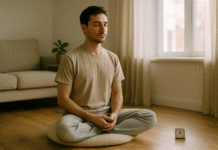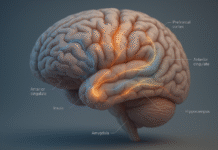
























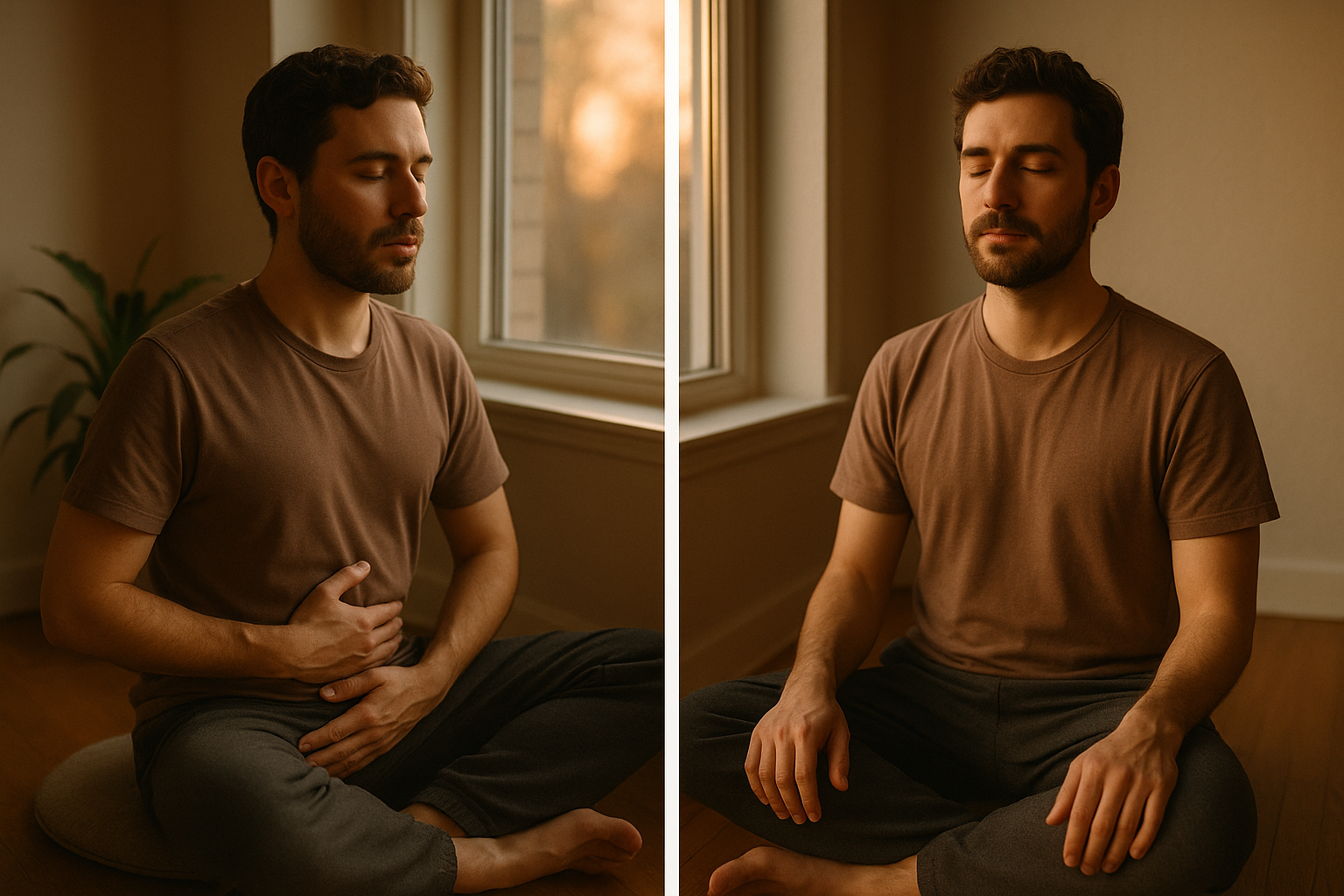
Breathwork and meditation are often framed as opposites—one “physiological,” the other “psychological.” In practice, they are teammates. Breathwork uses deliberate breathing patterns to shift your nervous system quickly; meditation trains attention and awareness to stabilize those shifts into longer-term benefits. In other words: breathwork changes your state in minutes, and meditation changes your traits over weeks. Used together, they help you regulate stress, sharpen focus, and sleep more deeply without turning well-being into a second job. (This article is educational and not a substitute for medical care. If you have a respiratory, cardiovascular, or mental health condition, consult a clinician before starting.)
Quick start (5 minutes): 1) Sit tall, breathe through your nose at ~6 breaths/min for 2 minutes; 2) Meditate with gentle attention on the breath for 2 minutes; 3) Finish with one minute of box breathing (inhale–hold–exhale–hold, all ~4 counts). That’s a compact, complementary stack to try today.
1. Breathwork Primes the Nervous System; Meditation Consolidates the Gains
Breathwork complements meditation by shifting autonomic tone fast—typically toward parasympathetic “rest-and-digest”—so your mind is calmer before you sit. Slow nasal breathing around 5.5–6 breaths per minute reliably increases heart-rate variability (HRV), a useful proxy for vagal tone and flexible stress response. Meditation then reinforces and generalizes that calmer baseline, producing small-to-moderate improvements in anxiety, depression, and stress over structured programs. Think of breathwork as the on-ramp and meditation as the highway: one gets you into the right lane; the other takes you where you want to go and keeps you there. Evidence reviews consistently show slow breathing improves autonomic balance, while mindfulness programs confer psychological benefits across populations.
1.1 Why it matters
- Faster entry: Two minutes of slow breathing can reduce respiratory rate and calm arousal, cutting the “settling time” at the start of meditation.
- Better quality sits: A quieter body reduces mind-wandering and reactivity, so you spend more time actually meditating instead of “trying to.”
- Habit stickiness: Quick wins increase adherence—an under-appreciated factor in all mind-body training.
1.2 Mini-checklist
- Aim for ~5.5–6 breaths/min (about one 10–11-second breath).
- Breathe nasally, low and quiet, with a gentle belly rise.
- Keep exhale length equal or slightly longer than inhale.
- After 2–5 minutes, begin your meditation without changing posture.
Synthesis: Lead with breath to stabilize physiology; follow with meditation to engrain it.
2. From Body to Mind: Interoception Bridges Breathwork and Meditation
The most natural meditation object is the breath. Breathwork heightens interoception—your ability to sense internal signals—which meditation then refines into steady, non-reactive awareness. When you slow and smooth the breath, you amplify predictable sensations at the nostrils, chest, and abdomen. That predictability is gold for focused-attention practices (e.g., breath-focused mindfulness): you have a clear anchor, fewer false alarms, and a kinder learning curve. Over time, the skill generalizes from breath to thoughts and emotions, allowing you to notice, label, and let go without getting hooked. Trials show that both diaphragmatic breathing and mindfulness training improve attention and working memory, partly via reduced mind-wandering. Frontiers
2.1 How to do it (breath-anchored meditation)
- Set a target: 6–10 minutes.
- Start with breathwork: 2 minutes slow nasal breathing.
- Switch to observing: Feel the whole breath—in, out, and the pauses—without controlling it.
- Label gently: When the mind wanders, say “thinking,” return to breath.
- Close cleanly: One minute of even, quiet breathing.
2.2 Numbers & guardrails
- Most people perceive the breath clearly at nostrils sitting upright; try abdomen if you feel anxious.
- 3 days/week is good; 5+ is better; consistency beats duration.
Synthesis: Breathwork tunes the instrument; meditation plays the music.
3. Sharper Focus, Less Mind-Wandering: A Two-Step Attention Upgrade
Combining breathwork and meditation reliably improves sustained attention. Breathwork reduces physiological noise (erratic CO₂ and heart-rate fluctuations), making it easier to maintain a stable attentional spotlight. Mindfulness training then strengthens cognitive control—working memory and task focus—by repeatedly noticing mind-wandering and returning to the target. In university settings, brief mindfulness courses have improved GRE reading comprehension and working memory capacity, with benefits mediated by less mind-wandering; adding pre-sit breathwork can further smooth the entry. PubMed
3.1 Mini protocol for deep work
- Before a focus block (3–5 minutes):
- 2 minutes slow nasal breathing (~6 bpm).
- 1 minute box breathing (4–4–4–4).
- 30–60 seconds open-monitoring (notice sensations, sounds, emotions, allow).
- During work: Every 25–50 minutes, take three slow breaths, eyes soft.
3.2 Common mistakes
- Forcing the breath (creates tension).
- Using fast breathing as a focus primer (can agitate).
- Treating meditation as “relaxation only” rather than attention training.
Synthesis: Quiet the body, then train the mind; attention sticks.
4. Stress & Anxiety: Acute Relief Meets Long-Term Resilience
Breathwork and meditation tackle stress on different time horizons. Slow, controlled breathing can downshift arousal quickly, improving mood and reducing respiratory rate within a single session; structured mindfulness programs produce small-to-moderate reductions in anxiety and depression over weeks. Meta-analyses and randomized trials support both effects: breathwork interventions show meaningful improvements in stress and mental-health symptoms, and mindfulness meditation programs (e.g., MBSR) reduce anxiety, depression, and stress compared with active controls. A 2023 RCT even found brief, structured breathwork outperformed mindfulness meditation for short-term mood enhancement, underscoring the “state-change first, trait-change next” synergy.
4.1 Tools & examples
- Physiological downshift (2–5 min): 6 bpm nasal breathing or “box” 4–4–4–4.
- Daily base: 10–20 minutes mindfulness (breath-focused or body scan).
- High-anxiety moment: 1–2 minutes of longer-exhale breathing (e.g., inhale 4, exhale 6–8).
4.2 Numbers & guardrails
- Effective interventions typically avoid fast-only breathing and sessions <5 min; multiple sessions and some guidance help.
Synthesis: Use breathwork for immediate relief; use meditation to widen your stress “window of tolerance.”
5. Sleep: Pair Breath-Downshifts with Mindful De-Ruminating
Breathwork can shorten sleep-onset latency by lowering arousal, and mindfulness reduces pre-sleep rumination that keeps you awake. In older adults with moderate sleep disturbances, a community mindfulness course improved Pittsburgh Sleep Quality Index scores versus sleep-hygiene education. If your mind races at night, use 2–4 minutes of slow nasal breathing (exhale slightly longer), then a brief, eyes-closed body scan to unhook from looped thoughts. Keeping breathwork gentle avoids over-stimulation; save vigorous techniques for daytime. PMC
5.1 Bedtime routine (10–15 minutes)
- Lights dim, screens off.
- Breath (3–5 min): 6 bpm, longer exhale.
- Body scan (5–8 min): Move attention from toes to head, note sensations without fixing them.
- If awake in bed: Repeat 2–3 cycles of inhale 4 / exhale 6.
5.2 Region-specific tip
- In hot climates, use a fan and light clothing; overheating increases respiratory rate and arousal—counterproductive at bedtime.
Synthesis: Breathe to settle the body; meditate to unstick the mind.
6. Emotional Regulation: Vagal Tone Meets Non-Reactive Awareness
Emotions are embodied. Slow breathing enhances vagal engagement and HRV, which correlate with better emotion regulation and flexibility under stress. Meditation trains the complementary skill of non-reactivity—noticing an emotion without immediate avoidance, suppression, or rumination. Together, they reduce “emotional whiplash”: you feel feelings fully, but you’re less yanked around by them. Reviews show slow breathing at ~6 bpm increases HRV, and mindfulness training reduces negative affect and reactivity across trials.
6.1 Try this on a tough day
- Name it: “This is frustration.”
- Breathe 2 minutes: In 4, out 6–8, through the nose.
- Note & allow (3–5 min): Observe sensations of emotion, allow waves to pass.
- Close: One compassionate sentence to yourself.
6.2 Common pitfalls
- Using breath to avoid feelings entirely (that’s suppression).
- Forcing long breath holds when anxious (may backfire).
Synthesis: Physiology supplies the brake; awareness steers.
7. Performance & Focus Under Pressure: Pre-Task Breath, Post-Task Reset
Before a presentation, exam, or workout, breathwork provides a state-tuning dial: slightly slower than normal to calm, or even-paced box breathing to steady. After the task, 1–2 minutes of slow breathing and a brief mindful check-in reset your baseline, preventing stress “carryover.” Over weeks, meditation trains meta-awareness so you can catch rising distraction or impulsivity sooner—useful for study sprints, sales calls, or late-game decisions. HRV-centric approaches and slow breathing are increasingly used alongside standard focus routines; simple, even breathing around 5.5–6 bpm is an evidence-informed anchor.
7.1 Pre-task micro-stack (3 minutes)
- Set posture: Feet grounded, spine tall.
- Breathe: 1 min at ~6 bpm.
- Box: 1 min at 4–4–4–4.
- Mindful cue: 1 min “single-point” attention on breath at nostrils.
7.2 Post-task reset (2–4 minutes)
- Breathe: In 4 / Out 6 for 2 minutes.
- Note three facts: One thing you did well; one learning; one next action.
Synthesis: Use the breath as your clutch; use meditation to shift gears smoothly.
8. Safety & Individualization: Matching Techniques to Your Nervous System
“Breathwork vs meditation” is not a competition; it’s a fit check. Some people do not feel calmer when focusing on breath—it can trigger lightheadedness or panic, especially with fast or forceful techniques. Others may experience difficult emotions during meditation. Evidence summaries note that while serious adverse events are uncommon, negative experiences do occur; a small percentage of participants in large samples report anxiety or low mood during meditation. Choose gentle, slow breathing if you’re sensitive; avoid rapid, forceful patterns if you have panic disorder tendencies, and seek qualified guidance if you have a psychiatric history.
8.1 Safety guardrails
- Prefer nasal, slow patterns; skip vigorous breathwork if dizzy, pregnant, or you have cardio-respiratory issues.
- If breath focus spikes anxiety, anchor on sounds or touch instead.
- Start with short sessions (3–10 min) and build gradually.
- Discontinue and consult a clinician if you experience worsening distress.
8.2 Notes on hyperventilation
- Rapid, deep breathing can lower CO₂ and cause respiratory alkalosis, leading to tingling, lightheadedness, or panic-like sensations; that’s counterproductive for most stress goals.
Synthesis: Your physiology is the guide; pick techniques that feel safe and stabilizing.
9. A Practical Weekly Stack: Simple, Scalable, and Trackable
Here’s a complementary plan you can scale. The goal isn’t perfection; it’s consistency. You’ll pair short, reliable breathwork “primers” with focused meditation, then use micro-bursts during the day to maintain gains. Keep a simple log of session length, mood (−2 to +2), and sleep quality (0–10). Over 4–6 weeks you should see smoother stress responses and easier focus. Meta-analyses suggest benefits are generally small to moderate, so look for steady, realistic gains rather than miracles.
9.1 The weekly template
- Mon–Fri (10–15 min):
- Breathwork (2–4 min): 6 bpm nasal breathing (equal in/out).
- Meditation (8–10 min): Breath-focused mindfulness.
- Close (1 min): Box 4–4–4–4 or one minute of longer-exhale breathing.
- Sat (20–30 min): Longer sit; include a body scan.
- Sun (10–15 min): Gentle breath + short reflection journaling.
9.2 Daily “on-the-go” inserts
- Before calls, exams, or reps: 1 minute box.
- After stressors: 3 slow breaths, eyes soft.
- At night: 3–5 minutes slow breathing + mindful body scan.
9.3 Tracking & tweaks
- Track mood, focus, sleep (simple 0–10 scales).
- If anxiety rises during breath focus, switch anchor to sounds for a week.
- If you feel dull/sleepy, shorten exhale a touch (e.g., 4-5 pattern).
- If you plateau, increase meditation by +3–5 minutes for two weeks.
Synthesis: A light, repeatable stack beats heroic bursts—and the duo works better than either alone.
FAQs
1) Is breathwork better than meditation for stress?
They work on different timelines. Breathwork often reduces arousal immediately (within minutes) by shifting autonomic tone; meditation builds resilience over weeks by training attention and perspective. Many people get the best results by pairing a short breath primer (2–5 minutes) with 8–15 minutes of mindfulness, then using micro-breaths during the day. Evidence supports both: slow breathing boosts HRV acutely, while mindfulness programs reduce anxiety and depression over time.
2) How many breaths per minute should I use?
For calming and focus, ~5.5–6 breaths/min is a widely studied sweet spot. That’s about a 10- to 11-second breath cycle with an even inhale and exhale. If that feels strained, start at 8–10 breaths/min and work down. Keep the breath gentle and nasal; comfort beats precision for adherence.
3) Should my exhale be longer than my inhale?
Slightly longer exhales can enhance down-regulation for some people (e.g., inhale 4, exhale 6–8). The key is relaxation without breath hunger. Equal ratios (e.g., 5–5) at 5.5–6 bpm are also effective for HRV. Try both and use what feels calming, not forced.
4) Can breathwork replace meditation?
Not if your goals include reduced mind-wandering, improved working memory, or a steadier relationship to thoughts and emotions. A 2023 RCT found breathwork boosted mood more than mindfulness in the short term, but meditation still trains enduring attentional skills. Blending them covers both state and trait change.
5) What if focusing on my breath makes me more anxious?
You’re not alone. Some people feel uneasy when attending to breathing. Switch to a different anchor—ambient sounds, touch points (e.g., hands on thighs), or a visual spot—and keep breathing naturally. Avoid fast or forceful breathing if you’re prone to panic; rapid over-breathing can cause lightheadedness by lowering CO₂. Better Health Channel
6) Does this help with sleep problems like insomnia?
Mindfulness training has improved sleep quality in randomized trials of older adults with moderate sleep disturbance, and gentle slow breathing before bed often eases sleep onset. Use calm nasal breathing (longer exhale), then a short body scan to reduce rumination. If insomnia persists, consult a clinician.
7) Are there risks to meditation or breathwork?
Serious adverse events are uncommon, but negative experiences—like anxiety spikes, low mood, or unsettling perceptions—are reported. Go gently, use shorter sessions, and seek qualified guidance if you have a psychiatric history. With breathwork, avoid intense hyperventilation-style techniques unless supervised. PubMed
8) How long until I notice benefits?
Many people feel calmer immediately after 2–5 minutes of slow breathing. For trait-level changes (less mind-wandering, improved emotional balance), structured meditation studies typically run 6–8 weeks with small-to-moderate effects. Consistency matters more than session length.
9) Which should I do first—breathwork or meditation?
Do breathwork first to settle physiology, then meditate while the body is calm. Two to five minutes of slow nasal breathing is plenty as a primer. This sequence reduces the “fight” at the start of your sit and often improves session quality. PMC
10) What gear or apps do I need?
None. A timer and a comfortable seat suffice. If you like gadgets, HRV-capable wearables can track progress, and many mindfulness apps offer breath-paced sessions and body scans. Remember, technology should support—not complicate—your routine.
Conclusion
The “Breathwork vs Meditation” debate misses the point. Breathwork and meditation are complementary levers on the same system: the human stress-attention loop. Breathwork is the fast-acting dial, shifting autonomic tone in real time so the mind is easier to train. Meditation is the long-game, consolidating calmer states into durable traits—less reactivity, steadier focus, kinder self-talk. When you pair a 2–5-minute breath primer with 8–15 minutes of mindfulness most days, you get the best of both worlds: immediate relief and cumulative resilience. Keep it simple, keep it gentle, and track how you feel and sleep for a few weeks. If a technique spikes discomfort, scale back or switch anchors. In time, you’ll build a personal stack that works in your body and your life.
Try it today: two minutes of 6-bpm breathing, ten minutes of breath-focused meditation, one minute of box breathing. Repeat tomorrow.
References
- Meditation and Mindfulness: Effectiveness and Safety. National Center for Complementary and Integrative Health (NCCIH). June 3, 2022. NCCIH
- The Physiological Effects of Slow Breathing in the Healthy Human. Frontiers in Human Neuroscience. 2017. PMC
- An Overview of Heart Rate Variability Metrics and Norms. Frontiers in Public Health. 2017. Frontiers
- Meditation Programs for Psychological Stress and Well-being: A Systematic Review and Meta-analysis. JAMA Internal Medicine. 2014. JAMA Network
- Mindfulness Meditation and Improvement in Sleep Quality and Daytime Impairment Among Older Adults With Sleep Disturbances: A Randomized Clinical Trial. JAMA Internal Medicine. 2015. JAMA Network
- Breathwork Interventions for Adults With Clinically Diagnosed Anxiety Disorders: A Systematic Review. Frontiers in Psychology. 2023. PMC
- Effect of Breathwork on Stress and Mental Health: A Meta-analysis. Scientific Reports. 2023. Nature
- Brief Structured Respiration Practices Enhance Mood and Reduce Physiological Arousal Compared to Mindfulness Meditation. Cell Reports Medicine. 2023. PMC
- Mindfulness Training Improves Working Memory Capacity and GRE Performance While Reducing Mind-Wandering. Psychological Science. 2013. SAGE Journals
- 8 Things to Know About Meditation and Mindfulness (Safety Tips). NCCIH. 2022. NCCIH
- Relaxation Techniques: What You Need To Know (HRV Biofeedback and Breathing). NCCIH. June 8, 2021. NCCIH
- Respiratory Alkalosis: Causes, Symptoms & Treatment. Cleveland Clinic. 2021–2024. Cleveland Clinic