


























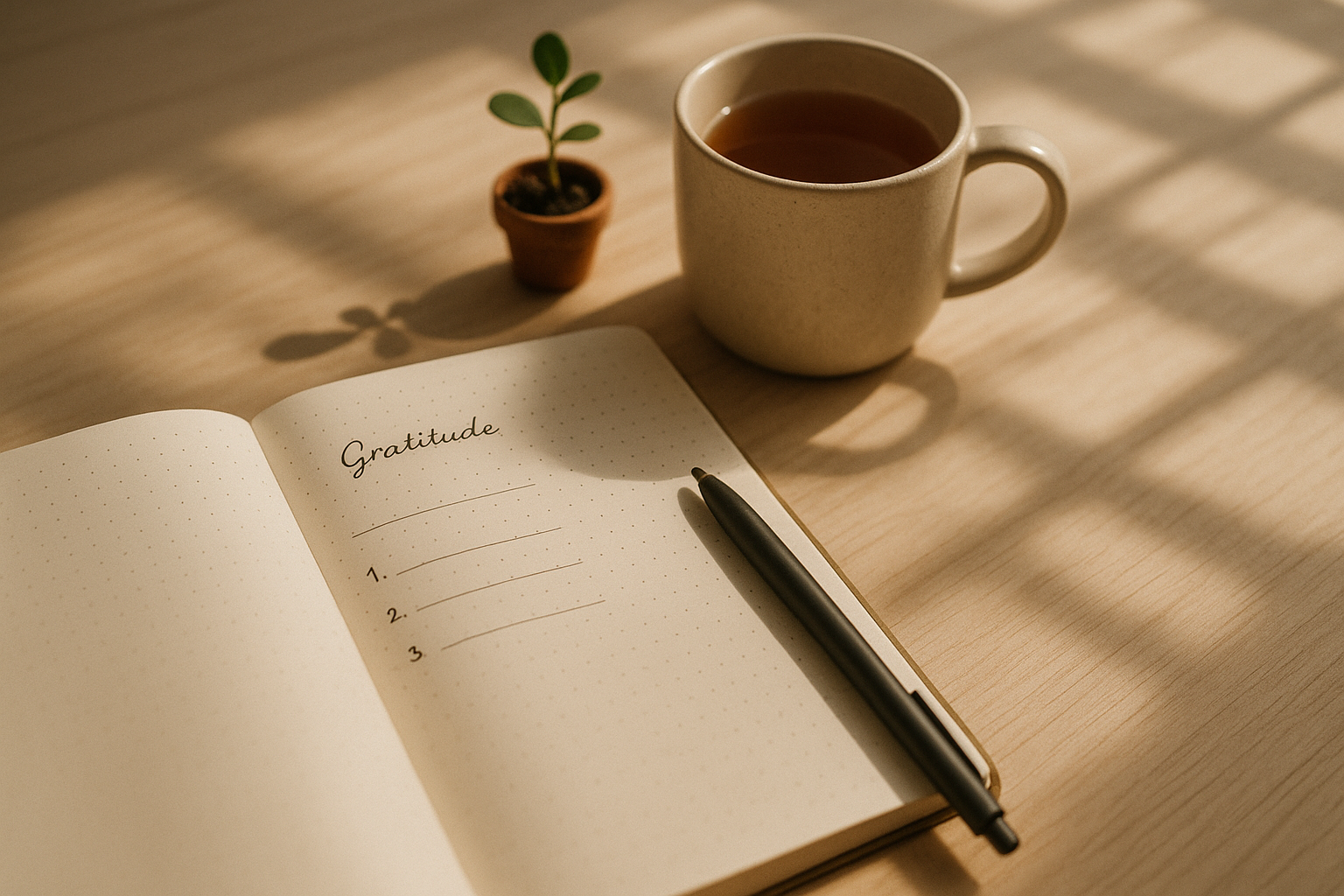
Gratitude isn’t forced positivity; it’s trained attention. The fastest way to train it is with structured prompts that make noticing and naming the good feel easy and repeatable. Below you’ll find 12 research-aligned prompts designed to boost mood, sharpen perspective, and deepen relationships. Use them in 5–10 minutes a day, in any language, with paper or a notes app.
Quick answer: gratitude journal prompts are short, specific questions that cue you to recall, savor, and explain positive moments; writing 3–5 lines daily is enough to see benefits.
Quick-start steps: pick one prompt below, set a 5-minute timer, write concrete details (who/what/when/where/why), end with one tiny action (thank, repeat, or share).
1. Three Good Things (and Why)
Start with “Three Good Things” to record three recent, specific positives and why they happened; it reliably trains your brain to scan for what works. This classic prompt is powerful because it blends recall with causal reasoning—linking events to actions, people, or luck—so the memory sticks and perspective widens. Keep entries small (a tasty naan at lunch, a kind text, a cool evening breeze) and recent (last 24 hours) to avoid generic lists. The “why” line turns moments into lessons or repeatable patterns. Do it at night to counter the brain’s built-in negativity bias and to prime a calmer sleep. If you miss a day, simply continue; consistency over perfection is the aim.
1.1 How to do it
- Write 3 small wins or pleasures from the last 24 hours.
- For each, add “because…” (e.g., “because I prepped ahead”).
- Note one tiny repeat step for tomorrow (≤1 minute).
- Keep entries sensory and time-stamped (who/what/when/where).
- Re-read yesterday’s list before you start today’s.
1.2 Common mistakes
- Vague items (“family,” “health”) without detail or timing.
- Skipping the “why,” which is the learning engine.
- Overreaching (huge goals) instead of micro-moments.
Close by picking one “good thing” to repeat tomorrow; repetition compounds the benefit.
2. Gratitude for Challenges (Reframe the Hard Thing)
Use this prompt to explore one difficulty and identify what you learned, gained, or strengthened through it. It doesn’t deny pain; it looks for growth alongside it. Write about a current stressor or a past setback, then list the hidden skills or supports it revealed—patience, problem-solving, a friend who showed up, your own persistence. This builds cognitive flexibility and reduces rumination, making future challenges feel more workable. If the issue is still raw, set gentle boundaries: write for a short, fixed time and end with a supportive next step.
2.1 How to do it
- Name the challenge in one sentence—no backstory spiral.
- List 3 things it taught or gave you (traits, tools, allies).
- Identify one person or resource that buffered the impact.
- Note one action you can take in 5 minutes to ease it.
2.2 Mini-checklist
- Specific?
- Balanced (acknowledge pain + growth)?
- Ends with a doable step?
You’re not grateful for suffering; you’re grateful for the strength and support discovered through it.
3. The Gratitude Letter (Not Sent… or Sent)
Write a short letter to someone who made your life better, describing exactly what they did and how it affected you. Read it aloud, deliver it, or simply keep it as a private appreciation—either way, you’ll experience a lift. This prompt deepens social bonds, which is a core pathway through which gratitude improves well-being. If writing in Urdu or any preferred language helps emotion flow, do that; authenticity beats formality. For a cultural touchpoint, pair the practice with tea time or after Maghrib when reflection fits naturally into the day.
3.1 How to do it
- Person’s name + one scene with vivid detail.
- What they did (actions/words) and when.
- How it changed you then and now.
- Optional: deliver in person or by voice note.
3.2 Common mistakes
- General compliments (“you’re amazing”) without a scene.
- Making it about you only; center their impact.
Finish by scheduling a 2-minute “thank you” message this week; the ripple effect is real.
4. Savoring a Micro-Moment
Choose a tiny sensory moment and slow it down on paper. Gratitude grows when you linger on texture, color, temperature, and sound—what positive psychology calls “savoring.” Pick today’s freshest micro-moment: a cool breeze after heat, cardamom in chai, the hush before Fajr, the smile of a shopkeeper. Describe it like a camera close-up so your future self can re-experience it. This builds a catalog of vivid positives that are easier to spot tomorrow.
4.1 How to do it
- Name the moment in 7–12 descriptive lines.
- Include at least 4 senses (sight, sound, smell, touch/taste).
- End with one reason it mattered (“It slowed my racing mind”).
- Add a cue to recreate it (e.g., sit by a window at 7 a.m.).
4.2 Mini case
- “The first rain on hot stone sounded like soft applause; I stood still for 30 seconds and breathed in petrichor. I felt unhurried for the first time today.”
Close by underlining one word that captures the feeling (calm, connected, encouraged); name it to claim it.
5. Past, Present, Future Gratitude
This time-travel prompt widens appreciation across your timeline. In three short paragraphs, thank a past version of you for something they did, name one present comfort you’re enjoying, and anticipate one future moment you’re eager to meet. This structure trains your mind to anchor in now while staying compassionate to your past and hopeful toward your future, which reduces anxiety and regret loops.
5.1 How to do it
- Past: “Thank you, earlier me, for…” (one choice or effort).
- Present: “Right now, I appreciate…” (a concrete detail).
- Future: “I’m looking forward to…” (a small, likely event).
5.2 Guardrails
- Keep each paragraph ≤6 lines to avoid rumination.
- Future entries should be realistic within 1–7 days.
- If the past is heavy, choose a neutral, effort-based thank-you.
End by circling the present paragraph to reinforce here-and-now stability.
6. Category Inventory (Home, Health, Work, People)
When you feel “nothing good happened,” swap open-ended lists for a guided inventory across four categories: home, health, work/study, and people. This combats all-or-nothing thinking by distributing attention. Aim for one small item per category (e.g., “clean drinking water,” “a 10-minute walk,” “finished one email,” “neighbor’s wave”). Over time, these entries map your supports and routines—the resilient scaffolding you forget when stressed.
6.1 How to do it
- Draw four headers: Home | Health | Work | People.
- Write one concrete item under each.
- Add a “+1” bonus category relevant to you (faith, learning, nature).
6.2 Common mistakes
- Writing “family” or “job” without the scene behind it.
- Skipping a hard category; push yourself to find one micro-item.
Conclude by starring the category that felt thinnest and add one tiny action to enrich it tomorrow (send a check-in text, step outside, prep fruit).
7. Strengths You’re Grateful For
Gratitude lands deeper when you include your own strengths—not only external gifts. This prompt spotlights a character strength you used today (kindness, prudence, humor) and how it helped. Naming strengths builds self-respect and agency, making gratitude feel earned rather than lucky. If you’ve taken a VIA strengths survey, use your top five as a rotation; if not, simply choose from traits you notice in action.
7.1 How to do it
- Pick one strength you used in the last 48 hours.
- Describe the situation and the outcome in 5–7 lines.
- Thank the people or systems that supported you in using it.
- Note how you’ll apply it again tomorrow.
7.2 Mini-checklist
- Is the strength observable in behavior (not just identity)?
- Did you include a person or resource that enabled it?
- Is there a next use-case identified?
Close by writing one sentence of self-gratitude: “I’m thankful I stayed patient with my child’s homework tonight.”
8. Gratitude for Your Body
This prompt shifts attention from appearance to appreciation for function. Choose a body part or system and thank it for what it allows you to do—lungs for breathing, hands for cooking, legs for walking markets. Include care actions you took (hydration, stretching) to reinforce supportive habits. Many people find this gently reduces self-criticism and increases health-protective behaviors over time.
8.1 How to do it
- Pick one body part/system (e.g., eyes, heart, skin).
- Write 5–8 lines on what it did for you today.
- Note one care action you took or will take in 2 minutes.
- If spiritual practice is meaningful, add a brief prayer of thanks.
8.2 Common mistakes
- Focusing on appearance or deficit.
- Using medical jargon that distances emotion.
Finish by placing a reminder (water bottle on desk, short walk after lunch) to align gratitude with care.
9. A Nature Noticing Walk (Paper in Pocket)
Gratitude amplifies outdoors. Take a 5–15 minute walk and jot five natural details: light on buildings, birdsong, leaves moving, the feel of evening air. This prompt uses motion to quiet mental noise while your pen gathers small wonders. In dense urban areas, nature still shows up—in cracks, sky color, houseplants, the rhythm of rain. If the heat is high, try early morning or after sunset; if air quality is poor, observe from a balcony or window.
9.1 How to do it
- Set a 7-minute timer; walk slowly.
- Collect 5 observations with sensory detail.
- Underline one surprise or delight.
- End with a single photo (optional) to anchor memory.
9.2 Mini case
- “At the corner, two mynas argued on a wire; a boy laughed; the light turned honey-gold on the brick wall.”
Return home and circle the line that changed your mood; that’s a cue to seek more often.
10. Gratitude to Your Future Self
Write to your future self as if they’ve already benefited from a habit you’re building—hydration, reading, prayer, budgeting—and thank them for sticking with it. This backward-from-the-future framing taps motivation without pressure. Keep the habit tiny and specific. By recognizing the delayed gifts of present effort, you make consistency feel rewarding now, not just “someday.”
10.1 How to do it
- Date a short note: “Dear future me, thank you for…”
- Name the micro-habit (≤2 minutes/day) and its felt results.
- List two obstacles and how you navigated them.
- Close with one thing you’ll do today to keep the streak alive.
10.2 Common mistakes
- Writing about big, vague goals (“be healthier”) instead of behaviors.
- Skipping obstacles; planning for friction makes habits stick.
Seal it by placing that one tiny action on your calendar today.
11. What Went Right Today (Event → Cause → Repeat)
Each evening, pick one thing that went right and dissect it: what happened, what caused it, and how you can repeat it. This prompt builds a library of workable patterns—a commute hack, a helpful phrase, a break that reset your focus. By naming the cause (people, prep, timing), you reduce the sense that “good days just happen” and increase the sense that you can create more of them.
11.1 How to do it
- Describe one “right” moment in 3–5 lines.
- Identify the main cause(s).
- Choose one lever to pull again tomorrow.
- Thank anyone involved with a quick message.
11.2 Mini-checklist
- Concrete event?
- Cause named?
- Repeat lever chosen?
End by sending that thank-you or scheduling the repeat; gratitude becomes a feedback loop for better days.
12. Pay-It-Forward Gratitude (Intention to Act)
Turn appreciation into action by planning one small generosity inspired by something you’re grateful for—sharing notes, leaving a review, bringing fruit for a colleague, donating a book. This prompt closes the loop between feeling and doing, which research links to sustained well-being. Keep actions small and local so they’re easy to complete; the point is momentum and connection, not perfection.
12.1 How to do it
- Name today’s gratitude.
- Plan one 2–5 minute generosity inspired by it.
- Set a time and place; write the exact wording if relevant.
- Do it within 24 hours.
12.2 Common mistakes
- Planning big actions you won’t complete.
- Keeping it anonymous if a simple “thank you” would matter.
Write a one-line reflection after you act; noticing impact encourages the next generous step.
FAQs
1) How often should I use gratitude journal prompts?
Most people do well with 5–10 minutes daily or 3–4 days a week. Frequency matters less than consistency: shorter, regular sessions beat occasional long ones. If you’re starting, choose one prompt and stick with it for seven days before rotating. Evening entries often help sleep; mornings can set a hopeful tone.
2) What if I don’t feel grateful right now?
Begin with neutral, factual observations (running water, sunlight on the wall, a completed task). You’re training attention, not forcing emotion. Over time, naming small, concrete details tends to generate genuine appreciation. If you’re in acute distress, combine brief gratitude prompts with professional support and self-care basics.
3) Paper journal or phone app—which is better?
The best tool is the one you’ll use. Paper can reduce distraction and feels tangible; digital notes are searchable and always with you. Many people pair the two: quick notes on the phone during the day, then a short paper summary at night. Use reminders and a fixed spot to lower friction.
4) Should I write the same things every day?
Repetition is fine if the details change. “My partner” becomes “the way they set aside fruit for me before work.” Specifics keep your brain engaged and prevent the list from going stale. If you notice copy-paste entries, switch prompts for a week to refresh attention.
5) How do I make prompts work during busy seasons?
Shrink the scope: one sentence, one micro-moment, one name. Tie the habit to an anchor you already do—after brushing teeth, after Isha, or with morning tea. Use a two-minute timer and stop when it rings; unexpected brevity keeps the habit alive until life slows down.
6) Can gratitude prompts help with anxiety or low mood?
They can support mood by interrupting worry loops and highlighting resources, but they’re not a substitute for clinical care. Combine prompts with sleep, movement, and social connection. If symptoms persist or impair functioning, consult a qualified professional and use journaling as a supportive practice.
7) What’s the difference between gratitude and toxic positivity?
Gratitude acknowledges hard realities and finds what still helps; toxic positivity denies difficulty and pressures constant cheerfulness. In your entries, allow mixed feelings, name the challenge, and then look for supports, strengths, or lessons. The “Challenges” prompt (Section 2) is designed to keep things honest.
8) Is it better to write in the morning or evening?
Evening entries pair well with “Three Good Things” and sleep; mornings are excellent for “Pay-It-Forward” intentions. Choose one time and protect it with a reminder. If your schedule varies, stack journaling onto a daily constant (first sip of tea, transit, bedtime).
9) How do I bring other people into my gratitude practice?
Use the Gratitude Letter, quick thank-you texts, or “What Went Right” debriefs with family. Try a weekly ritual—Friday dinner shout-outs or a Sunday message to one person who helped you. Social expressions amplify benefits and strengthen your support network.
10) What if writing feels awkward—can I use voice notes?
Yes. Speak your responses for 60–90 seconds and, if possible, jot one keyword afterward to index the entry. The goal is the mental shift, not perfect prose. For privacy, use headphones and a locked notes app.
11) How soon will I notice benefits?
Many people report small lifts in 1–2 weeks with regular practice, mostly in mood and perspective. Relationship benefits often follow as you share appreciation more often. Track changes by rating mood (1–10) before and after writing; trends over a month are more telling than single days.
12) Can I journal in another language or with my faith practice?
Absolutely. Write in the language that carries your feelings best; blend with dua, prayer, or blessings if that’s part of your life. Cultural and spiritual alignment increases meaning and staying power. Gratitude is a universal practice with personal flavor—make it yours.
Conclusion
Gratitude grows where attention goes. The 12 prompts above make attention easy to guide: toward what went right, the people who help, the strengths you used, and the small sensory moments that would otherwise blur past. Keep sessions short, details concrete, and actions tiny. If you cycle through one prompt per day for two weeks, you’ll likely notice more good while creating more of it—because recognizing patterns lets you repeat them. When a tough day arrives, use the “Challenges” or “What Went Right” prompts to stay honest and hopeful. Pair your writing with one outward expression—a thank-you note, a kind text, a small generosity—and gratitude shifts from an inner feeling to a lived practice.
Ready to start? Pick one prompt, set a 5-minute timer tonight, and write your first three lines.
References
- Emmons, R. A., & McCullough, M. E. (2003). Counting blessings versus burdens: An experimental investigation of gratitude and subjective well-being in daily life. Journal of Personality and Social Psychology. American Psychological Association. https://pubmed.ncbi.nlm.nih.gov/12585811/
- Seligman, M. E. P., Steen, T. A., Park, N., & Peterson, C. (2005). Positive psychology progress: Empirical validation of interventions. American Psychologist. (PDF hosted by Greater Good Science Center) https://greatergood.berkeley.edu/images/uploads/Seligman-PosPsychProgress.pdf
- Wood, A. M., Froh, J. J., & Geraghty, A. W. A. (2010). Gratitude and well-being: A review and theoretical integration. Clinical Psychology Review. Elsevier. https://www.sciencedirect.com/science/article/abs/pii/S0272735810000450
- Greater Good Science Center (Brown, J., & Wong, J.). (2017, June 6). How gratitude changes you and your brain. UC Berkeley. https://greatergood.berkeley.edu/article/item/how_gratitude_changes_you_and_your_brain
- Harvard Health Publishing. (2021, Aug 14). Giving thanks can make you happier. Harvard Medical School. https://www.health.harvard.edu/healthbeat/giving-thanks-can-make-you-happier
- Harvard Health Publishing. (2024, Sept 11). Gratitude enhances health, brings happiness — and may even lengthen lives. Harvard Medical School. https://www.health.harvard.edu/blog/gratitude-enhances-health-brings-happiness-and-may-even-lengthen-lives-202409113071
- Emmons, R. A., & McCullough, M. E. (2003). Counting Blessings Versus Burdens. Author site (PDF). University of California, Davis. https://emmons.faculty.ucdavis.edu/wp-content/uploads/sites/90/2015/08/2003_2-Emmons_McCullough_2003_JPSP.pdf
- BrainWaves. (2024). Three Good Things (classroom handout referencing Seligman et al., 2005). https://education.brainwaveshub.org/wp-content/uploads/2024/09/Three-good-things.pdf
- Wood, A. M., Froh, J. J., & Geraghty, A. W. A. (2010). Gratitude and well-being: A review and theoretical integration. PubMed record (metadata). National Library of Medicine. https://pubmed.ncbi.nlm.nih.gov/20451313/