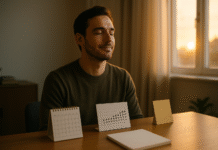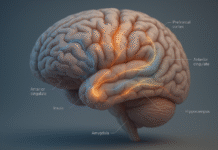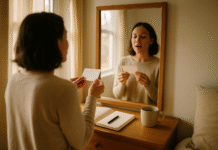








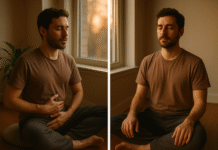


















Visualization for public speaking confidence means using mental imagery—deliberate, sensory-rich “rehearsals” of your talk—to lower anxiety and improve delivery. Done well, mental practice strengthens the same neural pathways engaged during performance and prepares you to handle curveballs without freezing. In this guide you’ll learn 12 practical, research-backed visualization methods that help you speak with clarity, presence, and poise—whether you’re pitching to five people in a meeting room or keynoting a hall of 500. This article is educational, not medical advice; if anxiety significantly disrupts your life, consider professional support.
Quick start (60 seconds): Write a one-sentence talk goal; picture your closing moment of success; breathe slowly for four cycles; mentally walk from “Good afternoon…” to your first slide; imagine a friendly face; say the last line out loud. Repeat twice.
Mental practice has repeatedly been shown to enhance performance across complex skills when combined with real practice. Reframing nerves as useful energy and rehearsing specific “if–then” responses to hiccups further improves outcomes. These approaches aren’t magic—they’re structured cognitive tools that turn stress into readiness.
1. Build a “Success Snapshot” You Can Replay on Demand
Create a vivid 20–40 second mental clip of the exact outcome you want: you speak clearly, the audience nods, you finish on time, and the first question is thoughtful. This tight “success snapshot” anchors your practice; it’s short enough to repeat, rich enough to feel real, and specific enough to direct your behavior. Start with the final image—your last line lands, you pause, then receive warm applause—and rewind to the first breath at the lectern. When anxiety spikes, run the clip to reset attention on what “done well” looks and feels like.
1.1 How to do it
- Write your last line verbatim; this is the anchor.
- Note 3 sensory details (room temperature, mic weight, audience rustle).
- Name 1 person in the room you’ll make friendly eye contact with.
- Add 1 physical cue (relax shoulders, plant feet).
- Keep it <40 seconds so it’s repeatable.
1.2 Mini-checklist
- Is the scene specific to your venue and audience?
- Does it include sound, sight, and bodily feel (not just “seeing”)?
- Can you play it twice without losing detail?
Close by pairing the snapshot with two slow breaths. This combination helps quiet sympathetic arousal while pointing your mind toward the goal behavior rather than the fear. Mental snapshots are a cornerstone across performance fields because they prime motor planning and attention toward desired outcomes.
2. Walk the Talk: First Minute → Transitions → Close
Your audience forms an impression early, and your ending shapes memory. Visualize the first 60 seconds, each transition between sections, and your closing. See yourself opening with your hook, pausing, and scanning the room. Picture the exact words you’ll use to shift from point A to B (“Now that we’ve seen the problem, here’s the plan”). Then rehearse ending calmly—no rushing—followed by a clean invitation to Q&A.
2.1 Steps
- Map the beats: Hook → Agenda → First insight → Transition line.
- Time-box: First minute at a steady pace; close with 5–7 seconds of stillness.
- Rehearse pauses: Imagine a 2–3 second pause after key statements.
- Run 3 reps: First minute, two transitions, closing line.
2.2 Numbers & guardrails
- Many presenters sound best near 100–150 words/min for talks; rehearse at the slower end in your head so you don’t speed up live. Tools like VirtualSpeech’s guidance on speaking rate are useful for setting a baseline.
Finishing a mental run-through with the ending cements the narrative arc and prevents the common “fade-out” under pressure.
3. Switch Camera Angles: First-Person and Third-Person Imagery
Use first-person imagery (through your own eyes) to encode timing, breathing, and mic handling; switch to third-person (as if watching a recording) to polish posture, gestures, and stage movement. Different perspectives cue different systems: first-person supports internal sensations and action timing, while third-person helps evaluate form and spatial choreography. Combine both for a fuller rehearsal.
3.1 How to do it
- Run 2x first-person: Feel breath, throat, and stance; imagine the clicker in your hand.
- Run 1x third-person: Watch yourself from the back row; fix pacing and hand fidgets.
- Layer kinesthetics: Add the feel of a lapel mic cable, the lectern edge, or floor texture.
3.2 Why it matters
Research distinguishes first- vs third-person imagery with complementary strengths; blending perspectives can improve learning and execution for complex sequences. While results vary by task, evidence suggests internal perspective supports accuracy, and external can aid learning new sequences—together they offer coverage you can’t get from one angle alone. PMCMDPI
Close with one short real-world rep (aloud) to tether imagery to your actual voice.
4. Make It Real with the PETTLEP Checklist
Borrowed from sport psychology, PETTLEP stands for Physical, Environment, Task, Timing, Learning, Emotion, Perspective. The idea: the more your imagery matches real performance, the more it “transfers.” For speaking, that means rehearsing in (or like) the venue, wearing similar shoes, holding a remote, keeping real-time pacing, updating scripts as you learn, feeling the emotions of the moment, and switching perspectives intentionally.
4.1 Mini-checklist (adapted for talks)
- Physical: Stand; use the mic/remote you’ll actually use.
- Environment: Dim a light; face a doorway; simulate audience placement.
- Task: Incorporate slides, laser pointer, or whiteboard marks.
- Timing: Run in true time (no fast-forwarding transitions).
- Learning: Update imagery after feedback.
- Emotion: Intentionally feel “nervous and ready.”
- Perspective: Alternate first- and third-person.
4.2 Tools/Examples
- In a conference room, practice with lights on/off to mimic session turnover.
- Add the walk on and walk off; your brain treats those as part of the task.
PETTLEP-based imagery has two decades of evidence guiding how to align mental and physical practice. You don’t need every element every time—but the closer your rehearsal matches showtime, the more confident you’ll feel.
5. Reframe Nerves as Fuel (Arousal Reappraisal)
Instead of trying to “calm down,” visualize your racing heart as oxygen for focus and energy for emphasis. See the same sensations—warm hands, faster pulse—powering your voice and gesture. Then imagine yourself saying, “This energy will help me connect.” In studies, reinterpreting arousal as helpful can improve performance and reduce avoidance; you’re not suppressing feelings, you’re assigning them a new job.
5.1 How to do it
- Before a rep, label sensations (“heart fast,” “breath shallow”).
- Mentally redirect them toward your goal (“this is readiness”).
- Visualize yourself delivering the first 30 seconds with that energy—not despite it.
5.2 Numbers & guardrails
- Use reappraisal before and during a talk; it pairs well with breath pacing (see #9).
- Expect improvement over several reps, not instant silence of symptoms.
Arousal reappraisal is a lightweight cognitive intervention with growing support; when combined with practice, it helps speakers use stress responses rather than fear them. ResearchGate
6. Pre-Plan “If–Then” Moves for Common Hiccups
Visualization becomes far more powerful when you attach implementation intentions: simple If X, then I will Y plans you rehearse in your mind. For example, “If I blank, then I’ll pause, sip water, glance at my next slide title, and restart from the last subheading.” These micro-scripts automate good choices under pressure.
6.1 How to do it
- List 5 likely triggers (blanking, fast pace, tech glitch, tough question, heckle).
- Write a 1-sentence If–Then for each.
- Mentally run each scenario once per rehearsal; keep the action concrete and visible.
6.2 Common mistakes
- Vague actions (“I’ll try to relax”); replace with observable steps.
- Too many plans; start with 3–5 high-yield triggers.
Across 90+ studies, implementation intentions produce medium-to-large gains in goal execution. For speaking, that means your brain has cached a smart response and doesn’t need to invent one on the spot.
7. Use WOOP/Mental Contrasting to Pressure-Test Your Talk
WOOP (Wish, Outcome, Obstacle, Plan) pairs positive imagery with a specific look at what could get in the way—and a plan. Visualize your desired talk outcome; then mentally contrast it with real obstacles: low projector brightness, a skeptical stakeholder, limited time. Finally, create the plan (often an If–Then). WOOP prevents “fantasy trap” rehearsals that feel good but don’t prepare you for reality.
7.1 How to do it
- Wish: “Deliver a clear, on-time update to win approval.”
- Outcome: See the team aligned and next steps green-lit.
- Obstacle: Picture the tough cross-examiner or a data gap.
- Plan: If asked for data you don’t have, summarize the knowns and commit to a follow-up by 5 p.m. with a one-pager.
7.2 Mini-checklist
- Did you name one internal (self-talk) and one external (room/tech) obstacle?
- Is your plan visible (something a camera would see you do)?
Mental contrasting with implementation intentions (MCII/WOOP) has solid evidence for turning desires into actions across settings; speaking is no exception.
8. Stress-Inoculate with Graded Exposure (Live, VR, or Imaginal)
Visualization is even more effective when paired with graded exposure to the stressor itself. Use imaginal exposure (in your head), VR rooms, or small real audiences, increasing intensity stepwise. Visualize walking onto progressively larger stages, then practice in a real meeting, then a class, then a meetup. If you have access to VR apps (e.g., VirtualSpeech or Ovation), rehearse with simulated audiences and Q&A; your imagery can include headset views, avatars, and ambient noise.
8.1 How to do it
- Build a ladder (1→5): empty room → 5 colleagues → 20 peers → meetup → big room.
- For VR, schedule 2–6 sessions of 20–40 minutes each; rehearse the same talk.
- After each step, visualize what improved and one adjustment for the next step.
8.2 Tools/Examples
- VirtualSpeech/Ovation provide simulated rooms and AI feedback on pace, eye contact, and filler words; several studies and reviews show VR exposure reduces public speaking anxiety and can rival in-vivo practice for some learners. VirtualSpeechovationvr.com
Exposure therapy principles are well established for anxiety; applied to speaking, the combination of imagery + stepwise exposure builds self-efficacy without flooding.
9. Link Imagery to Breath (Resonance or “Box” Breathing)
Combine visualization with slow, measured breathing. Two reliable options: resonance breathing (~6 breaths/min, e.g., 4s inhale, 6s exhale) or box breathing (inhale-hold-exhale-hold, equal counts). As you imagine delivering key lines, match sentences to your exhalation. This helps down-shift arousal and steadies pace; in trials, brief daily breathwork improved mood and reduced state anxiety versus mindfulness alone.
9.1 How to do it
- Resonance: 4-in / 6-out for 1–3 minutes while visualizing your opener.
- Box: 4-4-4-4 for 1–2 minutes before you “walk on” in your mental clip.
- Anchor: Imagine a small square tracing with each breath cycle.
9.2 Numbers & guardrails
- Evidence links slow, controlled breathing and HRV biofeedback to improved stress regulation; start with short sessions to avoid lightheadedness.
Pairing breath and imagery conditions your timing and phrasing, making your spoken cadence feel natural under pressure.
10. Rehearse Tough Q&A—On Purpose
Q&A fear often outranks the talk itself. Visualize three hard questions (data gaps, budget pushback, “Why you?”). See yourself pausing, paraphrasing, answering, checking for satisfaction. Add If–Then plans: “If it’s outside scope, I’ll summarize what we do know and propose a follow-up.” Include at least one question from a supportive ally and one from a skeptic to normalize variability.
10.1 Mini-checklist
- Paraphrase first (“So you’re asking…?”).
- Answer in one sentence, then add detail if invited.
- Bridge back to your main point or next step.
10.2 Tools/Examples
- Record yourself answering without slides; apps like Orai provide feedback on filler words and clarity.
Visualizing deliberate calm in Q&A trains you not to rush or ramble, and it clarifies which data/diagrams to add or remove before showtime.
11. Micro-Skills: Hooks, Pauses, and Pace
Speakers often visualize “the whole talk” but skip the small pieces that change how it lands. Spend separate reps on micro-skills: the first sentence, gesture on your key metric, the exact pause after a story. Visualize pacing that lets ideas breathe; practice a 10-minute talk at ~100–140 wpm in your head so your live delivery doesn’t surge. Pair the imagery with a simple metronome-like breath to stabilize tempo.
11.1 How to do it
- Hook lab: Picture your first sentence said three ways (curious, direct, story).
- Pause lab: See yourself count “one-one-thousand, two-one-thousand” after a key claim.
- Pace lab: Rehearse one slide at a time, imagining smooth hand/eye movement.
11.2 Numbers & guardrails
- Use a speaking-rate guide to align script length to time; common ranges for presentations are ~100–150 wpm. For dense content, aim lower.
Finishing micro-skill reps builds fine control—like practicing scales—so that your performance feels unforced.
12. Post-Talk Replay: Learn Faster with Reflective Imagery
After a practice round or live talk, close your eyes and replay the performance like game film: beginning → middle → end. Mark three moments: what worked, what wobbled, what to change. Then create a revised “success snapshot” (see #1) that incorporates those upgrades. This reflective visualization consolidates learning and keeps your mental model aligned with reality.
12.1 How to do it
- Record the talk; review once, then replay mentally without the video.
- Tag the timestamp of one strong moment and one fix.
- Reshoot the mental clip with the fix baked in.
12.2 Mini-checklist
- Did you define a single change for the next rep?
- Did you update your If–Then for any new hiccup?
Mental simulation after action speeds skill acquisition by tightening the loop between intention, execution, and adjustment—one of the reasons imagery is so potent when integrated with real practice.
FAQs
1) What exactly is “visualization” in public speaking?
It’s deliberate mental rehearsal that engages sight, sound, and bodily feel to prime attention and motor plans for your talk. Instead of daydreaming, you run structured “clips” (openings, transitions, Q&A), often paired with breath or micro-scripts (If–Then plans). Research shows mental practice can enhance performance when combined with real practice, especially for complex tasks like speaking.
2) How long should I visualize before a talk?
Short and frequent wins. Many speakers benefit from 5–10 minutes daily in the week before, plus 2–3 minutes just before going on. Keep each clip under 40 seconds so you can run multiple reps (opening, a transition, the close). Quality (sensory detail, realism) beats duration.
3) Does visualization replace actual practice?
No. Think of it as a force multiplier. It’s most effective alongside spoken run-throughs, exposure (small audiences, VR rooms), and feedback. Meta-analyses across domains suggest mental rehearsal augments—not replaces—live practice.
4) I get shaky and my heart races. Can visualization help with that?
Yes, especially when paired with breath-synchronized imagery and arousal reappraisal (“this energy helps me project”). Controlled-breath trials show mood and anxiety benefits; you can visualize speaking while breathing at ~6 breaths/min to steady pace and voice.
5) What if I blank on stage?
Pre-visualize an If–Then: If I blank, then I pause, sip water, glance at the next slide title, and restate the last subheading. Rehearse that sequence mentally so it’s automatic. Implementation intentions show reliable medium-to-large effects on goal execution.
6) Is VR actually useful, or just a gimmick?
VR exposure can simulate rooms, audiences, and Q&A. Reviews and trials show VR-based public speaking training reduces anxiety and improves performance for many learners; it’s also less logistically demanding than arranging live audiences. Pair it with the techniques here for best results.
7) I have social anxiety—are these methods safe?
They’re educational strategies, not treatment. If your anxiety is severe or persistent, consult a qualified clinician. For anxiety disorders, graded exposure and CBT are evidence-based; imaginal and VR exposures can be part of that work under guidance.
8) How do I visualize timing so I don’t run over?
Rehearse in real time (PETTLEP “Timing”). In your mental run, imagine slide changes and pauses at true speed. Use a speaking-rate benchmark (e.g., ~100–150 wpm for presentations) to size your script, then sync imagery with a slow exhale to prevent rushing.
9) Should I visualize the audience as friendly or critical?
Both. Use a success snapshot with friendly cues to build confidence, and separate exposure runs with neutral or skeptical faces to inoculate against curveballs. That’s WOOP/MCII in action: picture the goal and the obstacles, then plan the response.
10) Can visualization help non-native speakers?
Yes—perhaps even more. Visualizing slower phrasing, emphasis on keywords, and deliberate pausing (plus breath pacing) can stabilize prosody. Tools that give feedback on clarity and filler words (e.g., Orai) complement imagery by turning awareness into measurable change. Orai
11) How do I make my imagery more vivid?
Engage multiple senses (sight, sound, kinesthetic), match the environment (lights, room layout), and rehearse in true time. The PETTLEP framework is a practical checklist for making imagery “functionally equivalent” to the real task.
12) What if visualization makes me more anxious?
Scale down: shorten clips, use gentler scenes, or start with third-person (less intense) before switching to first-person. Add a minute of slow breathing first. If distress persists, pause and consider support from a coach or clinician; exposure should be graded, not overwhelming. PMC
Conclusion
Visualization for public speaking confidence is less about picturing perfection and more about training specific behaviors under realistic conditions. Short, vivid clips (your “success snapshot”) give your mind a target; first- and third-person angles refine timing and form; PETTLEP keeps practice anchored in reality; arousal reappraisal converts jitters into fuel; If–Then plans and WOOP prevent surprises from derailing you; breath-linked imagery steadies your pace; graded exposure—live or VR—hardens the skill. Treat these 12 methods like a circuit: rotate through them across the week before your talk, increasing realism as you go. Your next step: pick two techniques (e.g., #1 and #6) and run them tonight for 8 minutes total. Tomorrow, add #9 for a minute of breath-linked practice. Repeat; refine; record; replay. You’ll finish clearer, calmer, and more credible.
Ready to put this into practice? Block 10 minutes today: write your last line, craft your success snapshot, and record one If–Then plan.
References
- Driskell, J. E., Copper, C., & Moran, A. (1994). Does Mental Practice Enhance Performance? Journal of Applied Psychology, 79(4), 481–492. https://www.researchgate.net/profile/Aidan_Moran/publication/228118007_Does_Mental_Practice_Enhance_Performance/links/00b49527e74ea53a69000000.pdf
- Cole, S. N., Balcetis, E., & Dunning, D. (2021). Synthesizing the effects of mental simulation on behavior. Perspectives on Psychological Science. https://pmc.ncbi.nlm.nih.gov/articles/PMC8500882/
- Gollwitzer, P. M., & Sheeran, P. (2006). Implementation Intentions and Goal Achievement: A Meta-Analysis of Effects and Processes. Advances in Experimental Social Psychology, 38, 69–119. https://www.sciencedirect.com/science/article/abs/pii/S0065260106380021
- Wang, G., He, F., He, L., & Zhu, Y. (2021). A Meta-Analysis of the Effects of Mental Contrasting With Implementation Intentions. Frontiers in Psychology. https://pmc.ncbi.nlm.nih.gov/articles/PMC8149892/
- Rozek, C. S., Ramirez, G., Fine, R. D., & Beilock, S. L. (2019). Reducing socioeconomic disparities in the STEM pipeline through student emotion regulation. PNAS, 116(5), 1553–1558. https://www.pnas.org/doi/pdf/10.1073/pnas.1808589116
- American Psychological Association. (n.d.). What Is Exposure Therapy? https://www.apa.org/ptsd-guideline/patients-and-families/exposure-therapy
- Wechsler, T. F., et al. (2021). 360° video virtual reality exposure therapy for public speaking anxiety. Cyberpsychology, Behavior, and Social Networking. https://pubmed.ncbi.nlm.nih.gov/34304028/
- Lehrer, P. M., & Gevirtz, R. (2014). Heart rate variability biofeedback: how and why does it work? Frontiers in Psychology. https://www.frontiersin.org/journals/psychology/articles/10.3389/fpsyg.2014.00756/full
- Balban, Y. M., et al. (2023). Brief structured respiration practices enhance mood and reduce physiological arousal. Scientific Reports. https://pmc.ncbi.nlm.nih.gov/articles/PMC9873947/
- Holmes, P. S., & Collins, D. J. (2001). The PETTLEP Approach to Motor Imagery: A Functional Equivalence Model for Sport Psychologists. Journal of Applied Sport Psychology. https://www.tandfonline.com/doi/abs/10.1080/10413200109339004
- Scott, M. W., et al. (2022). Twenty years of PETTLEP imagery: An update and new directions. Psychology of Sport & Exercise. https://www.sciencedirect.com/science/article/pii/S2667239122000260
- VirtualSpeech. (2022). Average Speaking Rate and Words per Minute. https://virtualspeech.com/blog/average-speaking-rate-words-per-minute