
























If you sit a lot or your shoulders round forward, your mid-back (thoracic spine) often gets stiff while your neck and lower back overwork to compensate. These 10 thoracic mobility drills improve extension and rotation so your chest can open, your shoulder blades move freely, and your head sits over your rib cage—not in front of it. In short: thoracic mobility drills are focused movements that restore mid-back extension/rotation to support an upright, comfortable posture and efficient shoulder motion. Evidence suggests erect posture immediately improves shoulder range of motion compared with slouched posture, though long-term effects depend on consistent practice.
Quick-start plan (skimmable): 5–10 minutes, 5–7 days/week; 1–2 drills from extension, 1–2 from rotation, plus 1 breathing or scapular control drill. Hold stretches 10–30 seconds (up to 60 seconds for older adults) and repeat until ~60 seconds total per side, as of August 2025. Stop any movement that causes pain, tingling, or dizziness, and consult a clinician if you have osteoporosis, recent injuries, or persistent symptoms.
1. Foam Roller Thoracic Extensions
Start here to undo desk-posture stiffness. This drill directly restores thoracic extension—the ability to lengthen the front of the chest and open the rib cage—without hinging from the lower back. In practice, you’ll place a foam roller horizontally under your upper back and “bow” over it, moving one vertebral segment at a time. Expect a gentle, pressure-based stretch across the front of the chest and between the shoulder blades. Extension range in the thoracic spine is limited compared with other regions, so small, well-controlled arcs matter far more than big, dramatic bends. A consistent, modest routine has better carryover to posture than occasional, intense sessions. JOSPT
1.1 How to do it
- Lie on your back, knees bent, feet flat; foam roller placed across your upper back (below the shoulder blades).
- Support your head lightly with your hands; keep ribs softly down (avoid big flares).
- Inhale to prepare; on the exhale, gently extend over the roller 10–15°, pausing where you feel a stretch—don’t force it.
- Return to neutral as you inhale; perform 6–10 slow reps, then shift the roller one segment higher/lower and repeat.
- Finish with two 20–30 second holds at the stiffest spot, breathing slowly.
1.2 Numbers & guardrails
- Dosage: 2–3 segments, 6–10 reps/segment; holds totaling ~60 seconds where you feel most stiff.
- Frequency: 5–7 days/week for 2–4 weeks, then 3–5 days/week to maintain.
- Sensation: a broad stretch—not sharp, pinching, or tingling.
Synthesis: Controlled segmental extensions plus calm breathing reduce stiffness while avoiding lumbar overextension, laying the foundation for the rest of this plan.
2. Bench “Prayer” Stretch (Lat + T-Spine Extension)
When the lats are short or overactive, they tether the rib cage and shoulder blades, making you arch from the lower back instead of extending through the thoracic spine. The bench “prayer” stretch lengthens the lats while cueing thoracic extension and posterior rib expansion. You’ll kneel in front of a bench or chair, rest your elbows on it, and sink your chest as you breathe into the sides/back of your rib cage. Many lifters notice overhead mobility and posture improve simply by restoring this front-of-rib-cage lift and shoulder blade glide.
2.1 How to do it
- Kneel facing a bench/chair; elbows and forearms on the surface, hands holding a light dowel or just clasped.
- Stack hips over knees; gently tuck pelvis so ribs don’t flare.
- Inhale into your sides and back; as you exhale, let your chest “melt” toward the floor, keeping neck long.
- Hold 20–30 seconds; maintain gentle pressure of elbows into bench to feel the under-arm stretch.
- Repeat 2–3 times; if comfortable, add a slight “press” of the dowel overhead to intensify the lat stretch.
2.2 Common mistakes
- Dumping into the lower back instead of letting the rib cage lift.
- Holding breath; this reduces rib motion and limits mobility gains.
- Flaring ribs or shrugging shoulders, which bypasses the thoracic segment you’re trying to mobilize.
Synthesis: Pairing lat length with targeted rib-cage breathing encourages true thoracic extension without lumbar compensation—key for upright posture and overhead tasks.
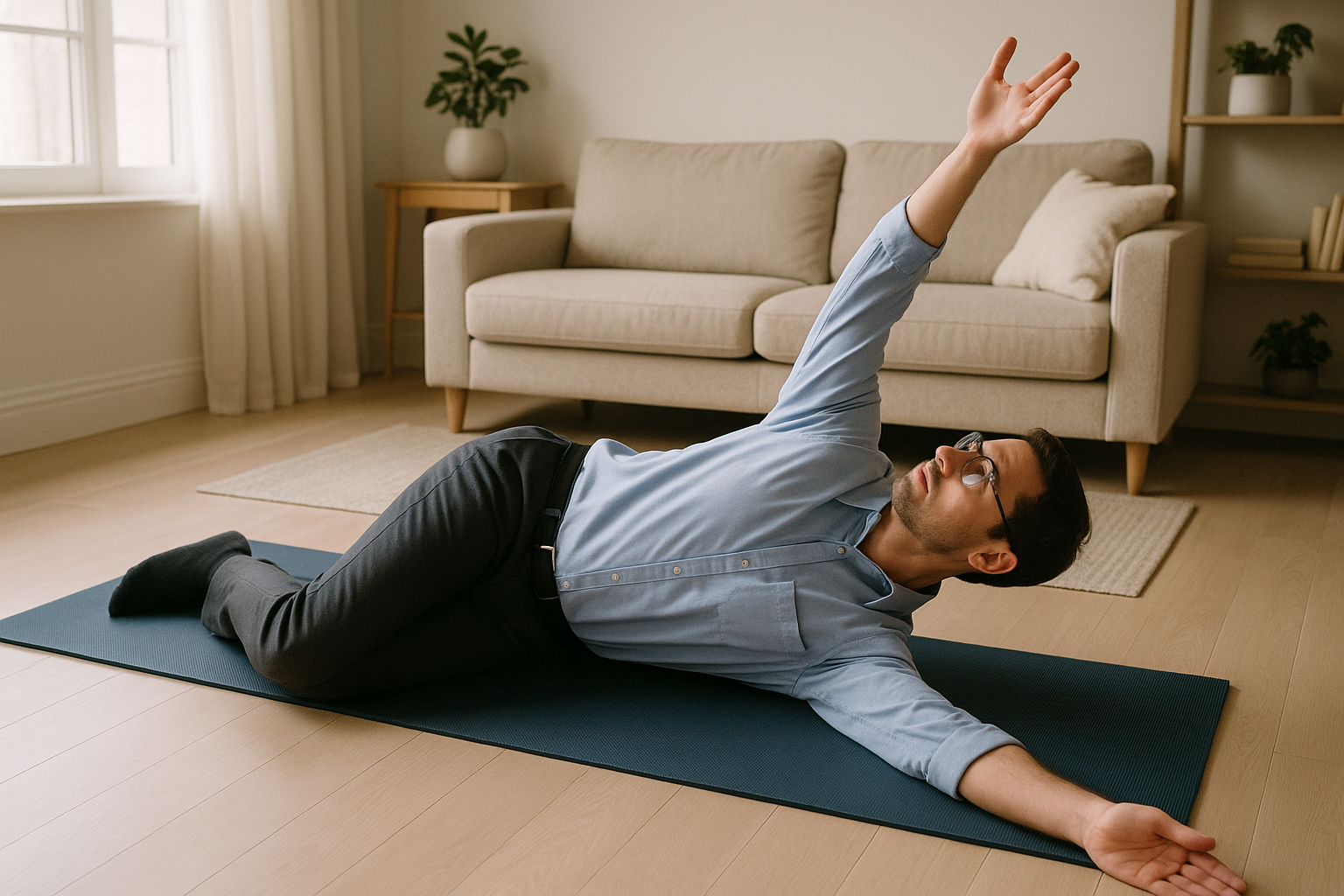
3. Side-Lying “Open Book” Rotations
Open books restore thoracic rotation—turning your mid-back without dragging the pelvis or neck. Improved rotation helps square your chest over your hips and reduces the “twist” many people carry from asymmetrical sitting or mousing. Imaging studies suggest average thoracic rotation around ~30° (with normal variation), so aim for smooth, pain-free motion rather than maximal range. In the short term, you should feel space across the chest; over weeks, your pushups, presses, and desk posture often feel more natural.
3.1 How to do it
- Lie on your side with hips/knees stacked at 90° (pillow between knees if needed).
- Arms straight in front at shoulder height; palms together.
- Inhale; sweep the top arm in a wide arc, letting eyes follow your hand; keep knees stacked.
- Exhale as your chest opens; stop before the top knee lifts.
- Return slowly; 6–10 reps/side, then 20–30 second relaxed hold in the open position.
3.2 Mini-checklist
- Knees stay stacked = motion from thoracic spine, not lumbar/pelvis.
- Eyes follow hand to relax neck; don’t force shoulder to floor.
- Smooth breath—3–4 second inhale, 4–6 second exhale.
Synthesis: Quality rotation in your thoracic spine makes upright sitting and reaching overhead easier by letting the rib cage and shoulder girdle share motion efficiently.
4. Quadruped “Thread the Needle” with Reach
This drill blends thoracic flexion, rotation, and scapular glide while your pelvis stays neutral. It’s great for people who feel tight between the shoulder blades or “locked” on one side. Starting on hands and knees, you’ll slide one arm under the other to rotate, then reach the same arm to the ceiling to re-center the chest over the sternum. Focus on expanding the back of the rib cage as you exhale; the breath helps mobilize rib-to-spine joints that are often stiff with long sitting.
4.1 How to do it
- Hands under shoulders, knees under hips; keep a long spine.
- Inhale; slide your right arm under the left (“thread”), palm up, letting the shoulder blade protract.
- Exhale; press the left hand, unwind, and reach the right hand up, eyes follow.
- Pause 2–3 breaths at end-range; repeat 6–10 reps/side.
4.2 Why it matters
- Thoracic segments move non-uniformly and respond to breath; combining rotation with controlled exhalation can free stiff rib articulations and improve overall trunk mechanics.
Synthesis: Thread-and-reach coordinates rotation with rib movement, easing mid-back tightness and helping the chest stack over the pelvis for better posture.
5. Wall Angels / Wall Slides (Scapular Posterior Tilt + Rib Control)
Many “posture” drills fail because they pin the shoulder blades back without restoring the scapula’s natural upward rotation and posterior tilt. Wall angels cue those exact motions when you manage your ribs. You’ll stand with hips, rib cage, and head lightly touching a wall, then slide your forearms up as if making a snow angel. As of 2024–2025, EMG work shows posterior tilt-focused exercises increase serratus anterior and lower trapezius activity—muscles you need for shoulder blade positioning that supports an upright thorax.
5.1 How to do it
- Stand with back to the wall; slight knee bend; pelvis neutral; ribs softly down.
- Elbows at ~90°, backs of hands/forearms on wall if comfortable.
- Inhale; as you exhale, slide arms upward, keeping forearms light on the wall and neck long.
- Stop before ribs flare or low back arches; lower slowly.
- 6–10 reps; finish with a 20–30 second hold at your highest clean position.
5.2 Common mistakes
- Forcing wrists flat and overcompensating with low-back arch.
- Using shrug muscles (upper traps) instead of letting shoulder blades glide and tilt.
- Flattening the rib cage so much you can’t breathe—aim for “stacked and easy,” not braced.
Synthesis: Wall angels teach the shoulder blades to tilt and rotate as the ribs stay organized—exactly the synergy upright posture requires.
6. Seated Segmental Cat–Cow (Thoracic Focus)
Classic cat–cow often turns into a lower-back sway. The seated, thoracic-focused variant isolates the mid-back while your pelvis stays planted. That makes it ideal during work breaks or travel. You’ll articulate the thoracic spine vertebra by vertebra—slight flexion to gentle extension—coordinated with slow breathing. Meta-analytic evidence indicates well-designed exercise programs can reduce thoracic kyphosis and rounded-shoulder angles; segmental control drills are a practical way to own those changes.
6.1 How to do it
- Sit tall at the front of a chair, feet grounded, hands across the chest.
- Inhale to expand the sides/back of your ribs; exhale and gently flex (sternum softens).
- Inhale to lengthen tall; on the exhale, extend through the upper back 5–10° without flaring ribs.
- Move one “segment” at a time, slow and smooth; 8–12 reps.
- Finish with two 20-second holds at the end of your clean extension range, breathing calmly.
6.2 Mini-checklist
- Pelvis stays stacked over sit bones.
- Neck follows the chest (no craning).
- Motion stays “small but precise.”
Synthesis: Seated segmental work builds awareness and control you can use at your desk—where posture truly lives day to day.
7. Half-Kneeling Windmill (Unloaded) for Rotation + Lateral Rib Expansion
The windmill teaches you to rotate through the thoracic spine while the pelvis remains stable. In half-kneeling, one hip flexes and the other extends, helping “lock” the lumbar spine so rotation happens up top. This drill also opens the lateral rib cage—useful for people who habitually breathe only into the front. In sports, trunk rotation and sequencing drive efficient upper-limb movement; restoring rotation centrally can offload the neck and shoulders at work and in training.
7.1 How to do it
- Half-kneel with left knee down, right foot forward; tall posture.
- Reach your right hand down the inside of the right thigh; left arm reaches to the ceiling.
- Inhale; as you exhale, hinge the hips slightly and rotate the chest to the left (toward the up arm).
- Keep eyes on the top hand; hold 2–3 breaths; return and repeat 6–8 reps/side.
7.2 Why it matters
- Thoracic rotation contributes a large share of trunk axial rotation and kinetic energy transfer; training it with pelvic control supports posture and upper-limb mechanics.
Synthesis: The windmill marries rotation, hinge, and breath—an efficient way to carry mobility into real-world lifting, reaching, and standing tasks.
8. Standing Band-Resisted Horizontal Rotation
Think of this as a “Pallof with motion.” You’ll rotate the rib cage across the pelvis against a light band, then control the return. It’s both mobility and motor control: you explore range while teaching the ribs and shoulder blades to track smoothly. Office workers with neck discomfort often lack this dissociation; band-resisted rotation restores it without heavy loading. As part of broader programs, thoracic mobility exercises have been linked with improvements in neck pain and cervical range of motion in deskbound populations.
8.1 How to do it
- Anchor a light band at chest height; stand side-on, feet shoulder-width, soft knees.
- Hold the band with both hands at sternum level; ribs stacked, pelvis neutral.
- Exhale as you rotate your chest away from the anchor; arms follow but elbows stay soft.
- Inhale to return with control; 8–12 reps/side for 2–3 sets.
8.2 Numbers & guardrails
- Choose resistance that allows smooth rotation without rib flare or low-back sway.
- Keep shoulder blades gliding—no shrugging.
- If you feel low-back strain, lighten the band and reduce range.
Synthesis: Light resistance plus clean rib-cage motion builds usable rotation you’ll notice when turning, sitting tall, or carrying loads. PMC
9. 90/90 Supine Breathing for Posterior Rib Expansion
Breath is a mobility tool. The rib cage expands and recoils with every breath, and targeted breathing helps mobilize the costovertebral joints that tie ribs to the thoracic spine. Posterior expansion—breathing “into the back”—is especially valuable for people who only feel air in the front of the chest. This drill uses a 90/90 hip position to quiet the lumbar spine so the rib cage can move. Over time, it often reduces upper-back tension and helps the head sit more naturally over the sternum.
9.1 How to do it
- Lie on your back, hips/knees at 90° on a chair/bench; feet flat on the surface.
- Lightly tuck pelvis so low ribs melt toward the floor.
- Hands on lower ribs; inhale “back and wide” for 3–4 seconds; exhale fully (6–8 seconds) feeling ribs drop.
- 5–8 slow breaths; rest; complete 3–4 rounds.
9.2 Why it matters
- The sternum and ribs move harmoniously during breathing and significantly influence thoracic mechanics; improving posterior expansion can ease stiffness and support posture with less muscular bracing.
Synthesis: Targeted breathing mobilizes the rib-spine system from the inside out—lower effort, higher payoff for sustainable posture.
10. Prone “Swimmers” (Y-T-W Raises) with Gentle Thoracic Lift
Finish by coordinating mobility with scapular control. In prone swimmers, you lift the chest slightly as you sweep the arms through Y, T, and W positions—teaching the shoulder blades to upwardly rotate and posteriorly tilt while the thoracic spine extends just enough to support them. The key is smooth scapular motion driven by serratus anterior and lower trapezius, not a big lumbar arch. Over weeks, this helps your shoulder blades “live” on your rib cage, supporting an upright torso without pinching.
10.1 How to do it
- Lie face down, forehead on a towel, glutes relaxed, ribs softly down.
- Inhale; lift your chest 1–2 cm (not a big backbend).
- Sweep arms overhead to a Y; exhale and lower; repeat in T and W positions.
- 6–8 reps/position; rest and complete 2–3 rounds.
10.2 Common mistakes
- Lifting the chest too high (lumbar hinge).
- Shrugging shoulders instead of gliding the scapulae.
- Rushing the sweep—tempo should match calm breathing.
Synthesis: Swimmers cement the link between thoracic extension and scapular mechanics so your posture feels “held up” by motion—not forced by tension.
FAQs
1) How often should I do thoracic mobility drills?
Most people benefit from brief daily work (5–10 minutes) for 2–4 weeks, then 3–5 days/week to maintain. For stretches, guidelines suggest holding 10–30 seconds (up to 60 seconds for older adults), repeating until ~60 seconds total per area. You’ll typically notice posture feels “lighter” within days, with clearer changes in 4–8 weeks when paired with smart strength and ergonomics.
2) Will these drills fix a hunched back (hyperkyphosis)?
They can help. Research shows exercise programs can reduce forward head, rounded-shoulder, and thoracic kyphosis angles, and thoracic mobilization over eight weeks improved forward shoulder posture in people with hyperkyphosis. That said, structural curves, bone quality, and habits matter—combine drills with strength work and workstation tweaks for best results.
3) Are mobility drills better than manual therapy?
They complement each other. Manual therapy can create short-term change, while active drills teach your rib cage and shoulder blades to move and stay mobile during life and training. Reviews suggest both can improve postural measures in the short to medium term; lasting change usually requires active practice. ScienceDirecte-jer.org
4) Which drills should I pick if I only have 5 minutes?
Choose one extension drill (Foam Roller Extensions or Bench Prayer), one rotation drill (Open Books or Thread the Needle), and one scapula or breathing drill (Wall Angels or 90/90 Breathing). Do 6–10 reps each, plus one 20–30 second hold where you feel most stiff. Over time, rotate through all 10 to keep gains.
5) Can poor thoracic posture really affect shoulder motion?
Yes—erect posture immediately increases shoulder range compared with slouched posture, and thoracic spine mobility is closely linked with upper-limb mechanics. That doesn’t mean posture alone causes shoulder pain, but it’s a meaningful performance and comfort factor for many people.
6) What if I feel tingling, sharp pain, or dizziness?
Stop the drill, note the position that triggered symptoms, and consult a qualified clinician—especially if symptoms persist or you have a history of osteoporosis, rib injuries, or spinal conditions. Mobility work should feel like gentle stretch/pressure, not nerve-like zaps or breathlessness.
7) Do I need equipment?
A foam roller and a light resistance band cover most drills. A chair/bench and a dowel or broomstick are useful but optional. If space is limited (e.g., small apartments or office), prioritize seated segmental work, wall angels, and 90/90 breathing—quiet, compact, and effective.
8) Can I overdo thoracic mobility?
Yes—if you push into end ranges with force or substitute lumbar extension for thoracic extension, you can irritate joints or strain muscles. Keep ranges modest, move slowly with breath, and progress volume over weeks. Research and guidelines favor frequent, low-to-moderate intensity work for flexibility and control.
9) How long until I notice posture changes?
Many people feel a difference within the first week (less mid-back tension, easier breathing). Visible changes depend on consistency, desk habits, and strength balance; expect 4–8 weeks for noticeable, sustainable improvements when combining mobility, scapular strengthening, and ergonomic tweaks.
10) I lift overhead—will these help?
Likely. Thoracic extension/rotation and coordinated scapular motion are foundations for safe overhead work. Better mobility reduces the need to compensate with a low-back arch or shoulder shrug, supporting performance and comfort during presses and carries.
11) Is breathing work really necessary?
Yes. The ribs and thoracic spine move continuously with respiration; improving posterior and lateral rib expansion is a low-effort way to mobilize the mid-back and reduce bracing. It complements stretching and control drills and can be done anywhere.
12) What if my shoulders wing or feel unstable?
Add control drills that emphasize serratus anterior and lower trapezius (e.g., wall slides/angels, prone swimmers), and keep ranges pain-free. These muscles support scapular upward rotation and posterior tilt, both key for posture. If winging persists, consult a clinician to rule out nerve causes. Physiopedia
Conclusion
Better posture isn’t a pose—it’s a by-product of how well your rib cage, thoracic spine, and shoulder blades share movement. The 10 drills above give you the essentials: small, precise thoracic extensions; smooth rotation dissociated from the pelvis; and scapular mechanics tied to calm, expansive breathing. Use short daily sessions to build momentum (5–10 minutes), then maintain with 3–5 days per week as your work and training allow. Over time, expect your chest to sit higher, your head to stack more easily over your sternum, and everyday reaching or lifting to feel less effortful and more natural. Pair these drills with strength work for the upper back and hips, ergonomic tweaks at your workstation, and frequent micro-breaks during long sitting. Your posture will start taking care of itself.
Ready to begin? Do two drills now—one extension, one rotation—and breathe slowly for five rounds in each.
References
- Heneghan NR, et al. Clinical reasoning framework for thoracic spine exercise prescription in sport: a systematic review and narrative synthesis. BMJ Open Sport & Exercise Medicine, 2020. PMC
- Barrett E, et al. Is thoracic spine posture associated with shoulder pain, range of motion and function? A systematic review. Manual Therapy, 2016. PubMed
- Park SJ, et al. Effects of thoracic mobilization and extension exercise on thoracic alignment and shoulder function in patients with subacromial impingement syndrome: A randomized controlled pilot study. Healthcare (Basel), 2020. PMC
- Jung SH, et al. Effect of improved thoracic kyphosis on forward shoulder posture via thoracic mobilization: An 8-week study. Clinical Biomechanics, 2022. (PDF: ) ScienceDirectclinbiomech.com
- Ichikawa K, et al. Assessing validity of thoracic spine rotation range of motion with MRI. PLOS ONE, 2024. PMC
- Burgos J, et al. Non-uniform segmental range of motion of the thoracic spine and rib mechanics during breathing. Journal of Clinical Medicine, 2021. PMC
- Gu Q, et al. Effect of scapular posterior tilting exercise on lower trapezius and serratus anterior EMG activity under unstable surfaces. Healthcare, 2024. PMC
- Paine R, Voight ML. The role of the scapula in shoulder function. International Journal of Sports Physical Therapy, 2013. PMC
- ACSM. Stretching and flexibility guidelines update. American College of Sports Medicine, March 18, 2021. RebrandX
- American Heart Association News. How much and how often should people stretch? AHA News, Aug 7, 2024. www.heart.org
- Sepehri S, et al. The effect of various therapeutic exercises on forward head posture, rounded shoulders, and thoracic kyphosis: A meta-analysis. BMC Musculoskeletal Disorders, 2024. PMC
- Esteban-González P, et al. Thoracic spine extension range of motion in young, asymptomatic subjects: A systematic review and meta-analysis. Healthcare, 2022. PMC