


























A well-planned plant-based plate can be simple, satisfying, and complete. This guide shows you exactly how to balance protein, carbs, fats, and the key micronutrients people worry about—iron, calcium, B12, iodine, and omega-3s—without overthinking it. You’ll get a practical plate template, specific numbers and guardrails, and smart prep tactics that work for busy weekdays and diverse cuisines. Quick note: this article is general education, not medical advice; check with a clinician or registered dietitian for personal needs. In a sentence, plant-based meal planning means structuring meals around legumes, whole grains, vegetables, fruits, nuts, and seeds to consistently meet energy and nutrient targets. Use the steps below to turn that definition into everyday meals that deliver.
Fast start (how-to, at a glance): choose a plate ratio, anchor a protein (20–40 g per meal for most active adults), add a whole-grain/starchy base, pile on color from non-starchy veg, layer healthy fats and vitamin C-rich produce, season with iodized salt, and plan leftovers.
1. Use the Plant Plate: ½ vegetables, ¼ whole grains/starches, ¼ protein
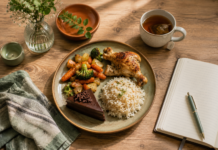
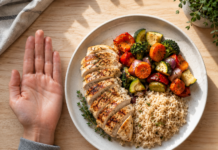
A reliable, visual template is the easiest way to keep meals balanced. Start with half a plate of non-starchy vegetables for fiber, volume, and micronutrients. Fill a quarter with whole grains or starchy vegetables for steady energy and key minerals. Reserve the final quarter for protein-rich plants—legumes, tofu/tempeh, seitan, or soy yogurt. This ½–¼–¼ framework prevents “carb-plus-veg” meals that underdeliver on protein while also keeping portions of refined carbs in check. It’s flexible across cuisines (e.g., dal + roti + kachumber; tofu stir-fry + brown rice; hummus bowl + bulgur + salad) and adapts to goals like weight management or training by adjusting the grain/protein quarters. For fast decisions, think: build the quarters, then accessorize with healthy fats, vitamin C fruits/veg, herbs, and spices. Harvard’s Healthy Eating Plate supports this approach, emphasizing whole grains, healthy proteins, and plenty of vegetables.
1.1 Why it matters
- Visual cues simplify portions and reduce decision fatigue.
- The mix naturally improves fiber (25–38 g/day target) and lowers sodium and added sugar when meals are cooked at home.
1.2 How to do it (mini-checklist)
- ½ plate: non-starchy veg (kale, peppers, okra, cabbage, carrots, tomatoes).
- ¼ plate: whole grains/starches (brown rice, quinoa, whole-wheat roti, oats, potatoes).
- ¼ plate: protein (1–1½ cups cooked beans/lentils, 150–200 g tofu/tempeh, or seitan).
- Add healthy fats (nuts, seeds, avocado, olive or canola oil) and vitamin C (citrus, tomatoes).
Synthesis: Start with the visual plate and you’ll automatically cover most macros; the remaining strategies fine-tune micronutrients and performance.
2. Hit Your Protein Target—Consistently and Evenly
Most adults can meet protein needs on plants by aiming for a daily baseline of 0.8 g/kg body weight (e.g., ~56 g at 70 kg). Distribute protein across meals to support muscle maintenance and appetite control. If you train regularly, research suggests 1.4–2.0 g/kg/day suits most exercising individuals, with ~0.25 g/kg (20–40 g) per eating occasion to maximize muscle protein synthesis (MPS). Soy foods (tofu, tempeh, edamame), seitan, lentils, chickpeas, and higher-protein grains (quinoa, buckwheat) are your workhorses; mix them over the day rather than “combining” at one sitting—protein complementing within the same meal isn’t necessary when total intake and variety are adequate.
2.1 Numbers & guardrails
- General adult: 0.8 g/kg/day.
- Active/athletic: 1.4–2.0 g/kg/day; per-meal ~0.25 g/kg (20–40 g).
- Per meal ideas (~25–35 g): 200 g extra-firm tofu + ½ cup edamame; 1½ cups cooked lentils; 1 cup Greek-style soy yogurt + seed mix; 120 g seitan + bean salad.
2.2 Common myths (and fixes)
- Myth: You must combine specific plant proteins in one meal.
Reality: Variety across the day covers all essential amino acids. - Myth: Beans aren’t “complete.”
Reality: Adequate total protein + varied sources is what counts.
Synthesis: Pick a protein anchor at each meal and you’ll rarely miss the daily target or feel hungry an hour later.
3. Make Iron and Zinc Work for You (Boost Absorption, Not Just Intake)
Plants have plenty of iron and zinc, but forms and absorption vary. Non-heme iron is less bioavailable than heme iron; vegetarians often aim for ~1.8× the iron RDA to compensate (e.g., adult women 19–50 may target ~32 mg instead of 18 mg). Practical tweaks boost absorption: pair iron-rich foods with vitamin C (citrus, tomatoes, capsicum), and avoid coffee/tea with meals, as tannins inhibit iron uptake. Soaking, sprouting, fermenting, and using sourdough can reduce phytates that hinder both iron and zinc absorption. Focus on legumes, soy, pumpkin seeds, tahini, fortified cereals, and whole grains; schedule calcium-rich foods away from your highest-iron meals if ferritin is low.
3.1 How to do it
- Pairings that work: chana masala + tomato & lemon salad; lentil soup + orange; tofu bhurji + bell peppers.
- Timing tips: take tea/coffee ≥1 hour away from iron-focused meals.
- Kitchen techniques: soak beans; sprout mung; use sourdough; try tempeh.
3.2 Numbers & guardrails
- Iron RDAs (non-vegetarian baseline): men 8 mg; women 19–50 y 18 mg; pregnancy 27 mg; vegetarians consider ×1.8 target.
- Zinc RDAs: men 11 mg, women 8 mg; absorption improves with leavened whole grains, sprouting, and adding vitamin C-rich produce. Office of Dietary Supplements
Synthesis: Don’t just add more lentils; engineer the context—vitamin C, smart timing, and phytate-reducing techniques move your lab numbers.
4. Nail Calcium and Vitamin D—Even Without Dairy
You can meet calcium needs from fortified plant milks, tofu set with calcium sulfate, low-oxalate greens (kale, bok choy), beans, almonds, and tahini. Note that spinach and chard are high in oxalates, so their calcium is poorly absorbed; lean on lower-oxalate greens more often. Most adults need ~1,000 mg calcium/day (women 51+ and men 71+ need 1,200 mg). Vitamin D aids calcium absorption; adults typically need 600–800 IU (15–20 mcg) vitamin D/day, via safe sun, fortified foods, or supplements—particularly in low-sun seasons or for people with limited outdoor exposure. As of August 2025, these values remain current across major guidelines.
4.1 Numbers & guardrails
- Calcium: Adults 19–50 y: 1,000 mg/day; Women 51+ & Men 71+: 1,200 mg/day.
- Vitamin D: Adults 19–70 y: 600 IU/day; 71+: 800 IU/day.
4.2 Mini-plan (example day ≈1,100 mg calcium)
- 1 cup calcium-fortified soy milk (300 mg)
- 150 g calcium-set tofu (250–350 mg)
- 2 cups cooked kale/bok choy (180–250 mg)
- 2 tbsp tahini (120 mg) + ¼ cup almonds (90 mg)
- Whole-grain roti + bean curry (rest)
Synthesis: Choose low-oxalate greens and fortified staples, and give vitamin D the same priority as calcium to make the math work.
5. Cover Omega-3s the Plant-Smart Way (ALA Daily, Consider Algae EPA/DHA)
Plant-based eaters should first hit the ALA target—about 1.1 g/day (women) and 1.6 g/day (men)—from flax/chia (1 tbsp ground flax ≈ 1.6–1.8 g ALA), walnuts, or canola oil. Human conversion of ALA to EPA/DHA is limited, so many people add an algae-based EPA/DHA supplement; major authorities cite ~250 mg/day EPA+DHA as a cardiovascularly relevant intake for adults (not a formal U.S. RDA). If you’re pregnant or lactating, DHA needs are higher—speak with your clinician. Practical move: 1–2 tbsp ground flax or chia daily + a 250–500 mg algae DHA/EPA supplement if you don’t eat fish.
5.1 Tools & examples
- ALA habits: smoothie with 1 tbsp flax; oatmeal + walnuts; salad with canola or walnut oil.
- Label check: look for “DHA/EPA from algae” and a combined 250–500 mg dose.
5.2 Common mistakes
- Skipping daily ALA “baseline.”
- Assuming seaweed alone covers EPA/DHA (iodine yes; EPA/DHA varies).
- Forgetting that conversions are modest, so consistent intake matters. FAOHome
Synthesis: Hit ALA every day and consider algae EPA/DHA to cover the small conversion gap without changing your dietary pattern.
6. Lock In B12 and Iodine—Your Two Non-Negotiables
Vitamin B12 is essential for nerves and blood; adults need ~2.4 mcg/day. Because reliable plant sources are limited, use fortified foods and/or a supplement. Practical options many vegan groups endorse: ≥10 mcg/day or ~2,000 mcg/week, cyanocobalamin preferred unless instructed otherwise. For iodine, adults need ~150 mcg/day; iodized salt is the simplest route. Just ¼ tsp iodized salt provides ≈78 mcg iodine, but keep total sodium <2,000 mg/day per WHO. Seaweed iodine varies dramatically—some products contain 16–2,984 mcg/g, so use nori in modest amounts and avoid kelp supplements unless advised. In South Asia and other regions, check that your household salt is iodized on the label.
6.1 Mini-checklist
- Choose fortified plant milks/cereals with B12.
- Take a B12 supplement (daily or weekly dosing as above).
- Use iodized (not specialty non-iodized) salt when cooking; still watch sodium.
6.2 Region note
- Packaging and fortification laws vary; in warm, humid climates, potassium iodate is often recommended for salt iodization due to better stability.
Synthesis: Treat B12 and iodine like seatbelts—simple, routine, and essential.
7. Optimize Carbs and Fiber for Steady Energy (and a Happy Gut)
Carbohydrates power training and daily activity, but quality and context matter. Target 25–38 g of fiber/day (lower after age 50), favoring whole grains, beans, fruit, and non-starchy vegetables. Pair carbs with protein and healthy fats to moderate glycemic swings and improve satiety. Batch-cook whole grains and roasted root veg for fast assembly bowls, and keep fruit visible for easy snacking. If your gut is sensitive, increase fiber gradually and diversify types (soluble from oats/legumes; insoluble from whole grains/veg). The goal isn’t low-carb; it’s smart-carb—enough for your goals, anchored to plate balance and protein distribution. Harvard Health
7.1 Steps to steady energy
- Build bowls with whole grains + beans + veg + protein.
- Add nuts/seeds (tahini, almonds) for fat and minerals.
- Snack on fruit + soy yogurt or a small tofu wrap between meals.
7.2 Example day (~35–40 g fiber)
- Breakfast: oatmeal + chia + berries.
- Lunch: quinoa-chickpea bowl with kale and tahini.
- Dinner: red lentil curry + brown rice + salad.
- Snack: apple + peanut butter. The Nutrition Source
Synthesis: Prioritize whole-food carbs and fiber diversity; your energy and microbiome will thank you.
8. Plan, Prep, and Budget Like a Pro (So It Actually Happens)
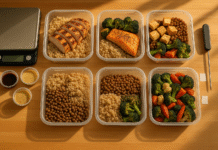
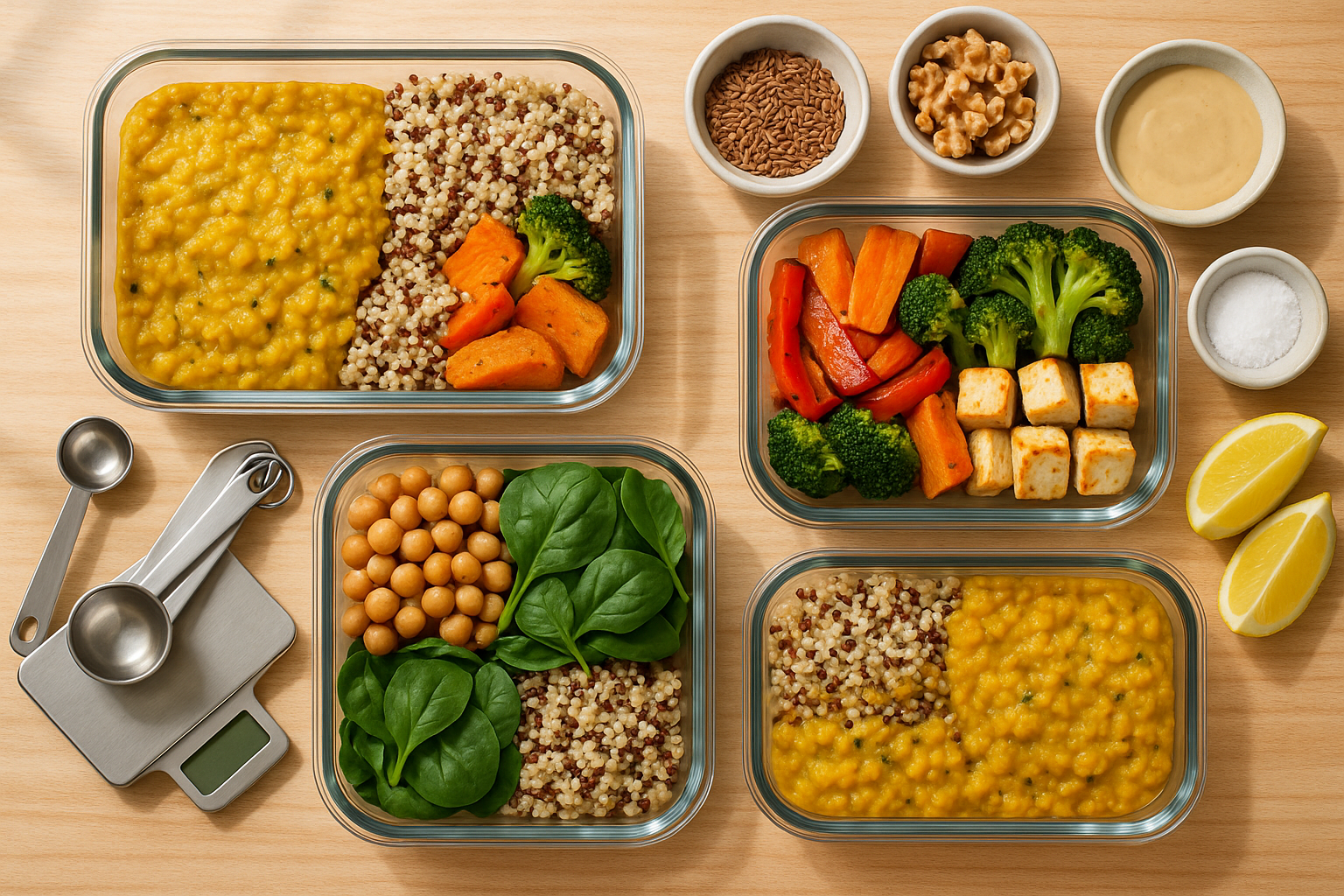
Consistency beats perfection. Stock a “core pantry” (lentils, chickpeas, beans, whole grains, canned tomatoes, spices), pick 2 proteins + 2 grains each week to batch-cook, and pre-portion sauces (tahini-lemon, peanut-ginger) to make simple veg taste exciting. Build a two-day loop: cook once, assemble twice (e.g., Sunday dal becomes Monday dal-bowl and Tuesday stuffed roti). Scan plant milks and cereals for fortification (calcium, B12, vitamin D), read sodium on canned goods, and keep lemons, limes, or tomatoes handy to amplify vitamin C at iron-rich meals. Use an app like Cronometer to spot micronutrient gaps and adjust. Dining out? Choose bowls and wraps you can tweak: add beans/tofu, extra veg, whole-grain base, and ask for iodized-salt seasonings where available.
8.1 Mini-checklist
- Batch: 1 legume + 1 tofu/tempeh; 1 grain + 1 starchy veg.
- Fortify: choose B12/calcium-fortified staples.
- Season: iodized salt + citrus/herbs; keep sodium <2,000 mg/day.
- Track (periodically): verify iron, calcium, B12, iodine, omega-3.
8.2 Regional swaps (South Asian–friendly)
- Protein anchors: chana, rajma, moong/massor dal, tofu bhurji.
- Whole-grain base: atta roti, brown basmati, millets (jowar, bajra).
- Vitamin C sides: kachumber, lemon-dressed cabbage, guava.
Synthesis: Systematize shopping and prep, and your nutrient balance becomes automatic—even on your busiest weeks.
FAQs
1) Do I need to combine plant proteins in the same meal to make them “complete”?
No. When calories and total protein are adequate and you eat a variety of plant proteins across the day, you’ll cover all essential amino acids. The Academy of Nutrition and Dietetics confirms well-planned vegetarian and vegan diets are nutritionally adequate. PMC
2) How much protein should I target if I exercise?
Most active people do well at 1.4–2.0 g/kg/day, split into ~0.25 g/kg (20–40 g) per meal/snack to support muscle protein synthesis, recovery, and satiety. Adjust upward during energy deficits; speak with a sports dietitian for cutting phases. PubMed
3) What are the best plant iron strategies if my ferritin runs low?
Increase iron-rich foods (lentils, beans, tofu, fortified cereals) and pair with vitamin C (citrus, tomatoes, peppers). Keep tea/coffee away from iron-focused meals and use soaking/sprouting to cut phytate. Vegetarians often aim for ~1.8× RDA. Follow up with your clinician.
4) How do I get enough calcium without dairy?
Rely on fortified plant milks, calcium-set tofu, low-oxalate greens (kale, bok choy), beans, almonds, and tahini. Remember that spinach’s calcium is poorly absorbed due to oxalates. Adults need ~1,000 mg/day (higher for some ages).
5) Do vegans need a B12 supplement? Which dose?
Yes—B12 is a must. Many groups suggest fortified foods or a supplement providing ≥10 mcg/day or ~2,000 mcg/week of cyanocobalamin. Adults need ~2.4 mcg/day; supplements ensure reliability. The Vegan Society
6) What about iodine—can’t I just eat seaweed?
Seaweed iodine varies widely (from ~16 to ~2,984 mcg/g). The safer baseline is iodized salt (check the label). ¼ tsp iodized salt supplies ≈78 mcg iodine; keep sodium under 2,000 mg/day.
7) How do I cover omega-3s without fish?
Hit ALA daily (flax, chia, walnuts, canola oil) and consider an algae-based EPA/DHA supplement around 250 mg/day (or as advised), given limited ALA conversion. Office of Dietary Supplements
8) Is soy safe, and how much can I eat?
For most people, traditional soy foods (tofu, tempeh, edamame) are safe and nutritious protein sources. Focus on minimally processed forms and vary your proteins (legumes, grains, nuts/seeds). If you have thyroid issues or iodine deficiency risk, ensure adequate iodine intake and speak with your clinician.
9) How can I keep sodium low while using iodized salt?
Season primarily with herbs, spices, citrus, and vinegars, and salt in the pot, not at the table. Use iodized salt modestly and avoid ultra-processed foods, aiming for <2,000 mg sodium/day (≈5 g salt).
10) Do I need to track nutrients every day?
No. Periodic spot-checks (e.g., a week each quarter) with a nutrient tracker help you catch gaps in B12, iodine, calcium, and omega-3s. If labs or symptoms suggest an issue, follow up with a registered dietitian or clinician.
Conclusion
Balanced plant-based eating is less about chasing superfoods and more about repeatable systems: a visual plate template, a protein anchor every meal, smart iron/zinc pairings, consistent ALA with optional algae EPA/DHA, and routine B12 + iodine. Layer in fortified staples and low-oxalate greens for calcium and back it with vitamin D. When you batch-cook proteins and grains, lean on seasonal produce, and read labels for fortification and sodium, nutrient balance stops being a guessing game and becomes a weekly habit. Start with one or two changes—say, a tofu + lentil double batch and a switch to iodized salt—and build from there. Ready to try it? Plan this week’s two protein anchors, pick your grains, and set your pantry—then eat on autopilot.
References
- Vitamin B12 – Health Professional Fact Sheet, NIH Office of Dietary Supplements, July 2, 2025. https://ods.od.nih.gov/factsheets/VitaminB12-HealthProfessional/
- Omega-3 Fatty Acids – Health Professional Fact Sheet, NIH Office of Dietary Supplements, accessed Aug 2025. https://ods.od.nih.gov/factsheets/Omega3FattyAcids-HealthProfessional/
- Calcium — The Nutrition Source, Harvard T.H. Chan School of Public Health, updated 2025. https://nutritionsource.hsph.harvard.edu/calcium/
- Calcium-Rich Foods: How to Boost Your Intake, Harvard Health Publishing, Feb 4, 2025. https://www.health.harvard.edu/nutrition/calcium-rich-foods-how-to-boost-your-intake-of-this-important-mineral
- Iron – Health Professional Fact Sheet (note on 1.8× for vegetarians), NIH Office of Dietary Supplements, Oct 9, 2024. https://ods.od.nih.gov/factsheets/Iron-HealthProfessional/
- Are Anti-Nutrients Harmful?, Harvard T.H. Chan School of Public Health, accessed Aug 2025. https://nutritionsource.hsph.harvard.edu/anti-nutrients/
- Healthy Eating Plate (PDF), Harvard T.H. Chan School of Public Health, 2011 (current graphic resource). https://nutritionsource.hsph.harvard.edu/wp-content/uploads/2012/10/healthy-eating-plate.pdf
- Vitamin D – Health Professional/Consumer Fact Sheets, NIH Office of Dietary Supplements, June 27, 2025 / Nov 8, 2022. https://ods.od.nih.gov/factsheets/VitaminD-HealthProfessional/ and https://ods.od.nih.gov/factsheets/VitaminD-Consumer/
- Calcium – Consumer Fact Sheet, NIH Office of Dietary Supplements, Sept 14, 2023. https://ods.od.nih.gov/factsheets/Calcium-Consumer/
- Omega-3 Intakes/Guidance (EPA+DHA ≈250 mg/day), EFSA & related summaries (2012–2021). https://www.efsa.europa.eu/en/efsajournal/pub/2815 and https://pmc.ncbi.nlm.nih.gov/articles/PMC8007408/
- Sodium Reduction, World Health Organization, Feb 7, 2025. https://www.who.int/news-room/fact-sheets/detail/sodium-reduction
- Position of the Academy of Nutrition and Dietetics: Vegetarian Diets, Journal of the Academy of Nutrition and Dietetics, 2016. https://pubmed.ncbi.nlm.nih.gov/27886704/
- International Society of Sports Nutrition Position Stand: Protein and Exercise, JISSN, 2017. https://jissn.biomedcentral.com/articles/10.1186/s12970-017-0177-8
- Appendix J: Dietary Reference Intakes Summary Tables, National Academies (Protein RDA, Fiber chapter ref), accessed Aug 2025. https://nap.nationalacademies.org/read/25353/chapter/28
- Fiber – Dietary Reference Intakes (chapter), Institute of Medicine, 2005. https://nap.nationalacademies.org/read/10490/chapter/9
- Iodine – Health Professional Fact Sheet (iodine in iodized salt; seaweed variability), NIH Office of Dietary Supplements, 2024. https://ods.od.nih.gov/factsheets/Iodine-HealthProfessional/
- What Every Vegan Should Know About Vitamin B12, The Vegan Society, accessed Aug 2025. https://www.vegansociety.com/resources/nutrition-and-health/nutrients/vitamin-b12/what-every-vegan-should-know-about-vitamin-b12