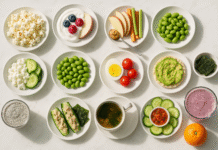











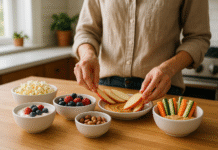














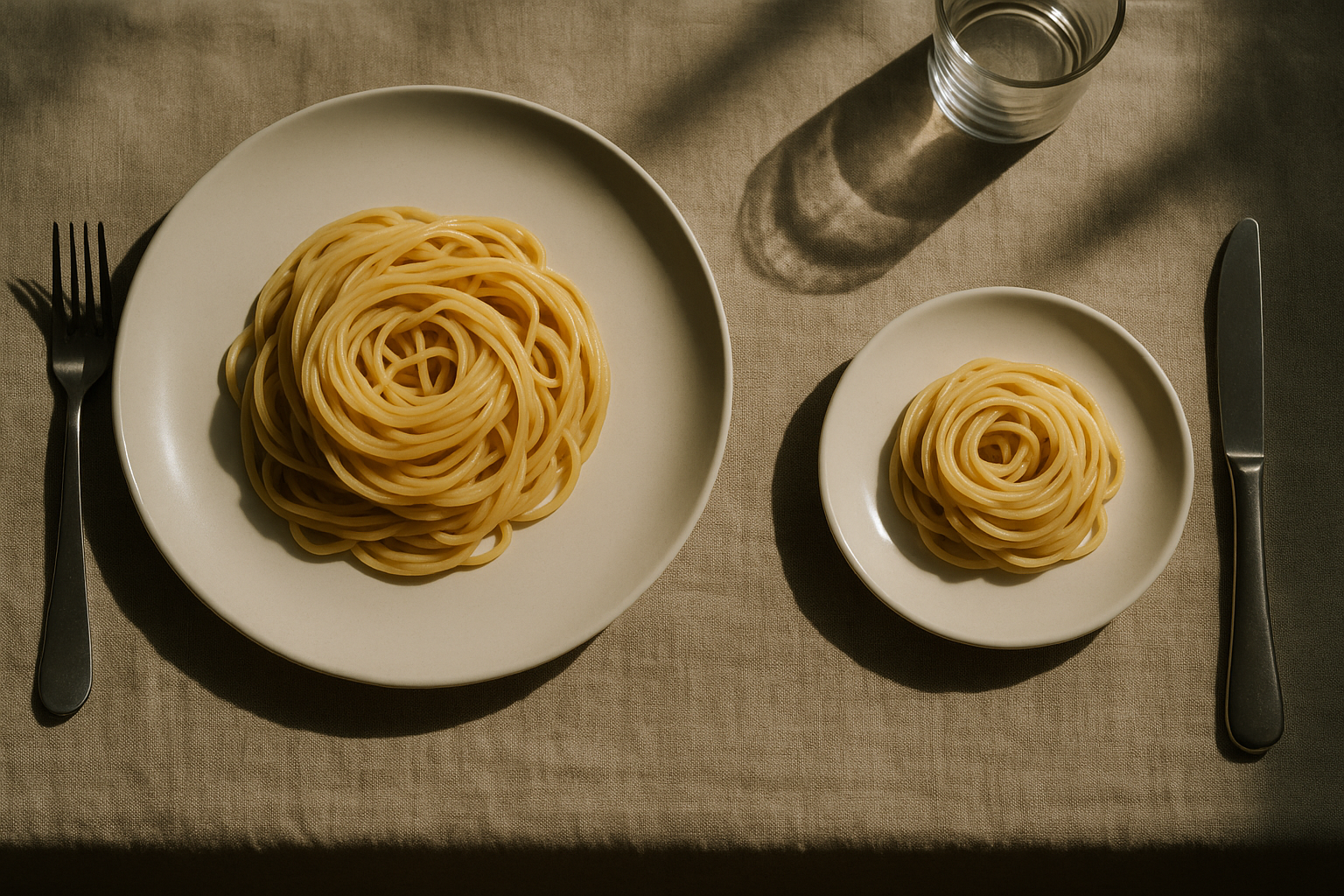
Why do bigger plates so often mean bigger meals? The short answer: our brains rely on visual cues, social norms, and “good enough” heuristics to decide how much looks appropriate—and larger tableware shifts those cues upward. In everyday settings, people served larger portions reliably eat more, often without feeling fuller. This article explains the psychology of portion sizes through nine evidence-backed insights and gives practical steps to outsmart those cues at home, work, and restaurants. This is general educational information and not a substitute for personalized medical or dietary advice.
In one line: Bigger plates change what looks “normal,” nudging you to serve—and finish—more than you need.
1. The Portion Size Effect: When You’re Served More, You Eat More
The core finding is simple: increasing the amount of food served leads most people to consume more at that meal and across the day, with only partial compensation later. Laboratory and free-living trials show that when portions are upsized, daily energy intake rises and stays elevated over several days to weeks. Meta-analytic evidence indicates that reducing served portion sizes lowers daily calories, and the effect scales with how many meals you downsize and by how much. This means that plate size is influential largely because it increases the portions people put on those plates.
1.1 Numbers & guardrails
- In adults, a 25% reduction in portion size decreased daily intake by about 231 kcal/day over two days; combining smaller portions with lower energy density roughly doubled the calorie reduction.
- Across studies (1 day to 6 months), smaller portions consistently reduced daily intake; downsizing at most meals had the largest impact.
- Effects are curvilinear: cutting an already “normal” portion can yield larger percentage reductions than trimming an oversized one to “normal.”
1.2 Mini example
If a cafeteria trims entrées by 20% at lunch and dinner (about 150–200 kcal each), typical patrons could end up 300–400 kcal/day lower without reporting more hunger—findings echoed in short-term trials.
Takeaway: Target the portion, not just the plate. Plate size matters because it shapes how much you serve to begin with.
2. Visual Illusions: How the Delboeuf Illusion Makes Portions Look Smaller on Big Plates
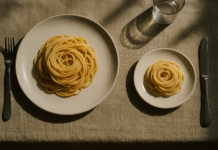
A larger plate makes the same amount of food appear smaller—an instance of the Delboeuf illusion, where a circle looks smaller when surrounded by a larger ring. In dining, that translates to over-serving on big plates and under-serving on small ones. Experiments in consumer research and perception labs show that plate size and color contrast can shift how large a portion appears and how much people self-serve. However, when the portion served is held constant, plate size by itself often does not change how much people eat, underscoring that the illusion mainly acts through self-served amounts. FoodNavigator-USA.com
2.1 Why it matters
- Appearance → serving: On larger plates, a standard scoop looks meager, inviting a “top-up.”
- Contrast counts: Low contrast between food and plate (e.g., white pasta on white plate) increases self-served amounts; higher contrast can reduce them.
2.2 What the evidence says
- Systematic reviews/meta-analyses are mixed on plate size → intake; effects are more consistent for plate size → self-served portion and when plate size is confounded with portion size. Recent trials again find no direct intake effect when breakfast portions were fixed. Deakin UniversityScienceDirect
2.3 Mini checklist
- Use 9–10 inch plates for everyday meals.
- Increase food–plate contrast (e.g., leafy greens on light plates, grains on darker plates).
- Serve once onto the plate from the kitchen, not at the table.
Synthesis: Plate illusions change what looks “enough.” They’re strongest when you’re deciding how much to plate in the first place.
3. Unit Bias: “One of These” Feels Like the Right Amount
People intuitively treat one unit—a plate, bowl, package, or spoonful—as a “correct” serving. When the unit is bigger, intake rises even if you’re free to choose how much to eat. Classic studies show that larger units (e.g., bigger serving spoons or packages) lead to greater consumption; smaller units (like 100-kcal packs) can reduce intake, though not universally and not for everyone. This unit heuristic helps explain why “supersized” packaging and dishware can stealthily raise daily calories. SAGE Journals
3.1 Tools/Examples
- Spoon size: People took more M&Ms with a larger spoon even with no limit on spoonfuls—unit bias did the work.
- 100-kcal packs: Switching standard snack bags to 100-kcal mini-packs reduced weekly snack grams in a crossover study, although the effect waned with time and order effects mattered.
3.2 Mini checklist
- Pre-portion snacks into smaller units (bags, ramekins).
- Use smaller serving utensils at buffets.
- At restaurants, box half before you start eating.
Synthesis: Your brain often eats by the unit, not by hunger. Shrink the unit and you shrink the meal.
4. Portion Distortion & Renormalization: Big Today Becomes “Normal” Tomorrow
Repeated exposure to large portions shifts your internal sense of a “normal” amount—portion distortion. Over time, larger helpings start to look appropriate for a single eating occasion, and people may adjust future choices upward. Conversely, being served smaller portions can recalibrate norms and reduce later intake of that food. This norm-shifting dynamic is why food environments packed with oversized servings can make restraint harder at the next meal or the next week. PMCSemantic Scholar
4.1 Numbers & guardrails
- Serving smaller portions today changed perceived norms and reduced intake of the same food the next day in experimental work.
- Among children and adults, larger portions are robustly linked to higher energy intake, suggesting a population-level driver of weight gain if sustained.
4.2 Practical steps
- Rotate in smaller defaults at home for a few weeks to set a new “normal.”
- Use visual anchors (e.g., ½ plate vegetables) to override distorted norms.
- Beware “value for money” framing—cheap large portions still shift your baseline. BioMed Central
Synthesis: What looks normal is malleable. Repeated smaller servings can reset your visual and social anchors. MDPI
5. Defaults, Labels & Anchors: “Regular” Isn’t Always Regular
Words like “small,” “regular,” and “large” act as anchors, steering how much seems appropriate. If the largest option is called “regular,” people pick—and drink—more. Experiments show that serving-size labels can either amplify or dampen the portion-size effect, and that the portion presented acts as an anchor from which people insufficiently adjust. Well-designed labels can help, but token menu tweaks rarely move intake in real-world settings without changes to actual portion offerings.
5.1 How to apply it
- Favor menus that show reference serving sizes (e.g., “1 cup cooked”).
- Be skeptical of size names; check ounces/grams instead.
- Where offered, pick smaller default options—and advocate for them at work cafeterias.
5.2 Mini example
A café renames a 16-oz drink “regular” and adds a 24-oz “large.” Many customers shift up one size because the anchor moved—an effect documented in field and lab research on size labels and anchoring.
Synthesis: Names and defaults are not neutral. Relabeling can silently upsize your “normal.” Choose by volume, not by name. PMC
6. Energy Density & the “Plate-Fill” Heuristic: We Eat Volume, Not Just Calories
People tend to fill a plate and eat much of what’s on it. If a plate’s filled with high-energy-dense foods, the same visual volume delivers many more calories. Trials show that cutting portion size by 25% reduced intake about 10%, while lowering energy density by 25% reduced intake about 24%, with additive benefits when combined—often without more hunger. This is why swapping part of a dish for bulky, lower-calorie foods (vegetables, broth-based soups, high-water fruits) can meaningfully lower energy intake even when the plate still looks “full.”
6.1 How to do it
- Build plates around low-energy-density foods (non-starchy veg, broth soups, beans).
- Use smaller plates primarily as a cue to reduce self-served amounts; rely on energy-density swaps for the bigger win.
- For rice/pasta bowls, make ½–⅔ the visual volume vegetables.
6.2 Mini example
Replacing 150 g of pasta with 150 g of sautéed zucchini and mushrooms can drop a serving by 100–200 kcal with similar plate coverage—mirroring trial-level effects of energy-density reductions.
Synthesis: Keep the plate looking full—but with foods that deliver fewer calories per bite. The eye is satisfied; intake drops.
7. Self-Serving on Larger Plates: Where the Biggest Plate Effects Show Up
The plate-size effect is most reliable when people serve themselves. Meta-analysis across dozens of studies finds that larger plates and bowls substantially increase the amount self-served (and therefore consumed), while studies that fix the served portion often show no intake difference by plate size. In short: plates change behavior at the serving moment; after food is plated, the magic fades. SSRN
7.1 Practical guardrails
- Serve in the kitchen from pots/pans, not “family-style” at the table.
- Use smaller serving bowls for energy-dense sides; larger bowls for salads/veg.
- At buffets, start with veg and protein before starches; use a smaller plate if available.
7.2 Real-world note
Worksite pilot trials that reduced portion sizes at the point of purchase cut energy purchased from targeted items—hinting at scalable impacts when service defaults change.
Synthesis: Control the serving moment. That’s where plate size wields the most influence.
8. Proximity, Visibility & Effort: Tiny Frictions Shift How Much We Eat
What’s within reach gets eaten. Raising the effort cost—even by moving snacks a few meters away—reduces the odds and amount of intake in workplaces and labs. Visibility matters too: foods in clear line-of-sight are more likely to be eaten. While some early proximity findings came from labs later marred by research-integrity issues, subsequent independent studies and field work confirm that distance and visibility robustly nudge consumption.
8.1 Mini checklist
- Store sweets out of sight and out of reach; keep fruit visible on the counter.
- Place snacks farther from coffee/tea stations to avoid hand-in-hand grabbing.
- At home, serve once, then put food away before eating.
8.2 Numeric example
When snacks are placed farther from beverage stations at work, the likelihood of taking a snack drops measurably—evidence that micro-frictions change real choices in real workplaces. ScienceDirect
Synthesis: A few meters—or a closed cupboard—can be the difference between nibbling and not. Design your space accordingly. ScienceDirect
9. What Actually Works: Combine Smaller Defaults, Smarter Plates & Packaging
If plate size alone is a blunt tool, what combination works best? Evidence suggests: (a) trim served portions at main meals, (b) lower energy density, (c) use smaller defaults for plates and packages to keep self-served amounts in check, and (d) employ simple packaging tactics like sub-packaging snacks—while knowing effects can vary. Recent work also cautions that smaller tableware isn’t a stand-alone, long-term fix, so pair it with the strategies above.
9.1 Mini-playbook (home & dining out)
- Downsize entrées by 10–30%; don’t chase the gap with sides of equal energy density.
- Sub-package snacks (or buy 100-kcal packs) to reduce mindless grazing; monitor whether the effect sticks for you.
- Make salad/veg the largest visual element; starches complement, not dominate.
- Prefer venues that offer smaller standard portions or let you order half-plates. PMC
9.2 Region-specific note (as of August 2025)
Field studies in cafeterias and restaurants are expanding; outcomes vary by setting and socioeconomic factors, but the overarching pattern remains: smaller defaults reduce energy purchased/consumed without consistent drops in satisfaction.
Synthesis: Use smaller plates to nudge self-serving, but rely on smaller portions and lower energy density for reliable, lasting impact.
FAQs
1) Do bigger plates always make you eat more?
Not automatically. Bigger plates reliably make portions look smaller, encouraging you to serve more; but when researchers fix the portion size (you eat what you’re given), plate size often doesn’t change intake. The strongest effects of plate size appear at the self-serving stage, not while eating a pre-plated meal.
2) What plate size should I use at home?
A 9–10 inch dinner plate is a practical default because it reduces the chance of over-serving without cramping balanced meals. Combine it with pre-plating in the kitchen and a focus on vegetable-heavy volume to get the biggest effect. Evidence suggests smaller tableware alone won’t transform intake unless it changes what you serve.
3) Does plate color or contrast matter?
Yes, visually. Low contrast between food and plate (e.g., white pasta on white plates) can increase self-served amounts, while higher contrast can make portions look larger. Use contrast to your advantage—especially with starches and desserts.
4) Are 100-calorie snack packs effective or just marketing?
Short-term studies show that sub-packaging snacks into 100-kcal units can reduce how much people eat, though the effect isn’t universal and may diminish as people adapt. Try it and observe your own response; pair with storing snacks out of sight.
5) Will smaller portions make me hungrier?
Not necessarily. In controlled trials, reducing portion size and energy density lowered daily intake without increasing hunger or reducing fullness ratings over a couple of days—especially when swaps preserved plate volume (e.g., more vegetables).
6) Do the same rules apply to kids?
Largely, yes. The portion-size effect is robust in children: offering larger portions reliably increases intake regardless of food type, and there’s growing evidence that downsizing can reset what looks “normal.” Keep portions child-sized and let kids decide how much to finish. ResearchGateScienceDirect
7) What about “clean your plate” rules?
Pressuring children to clean their plates can undermine self-regulation and is not recommended by pediatric groups. Encourage tasting and offer age-appropriate portions instead; let children stop when satisfied. PMCHealthyChildren.org
8) Do menu labels and “small/regular/large” names matter?
They can. Size names and serving-size labels act as anchors that shift choices. Where possible, look for objective grams/ounces and choose smaller defaults; good labels can help, but they’re no substitute for actually smaller servings. PubMedScienceDirect
9) Is energy density more important than plate size?
For many people, yes. Lowering energy density (more vegetables, broths, high-water foods) can cut calories twice as much as simply shrinking portions—while keeping the plate looking generous. Combine both for best results.
10) Do workplace or cafeteria changes help?
Early field trials suggest that reducing portion sizes at point-of-purchase reduces energy purchased/consumed from targeted items. Advocating for smaller standard portions (with fair pricing) can make healthier choices easier for everyone.
Conclusion
Portion control isn’t about iron willpower—it’s about designing the cues that shape what looks and feels like enough. Bigger plates exploit visual illusions and unit bias to make standard servings seem skimpy, nudging you to serve more. The most reliable way to harness this psychology is to change what and how much you serve, then use plates and packaging to support—rather than sabotage—those choices. Start by trimming main-meal portions 10–30%, lowering energy density with vegetables and broth-based sides, serving in the kitchen (not family-style), and defaulting to smaller plates for self-served foods. Add micro-frictions—distance, lids, opaque containers—to reduce impulse nibbles. Over a few weeks, these cues recalibrate your sense of “normal,” making right-sized meals feel natural again.
Copy-ready next step: Tonight, plate dinner in the kitchen on a 9–10″ plate, make ½ the plate vegetables, and put leftovers away before you sit down.
References
- Portion, package or tableware size for changing selection and consumption of food, alcohol and tobacco — Cochrane Review (Hollands et al.), Cochrane, 2015. cochrane.org
- Downsizing food: a systematic review and meta-analysis of the effect of reducing served food portion sizes on daily energy intake (Robinson et al.), Proceedings of the Nutrition Society, 2022. PMC
- Reductions in portion size and energy density of foods are additive and lead to sustained decreases in energy intake (Rolls et al.), American Journal of Clinical Nutrition, 2006. PubMed
- The effect of large portion sizes on energy intake is sustained over 11 days (Rolls et al.), Obesity, 2007. Wiley Online Library
- Increased portion size leads to a sustained increase in energy intake over 4 days (Kelly et al.), British Journal of Nutrition, 2009. Cambridge University Press & Assessment
- Plate Size and Color Suggestibility: The Delboeuf Illusion’s Bias on Eating and Serving Behavior (van Ittersum & Wansink), Journal of Consumer Research, 2012. JSTOR
- Will smaller plates lead to smaller waists? A systematic review and meta-analysis (Robinson et al.), Obesity Reviews, 2014. PubMed
- Using a smaller plate did not reduce energy intake at meals (Rolls et al.), Obesity Research, 2007 (PMC article). PMC
- Whether Smaller Plates Reduce Consumption Depends on Who’s Serving and Who’s Looking: A Meta-Analysis (Holden et al.), Journal of the Association for Consumer Research, 2016. Chicago Journals
- The portion size effect on food intake: An anchoring and adjustment process (Marchiori et al.), Appetite, 2014. ScienceDirect
- Can serving-size labels reduce the portion-size effect? A pilot study (Spanos et al.), Appetite, 2015. www2.psy.unsw.edu.au
- Unit bias: A new heuristic that helps explain the effect of portion size on food intake (Geier, Rozin & Doros), Psychological Science, 2006. PubMed
- Do calorie-controlled portion sizes of snacks reduce energy intake? (Stroebele et al.), Journal of the American Dietetic Association, 2009. PMC
- Impact of reducing portion sizes in worksite cafeterias: A stepped wedge trial (Hollands et al.), International Journal of Behavioral Nutrition and Physical Activity, 2018. BioMed Central
- Impact of proximity of healthier versus less healthy foods on intake (Hunter et al.), Appetite, 2019 (Open Access summary). PMC
- The Role of Tableware Size in Healthy Eating—Effects on Downstream Food Intake (Abeywickrema & Peng), Foods, 2023. MDPI
- Reductions to main-meal portion sizes reduce daily energy intake (Haynes et al.), IJBNPA, 2020. BioMed Central
- Consumer understanding and interpretation of serving size information (Kliemann et al.), Nutrients, 2019. MDPI