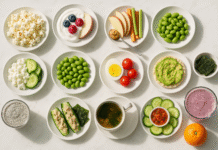











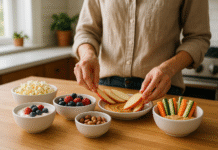














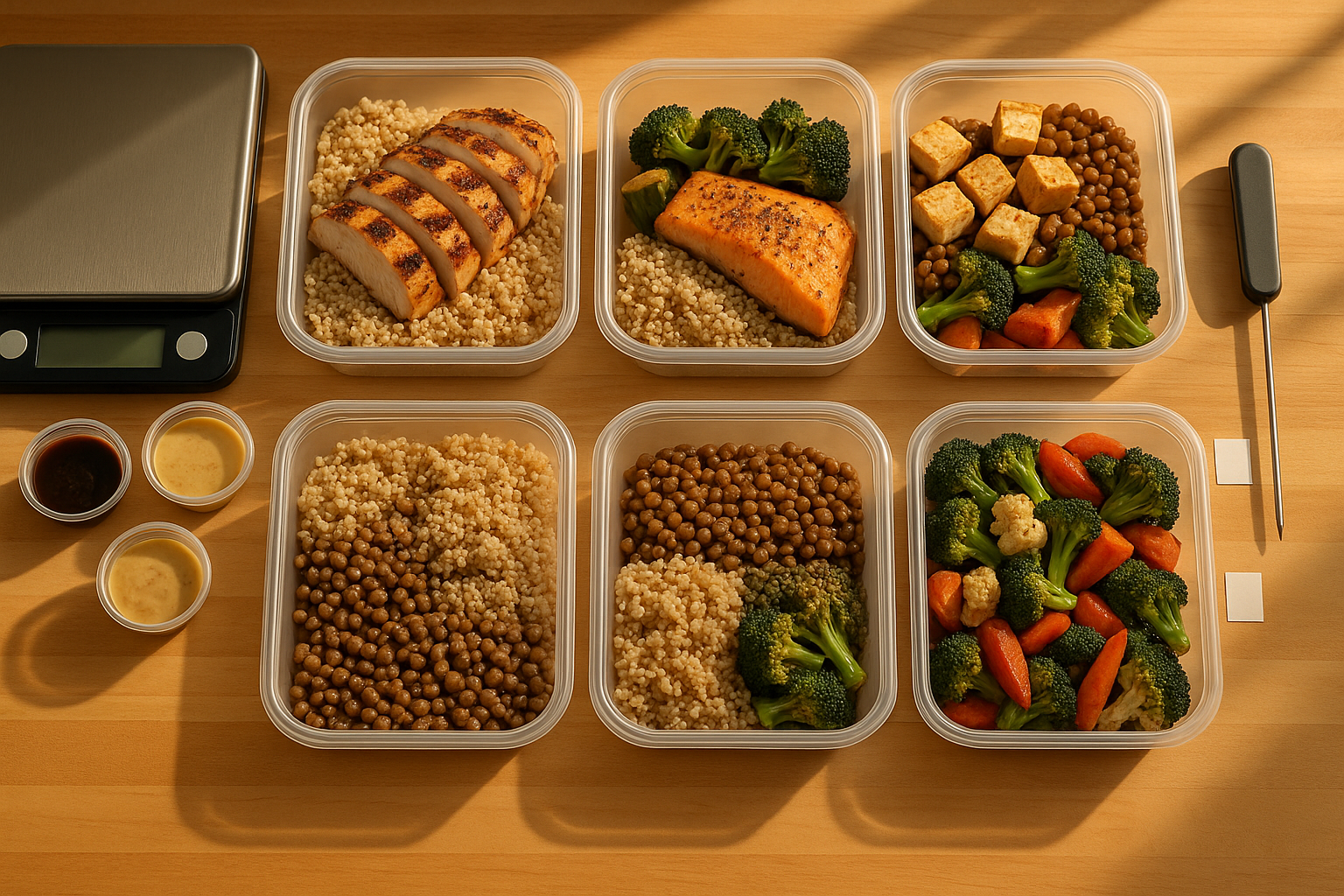
High-protein meal prep is the practice of planning, cooking, and storing protein-forward meals 3–5 days ahead so you consistently hit your daily protein target while saving time and money. Done right, it supports post-training recovery, steady muscle growth, and easier nutrition decisions during busy weeks. In this guide, you’ll learn evidence-based targets, safe batch-cooking methods, and practical menus that keep meals flavorful—not repetitive. It’s written for lifters, runners, and anyone training consistently who wants more protein without spending every evening in the kitchen. In short: you’ll set a clear protein goal (g/kg/day), distribute it across meals you enjoy, and assemble boxes that reheat well. At a glance, the weekly flow looks like this: set your target, shop once, batch-cook safely, portion with a scale, label and store, then rotate flavors midweek. That’s it—let’s get specific.
Quick definition (for skimmers): High-protein meal prep = planning and batching protein-rich meals to reliably reach ~1.6–2.2 g of protein per kg body weight per day, while controlling calories, cost, and time.
1. Lock Your Daily Protein Target (g/kg) and Per-Meal Plan
Start by setting a daily protein target that actually matches your training and body size; for most active adults aiming for muscle gain or maintenance, 1.6–2.2 grams of protein per kilogram of body weight per day is a practical, research-supported range. Anchoring your prep to this number transforms “eat more protein” into a measurable plan: you’ll reverse-engineer meals and snacks to hit the total. Next, spread that daily protein into 3–5 eating occasions, aiming for roughly 0.25–0.40 g/kg per meal, which aligns with what maximizes muscle protein synthesis in a single sitting for most people. If you lift in the afternoon, place one protein-rich meal 1–3 hours pre-workout and another within a few hours after. During calorie deficits, you can push to the higher end of the range to help maintain lean mass. Finally, choose your preferred cadence—three bigger meals, or three meals plus one to two protein snacks—then lock it in for the week.
1.1 Numbers & guardrails
- Daily target: 1.6–2.2 g/kg body weight (e.g., 75 kg → 120–165 g/day).
- Per meal: 0.25–0.40 g/kg (75 kg → ~19–30 g per meal).
- Meal count: 3–5 eating occasions that you can maintain consistently.
- Deficit phase: Nudge toward the upper end to help preserve lean mass.
1.2 Mini case
- Athlete: 75 kg, 4 lifts/week.
- Daily protein: 150 g/day (middle of the range).
- Distribution (4 feedings): 35 g breakfast, 35 g lunch, 50 g dinner (post-lift), 30 g evening snack.
Checklist
- Decide your number (g/day) and write it on a sticky note near your scale.
- Select 3–5 eating times you can repeat daily.
- Allocate grams per meal now, not later.
Bottom line: when grams per day and per meal are baked into your plan, every container you fill has a purpose—and the math drives the menu.
2. Choose Complete Proteins (and Hit the Leucine “Trigger”)
To get the most out of each meal, emphasize complete proteins that provide all essential amino acids and enough leucine—typically ~2–3 grams—to robustly trigger muscle protein synthesis. Animal sources like whey, dairy, eggs, poultry, fish, and lean beef are naturally complete and generally leucine-rich. Plant-focused athletes can fully meet needs by pairing complementary proteins (e.g., rice + pea, legumes + grains, soy foods), and by ensuring each feeding contains sufficient total protein to reach the leucine threshold. This is where powders can be pragmatic add-ons: 25–30 g of whey or a soy/pea blend tops up a meal fast. The goal is not perfection but reliability—each meal or snack should confidently advance you toward your daily total and provide a strong anabolic signal.
2.1 Tools/Examples
- Whey isolate (25–30 g): ~2.5–3 g leucine; mixes into oats or yogurt.
- Greek yogurt (200–250 g): 20–25 g protein; add milk powder to boost.
- Eggs (3 large): ~18–19 g protein; combine with beans/tofu for extra leucine.
- Tofu/tempeh (150–200 g): ~18–30 g protein; pair with rice or quinoa.
- Lentils/chickpeas (1 cup cooked): 15–18 g protein; add soy or seitan.
2.2 Common mistakes
- Relying on tiny “protein” portions (e.g., 10–12 g) that never add up.
- Assuming plant proteins are inadequate rather than planning complementary pairs.
- Forgetting leucine—total grams matter, but threshold per meal matters too.
Quick synthesis: Prioritize complete or well-combined proteins and aim for ~25–40 g protein per sitting so you reliably hit the leucine trigger without overcomplicating it.
3. Design a One-Page Weekly Menu Matrix You’ll Actually Cook
The simplest way to prevent prep fatigue is to map a single page that cross-references Protein × Carb × Veg × Sauce—then mix and match it all week. Begin with two to three primary proteins that cook and reheat well (e.g., chicken thighs, extra-firm tofu, salmon), two starchy carbs (e.g., rice, potatoes), and at least three vegetables that roast in the same oven temperature. Add two sauces or spice blends to shift cuisines midweek—think peri-peri vs. teriyaki, chaat masala vs. garlic-herb. This matrix approach keeps variety without extra cooking sessions. You’ll also flag one “emergency” protein (like canned tuna or ready-to-eat paneer) to bridge unexpected days.
3.1 Mini checklist
- Proteins (2–3): e.g., chicken thighs, salmon, tofu.
- Carbs (2): e.g., basmati rice, sweet potatoes.
- Veg (3): e.g., broccoli, peppers, carrots (roast together at 200°C/400°F).
- Sauces (2): e.g., yogurt-tahini; chili-garlic.
3.2 Tips to keep it fresh
- Cook proteins with only salt/pepper; define flavors at plating with sauces.
- Batch roast veg on two trays; slightly undercook for better reheats.
- Pre-portion sauces separately to prevent sogginess.
When the menu lives on one sheet, you free brainpower for training and recovery while still eating meals you look forward to.
4. Shop Once, Spend Less: Build a Protein-First List (and Cost per 25 g)
Protein is the anchor, so your shopping list should start with it—then fill in carbs, veg, and flavor. Scan weekly deals on lean meats/fish and stock shelf-stable options like lentils, chickpeas, canned tuna, and long-life milk powder. For budget control, compare the cost per 25 g protein rather than price per package; this normalizes decisions across foods. Don’t overlook frozen fish and vegetables—they’re often cheaper and reduce waste. Consider regional staples: in South Asia, eggs, dahi (yogurt), lentils (dal), and paneer give excellent protein ROI with familiar flavors. Finally, double-check pantry boosters (whey/soy/pea protein, powdered milk, nuts/seeds) that can turn a 20 g meal into 30–35 g without extra cooking.
4.1 How to calculate “per-25 g” quickly
- Read the label (protein per 100 g or per serving).
- Determine grams needed to reach ~25 g.
- Divide price by the number of 25 g “units” in the package.
4.2 Smart substitutions
- Chicken breast ↔ chicken thighs or turkey (often cheaper, juicier when reheated).
- Fresh fish ↔ frozen fillets; paneer ↔ extra-firm tofu for lower cost.
- Quinoa ↔ rice + lentils (similar amino acid coverage, lower cost).
In short, plan from protein outward, buy once with intent, and you’ll spend less while hitting your targets more consistently.
5. Batch-Cook Proteins the Safe, Juicy, Reheat-Friendly Way
Batch cooking only pays off if the food stays delicious through reheats and safe through storage. Prioritize methods that produce tender results with minimal hands-on time: oven roasting for chicken and vegetables, sheet-pan salmon, stovetop pressure-cooker dal, and air-fryer tofu. Lightly salt proteins in advance (even 30–60 minutes helps) to improve moisture retention; keep seasonings simple so sauces can pivot the cuisine. Use an instant-read thermometer to hit safe internal temperatures—e.g., 74°C/165°F for poultry—and avoid guesswork. Cool cooked foods quickly in shallow containers to move through the bacterial “danger zone” fast, then refrigerate promptly. Portion as you go to make weekday assembly effortless.
5.1 Practical yields (approximate, cooked)
- Chicken thighs: 1 kg raw → ~650–700 g cooked, ~150–170 g protein total.
- Salmon: 1 kg raw → ~800–850 g cooked, ~200 g protein total.
- Extra-firm tofu: 1 kg → ~1 kg cooked (water expressed), ~120–150 g protein.
- Lentils (dry): 500 g → ~1.2–1.4 kg cooked, ~120–130 g protein.
5.2 Reheat playbook
- Moist proteins (thighs, salmon) reheat better than ultra-lean cuts.
- Add a spoon of water/broth under a microwave cover; reheat to steaming hot.
- Keep sauces separate and add after reheating.
Cook once, eat well repeatedly—that’s the core advantage when you respect both flavor and food safety.
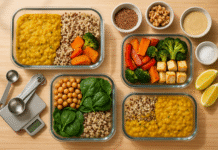
6. Assemble Balanced Boxes: Protein + Smart Carbs + Color + Fat
Each box should deliver your planned protein plus carbs for training fuel, colorful vegetables for micronutrients and fiber, and a little fat for satiety and flavor. Start by dropping in your protein portion (e.g., 150 g chicken for ~35–40 g protein), then add 1–1.5 cups cooked carb (rice, potatoes, whole-wheat pasta) matched to your energy needs. Fill at least a third of the container with vegetables to keep meals high-volume and satisfying. Finally, add 1–2 tablespoons of a sauce or dressing with flavor and some fat—olive oil, tahini, peanut sauce, yogurt-herb. Label the box with protein grams and date; future-you will thank present-you.
6.1 Mini example (40 g protein target box)
- 160 g roasted chicken thigh (~38–40 g protein)
- 1 cup cooked basmati rice (~45 g carb)
- 1.5 cups roasted broccoli & peppers
- 1 tbsp yogurt-tahini sauce + lemon
6.2 Quick swaps
- Chicken ↔ tofu + 1 tbsp ground sesame for extra leucine.
- Rice ↔ potatoes or whole-wheat couscous depending on training day.
- Yogurt-tahini ↔ chili-garlic or herb chimichurri.
When each box is built to numbers and taste, adherence goes up—because you don’t have to negotiate with yourself at 8 p.m.
7. Protein-Forward Breakfasts That Survive (and Shine In) Reheats
Breakfast is the meal most likely to be rushed and under-protein’d; fix that with options that prep in bulk and reheat gracefully. Egg-based bakes (frittatas, egg-muffins), high-protein overnight oats (milk + Greek yogurt + whey/soy), tofu bhurji with peas, and cottage-cheese parfaits can all deliver 25–35 g protein with minimal morning effort. Many athletes under-eat early, which makes later meals do heavy lifting; instead, use breakfast to bank protein so your lunch and dinner don’t have to be enormous. Pre-portion in lidded containers, or in mason jars for oats/parfaits, and keep a portable option (a protein shake and fruit) ready for truly chaotic mornings.
7.1 Breakfast builds (25–35 g protein)
- Overnight oats jar: 60 g oats + 200 g yogurt + 250 ml milk + 25 g whey.
- Tofu bhurji box: 200 g extra-firm tofu + peas + chili + turmeric + 1 roti.
- Egg bake square: 3 eggs + egg whites + spinach + potatoes + cheese.
- Cottage-cheese parfait: 250 g cottage cheese + berries + granola.
7.2 Tips
- Stir protein powder into yogurt or milk first to avoid clumps in oats.
- Line pans and slightly underbake egg dishes to prevent rubbery texture.
- Add fruit or pickle on the side to boost flavor and micronutrients.
A protein-anchored breakfast smooths your day’s intake and makes the rest of your targets easier to hit.
8. Mix-and-Match Lunches/Dinners: Flavor Rotations Prevent Burnout
Lunch and dinner are where variety matters most; the trick is rotating flavors on a shared base. For example, roast a tray of chicken thighs with only salt and pepper; across the week, serve it as peri-peri rice bowls, garlic-herb potatoes with broccoli, or yogurt-tahini wraps with pickled onions. Do the same with tofu or salmon—one batch, multiple cuisines. Build at least one legume-based entrée (dal tadka, chana masala) to raise fiber and keep costs down; pair with rice or quinoa for a complete amino acid profile. Keep sauces in small containers and apply after reheating to keep textures alive.
8.1 Flavor sets
- Peri-peri: chili-garlic sauce + lemon + cilantro.
- Herb-lemon: parsley, dill, garlic, olive oil, lemon zest.
- Yogurt-tahini: yogurt, tahini, garlic, cumin, salt.
8.2 Example builds (~35–45 g protein)
- 170 g chicken + 1 cup rice + veg + peri-peri.
- 200 g tofu + roasted veg + couscous + herb-lemon.
- 1.5 cups dal + 2 small rotis + cucumber raita.
Varying flavor on a consistent base gives you psychological variety without extra cook time—key for long-term adherence.
9. High-Protein Snacks & Add-Ins: Small Hinges, Big Doors
Snacks are not mandatory, but they’re powerful tools to reach daily protein without bloating main meals. Think of 20–30 g “plug-ins” you can deploy anywhere: Greek yogurt with milk powder stirred in, protein shakes (whey/soy/pea), cottage cheese with fruit, jerky/biltong, roasted chickpeas, or a tofu skewer in the fridge. These also serve as buffers on days when training runs long or meals get delayed. Keep a shelf or bag reserved for “emergency protein” and restock during your weekly shop; aim for shelf-stable where possible so your plan doesn’t fall apart if you miss a prep day.
9.1 Snack roster (20–30 g protein)
- 250 g Greek yogurt + 1 tbsp milk powder.
- 30 g whey/soy/pea in 300 ml milk or water.
- 200 g cottage cheese with berries.
- 2 boiled eggs + a cup of milk.
- Roasted chickpeas + small dairy or soy drink.
9.2 Common pitfalls
- Protein bars with <15 g protein masquerading as “high protein.”
- Grazing on nuts alone (great fats, modest protein per calorie).
- Forgetting to log snacks, then overshooting daily targets unintentionally.
Use snacks to smooth gaps—not to replace thoughtfully built meals.
10. Program Protein Around Training: Pre- and Post-Workout Made Easy
You don’t need a tiny “anabolic window,” but you do benefit from placing protein around training to support recovery and growth. A pre-workout meal 1–3 hours before lifting—containing ~0.25–0.40 g/kg protein plus easily digested carbs—helps performance and reduces hunger during the session. After training, aim for another protein-rich feeding within a few hours; if dinner is far away, a shake and a banana is a pragmatic bridge. Hydrate, and if you sweat heavily or train in heat, include sodium via food or a sports drink. The bigger principle is total daily protein and distribution, but smart timing makes the plan feel smoother and helps you hit numbers without cramming at night.
10.1 Simple templates
- Pre (90–120 min): chicken + rice bowl (~35 g protein + 45–60 g carbs).
- Bridge (immediately after): 25–30 g whey/soy + fruit.
- Post (meal): salmon + potatoes + veg (~40 g protein + 50–70 g carbs).
10.2 Mini checklist
- Don’t lift fasted if you struggle with energy.
- Keep one “bridge” shake in your gym bag.
- If dinner is soon, skip the bridge and eat the meal.
Protein timing is the polish; daily totals and consistent prep are the foundation.
11. Food Safety, Storage, and Reheat Rules You Must Not Ignore
Great macros mean little if your food safety is sloppy. Cool hot foods quickly in shallow containers; refrigerate within 2 hours of cooking (within 1 hour in very hot environments). Keep your refrigerator at or below 4°C/40°F, and understand the “danger zone” between 4°C/40°F and 60°C/140°F where bacteria multiply faster. Label boxes with the date; most cooked leftovers are best within 3–4 days in the fridge. Freeze portions you won’t eat by day 3 to extend life without quality loss. Reheat thoroughly until steaming hot, and—especially for poultry—cook to safe internal temperatures in the first place (e.g., 74°C/165°F for chicken and turkey).
11.1 Fridge/freezer guidance
- Fridge: 3–4 days for most cooked meats, fish, grains, legumes.
- Freezer: Many items keep 2–3 months with minimal quality loss.
- Store sauces separately; keep lids slightly ajar during cool-down to vent steam.
11.2 Safety mini-checklist
- Thermometer for cooking; thermometer for the fridge.
- Shallow containers; don’t stack hot containers tightly.
- If in doubt, throw it out.
Safety is not optional; it’s what lets you batch-cook with confidence every week.
12. Track, Review, and Adjust: Make Progress Visible
The final strategy is building a lightweight review loop so your prep evolves with your training. Track daily protein (and total calories if you have a body-weight goal) using any app or a simple spreadsheet. Weigh yourself 1–3 times per week under similar conditions and look for 2–4 week trends, not day-to-day noise. If you’re not progressing—strength, body composition, energy—adjust the plan: add 10–20 g protein per day, shift distribution toward workouts, or swap in denser protein foods if volume is too high. Keep notes about which meals reheat best, which sauces you love, and what you didn’t finish; these become next week’s upgrades.
12.1 Mini review ritual (10 minutes, weekly)
- Check average protein/day vs. target.
- Look at training log (performance, soreness).
- Pick one improvement (e.g., add a legume entrée, switch to thighs for reheats).
12.2 Tools
- Kitchen scale (1-gram resolution), instant-read thermometer, labeler or tape/marker.
- App for tracking (or a paper weekly tally).
- One “backup” protein (canned fish, shelf-stable milk, protein powder).
Iteration is the secret ingredient—your plan gets better, easier, and tastier every cycle you run.
FAQs
1) What is “high-protein meal prep” in one sentence?
Planning and batching protein-rich meals 3–5 days ahead so you reliably reach ~1.6–2.2 g/kg/day protein, save time and money, and support recovery and muscle growth. It’s a system that turns nutrition goals into repeatable containers, not complicated recipes.
2) How much protein do I actually need per day for muscle gain?
Most active adults grow well at 1.6–2.2 g/kg/day; smaller or larger athletes should choose a number that’s doable and adjust based on progress. In calorie deficits or very high training volumes, running the higher end can help maintain lean mass, but consistency beats perfection.
3) How many grams of protein should I eat per meal?
Aim for ~0.25–0.40 g/kg per meal—roughly 25–40 g for many people—so each feeding delivers enough leucine and essential amino acids to robustly stimulate muscle protein synthesis. This distribution also makes the daily total easier to hit without giant dinners.
4) Can plant-based eaters build muscle with meal prep?
Absolutely. Combine complementary proteins (e.g., legumes + grains, soy + grains, pea + rice) and ensure each meal reaches 25–40 g protein. Include soy or a blended plant protein powder if helpful. Plant-based athletes can match outcomes when totals and distribution are dialed in.
5) Is protein timing important post-workout?
Daily total and distribution dominate results, but placing a protein feeding within a few hours before and/or after training is practical and supports recovery. If dinner is far away, use a 25–30 g shake as a bridge rather than letting hours pass without protein.
6) Are high-protein diets safe for healthy adults?
For healthy, resistance-training adults, higher intakes within the ranges discussed are generally considered safe, with studies showing no adverse effects on kidney or liver markers over months in supervised settings. If you have medical conditions, consult a clinician first.
7) What containers are best for meal prep?
Shallow, microwave-safe containers with tight lids are ideal. Glass trays reheat evenly and clean well; BPA-free plastic is lighter for travel. Keep sauces in small separate cups to preserve texture, and label lids with protein grams and the prep date.
8) How long can I keep cooked meals in the fridge?
Most cooked foods are best within 3–4 days refrigerated. If you won’t eat a portion by day 3, freeze it. Always reheat to steaming hot, and when in doubt, throw it out. A fridge thermometer (≤4°C/40°F) is cheap insurance.
9) What are the best budget protein sources?
Eggs, milk/yogurt, lentils, chickpeas, canned tuna/salmon, chicken thighs, and tofu/tempeh deliver strong protein per currency unit. Calculate cost per 25 g protein across options to compare fairly, and lean on frozen fish and vegetables to cut waste.
10) How do I avoid meal-prep boredom?
Cook proteins simply, then rotate sauces and sides to change cuisines in seconds—peri-peri, yogurt-tahini, herb-lemon, chili-garlic. Use a matrix (Protein × Carb × Veg × Sauce) to create variety without extra cooking time.
11) Do I need supplements like whey or creatine?
You don’t need them, but whey/soy/pea powders are convenient for hitting per-meal targets, and creatine monohydrate (3–5 g/day) is one of the most researched performance supplements. Food first; use supplements for convenience and proven benefits.
12) What if I train early and can’t stomach a big meal?
Sip a small shake (15–25 g) before or during the session and eat a full protein-rich meal soon after. Keep an “emergency protein” kit—shake powder and a banana—in your bag so an early lift doesn’t derail your daily distribution.
Conclusion
High-protein meal prep works because it turns your goals into containers and grams, not guesses. You set a daily number that matches your training, distribute it intelligently across 3–5 feedings, and batch-cook proteins that reheat beautifully. From there, boxes assemble quickly: protein plus carbs, color, and a sauce that keeps meals craveable. Snacks plug gaps, timing around workouts adds polish, and food-safety habits let you prep with confidence. Most importantly, you review and adjust weekly—nudging totals, swapping proteins, and documenting what actually gets eaten. Commit to the system for four weeks and your fridge will become a results machine.
Copy-ready CTA: Prep your first five boxes this weekend—pick two proteins, one carb, three veg, and go.
References
- Morton, R. W., et al. “A systematic review, meta-analysis and meta-regression of the effect of protein supplementation on resistance training–induced gains in muscle mass and strength in healthy adults.” British Journal of Sports Medicine, 2018. https://bjsm.bmj.com/content/52/6/376
- Jäger, R., et al. “International Society of Sports Nutrition position stand: protein and exercise.” Journal of the International Society of Sports Nutrition, 2017. https://jissn.biomedcentral.com/articles/10.1186/s12970-017-0177-8
- Areta, J. L., et al. “Timing and distribution of protein ingestion during prolonged recovery from resistance exercise alters myofibrillar protein synthesis.” The Journal of Physiology, 2013. https://physoc.onlinelibrary.wiley.com/doi/full/10.1113/jphysiol.2012.244897
- Thomas, D. T., Erdman, K. A., Burke, L. M. “Position of the Academy of Nutrition and Dietetics, Dietitians of Canada, and the American College of Sports Medicine: Nutrition and Athletic Performance.” Journal of the Academy of Nutrition and Dietetics, 2016. https://www.jandonline.org/article/S2212-2672(15)01802-X/fulltext
- “Danger Zone (40 °F – 140 °F).” USDA Food Safety and Inspection Service, n.d. https://www.fsis.usda.gov/food-safety/safe-food-handling-and-preparation/food-safety-basics/danger-zone-40f-140f
- “Leftovers and Food Safety.” USDA Food Safety and Inspection Service, n.d. https://www.fsis.usda.gov/food-safety/safe-food-handling-and-preparation/leftovers-and-food-safety
- “Safe Minimum Internal Temperature Chart.” USDA Food Safety and Inspection Service, n.d. https://www.fsis.usda.gov/food-safety/safe-food-handling-and-preparation/food-safety-basics/safe-temperature-chart
- Antonio, J., et al. “A high protein diet has no harmful effects: a one-year crossover trial in resistance-trained males.” Journal of the International Society of Sports Nutrition, 2016. https://jissn.biomedcentral.com/articles/10.1186/s12970-016-0151-4
- FoodData Central. USDA Agricultural Research Service, 2019–present. https://fdc.nal.usda.gov/
- Phillips, S. M., Van Loon, L. J. C. “Dietary protein for athletes: From requirements to optimum adaptation.” Journal of Sports Sciences, 2011. https://www.tandfonline.com/doi/full/10.1080/02640414.2011.619204
Note: The information above is for healthy adults. If you have a medical condition or specific dietary needs, seek personalized advice from a qualified clinician or registered dietitian.