




























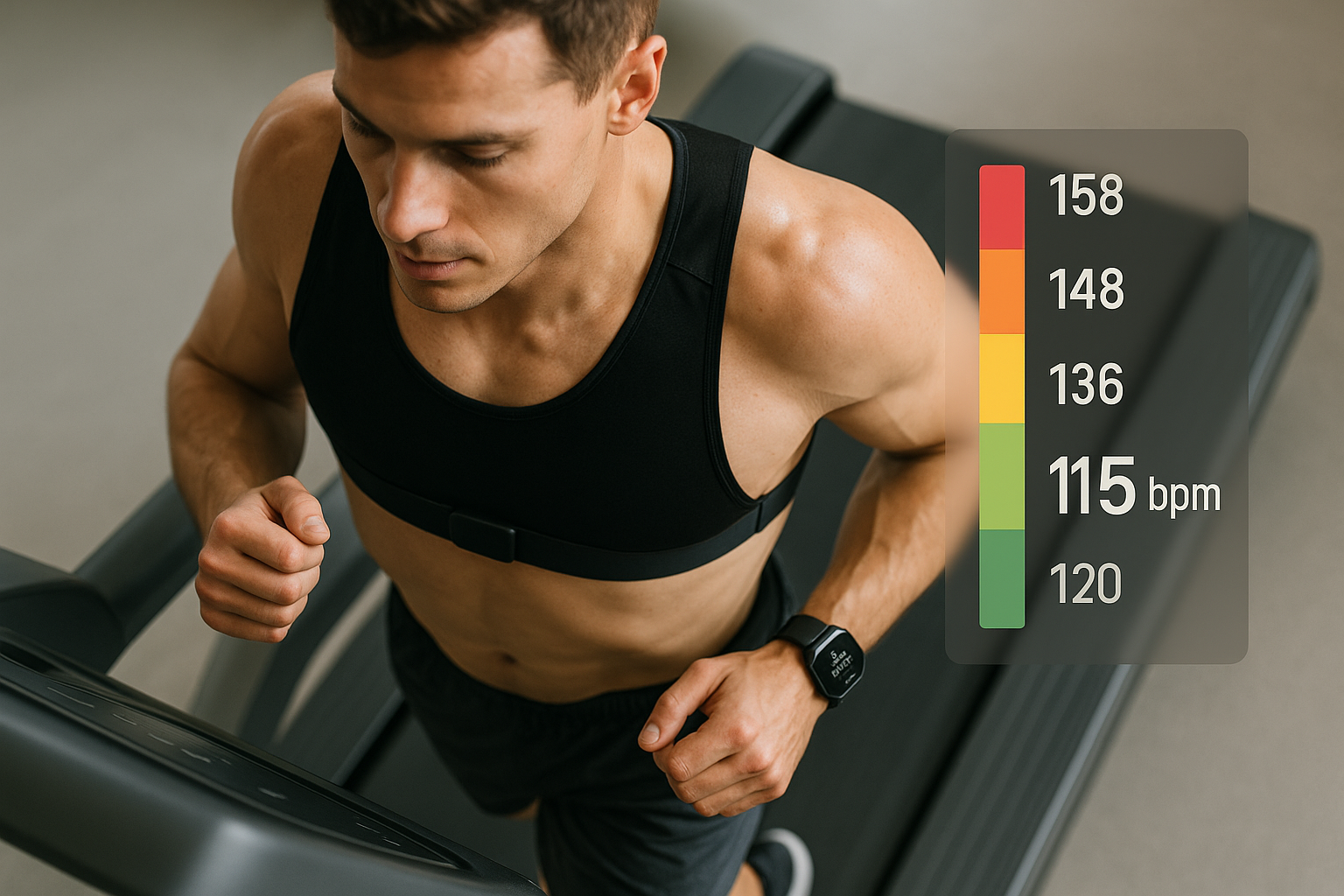
Heart-rate-based training turns guesswork into a plan. This guide shows you exactly how to use heart rate zones for cardio training—from calculating your personal zones to programming week-to-week workouts, then adjusting for heat, altitude, and medications. If you’re a runner, cyclist, rower, or gym-goer who wants safer, smarter gains without burning out, you’re in the right place.
Quick answer: Heart rate zones are intensity ranges (usually five) anchored to your physiology. You’ll (1) estimate or test your max heart rate and resting heart rate, (2) compute zones—ideally with heart rate reserve (HRR), and (3) use those zones to target specific adaptations: easy aerobic base (Zones 1–2), tempo/threshold (Zone 3–4), and high-end power/speed (Zone 5).
Fast steps (overview): Determine HRmax → log resting HR → compute zones (prefer HRR) → sanity-check with RPE & talk test → set device alerts → plan weekly distribution → design key workouts → adjust for heat/altitude/meds → re-test and refine.
Brief note: This article is educational, not medical advice. If you have a heart condition, are pregnant, or take heart-affecting medications (e.g., beta blockers), get personalized guidance first.
1. Get Your Max Heart Rate (HRmax) Right
Your zones are only as good as your HRmax, so start here. You can (a) test in a lab with gas analysis, (b) do a progressive field test (e.g., 3–5 min build to an all-out hill finish), or (c) estimate from age-based formulas. Lab and carefully supervised field tests are most accurate; formulas are convenient but imperfect. The classic 220 − age underestimates older adults and can be off in either direction for individuals. A more evidence-based estimate for healthy adults is HRmax ≈ 208 − 0.7×age (Tanaka). If you’re on medications like beta blockers, HR response is blunted, so standard targets won’t apply—use RPE/talk test and, ideally, a clinician-supervised test to anchor your zones safely. asep.org
1.1 How to do it (practical options)
- Best: Clinical cardiopulmonary exercise test (CPET) for direct HRmax and ventilatory thresholds (VT1/VT2).
- Solid field method: Warm up 15–20 min → 3–4 min steady hard climb → 2–3 min harder → 30–60 s near-all-out. Peak HR in last minute ≈ HRmax.
- If estimating: Use 208 − 0.7×age; log actual highs from workouts and update when you beat the estimate.
1.2 Numbers & guardrails
- A 35-year-old: 208 − 0.7×35 = 183 bpm (est.).
- Formulas vary (220−age, 207−0.7×age, etc.); don’t copy someone else’s number. A 5–10 bpm error shifts zones.
Bottom line: Use Tanaka as a starting point, but update with real data or lab testing. If on HR-affecting meds, don’t chase general HR targets—anchor to RPE/talk test and provider guidance.
2. Measure Resting Heart Rate (RHR) and Compute Heart Rate Reserve (HRR)
Resting HR is your baseline; subtract it from HRmax to get HRR = HRmax − RHR. HRR personalizes zones to your physiology (a low RHR means a larger reserve). Measure RHR after waking, before caffeine, for 3–7 days; use the lowest consistent value. HRR matters because %HRR tracks %VO₂ Reserve (VO₂R) far better than %HRmax or %VO₂max—so the same percentage actually means the same physiological stress. That equivalence is why leading guidelines favor HRR/VO₂R when prescribing intensity. ODU Digital Commons
2.1 How to do it
- RHR protocol: Lie quietly 5 minutes; note bpm. Repeat daily 3–7 days; record the lowest.
- Compute HRR: Example—HRmax 183, RHR 58 → HRR 125 bpm.
- Translate %HRR to target HR: Target HR = (RHR) + (%HRR × HRR).
2.2 Why HRR beats %HRmax
- Across 35–95% effort, %HRR ≈ %VO₂R (near 1:1 line). %VO₂max can mislead at easy intensities, especially in newer exercisers.
Bottom line: Take a week to lock in RHR and use HRR to make your zones physiologically meaningful.
3. Choose a Zone Model and Calculate Your Zones (with an Example)
Most recreational plans use five zones. You can define them by %HRmax (simple) or %HRR (preferred). You’ll also see threshold-based systems (anchored to VT1/VT2 or lactate threshold). All can work, but HRR best aligns with metabolic stress; threshold-based is excellent if you have CPET or field-tested thresholds.
3.1 Common five-zone ranges (starting point)
- By %HRR (recommended):
- Z1: 30–40% HRR
- Z2: 40–60% HRR
- Z3: 60–70% HRR
- Z4: 70–85% HRR
- Z5: >85% HRR
- By %HRmax (approximate):
- Z1: 50–60% HRmax
- Z2: 60–70% HRmax
- Z3: 70–80% HRmax
- Z4: 80–90% HRmax
- Z5: 90–100% HRmax
3.2 Worked example (35-year-old, HRmax 183, RHR 58 → HRR 125)
- Zone 2 at 40–60% HRR:
- Low end: 58 + 0.40×125 = 108 bpm
- High end: 58 + 0.60×125 = 133 bpm
- Zone 4 at 70–85% HRR: 146–164 bpm
3.3 Mini-checklist
- Pick one method and stick with it for 6–8 weeks.
- Recalculate after any new HRmax/RHR milestone.
- If you have VT1/VT2 or LTHR, map Z2 near VT1 and Z4 near threshold.
Bottom line: Start with HRR-based zones and refine later with threshold data if/when you have it.
4. Sanity-Check Zones with RPE and the Talk Test (and Adjust by Modality)
Even perfect math needs a reality check. Pair your zones with RPE (Borg 6–20 or 0–10) and the talk test. Below VT1 (easy/aerobic), you should speak in full phrases; around threshold, speech shrinks to short phrases; above VT2, you’re down to a few words. This simple check reliably reflects physiologic thresholds in healthy adults, athletes, and cardiac patients—and it’s especially valuable if devices hiccup or medications alter HR. Also note: running, cycling, and rowing can feel different at the same HR—validate zones per sport if you do more than one.
4.1 Quick talk-test mapping
- Comfortable conversation: Likely Z1–Z2 (≤VT1).
- Short sentences only: Around Z3–Z4 (near threshold/VT2).
- Only a few words: Z5 (well above VT2).
4.2 Modality notes
- HR and VO₂ relationships are broadly transferable, but small differences exist between running vs. cycling and other modes; validate with a steady 20–30-minute effort and compare HR vs. pace/power. PLOSBioMed Central
Bottom line: Use RPE + talk test to confirm you’re in the intended zone—crucial when devices or conditions make HR less reliable.
5. Set Up Devices and Alerts for Accurate, Real-Time Feedback
Good data makes good training. As of August 2025, wrist optical monitors are convenient and reasonably accurate in steady-state aerobic work, but chest straps still win for precision and rapid HR changes (HIIT, sprints). Arm-band optical sensors often split the difference. Whatever you use, enable zone alerts, record every workout, and review trends (not just single sessions).
5.1 Setup checklist
- Pair a chest strap for intervals; keep wrist wearables for easy days.
- Enable zone buzzers (e.g., alert if you drift above Z2 on long runs).
- Lock GPS and wear the strap snug (one finger tight) for cleaner signals.
- Log cadence/pace or power alongside HR to spot HR drift/decoupling later.
5.2 Common issues & fixes
- HR spikes at start? Warm up longer; moisten strap electrodes.
- Erratic wrist HR in intervals? Switch to chest strap for those workouts.
- Dark tattoos or loose fit? Expect optical errors—tighten band or use chest/arm sensor. JMIR mHealth and uHealthSpringerLink
Bottom line: Use the right sensor for the session and leverage alerts to stay in the intended zone.
6. Plan Your Week: Balance Low, Threshold, and High-Intensity Work
Zones are a tool to allocate training time. Many successful plans emphasize a large share of easy aerobic work (Z1–Z2) with smaller doses near threshold (Z3–Z4) and limited high-intensity (Z5). Evidence comparing intensity distributions is evolving; recent meta-analyses suggest polarized (mostly low intensity with some high) can outperform threshold-heavy models for endurance performance, though superiority isn’t universal and individual response matters. For general fitness, the AHA/ACSM guideline is 150–300 minutes/week of moderate or 75–150 minutes of vigorous activity—zones help you hit those minutes precisely. MDPIACSM
6.1 A practical weekly template (example)
- 3× Z2 aerobic sessions (40–90 min)
- 1× tempo/threshold session (Z3–Z4, 20–40 min quality within a 45–70 min run/ride)
- 1× high-intensity session (Z5 intervals totaling 6–15 min hard work)
- Optional: 1–2 short Z1 recovery sessions
6.2 Guardrails
- Put at least 48 hours between Z4–Z5 sessions.
- Keep 80–90% of total time ≤ Z2 if you’re new or ramping volume.
- Match zone targets to event demands (e.g., 10K vs. century ride).
Bottom line: Let zones enforce the right dose at the right time—most time easy, some time hard, just enough threshold.
7. Design Workouts That Map Cleanly to Adaptations
Each zone develops something specific. Use that on purpose. Z1–Z2 build aerobic base, capillary density, and durability; Z3–Z4 raise lactate/ventilatory thresholds and sustain race-pace power; Z5 boosts VO₂max and neuromuscular pop. Pair zone targets with repeatable session designs and clear stop rules (e.g., cap decoupling, HR ceilings).
7.1 Templates (mix and match)
- Z2 long aerobic: 60–120 min in Z2; cap Pa:HR decoupling ≤5%.
- Z3 steady tempo: 2×20 min at upper Z3 with 5–8 min Z1–Z2 recoveries.
- Z4 threshold: 3×10 min Z4, 5 min easy between.
- Z5 VO₂max: 6×2 min Z5, 2–3 min easy; stop if HR won’t rise or form breaks.
7.2 Mini rules that keep you honest
- Hit the zone early, then hold. If HR overshoots, slow down.
- Use talk test cross-checks mid-intervals (short phrases in Z4; few words in Z5).
- Abort criteria: HR won’t reach target after two intervals; RPE skyrockets; form deteriorates.
Bottom line: Build your week from zone-targeted sessions that are specific, repeatable, and measurable. PubMed
8. Adjust for Heat, Humidity, Altitude, Fatigue, and Medications
Conditions change physiology. In heat and dehydration, cardiovascular drift raises HR over time at the same pace/power, so your zones “feel” harder—slow down to stay in zone. At altitude, submax HR is higher for a given effort, while HRmax decreases with prolonged exposure; you’ll likely reduce targets in the first days to weeks. Beta blockers and some other meds blunt HR rise, so zones should be guided primarily by RPE and talk test, ideally informed by a stress test while on the medication. PubMed
8.1 Practical adjustments
- Hot/humid: Start 1–2 zones lower for the same pace/power. Drink to thirst; watch Pa:HR or Pw:HR decoupling—if >5–6%, back off.
- Altitude (first 3–7 days): Trim targets by 3–5% HR; shorten intervals; extend recoveries.
- On beta blockers: Use RPE 4–6/10 for moderate, 7–8/10 for vigorous; anchor with talk test rather than chasing HR.
8.2 Red-flag signs (stop and reassess)
- HR unusually high or low for effort, dizziness, chest pain, palpitations—stop and seek care.
Bottom line: Your zone is a moving target in tough environments and on certain meds—adjust benchmarks, not just effort.
9. Re-Test, Monitor Drift, and Recalibrate Every 6–8 Weeks
Zones aren’t “set and forget.” As fitness or fatigue changes, so will RHR, HRmax peaks, and zone feel. Every 6–8 weeks, repeat whichever method you chose (field test, CPET, threshold test), review Pa:HR or Pw:HR decoupling in long steady sessions (goal ≤5%), and scan resting HR trends. If Z2 feels like a conversation-killer, your zones are likely too high—or life stress is too high.
9.1 Mini-dashboard to track
- RHR (morning): trending down = improving aerobic fitness; trending up (3–5+ bpm for several days) = fatigue/illness.
- Max HR sightings: occasional peaks above estimate → update HRmax.
- Decoupling: ≤5% over your target duration = solid aerobic base.
- Threshold tests: repeat 20–40-min time trial or lab test when convenient. TrainingPeaks
9.2 When to change zones
- New HRmax or RHR → recompute HRR and all zones.
- After illness, heat waves, or altitude blocks, re-validate with talk test + RPE.
Bottom line: Periodic testing + trend review keeps your zones aligned with your current body, not last month’s.
FAQs
1) Which is more accurate for setting zones: %HRmax or %HRR?
%HRR is generally better because it correlates closely with %VO₂ Reserve, meaning the same percentage represents a similar metabolic load across people. %HRmax is simpler but less individualized, especially at easy intensities where it can mislead. If you can, use HRR. PubMed
2) I’m new to training—what’s the easiest way to start?
Use the Tanaka formula for HRmax, log RHR for a week, compute HRR-based zones, and verify with talk test and RPE. Then aim for 150–300 min/week of Z1–Z2, adding one Z3–Z4 session once you’re comfortable. Keep it simple and consistent. PubMed
3) How do zones relate to ventilatory or lactate thresholds?
VT1 typically sits near the top of Z2, and VT2/LT near Z4 in many five-zone systems. If you have CPET or lactate testing, map your zones to those anchors; otherwise, the talk test gives a practical approximation (phrases below VT1, few words above VT2). PMCSpringerOpen
4) Do wrist wearables work, or do I need a chest strap?
For steady aerobic sessions, modern wrist devices are reasonably accurate; for intervals and rapid HR shifts, chest straps remain more precise. An arm-band optical can be a good compromise. Choose based on session demands. PMCMDPI
5) What if I train in very hot weather?
Expect cardiovascular drift—HR rises over time at the same pace/power. Lower your pace or power to stay in zone, hydrate, and watch decoupling (target ≤5–6%). Heat makes Z2 feel like Z3; adjust accordingly.
6) How does altitude change my zones?
At altitude, submax work elicits higher HR, while HRmax may fall with prolonged exposure. In the first week, trim targets and extend recoveries; re-calibrate once acclimated.
7) I’m on a beta blocker—what should I do?
Use RPE and talk test as primary guides and, if possible, get a stress test on your medication to set safe targets. Don’t force general HR numbers; your blunted HR response changes the math. Mayo Clinic
8) What’s “aerobic decoupling,” and why does 5% matter?
It’s the drift between pace/power and HR during a steady session. If the second half is ≤5% less efficient than the first, your aerobic base matches the session’s duration; bigger drifts imply fatigue, heat stress, or under-fueling.
9) Is Zone 2 the “best” zone for health and performance?
Zone 2 is useful for building aerobic capacity and durability, but it’s not a magic bullet. Evidence is mixed on its superiority; most people progress best with mostly easy work plus some high-intensity, aligned to goals and time. PubMed
10) How often should I re-test zones?
Every 6–8 weeks, or after notable changes (PRs, illness, moving to heat/altitude). Re-check HRmax sightings, RHR trends, and decoupling; update zones if the data or feel changes.
Conclusion
Heart-rate-based training works because it connects effort to adaptation. By anchoring zones to your own HRmax and resting HR (preferably via HRR), then verifying with RPE and the talk test, you get a flexible system that holds up in the real world—even when conditions, devices, or life stress shift. Build your weeks around what zones are best at: plenty of easy aerobic time for durability, targeted threshold for sustainable speed, and occasional high-intensity for top-end capacity. Respect heat, humidity, altitude, and medications by adjusting targets, and keep a simple dashboard—RHR, max HR sightings, and ≤5% decoupling—to know when to push or pull back. Do this consistently, re-test every 6–8 weeks, and your zones will stay aligned with your evolving physiology.
Start today: calculate HRmax and HRR, set device alerts, and schedule one Z2, one threshold, and one short HIIT session this week—then review the data and refine.
References
- Age-Predicted Maximal Heart Rate Revisited. Journal of the American College of Cardiology (H. Tanaka et al.), 2001. JACC
- Accuracy of Commonly Used Age-Predicted Maximal Heart Rate Equations. International Journal of Exercise Science (D. Shookster et al.), 2020. PMC
- Heart Rate Reserve is Equivalent to %VO₂ Reserve, Not to %VO₂max. Medicine & Science in Sports & Exercise (D.P. Swain, B.C. Leutholtz), 1997. Europe PMC
- Relationship Between %HRR, %VO₂R, and %VO₂max. International Journal of Sports Medicine (J. Lounana et al.), 2007. PubMed
- Measuring Physical Activity Intensity. Centers for Disease Control and Prevention, Last reviewed June 3, 2022. CDC
- Target Heart Rates Chart. American Heart Association, Aug 12, 2024. www.heart.org
- Cardiovascular Drift During Heat Stress: Implications for Exercise Prescription. Exercise and Sport Sciences Reviews (J.E. Wingo et al.), 2012. Lippincott Journals
- Effect of Altitude on the Heart and the Lungs. Circulation (P. Bärtsch, B. Gibbs), 2007. AHA Journals
- Cardiovascular Response at Maximal Exercise at High Altitude. Journal of Applied Physiology (J.P. Richalet et al.), 2023. Physiology Journals
- How Do Beta Blocker Drugs Affect Exercise? American Heart Association, Jan 18, 2024. www.heart.org
- The Talk Test as a Useful Tool to Monitor Aerobic Exercise Intensity. Journal of Lifestyle Medicine (Y. Kwon et al.), 2023. PMC
- Are Activity Wrist-Worn Devices Accurate for Determining Heart Rate? Bioengineering (P. Martín-Escudero et al.), 2023. MDPI
- Accuracy of Wearable Heart Rate Monitors in Cardiac Patients. Cardiovascular Diagnosis and Therapy (M. Etiwy et al.), 2019. PMC
- Aerobic Decoupling (Pa:HR / Pw:HR). TrainingPeaks Help, Sept 12, 2023. help.trainingpeaks.com
- AHA Recommendations for Physical Activity in Adults. American Heart Association, Jan 19, 2024. www.heart.org
- VO₂ Reserve vs. Heart Rate Reserve During Moderate Intensity Work. International Journal of Exercise Science (T.J. Solheim et al.), 2014. PMC
- Polar: Heart Rate Zones (Reference Ranges). Polar Global (guide), accessed Aug 2025. polar.com
- ACSM/Aerobic Exercise Intensity (Infographic). American College of Sports Medicine, 2024–2025 resource. ACSM
- Comparison of Polarized vs Other Training Intensity Distributions: Systematic Review & Meta-analysis. Sports (P.S. Oliveira et al.), 2024. PMC