



























If you’ve ever started strong and faded fast, you’re not alone—consistency is the make-or-break skill in fitness. This guide shows exactly how to build a sustainable training habit that survives busy weeks, travel, and changing motivation. You’ll learn how to start smaller than you think, structure your week, make training frictionless, and progress at a pace you can keep. It’s written for beginners and experienced lifters alike who want results that stick, not just a hot streak. Quick disclaimer: this is educational information, not medical advice; talk to a professional if you have medical conditions, injuries, or concerns.
What is a sustainable training habit? It’s a repeatable routine you can keep for years—steady frequency, manageable effort, and recovery that matches the workload. In practice, that means most weeks you show up, get a solid (not perfect) session, and live to train again tomorrow.
Fast start, zero overwhelm—do this first:
- Pick 2–4 training days you can protect.
- Cap sessions at 20–45 minutes to start.
- Use full-body or simple push/pull/legs templates.
- Keep intensity around RPE 6–8 (challenging, not crushing).
- Track only adherence (did you show up?) and 1–2 notes.
1. Set a Minimum Effective Dose (Start Smaller Than You Think)
Your first goal isn’t “get fit quickly”—it’s “keep showing up.” Setting a minimum effective dose (MED) shifts your focus from heroic sessions to repeatable ones. Start with a workload your schedule and recovery can absorb even on bad days. MED helps you avoid the all-or-nothing trap, reduces soreness that derails the next session, and builds early wins that wire the habit loop. Think long game: sustainable progress comes from strings of decent sessions, not occasional perfect ones. Starting smaller than you think also leaves room to progress deliberately instead of peaking in week two and burning out.
1.1 Why it matters
- Consistency beats intensity. Two to four good sessions per week for six months outpace a single epic block followed by three weeks off.
- Lower barrier, higher adherence. When your plan fits a busy Tuesday, it’ll fit most Tuesdays.
- Recovery is bankable. Less early fatigue = better form, fewer missed weeks, more gains later.
1.2 Numbers & guardrails
- Frequency: 2–3 days/week to start; graduate to 3–4.
- Duration: 20–45 minutes per session.
- Intensity: RPE 6–8 on working sets (you could do 2–4 more reps).
- Volume: 6–10 hard sets per muscle/week to begin.
1.3 Mini-checklist
- Choose a 30-minute cap for the first two weeks.
- Use 3 exercises/session: one lower, one push, one pull.
- End every workout with one “easy win” set (light technique work or mobility).
Example: Week 1–2 = 2 sessions, 30 minutes, full-body. Week 3–4 = 3 sessions. Week 5–6 = add one set per big lift. That’s sustainable compounding. Bottom line: start where consistency is guaranteed, then stack from there.
2. Anchor Training to a Time & Trigger (Implementation Intentions)
A habit forms faster when it’s tied to a cue you already do—coffee, school drop-off, or ending your workday. Implementation intentions are “If X, then I will Y” statements that remove deliberation and reduce decision fatigue. Anchoring also protects your training from calendar creep; if it always happens after breakfast or at 6:30 p.m., you stop negotiating with yourself. Over time, the cue sparks action automatically, which increases adherence even when motivation dips. Think of it like rails for your routine—less willpower, more autopilot.
2.1 How to do it
- Write one clear plan: “After my morning coffee, I train for 30 minutes in the living room.”
- Use a location anchor (specific room/gym rack) and a time window (e.g., 6:30–7:15 a.m.).
- Set alerts: calendar block + device reminder + visible sticky note at the anchor point.
2.2 Common mistakes
- Vague timing. “Sometime after work” invites conflict and drift.
- Stacking too much. Don’t attach five new behaviors to one cue; anchor training first.
- Unprotected slots. If others book over your time, treat it as a meeting—with yourself.
2.3 Mini-checklist
- Choose a daily cue you never miss (coffee, commute, lunch).
- Pre-arrange gear at the anchor spot the night before.
- Put a no-negotiation rule on the first 10 minutes: start, then decide.
Synthesis: anchor + narrow time window turns “I should train” into “this is what I do next,” which is the engine of consistency.
3. Program a Simple Weekly Template (Frequency & Structure)
Complex plans collapse under real life. A simple weekly template keeps you consistent because you always know what today is for. Instead of chasing novelty, choose a repeatable pattern that fits your calendar, recovery, and goals: full-body 3x/week, an upper/lower split, or push/pull/legs. Templates reduce choice overload, help you balance muscle groups, and ensure you hit key movements weekly. They also make it easy to reschedule when life happens; if you miss Tuesday, you slide it to Wednesday without derailing the rest of the week.
3.1 Starter templates
- Full-body (3x/week): Mon/Wed/Fri. Squat/hinge, push, pull + core.
- Upper/Lower (4x/week): Mon/Tue/Thu/Fri. Two upper, two lower sessions.
- Push/Pull/Legs (3x/week): Rotate across the week; add accessory work as time allows.
3.2 Numbers & guardrails
- Hit each major pattern 2–3x/week (squat/hinge, horizontal/vertical push/pull).
- Keep main lifts 3–5 sets of 5–12 reps at RPE 6–8.
- Limit new exercises to 1 per week to maintain skill and tracking clarity.
3.3 Example week (full-body, 45 min)
- Day A: Back squat, bench press, row, plank.
- Day B: Deadlift (or RDL), overhead press, pull-ups/lat pull-down, side plank.
- Day C: Lunge, incline press, face pulls, loaded carry.
Synthesis: a simple template creates predictable work that accumulates—precision without paralysis.
4. Remove Friction and Design Your Environment
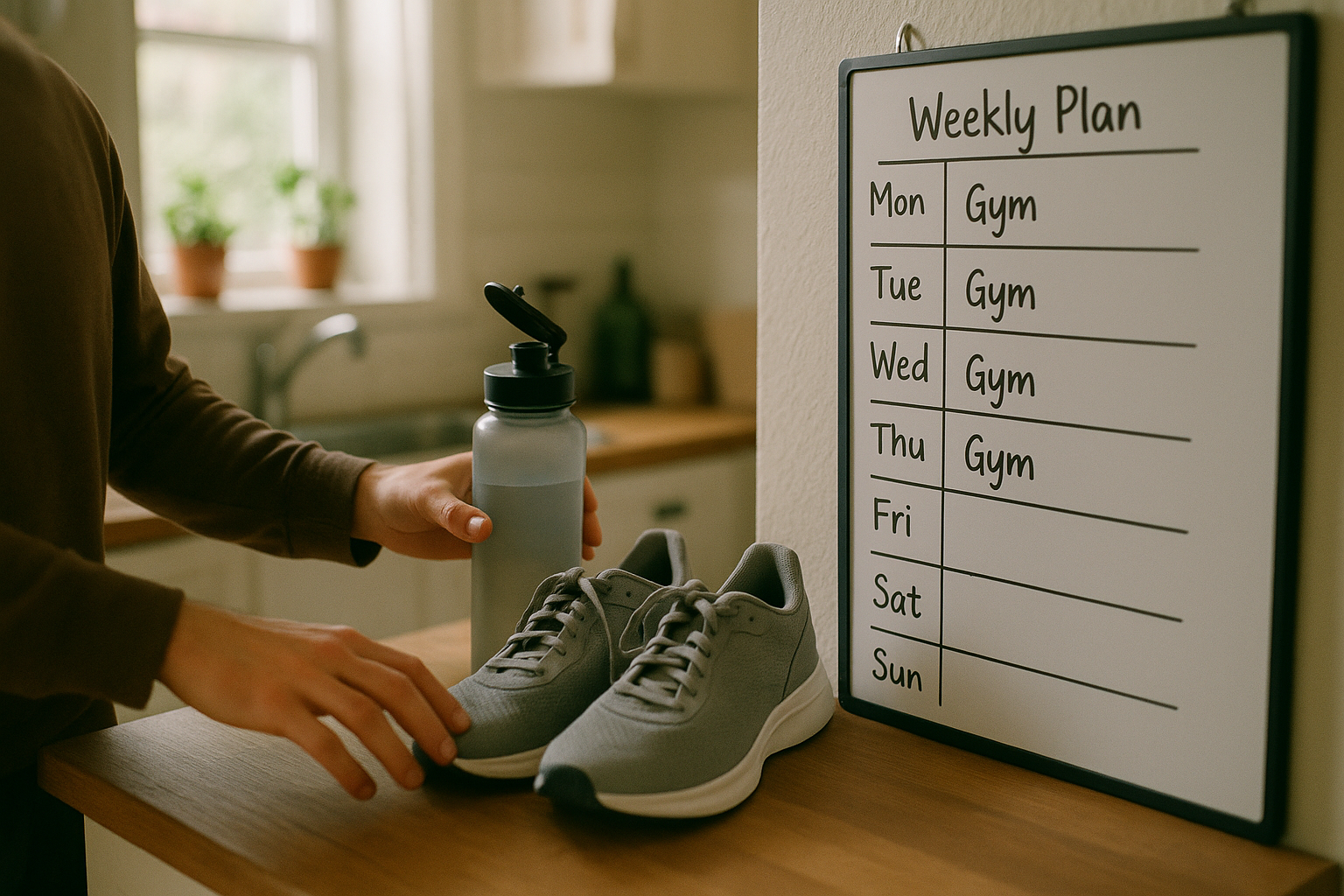
You won’t out-motivate friction forever. Environment design makes the easiest choice the default choice: pack your bag the night before, place your shoes by the door, keep adjustable dumbbells where you train. Removing tiny hassles—searching for a belt, queueing for a rack, commuting at rush hour—pays off disproportionately because it protects the “start” of the session. The smoother your setup, the fewer excuses you’ll find when a meeting runs late or energy dips. Make your plan fit your life, not the other way around.
4.1 Friction audit (3–7 minutes)
- Identify sticking points: gear, travel time, crowded hours, child care, heat.
- Lower the lift: choose home options, off-peak slots, or a gym near work.
- Automate: subscriptions for bands/chalk, recurring calendar blocks, automatic playlist.
4.2 Tools/Examples
- Home kit: adjustable dumbbells/kettlebell, bands, yoga mat, timer app.
- Gym hacks: reserve a rack (if possible), pre-plan supersets that don’t hog equipment.
- Clothing: keep a spare set in your bag/car; choose breathable fabrics for hot climates.
4.3 Mini-checklist
- Pack bag, charge headphones, fill bottle before bed.
- Decide your exact first exercise in advance.
- Set your music/timer to auto-start at your anchor time.
Synthesis: reduce “micro-tolls” and you’ll start more often—starting is 80% of consistency.
5. Progress Gradually with Auto-Regulation (RPE, Micro-Loads, Deloads)
Progress is motivating; overreaching is demotivating. Auto-regulation means you adjust load or volume to your readiness that day using simple tools like the RPE scale (how hard the set felt) and reps in reserve (RIR). Combined with micro-loading (adding small weight jumps) and periodic deloads, you’ll gain without frying your recovery. The aim is to finish sessions feeling like you could have done more most days—because you’ll be back in two days. Sustainable training respects stress outside the gym and flexes with it.
5.1 Numbers & guardrails
- Main lifts: RPE 6–8 most of the time (2–4 RIR).
- Load jumps: +1.25–2.5 kg (2.5–5 lb) per week on big lifts when reps are clean.
- Volume: cap increases at ~10%/week.
- Deload every 4–8 weeks or after a heavy life week (reduce volume/intensity by ~30–50%).
5.2 How to do it (simple)
- If you finish a set at RPE ≤7, add a small plate next week.
- If bar speed slows or form slips, hold or reduce 2–5% and keep reps crisp.
- Use rep ranges (e.g., 6–10). When you hit the top of the range at target RPE, add weight next time.
5.3 Mini case
Week 1: 3×8 at 50 kg, RPE 7.
Week 2: 3×9 at 50 kg, RPE 7–8.
Week 3: 3×10 at 50 kg, RPE 7–8.
Week 4: 3×8 at 52.5 kg, RPE 7.
Week 5: Deload 2×8 at 45 kg, RPE 6.
Synthesis: small, steady increases keep momentum high and injury risk low—exactly what long-term consistency needs.
6. Track the Right Things (Adherence, Streaks, Notes—Not Just PRs)
What you track shapes what you do. For sustainability, adherence (did you train as planned?) is a better north star than personal records. A clean, simple log builds awareness without becoming a second job. Track your sessions, main lifts, rough RPEs, and one or two notes about sleep, stress, or time pressure. A weekly glance tells you when life—not your program—is the limiter, which lets you adjust intelligently. Tracking also creates a reward loop; ticking a box feels good and reinforces the pattern.
6.1 What to track
- Session adherence: planned vs. completed (e.g., 3/3).
- Load & reps on main lifts + RPE.
- Context notes: sleep hours, travel, illness, big deadlines.
- Streaks: but cap the emotional weight—use them as information, not identity.
6.2 Tools
- Notebook or notes app, Google Sheets, or a simple tracker app.
- Calendar heatmaps to visualize consistency.
- Timer (interval or EMOM) to keep sessions moving in 30–45 minutes.
6.3 Mistakes to avoid
- Tracking too many metrics—you’ll stop.
- Perfectionism: missing one box is data, not failure.
- Only PR chasing: it hides progress in technique, stamina, and adherence.
Synthesis: measure what keeps you coming back; the numbers should serve the habit, not the other way around.
7. Prioritize Recovery (Sleep, Nutrition, Stress)
Training only works if you can recover from it. Adequate sleep, protein, hydration, and stress management turn sessions into adaptations. You don’t need athlete-level routines to benefit—just consistent basics: 7–9 hours of sleep, protein spread across meals, and at least one genuinely easy day each week. As workloads rise, deliberate recovery keeps you in the sweet spot where progress is visible but fatigue doesn’t spill into the rest of life. Recovery is not a luxury; it’s the multiplier on your training.
7.1 Numbers & guardrails
- Sleep: target 7–9 hours/night; keep bedtime and wake time within a 1-hour window.
- Protein: ~1.6–2.2 g/kg/day (0.7–1.0 g/lb) spread across 3–4 meals.
- Rest days: at least 1–2 per week; keep steps/light mobility but avoid grinding.
- Hydration: start with 30–35 ml/kg/day (13–16 cups for a 70 kg person), more in heat.
7.2 How to do it
- Create a wind-down: dim lights, hot shower, screens off 60 minutes before bed.
- Plan protein: add a palm-size portion to each meal; keep a ready-to-drink option.
- Use easy pace on active recovery days—conversation-pace walks or cycling.
7.3 Mini-checklist
- Bedtime alarm, not just wake alarm.
- Grocery list includes protein staples and electrolytes.
- One planned “nothing strenuous” day after your heaviest session.
Synthesis: protect sleep and basics first; better recovery = better consistency because you feel like training.
8. Make It Enjoyable and Identity-Based
People stick with what feels good and fits who they are. Build enjoyment into your plan—music, favorite variations, outdoor sessions—and tie your behavior to your identity (“I’m the kind of person who trains, even when it’s short”). Enjoyment isn’t fluff; it predicts adherence because you’ll choose activities you look forward to. Identity makes decisions simpler; when actions match how you see yourself, you don’t need a pep talk every time. The goal is to make training not just tolerable, but personally meaningful.
8.1 How to increase enjoyment
- Autonomy: keep 10–20% of each session for exercises you love.
- Mastery: revisit key lifts to watch skill improve.
- Purpose: connect sessions to a value—being strong for family, better mood, stress buffer.
8.2 Identity in practice
- Write a one-line identity: “I’m a consistent trainee who moves most days.”
- Use evidence stacking: every checkbox in your log is proof.
- Reframe misses: “I protect the next session,” not “I failed.”
8.3 Mini-checklist
- Build a playlist that auto-starts at your anchor time.
- Reserve a “fun finisher” 3–5 minutes (carries, sled, jump rope).
- Review your log weekly and note one proof you’re that person.
Synthesis: when training aligns with who you are and what you enjoy, consistency stops feeling like a fight.
9. Build Accountability and Social Support
Humans are social; use that to your advantage. Accountability—a partner, class, coach, or group—adds gentle pressure and shared momentum. Social support increases adherence by providing encouragement, norms, and practical help (spotting, form checks, childcare swaps). It also makes the process more fun: shared progress, inside jokes, and a reason to show up. This doesn’t require constant companionship; even one weekly check-in can keep your streak alive.
9.1 Options that work
- Workout partner: same schedule, similar goals.
- Group classes or clubs: pre-set times remove scheduling friction.
- Coach (in person or remote): plans, form feedback, accountability.
- Public log: post weekly recap to a small circle.
9.2 How to set it up
- Agree on time windows and backup plans in advance.
- Share one measurable goal (e.g., 3 sessions/week for 8 weeks).
- Do a Sunday check-in: plan, obstacles, and solutions.
9.3 Mini-checklist
- Invite one friend for a 4-week “consistency sprint.”
- Put shared sessions on both calendars.
- Celebrate process wins (showing up), not just PRs.
Synthesis: a little external structure plus camaraderie goes a long way toward doing the work, week after week.
10. Plan for Setbacks, Travel, and Busy Seasons (The Two-Day Rule)
Setbacks are normal; the difference between consistent and inconsistent trainees is recovery strategy, not perfect weeks. Adopt the Two-Day Rule: never miss two planned training days in a row. Build “travel workouts,” “sick-day mobility,” and “deadline-week 20-minute sessions” ahead of time so you don’t have to invent solutions under stress. Expect schedule shocks—holidays, exams, Ramadan fasting, heat waves—and plan lighter, morning-biased sessions or walks then. The goal isn’t to maintain full volume during disruptions; it’s to keep the habit alive so restarting is easy.
10.1 Fallback playbook
- Travel kit: bands + bodyweight circuit (squat, push-up, row, plank).
- Sick or run-down: mobility + easy walk; resume lifting at 80–90% of last loads.
- Deadline weeks: 20-minute EMOMs (every minute on the minute) with 2–3 movements.
- Heat/humidity: train earlier, shorten sessions, increase fluids/electrolytes.
10.2 Numbers & guardrails
- After 7+ days off, resume at ~80% of your previous load/volume for 1–2 sessions.
- Keep Two-Day Rule absolute during sprints/peaks: if you miss Day 1, must make Day 2.
- For fasting periods, shift to lower-intensity strength and walks near your feeding window.
10.3 Mini-checklist
- Pre-write a 20-minute hotel workout card in your bag.
- Save a “busy week” template in your notes.
- Keep electrolytes and a spare band where you travel.
Synthesis: disruptions don’t break habits—lack of a backup plan does. Protect the chain with pre-built fallbacks.
FAQs
1) How long does it take to build a sustainable training habit?
Most people feel momentum within 2–4 weeks and see habits stick after several months of consistent practice. A useful heuristic is to track adherence over 8–12 weeks; if you’re hitting 75–85% of planned sessions without dread, the habit is taking root. Keep the early workload light so wins are easy and you build a reliable pattern.
2) Is 2–3 days per week enough to make progress?
Yes. Two to three well-structured full-body sessions can improve strength, endurance, and mobility, especially for beginners or returners. If your intensity is moderate (RPE 6–8) and you accumulate 6–10 hard sets per muscle across the week, you’ll progress—provided sleep and nutrition support recovery.
3) Should I train when I’m sore or tired?
Mild soreness is fine if movement quality is solid. If soreness changes your form or you’re unusually fatigued, lower the load or switch to a lighter session. Auto-regulate using RPE: aim for an effort that feels challenging but controlled. If you’re ill or sleep-deprived, a short mobility session or walk preserves the habit without over-taxing you.
4) Do I need a complicated program to stay consistent?
No. Simpler templates outperform complex ones in adherence because they’re easier to run when life gets busy. Pick a structure (full-body 3x/week or upper/lower 4x/week), repeat core lifts, and make small, steady progress. Complexity can be a form of procrastination; clarity keeps you moving.
5) What if I miss a whole week?
Resume at ~80% of your last working loads/volume for a couple of sessions, then climb back. Don’t try to “make up” every missed set—that’s a fast route to burnout. Re-establish your anchor time and your normal session length first; performance follows adherence.
6) How heavy should I lift to stay consistent but still progress?
Train in the RPE 6–8 zone most of the time. That’s heavy enough to drive adaptation while leaving reps in reserve for better form and recovery. Save very hard sets (RPE 9–10) for the occasional test, not daily practice. Consistency thrives when sessions feel doable.
7) What’s the best way to track progress without getting obsessed?
Track adherence (planned vs. completed), main-lift load/reps, and a brief context note (sleep, stress). Review weekly for patterns and adjust. Resist tracking ten metrics; the best log is the one you’ll keep. A heatmap calendar or simple checkbox habit tracker works well.
8) Can I build a sustainable training habit at home?
Absolutely. With adjustable dumbbells or a kettlebell, a band set, and a mat, you can run effective full-body sessions. Home setups remove commute friction and make short sessions viable. If you miss heavy barbells, cycle to a gym block later—consistency first, equipment second.
9) How do I stay consistent during Ramadan, exams, or peak work seasons?
Bias shorter, lower-intensity sessions near feeding windows (for fasting), train earlier to beat heat, and pre-plan “busy week” templates. The aim is continuity, not peak performance. Keep the Two-Day Rule, hydrate intelligently, and return to normal volume as the season passes.
10) Do I need a coach or partner to be consistent?
Not required, but helpful. A coach reduces decision fatigue and provides feedback; a partner increases accountability and enjoyment. If neither is available, a simple weekly check-in with a friend (share your plan and results) can provide enough external structure to keep you rolling.
Conclusion
Consistency is a skill you can design, not a feeling you wait for. Start with a minimum effective dose that you can hit on your worst week, anchor it to a reliable cue, and run a simple weekly template that you can repeat without thinking. Remove small frictions, progress with auto-regulation, and track adherence instead of chasing PRs every session. Support the work with sleep and nutrition, and make training enjoyable and identity-affirming so it becomes part of who you are. Finally, plan for the messy parts of life—travel, deadlines, fasting, heat—by building fallbacks ahead of time. Do these things and you’ll turn intent into routine, routine into progress, and progress into a lifestyle. Start today: pick your anchor time, choose a 30-minute full-body plan, and check the first box.
References
- Physical Activity Guidelines for Americans, 2nd Edition — U.S. Department of Health and Human Services (2018). https://health.gov/sites/default/files/2019-09/Physical_Activity_Guidelines_2nd_edition.pdf
- Physical activity (Fact sheet) — World Health Organization (2022). https://www.who.int/news-room/fact-sheets/detail/physical-activity
- Progression Models in Resistance Training for Healthy Adults — American College of Sports Medicine Position Stand, Medicine & Science in Sports & Exercise (2009). https://journals.lww.com/acsm-msse/Fulltext/2009/03000/Progression_Models_in_Resistance_Training_for.26.aspx
- Lally, P., van Jaarsveld, C. H. M., Potts, H. W. W., & Wardle, J. How are habits formed in the real world? European Journal of Social Psychology (2009). https://onlinelibrary.wiley.com/doi/10.1002/ejsp.674
- Gollwitzer, P. M. Implementation intentions: Strong effects of simple plans. American Psychologist (1999). https://psycnet.apa.org/record/1999-10117-002
- Gardner, B., Lally, P., & Wardle, J. Making health habitual: the psychology of ‘habit-formation’ and general practice. British Journal of General Practice (2012). https://bjgp.org/content/62/605/664
- Wood, W., & Runger, D. Psychology of habit. Annual Review of Psychology (2016). https://www.annualreviews.org/doi/10.1146/annurev-psych-122414-033417
- Borg, G. Psychophysical bases of perceived exertion. Medicine & Science in Sports & Exercise (1982). https://journals.lww.com/acsm-msse/Abstract/1982/05000/Psychophysical_bases_of_perceived_exertion.13.aspx
- Dietary protein intake and muscle mass: a systematic review — Morton, R. W., et al., British Journal of Sports Medicine (2018). https://bjsm.bmj.com/content/52/6/376
- Lindsay Smith, G., Banting, L., Eime, R., O’Sullivan, G., & van Uffelen, J. The association between social support and physical activity in older adults: a systematic review. BMC Geriatrics (2017). https://bmcgeriatr.biomedcentral.com/articles/10.1186/s12877-017-0509-8