



















Eating out should feel joyful, not like a willpower test. Still, restaurants often serve portions that are bigger and richer than what we’d cook at home, and those extras add up quickly—especially when you’re hungry, distracted, or celebrating. This guide gives you practical, judgment-free strategies to keep portions in check without feeling deprived. It’s for anyone who wants to enjoy the full dining experience and still leave the table comfortable, energized, and in control. Quick note: this article is educational and not medical advice; if you live with conditions like diabetes, kidney disease, or food allergies, tailor choices with your clinician or dietitian.
Quick answer: portion control when dining out means making small, preemptive choices—using menu calories, ordering smaller formats, pre-portioning half to-go, swapping sides, and eating slowly—so you finish satisfied, not stuffed. Americans get roughly one-third of their calories away from home, so a few smart moves at restaurants can meaningfully shift your weekly intake. U.S. Food and Drug Administration
As of August 2025, many large chains in the U.S. and U.K. display calories on menus; use those numbers as a guide, not a judge. They’re not perfect, but they help you compare options quickly and set a plan before the bread basket lands.
1. Decide Before You Dine: Scan the Menu and Set a Simple Plan
The most reliable way to control portions at restaurants is to decide your format before you arrive: starter + side, one entrée shared, or half to-go. A 60-second scan of the online menu (or the first minute at the table) lets you identify lean proteins, veg-forward sides, and smaller formats with posted calories where available. Calorie labeling in U.S. chains (20+ locations) and many large U.K. venues provides at-a-glance comparisons; while the numbers aren’t perfect, they’re useful for relative choices (e.g., the grilled bowl vs. the sauced pasta). Once you’ve picked a format, you’ll order with purpose instead of improvising under hunger and social pressure. This removes decision fatigue and quietly right-sizes your meal before the first bite.
1.1 How to do it
- Skim the “grill,” “bowls,” and “salads” sections for lean proteins and clear veg sides.
- Use menu calories to compare like with like (two pastas, two sandwiches), not as moral scores.
- Pick a format now: two starters, share an entrée, or ask for half boxed.
- Add a veg-heavy side to increase volume without a big calorie lift.
- If you’re very hungry, decide to start with broth-based soup or a side salad.
1.2 Numbers & guardrails
- Chains posting calories help you target a comfortable meal size for you (many adults feel satisfied in the ~500–800 kcal range depending on day, activity, and goals).
- U.S. and U.K. menu-labeling rules apply to larger operators; independents may not post numbers—so use format as your control instead.
Bottom line: choose the format first, the flavors second—you’ll enjoy the meal more and finish at a comfortable fullness.
2. Order Small on Purpose: Starters, Half Portions, and Sharing
If portions are the problem, smaller default portions are the solution. Many restaurants will happily turn a starter into your main, split an entrée in the kitchen, or provide an extra plate for sharing. When you design the meal around smaller formats—like a grilled appetizer plus a hearty vegetable side—you get the same flavors with better control over total volume. This approach works even at upscale spots where plates are rich but beautifully seasoned: a small plate can be satisfying when you eat mindfully and pair it with fiber-rich sides. It also preserves flexibility across cuisines, from tapas to izakaya to meze, where the menu already favors variety over one large entrée.
2.1 Mini-checklist
- Ask: “Could I have this appetizer as a main with a side of vegetables?”
- Split big entrées before they reach the table (ask for an extra plate).
- For pasta, split + add a grilled veg or protein side for balance.
- Consider the kids’ portion where policy allows and the dish fits your needs.
- Skip the default side; swap fries for salad, seasonal veg, or extra greens.
2.2 Why it works
Reducing served portion size reliably reduces energy intake across the day—a relationship supported by systematic reviews and meta-analyses. You’re removing the need for restraint after the plate lands and instead changing the environment so your default matches your goal.
Bottom line: making “small” the default is easier than battling a big plate bite-by-bite.
3. The Half-Now, Half-Later Strategy (Ask for a To-Go Box at Ordering)
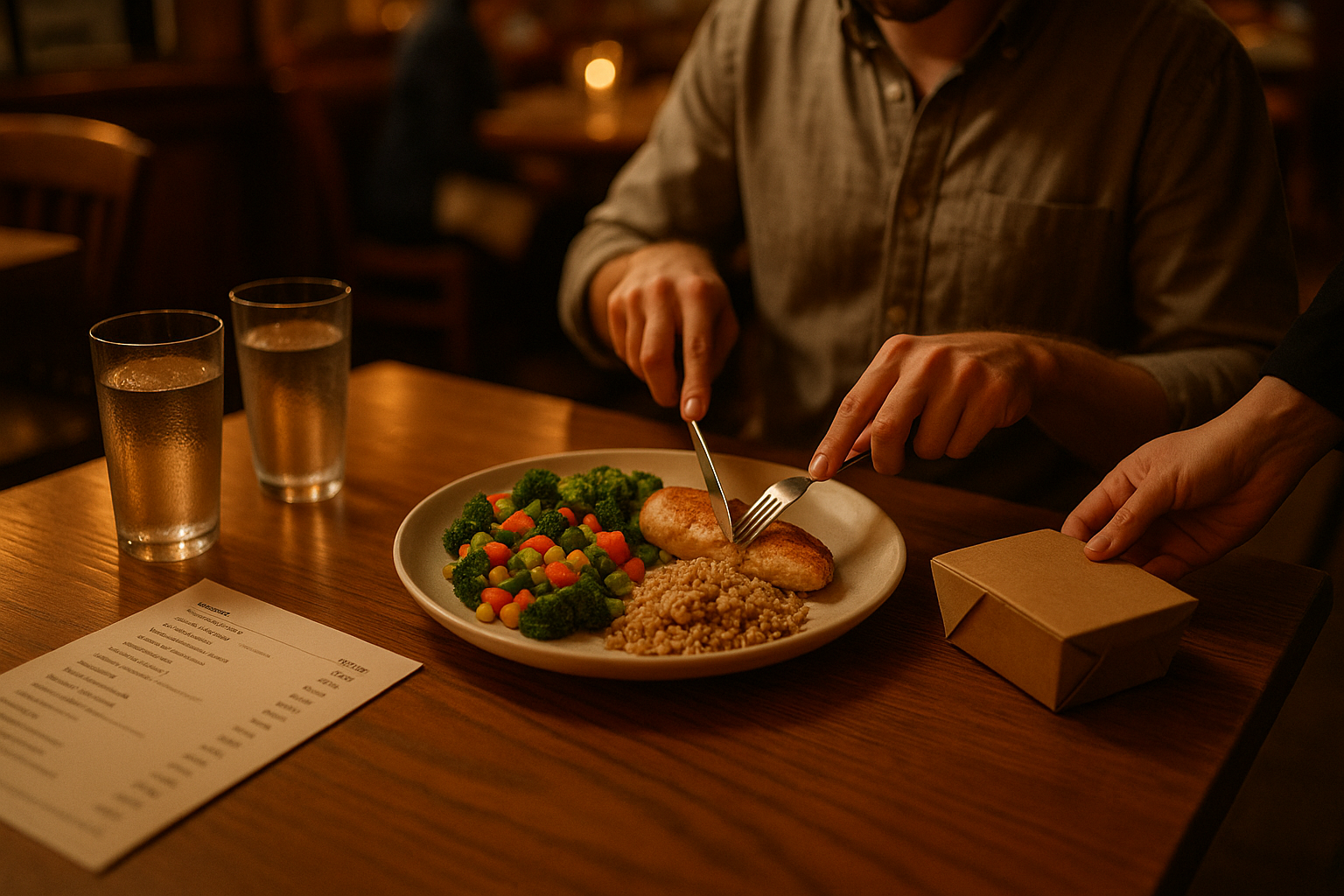
One of the most underrated restaurant skills is to pre-portion your meal. When you order, say: “Could you please box half before it comes out?” You’ll pay once, enjoy the dish twice, and avoid the urge to “finish” simply because it’s there. This is especially helpful at places known for generous servings or dishes drenched in rich sauces and cheese. If pre-boxing isn’t possible, mentally draw a line on the plate and shift half to one side, committing to take it home. Pair that with a starter salad or vegetable side so your plate still looks abundant.
3.1 Steps
- Request a to-go box when ordering; if that’s not possible, ask when the plate arrives.
- Portion out half immediately; close the lid; place it out of reach.
- Add low-calorie volume (greens, steamed veg, broth-based soups) to feel satisfied.
- Eat slowly; check fullness at the halfway point (see Section 6).
- Take leftovers home for a ready meal tomorrow.
3.2 Mini case
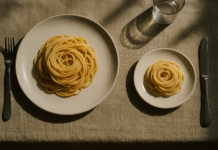
At an Italian spot, one standard pasta entrée can easily exceed many people’s needs for a single meal (studies sampling restaurant meals across countries consistently find high energy content). Halving it and adding a side salad converts a “food coma” into two satisfying meals.
Bottom line: portioning before the first bite is simpler—and more effective—than trying to stop halfway through.
4. Use the Plate Method Right at the Restaurant
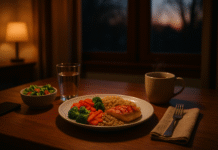
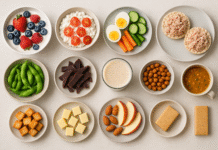
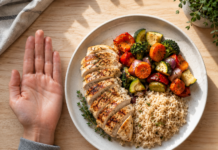
The Plate Method translates beautifully to restaurants: fill ½ your plate with non-starchy vegetables, ¼ with lean protein, and ¼ with whole grains or starchy veg. This visual template ensures you’re getting fiber, protein, and volume—the trio that supports fullness—without needing scales or apps. It also helps you navigate mixed dishes: if your main is carb-forward (e.g., noodles, rice bowls, pizza), balance the table by adding a plain veg side and protein-rich small plate. For salads, check ingredients to make sure they actually follow the pattern (greens + protein + whole-grain/starchy component) and ask for dressing on the side to dose to taste.
4.1 Tools/Examples
- Ask for extra vegetables or a double veg side to achieve the ½-plate goal.
- Choose grilled, roasted, steamed preparations to avoid hidden heavy sauces.
- For bowls: start with greens, add a fist of grains, palm of protein, colorful veg.
- For pizza: pair two slices with a large seasonal salad and grilled veg side.
- For curry: more veg + lean protein; share rice or naan across the table.
4.2 Why it matters
The Plate Method (popularized through national dietary guidance) helps people build balanced meals without measuring and naturally increases fiber and micronutrient intake. It’s a portion-control tool because it caps the starch/fat-dense quarter and expands low-calorie, high-volume vegetables.
Bottom line: the Plate Method makes quick visual sense, even with mixed cuisines and shared plates.
5. Front-Load Satiety: Protein, Fiber, and a Veg-First Start
Starting with a vegetable soup or salad and choosing a lean protein for your main can significantly change how full you feel per calorie. Vegetables add bulk and fiber; lean proteins like fish, poultry, tofu, beans, or lentils slow digestion and steady appetite. When you combine these with intact whole grains or starchy vegetables, you get long-lasting energy without the spike-and-crash of refined starches. If you arrive very hungry, explicitly sequence the meal: soup or salad first, then protein + veg, and save starches and desserts for last when you can better judge fullness.
5.1 Mini-checklist
- Lead with greens or broth-based soup; skip creamy starters if portion control is the aim.
- Opt for grilled fish, chicken, tofu, paneer, legumes as mains or small plates.
- Add beans or lentils to salads/bowls for extra fiber and protein.
- Choose whole-grain sides (brown rice, farro, quinoa) or starchy veg (sweet potato).
- Keep sauces on the side for better dosing.
5.2 Region notes
Many menus now mark higher-fiber, plant-forward dishes or offer swap-ins like extra veg instead of fries; use those icons or notes to build satiety into your order from the jump. Government tip sheets also encourage veg-first starts when dining out.
Bottom line: build satiety early so the rich bites don’t turn into a second entrée’s worth of calories.
6. Slow the Pace: Give Fullness Signals Time to Catch Up
Eating slowly isn’t about counting chews; it’s about creating a comfortable pace so your brain and gut can agree on “enough.” Many people notice fullness 10–20 minutes into a meal, so quick eaters can overshoot without realizing it. Research on eating rate shows mixed but promising effects on energy intake: slowing down can reduce intake for some people and may enhance satiety signals; mindful attention and fewer distractions (phone down, TV off) help too. In practice, pauses—putting the fork down between bites, sipping water, chatting—give your satiety system time to register comfort before the plate is empty. Live Science
6.1 How to do it
- Set a table rhythm: bite → put utensil down → sip water → talk → next bite.
- Aim to be the slowest eater at your table (in a friendly way).
- Check in at halfway: if you’re satisfied, pack the rest to go.
- Avoid eating while scrolling—distraction often increases intake.
6.2 Mini example
Turn a 7-minute “wolf down” into a 20-minute meal with conversation and water breaks; you’ll usually feel satisfied with less food—and enjoy it more.
Bottom line: slowing down is a universally useful, low-effort way to prevent accidental overeating.
7. Choose Smarter Preparations and Swaps (Without Losing Flavor)
Preparation methods change portions because they change how much energy density (calories per bite) lands on your plate. Grilled, roasted, broiled, steamed, or poached items usually come with less added fat and batter than deep-fried or cream-sauced options. Smart swaps keep the flavor while trimming energy density: vinaigrette instead of creamy dressing, salsa or chimichurri instead of heavy cream sauces, roasted potatoes instead of fries, or extra vegetables in place of some starch. Ask servers for dressing and sauces on the side so you can add flavor by the spoon, not by the ladle.
7.1 Practical swaps
- Sauces on the side; spoon 1–2 tablespoons at a time.
- Grilled/roasted instead of fried; salsa instead of cream sauce.
- Half starch + extra veg on bowls and plates.
- Whole-grain sides where available; skip the default fries.
- Add herbs, citrus, spice to keep dishes exciting without extra butter.
7.2 Why it works
Lowering energy density means your portion can be larger for the same calories—so you feel satisfied with less compromise. Restaurants that nudge portions by adding vegetables can increase veg intake without hurting satisfaction, which is precisely the goal.
Bottom line: cooking method and sauce strategy change how filling your plate feels for the same “visual” portion.
8. Hydrate Strategically: Water First, Sugary Drinks Last (or Not at All)
Drinks count. Sugary beverages and boozy cocktails add calories quickly without contributing much fullness. A simple tactic: have water before and during the meal. In some studies, drinking 500 ml (about 2 cups) of water 30 minutes before a main meal reduced energy intake or supported weight loss over time—especially in adults with higher body weights—though effects vary by person and context. Unsweetened tea or sparkling water with citrus keeps the experience festive. If you drink alcohol, consider one drink sipped slowly with food, or alternate each alcoholic drink with water.
8.1 Checklist
- Order water upon sitting; sip while scanning the menu.
- If you like a drink, pair it with food and go slow; alternate with water.
- Skip or downsize sugary drinks; ask for half-sweet options where offered.
- Try sparkling water with lime, iced tea, or a zero-sugar mixer.
8.2 Numbers & guardrails
Water preloading isn’t magic, but it’s a low-risk habit that can blunt “eyes bigger than stomach” ordering and eating—especially when you arrive very hungry.
Bottom line: what’s in your glass shapes how your plate feels; lead with water.
9. Manage the Bread Basket, Freebies, and Appetizer Traps
Free bread, chips and salsa, or papad can be delightful—and deceptive. Because they arrive fast and are shared, we often eat more than planned before the meal even starts. Portion control here is about intentionality: decide if these are worth it tonight, and if so, portion once (e.g., one piece of bread with olive oil, a small handful of chips) and move the basket out of reach. If bread or chips are your favorite part, you might plan a smaller main (two starters or half to-go) to keep the overall meal balanced.
9.1 Strategies
- Ask the server to hold or bring the basket with the main if you’re not interested.
- If you want some, portion once onto your side plate.
- Pair with veg-first starters (see Section 5) to buffer hunger.
- Keep your hands busy with water, conversation, or scanning the menu.
9.2 Why it’s important
These “free” starters are often energy dense and easy to eat mindlessly while you wait. Planning for—or against—them keeps the whole meal on track.
Bottom line: choose your pre-meal nibbles consciously, then move on to the food you came for.
10. Buffet, Family-Style, and All-You-Can-Eat: Create Gentle Rules
Buffets and family-style tables invite mindless refills. The fix is to set simple, visual rules before you serve yourself: do a reconnaissance lap, use a smaller plate, make your first plate ½ vegetables, and choose one starch and one protein you genuinely want. Sit with your back to the buffet if possible, and leave serving dishes out of reach at family-style meals. If you go for seconds, make it vegetables or fruit. Research continues to test cues and interventions for buffets; a consistent pattern is that guidance and plate-size changes can nudge people toward smaller self-served portions without ruining enjoyment.
10.1 Buffet checklist
- Survey everything; pick your favorites first, not “a little of everything.”
- Start with a salad plate or smaller plate if available.
- Build ½ veg, ¼ protein, ¼ starch on plate one.
- Sit far from the buffet; keep serving dishes off the table at family-style meals.
- Pause 10 minutes before considering seconds.
10.2 Region note
Some countries label calories at chain buffets; many do not. Use visual methods when numbers aren’t available.
Bottom line: a few pre-commitments turn unlimited food into a curated, satisfying meal.
11. Dessert Without Derailment: Share, Split, or Savor Slowly
Dessert can fit—if you plan it. Decide early: is tonight a dessert night? If yes, split one item across the table, choose fruit-forward options, or ask for a mini portion if the restaurant offers it. Eat it slowly and stop at “satisfied,” not “stuffed.” Avoid extreme social media “rules” like the viral “three-bite rule”; rigid limits can backfire, promoting guilt or disordered habits. A compassionate, flexible approach—sharing, savoring, and stopping when content—is more sustainable and enjoyable, and avoids turning a sweet finish into an uncomfortable night.
11.1 Practical options
- Share one dessert; ask for extra spoons.
- Choose fruit-based or sorbet options if you want something lighter.
- If you love rich desserts, plan the main meal smaller (Sections 2–3).
- Savor: small bites, pause between tastes, and stop when the joy drops.
11.2 Mini example
Two people split a molten cake after sharing a main and a veg side. Because the earlier courses were portioned, dessert lands as a happy finish, not a tipping point.
Bottom line: dessert is a choice, not a trap—share it, savor it, or skip it with zero drama.
12. Know the Landscape: Menu Labels, Mixed Evidence on Plate Size, and Realistic Expectations
Portion control isn’t about perfection; it’s about knowing your environment and using the levers that actually help. Calorie labeling at large U.S. chains has been in effect since 2018, and U.K. out-of-home calorie labeling applies to large businesses—use these numbers to compare options. Evidence is strong that larger served portions drive higher energy intake; cutting portions reduces intake. Other popular tips, like using smaller plates, show mixed effects in trials—use them if they help you, but don’t rely on them as your only strategy. Remember too that many restaurant entrées are energy-dense compared with home-cooked meals; small format choices, veg-first sequencing, and pre-portioning are what consistently protect you.
12.1 Practical synthesis
- Trust portion size and format over hacks with mixed evidence.
- Use menu labels where available for relative comparisons.
- Expect many entrées to be rich; plan two-starter meals or half-to-go.
- Keep your focus on enjoyment and comfort, not perfection.
12.2 Takeaway
When you know which levers work reliably (portion size, meal structure, pace), dining out becomes both fun and aligned with your goals.
Bottom line: combine proven levers—portion size, planning, pacing—with flexible, compassionate choices for a dining experience you actually enjoy.
FAQs
1) What is “portion control” when dining out, in one sentence?
It’s the practice of choosing smaller default servings and structuring your meal—using tools like menu calories, two-starter meals, pre-boxing half, veg-first sequencing, and slower eating—so you stop at comfortable fullness while still enjoying the experience.
2) Are menu calorie numbers accurate enough to trust?
They’re estimates, not lab results, but they’re good for comparisons (picking among similar dishes). Use labels to shortlist options and then apply the format tools in this guide; even imperfect numbers help you avoid the richest outliers. U.S. and U.K. rules cover large operators, so independents may not have labeling.
3) Does using a smaller plate really make you eat less?
Sometimes, but not always. Studies show mixed results: some find smaller plates reduce intake, others find little difference. Treat smaller plates as a cue, not a guarantee, and pair them with the higher-impact strategies here (pre-portioning, veg volume, meal pacing).
4) How can I keep from overeating before the main course arrives?
Decide in advance about the bread/chips; if you want some, portion once onto your plate and move the basket away. Ordering a broth-based soup or salad to come out first gives you warm, satisfying volume so you’re not “pre-full” before the entrée.
5) What’s a smart drink strategy at restaurants?
Lead with water. Consider 500 ml (about 2 cups) 30 minutes before the main meal, which supported lower intake or weight loss in some studies; then sip water between bites. If you drink alcohol, have it with food and alternate with water; skip or downsize sugary drinks.
6) I’m at a buffet—how do I avoid three full plates?
Do a reconnaissance lap, start with a smaller plate, build the first one ½ veg, ¼ protein, ¼ starch, and sit with your back to the buffet. If you go for seconds, make it vegetables or fruit. These structural choices lower the odds of mindless refills.
7) Is eating slowly really important, or is it a myth?
There’s real value in slowing down: some studies show reduced intake and improved satiety when people eat more slowly, though results vary. Practically, pausing between bites and putting your phone away helps you notice “comfortable” before “stuffed,” which is the goal. PMC
8) How do I handle dessert without derailing the meal?
Decide early. If it’s a dessert night, share one or choose something fruit-forward and eat it slowly. Avoid rigid social-media “rules” like “only three bites,” which can promote guilt or disordered patterns; flexible, shared enjoyment works better long term.
9) Are restaurant meals really that calorie-dense?
Many are. Studies sampling meals from full-service and fast-food restaurants in multiple countries found high energy contents, especially in certain cuisines and dishes. That’s why format (two starters, share, half-to-go) plus veg volume is so effective.
10) I don’t see calories on the menu—now what?
Use the Plate Method and format choices instead: two starters as a main, extra vegetables in place of some starch, grilled/roasted proteins, and pre-portioning. Ask your server for lighter preparation methods and sauces on the side to control dosing.
11) What about mindful eating—does it actually change intake?
Short-term studies suggest mindful attention can help some people reduce intake or improve dietary quality, while others show mixed results. It pairs well with structural tactics: slower eating, fewer distractions, and clear portioning decisions at the start of the meal. PMC
12) I have diabetes—any special portion tips at restaurants?
Lead with non-starchy vegetables and protein, measure starches more deliberately (¼ plate), and choose drinks without added sugars. Buffets are manageable if you survey first, use a smaller plate, and pause between servings. Always tailor plans with your clinician or dietitian and monitor how different meals affect you. EatingWell
Conclusion
Portion control when dining out isn’t about rigid rules; it’s about structuring the experience so you get the flavors and the fun without the “why did I eat so much?” aftermath. The strategies with the strongest track record are also the simplest: set your format before you order, leverage menu labels where available, build plates around vegetables and lean proteins, and slow the pace so fullness can catch up. Add in smart swaps and practical guardrails for bread baskets, drinks, buffets, and dessert, and you’ve covered the moments where overeating most often sneaks in. Most importantly, lead with enjoyment and curiosity—choose what you genuinely want, eat it attentively, and stop at contentment. That’s sustainable portion control.
Copy-ready next step: On your next restaurant visit, pick your format (two starters or half-to-go), order water first, and decide in advance about bread and dessert—then relax and enjoy your meal.
References
- Menu Labeling Requirements. U.S. Food & Drug Administration (Dec 13, 2023). https://www.fda.gov/food/nutrition-food-labeling-and-critical-foods/menu-labeling-requirements
- Calories on the Menu. U.S. Food & Drug Administration (Feb 25, 2022). https://www.fda.gov/food/nutrition-education-resources-materials/calories-menu
- Calorie Labelling in the Out of Home Sector: Implementation Guidance. UK Department of Health and Social Care (Sep 17, 2021). https://www.gov.uk/government/publications/calorie-labelling-in-the-out-of-home-sector/calorie-labelling-in-the-out-of-home-sector-implementation-guidance
- Higgins KA, et al. Systematic Review and Meta-Analysis on the Effect of Portion Size on Energy Intake. Nutrients (2021). https://pmc.ncbi.nlm.nih.gov/articles/PMC8803498/
- Robinson E., et al. Downsizing Food: A Systematic Review and Meta-analysis of the Effect of Reducing Served Food Portion Size on Daily Energy Intake and Body Weight. PLOS Medicine (2022). https://pmc.ncbi.nlm.nih.gov/articles/PMC9975786/
- Peng M., et al. How Does Plate Size Affect Estimated Satiation and Intake? Journal of Sensory Studies (2017). https://pmc.ncbi.nlm.nih.gov/articles/PMC5598018/
- Roberts SB., et al. Measured Energy Content of Frequently Purchased Restaurant Meals in Five Countries. BMJ (2018). https://www.bmj.com/content/363/bmj.k4864
- Dine Out / Take Out. USDA MyPlate (accessed 2025). https://www.myplate.gov/tip-sheet/dine-out-take-out
- Parretti HM., et al. Efficacy of Water Preloading Before Main Meals as a Weight Loss Strategy in Primary Care. Obesity (2015). https://onlinelibrary.wiley.com/doi/full/10.1002/oby.21167
- Davy BM., et al. Water Consumption Reduces Energy Intake at a Breakfast Meal in Overweight and Obese Older Adults. Journal of the American Dietetic Association (2008). https://pubmed.ncbi.nlm.nih.gov/18589036/
- Simonson AP., et al. Comparison of Mindful and Slow Eating Strategies on Acute Energy Intake. Obesity Science & Practice (2020). https://pmc.ncbi.nlm.nih.gov/articles/PMC7746965/
- Reinders MJ., et al. Menu-Engineering in Restaurants: Adapting Portion Sizes on Vegetables and Protein. International Journal of Behavioral Nutrition and Physical Activity (2017). https://ijbnpa.biomedcentral.com/articles/10.1186/s12966-017-0496-9
- Greene D., et al. Guiding People to Take Less Food from the Buffet. Food Quality and Preference (2024). https://www.sciencedirect.com/science/article/pii/S0950329324001757
- Marie Claire. TikTok’s “Three Bite Rule” Trend…Why Nutritionists Warn Against It. (Aug 2025). https://www.marieclaire.co.uk/life/health-fitness/tiktok-three-bite-rule
- Rakha A., et al. Drivers of Satiety Impacting Energy Intake: A Review. Frontiers in Nutrition (2022). https://pmc.ncbi.nlm.nih.gov/articles/PMC9549911/