




























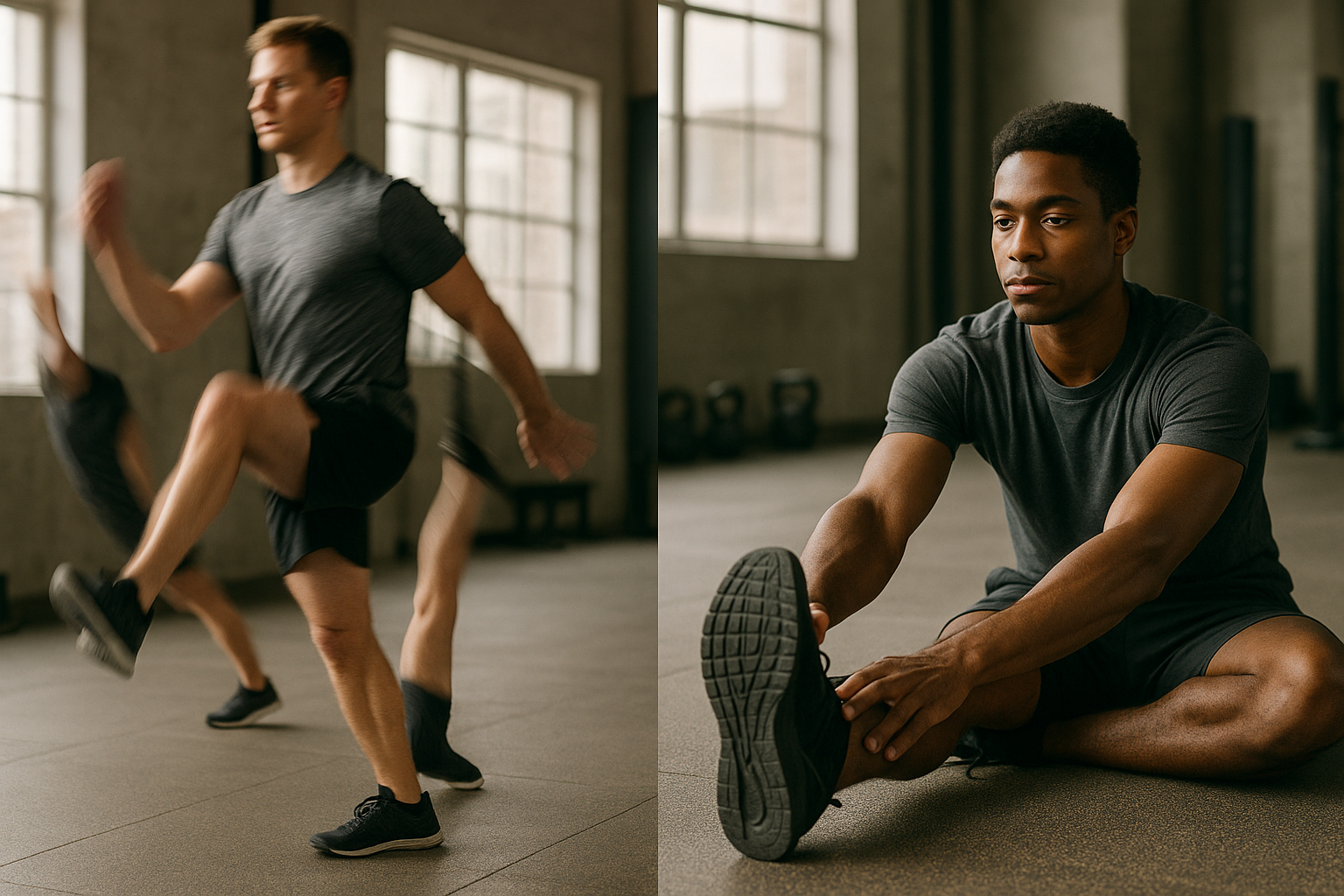
If you’ve ever wondered whether to warm up with moving drills or hold classic end-range stretches, you’re not alone. This guide breaks down dynamic flexibility vs static stretching with nine clear use cases so you can pick the right tool at the right time—whether you’re chasing speed, strength, endurance, or simply moving better day to day. Brief note: this article is educational and not a substitute for medical advice; if you’re injured or rehabbing, follow your clinician’s plan. In one line: use dynamic flexibility before activity to raise temperature, groove movement, and prime the nervous system; use static stretching after activity or in separate sessions to build and maintain range of motion (ROM). Quick chooser: before workouts go dynamic; after workouts and on off-days go static for ROM; keep long static holds out of explosive warm-ups.
Fast answer (for snippets): Dynamic flexibility involves active, controlled movement through ROM to prepare the body for action; static stretching is a passive hold at end range to improve flexibility. Choose dynamic pre-workout; choose static post-workout or in separate ROM sessions.
Quick steps to decide right now
- Identify your session goal (power, strength, endurance, mobility).
- If performance today matters, go dynamic in the warm-up.
- If flexibility over weeks matters, schedule static holds post-workout or on off-days.
- Keep any pre-workout static holds brief and targeted if a specific joint is limiting technique.
1. Power & Speed Sessions (Sprints, Jumps, Olympic Lifts)
Choose dynamic flexibility here; avoid long pre-workout static holds that can dampen explosive output. Power and speed depend on rapid force development and neural drive, both of which are acutely supported by temperature, stiffness tuning, and rehearsal of sport-specific patterns—hallmarks of dynamic warm-ups. Static stretching’s main upside is ROM over time, not immediate power, and longer holds (around a minute or more per muscle) can transiently reduce maximal strength or explosive performance. That doesn’t mean static is “bad”; it just belongs later in the day or after training. If a specific restriction is blocking safe technique (e.g., hip extension for sprint mechanics), keep any static hold brief and follow it with activation and movement prep.
1.1 Why it matters
Dynamic drills elevate core and intramuscular temperature, enhance motor unit recruitment, and pattern the exact movement you’re about to perform, supporting sprint times, jump height, and bar speed. Static holds, especially long ones, trend in the opposite direction for power outputs.
1.2 Numbers & guardrails (as of August 2025)
- Dynamic sets: 1–2 rounds of 6–10 reps per drill (smooth, not ballistic).
- Total warm-up time: ~8–12 minutes before main efforts.
- Pre-workout static holds: if truly needed, keep to ≤20–30 seconds and immediately follow with activation (e.g., band walks).
Mini sequence (power day)
- Light cardio 3–4 min → A-marches/A-skips → walking lunges + rotation → leg swings (front/side) → pogo hops → 3–5 short accelerations.
Wrap-up: for maximal pop, stay dynamic up front and bank your longer static holds for after the session.
2. Heavy Strength Days (Squats, Deadlifts, Presses)
Prioritize dynamic flexibility to open working ranges while preserving stiffness for force transfer, then use ramp-up sets to finish the job. Heavy barbell work benefits from tissue temperature, joint lubrication, and patterning under the empty bar—not from long passive holds right before your top sets. That said, a tight hip flexor or ankle can cap depth or neutral spine. In that case, insert brief, targeted static holds only to clear the minimum ROM needed, and immediately “re-stiffen” with activation (e.g., calf raises, glute bridges) and progressively heavier warm-up sets.
2.1 How to do it
- General warm-up (5 min): easy row/bike, thoracic openers.
- Dynamic mobility (6–8 min): ankle rocks, 90/90 switches, adductor rocks, PVC pass-throughs.
- Activation (3–5 min): banded glute work, scap push-ups.
- Ramp-up sets: 3–4 sets increasing load while nailing depth and bar path.
2.2 Common mistakes
- Long static hamstring holds before deadlifts (can sap pulling crispness).
- Skipping ankle prep before squats, then blaming “tight hips.”
- Random stretching with no link to the day’s main lifts.
Numeric example
If your working squat is 100 kg: empty bar ×10 → 40 kg ×5 → 60 kg ×3 → 80 kg ×2, then first working set. Insert a 20–30 s calf/hip flexor hold only if depth is limited, then do 10 heel raises or a light sled push.
Bottom line: use dynamic + ramp-ups as the default; static is a scalpel, not a sledgehammer.
3. Endurance Workouts (Runs, Rides, Rowing, Field Sports)
Go dynamic pre-session to reduce perceived stiffness and ready the gait cycle; park static holds for after or separate blocks. Endurance sessions need economical movement and gradual physiological ramping, both helped by dynamic drills—think leg swings, walking lunges, high knees, and short strides. Static holds don’t meaningfully prevent overuse injuries when done right before a run or ride, and they can feel “flat” for the first kilometers. After you finish, static can help maintain calf, hamstring, and hip ROM across training cycles.
3.1 Pre-run dynamic flow (6–8 minutes)
- 3–4 min brisk walk/jog
- Walking lunges with arm sweep ×10 each leg
- Leg swings (front/back, side) ×10 each
- Ankle circles + calf rocks ×10
- 2–3 × 60–80 m strides or spin-ups
3.2 Post-session static targets (8–12 minutes total)
- Calf wall stretch 2–4 × 20–30 s each
- Hip flexor half-kneel 2–4 × 20–30 s each
- Hamstring doorframe 2–4 × 20–30 s each
Region note (hot/humid climates): In very warm conditions (e.g., coastal South Asia summers), shorten the pre-session dynamic block by 2–3 minutes and start slower to manage heat load.
Takeaway: dynamic to start, static to sustain your stride over the long term.
4. Post-Workout Cooldown & Recovery Window
This is static’s home turf: hold gentle end-range positions after your session or later the same day to consolidate ROM adaptations and downshift your nervous system. Static stretching right after workouts won’t erase soreness by itself, but it can reduce perceived tightness and supports flexibility over weeks when done consistently. Keep the vibe relaxed, breathe, and never force a painful end range. Dynamic work post-session is optional unless you’re doing technique flushes or mobility circuits.
4.1 Mini-checklist
- Timing: immediately post-workout or evening wind-down.
- Dose: 2–4 sets of 20–30 s holds per muscle; older adults often benefit from 30–60 s.
- Order: hips → quads → hamstrings → calves → chest/shoulders → lats.
- Breathing: 4–6 slow breaths per hold; exhale into the stretch.
4.2 Common pitfalls
- Bouncing (ballistic) during cooldown.
- Pushing to pain instead of a firm, calm stretch sensation.
- Doing static only once a week and expecting big changes.
Example 10-minute sequence
Half-kneeling hip flexor (with glute squeeze), prone quad, hamstring strap, calf wall, doorway pec, child’s pose lat reach—2 × 30 s each side.
Net: cooldown static is a reliable, low-cost way to maintain and slowly build ROM.
5. Dedicated Flexibility Gains (Separate Mobility Sessions)
To meaningfully increase ROM over weeks, schedule static stretching (and optionally PNF/contract-relax) in stand-alone sessions or after light activity. Dynamic drills are excellent preparation but don’t drive long-term end-range tolerance as effectively as accumulated static time under tension. Twice to three times per week is a practical cadence for most people. Progress by extending total hold time per muscle, not by forcing painful extremes.
5.1 Numbers & progression
- Frequency: 2–3 days/week; total 10–15 minutes per targeted region.
- Holds: 2–4 × 20–30 s (30–60 s for older adults), rest 10–15 s between.
- PNF option: contract 5–6 s at ~30–50% effort, relax, then hold 20–30 s deeper.
5.2 Tools/Examples
- Hip flexors: couch stretch
- Hamstrings: doorframe/strap
- Adductors: frog stretch
- Shoulders: sleeper stretch, doorway pec
Mini case
Goal: palm-to-floor hamstring ROM in 8 weeks. Protocol: 3 days/week, doorframe hamstring 4 × 30 s + PNF once per session, plus daily 2-minute calf/ankle work. Re-test each week at the same time of day.
Bottom line: if ROM improvements are the goal, structured static work (with optional PNF) is your main driver.
6. Rehab & Return-to-Play (Under Clinician Guidance)
Use both methods strategically, but let your clinician set the sequence and dose. Early rehab often relies on gentle static holds to restore pain-free range without provoking symptoms, while later phases reintroduce dynamic mobility to integrate the regained ROM into real movement. The crucial distinction is tissue irritability: static can be dosed in seconds and perceived intensity; dynamic adds velocity and complexity that may need to wait. When you do add dynamic, start with low-amplitude, slow drills and progress to sport-specific patterns.
6.1 Practical guideposts
- Start sessions with heat or light cardio if cleared, then gentle static to the first stretch sensation.
- Progress to slow dynamic (e.g., controlled articular rotations) before adding faster drills.
- Pair new ROM with isometrics/isotonics to “own” it (e.g., end-range lifts).
- Log symptoms 24 hours later to calibrate dose.
6.2 Common mistakes
- Skipping static entirely because “stretching is bad for performance.”
- Jumping to high-velocity dynamic drills before tissue tolerance is ready.
- Chasing symmetry too soon; prioritize pain-free function.
Mini example
Post-ankle sprain (later stage): 2 × 30 s calf/soleus holds → controlled ankle circles ×10 → short shuffles and low skips → return-to-run progressions over days.
Key message: in rehab, static restores access; dynamic restores control.
7. Morning Stiffness, Desk Breaks & Travel Days
Favor gentle dynamic flows to get synovial fluid moving and reduce “sleep” stiffness; sprinkle in brief static holds only for areas that consistently feel restricted. Your nervous system is less primed early in the day, and long static holds can feel groggy or uncomfortable. Short movement snacks—spine segmentation, hip circles, arm sweeps—wake things up without needing a full workout. Static holds still have a place here if, for example, your hip flexors are chronically tight from sitting.
7.1 5-minute desk break
- Standing thoracic rotations ×10 each side
- Hip CARs (controlled circles) ×5 each way/leg
- Calf rocks ×15
- Doorway pec stretch 2 × 20–30 s
- Neck side-bends with gentle overpressure 2 × 15 s
7.2 Travel and heat notes
- Travel: do dynamic every 60–90 minutes (calf pumps, hip openers), then a short static block at day’s end.
- Hot/humid climates: keep dynamic smooth and shorter to avoid overheating; hydrate before any prolonged static holds.
Close-out: for everyday stiffness, motion is lotion—go dynamic first, add short static where your body asks for it.
8. Sport-Specific Technique & Mobility Demands
Blend dynamic prep with technique-matching drills before practice; reserve longer static holds for separate mobility work that supports the positions your sport needs. Swimmers, throwers, lifters, and dancers all face unique end-range demands. Dynamic warm-ups should rehearse those shapes at gradually increasing amplitude and speed, while static work later expands the envelope safely. Coaches and athletes can anchor this to key positions: overhead flexion for swimmers, hip external rotation for guards, front-rack mobility for lifters.
8.1 Templates
- Overhead sports: band dislocates, wall slides, serratus activations pre-session; doorway pec and lat stretches post.
- Field sports: skips, carioca, lateral lunges pre-session; adductor and hip flexor statics post.
- Weightlifting: empty-bar complexes pre-session; front-rack triceps/lat statics post.
8.2 Numbers & checks
- Dynamic: 1–2 rounds, 6–8 reps/drill, ramp intensity gradually.
- Static (separate or post): 2–4 × 20–30 s per target region.
- Screen: can you hit required joint angles without compensation? If not, prioritize mobility block.
In short: mirror your sport with dynamic first; build capacity for those shapes with static later.
9. When Time Is Tight: 5-Minute Warm-Up & 5-Minute Cooldown
On busy days, pick the highest-leverage pieces: a short dynamic circuit before you start, and a short static sequence afterward. Even five minutes of thoughtful prep can reduce stiffness and improve movement quality. The cooldown keeps your flexibility work from being “all or nothing.” Use a timer, keep transitions crisp, and avoid chasing intensity during the warm-up—you’re preparing, not performing.
9.1 5-minute dynamic warm-up (all-purpose)
- 60 s brisk cardio
- 45 s walking lunges + rotation
- 45 s leg swings (split front/side)
- 45 s inchworms
- 45 s pogo hops or skipping
- 60 s of movement rehearsal (e.g., empty-bar, easy strides)
9.2 5-minute static cooldown
- 30 s hip flexor each side
- 30 s hamstring each side
- 30 s calf each side
- 30 s pec doorway each side
- 30 s lat/child’s pose each side
Final word: short windows still count—stay dynamic before, go static after.
FAQs
1) What’s the simplest rule to remember?
Use dynamic flexibility to warm up before activity because it raises temperature and grooves the movement you’re about to perform. Use static stretching after activity or in separate sessions to gradually increase ROM. If you must use static before training to fix a position, keep it brief (around 20–30 seconds) and follow with activation.
2) Does static stretching before workouts cause injuries?
There’s no strong evidence that a brief static stretch before training directly causes injuries. The concern is performance—longer pre-workout holds (about a minute or more per muscle) can temporarily reduce maximal force or explosive output. If you need static to get into a safe position, keep it short and re-activate the muscle group.
3) Can dynamic stretching improve performance?
Yes, especially for tasks relying on speed, jump height, or quick changes of direction. Dynamic drills enhance neural readiness and temperature, and they pattern sport-specific mechanics. Athletes typically report better “snap” and coordination after a well-built dynamic warm-up of 8–12 minutes.
4) Will static stretching reduce soreness (DOMS)?
Static stretching may slightly reduce perceived soreness on a 100-point scale, but the effect is small and not a recovery cure-all. Sleep, nutrition, gradual loading, and active recovery matter more. Use static post-workout to maintain ROM; don’t expect it to erase DOMS by itself.
5) How long should I hold a static stretch?
For most adults, 20–30 seconds per hold, repeated 2–4 times, works well. Older adults often benefit from 30–60-second holds. Breathe slowly, aim for a firm stretch sensation (not pain), and accumulate time consistently across the week for best results.
6) What about PNF (contract-relax) stretching?
PNF can produce larger short-term ROM gains by pairing a light contraction (about 5–6 seconds at 30–50% effort) with a subsequent deeper hold. It’s best done after training or in a separate mobility block, not immediately before explosive performance.
7) Is ballistic stretching safe?
Ballistic stretching uses bouncing movements to push end range and is generally not necessary for most people. Well-controlled dynamic drills achieve readiness without the risks of uncontrolled end-range bouncing. If used by advanced athletes, it should be programmed carefully by a skilled coach.
8) How many days per week should I stretch to actually get more flexible?
Two to three days per week is a realistic minimum; more frequent, shorter sessions often beat one long weekly grind. Target the specific tissues that limit your goals (e.g., hip flexors for running economy, lats/triceps for front-rack position).
9) I sit all day—what’s the best approach?
Do brief dynamic movement snacks every 60–90 minutes (hip circles, thoracic rotations, calf rocks), then a short static block for predictable tight spots (hip flexors, pecs) in the evening. This splits “feel-better now” (dynamic) from “get more range” (static).
10) Should runners stretch before a race?
Use a short dynamic routine with strides to dial in cadence and mechanics. Skip long static holds in the last minutes before the start. If a specific area feels tight, keep any static to ≤20–30 seconds and follow with an activation drill like calf raises or skips.
Conclusion
“Dynamic vs static” isn’t a debate so much as a programming choice: dynamic flexibility is your ignition key; static stretching is your slow-burn engine for bigger ranges. When you separate readiness from ROM development, your warm-ups feel better and your performance becomes more consistent. Start sessions with targeted dynamic drills that mirror your day’s demands; finish with calm static holds to maintain or gradually expand your end ranges. Over weeks, add brief PNF work if you need faster ROM gains. In hot or time-crunched contexts, shorten the warm-up and keep it smooth; in rehab, let symptoms dictate the pace and mix. Put simply: go dynamic before you go; go static to grow.
CTA: Save this guide and plug the 5-minute warm-up/cooldown templates into your next session.
References
- A review of the acute effects of static and dynamic stretching on performance — European Journal of Applied Physiology, Behm & Chaouachi, 2011. https://pubmed.ncbi.nlm.nih.gov/21373870/
- Effect of acute static stretch on maximal muscle performance: a systematic review — Scandinavian Journal of Medicine & Science in Sports, Kay & Blazevich, 2012. https://pubmed.ncbi.nlm.nih.gov/21659901/
- Does pre-exercise static stretching inhibit maximal muscular performance? A meta-analytical review — Scandinavian Journal of Medicine & Science in Sports, Simic et al., 2013. https://onlinelibrary.wiley.com/doi/abs/10.1111/j.1600-0838.2012.01444.x
- Acute Effects of Dynamic Stretching on Muscle Flexibility and Performance: An Analysis of the Current Literature — Opplert & Babault, 2018. https://pubmed.ncbi.nlm.nih.gov/29063454/
- Effects of stretching before and after exercising on muscle soreness and risk of injury — Herbert & Gabriel, 2002. https://pubmed.ncbi.nlm.nih.gov/12202327/
- Stretching to prevent or reduce muscle soreness after exercise — Cochrane Review, Herbert & de Noronha, 2011. https://pubmed.ncbi.nlm.nih.gov/21735398/
- Stretching and Flexibility Guidelines Update — American College of Sports Medicine (ACSM) blog, Mar 18, 2021. https://rebrandx.acsm.org/blog-detail/acsm-certified-blog/2021/03/18/stretching-and-flexibility-guidelines-update
- Revisiting the “Whys” and “Hows” of the Warm-Up: Are We Doing What We Think We Are Doing? — Sports Medicine – Open, Afonso et al., 2023. https://pmc.ncbi.nlm.nih.gov/articles/PMC10798919/
- Impact of warm-up methods on strength-speed for sprinters — Frontiers in Sports and Active Living, Herrera & Suarez, 2024. https://www.frontiersin.org/articles/10.3389/fspor.2024.1360414/full
- A guide to basic stretches — Mayo Clinic, updated Apr 17, 2024. https://www.mayoclinic.org/healthy-lifestyle/fitness/in-depth/stretching/art-20546848
- Dynamic Warm-Ups for the Land-Based Athlete — National Strength and Conditioning Association (NSCA), technical PDF, 2018. https://www.nsca.com/contentassets/11647622285541019ee8ed532743cce5/coach-5.1.4-dynamic-warm-ups-for-the-land-based-athlete.pdf
- Revisiting the stretch-induced force deficit: a systematic review — Journal of Sport and Health Science, Warneke et al., 2024. https://www.sciencedirect.com/science/article/pii/S2095254624000693