























Tight ankles limit your stride, increase braking forces, and can shift stress up the chain to your knees and hips. The fastest fix is a small, consistent routine that increases dorsiflexion (knee moving over toes) and control of your foot and calf complex. Ankle mobility exercises for runners are simple drills—many weight-bearing—that improve dorsiflexion, tissue tolerance, and balance so you run smoother and with fewer niggles. In brief: test your range, pick 3–4 drills from the list below, train them 3–5 days per week, and retest every 2–3 weeks. Quick note: this article is educational and not a substitute for medical care; if pain persists, see a clinician.
Quick start (2-minute plan): Test your knee-to-wall distance (see #1). Warm up with 2–3 dynamic drills. Do one stretch (bent-knee soleus), one strength move (end-range calf raise), and one control drill (short foot or balance). Finish with a brief cool-down stretch.
Why dorsiflexion matters: Restricted ankle dorsiflexion changes knee/hip mechanics and has been linked to movement patterns associated with higher injury risk in athletes. Typical adult dorsiflexion is ~20–25° non-weight-bearing; in weight-bearing, studies report ~25° with the knee straight and ~39° with the knee flexed, though methods differ. Improving what you can control—mobility, strength at end-range, and foot control—pays off in running economy and resilience.
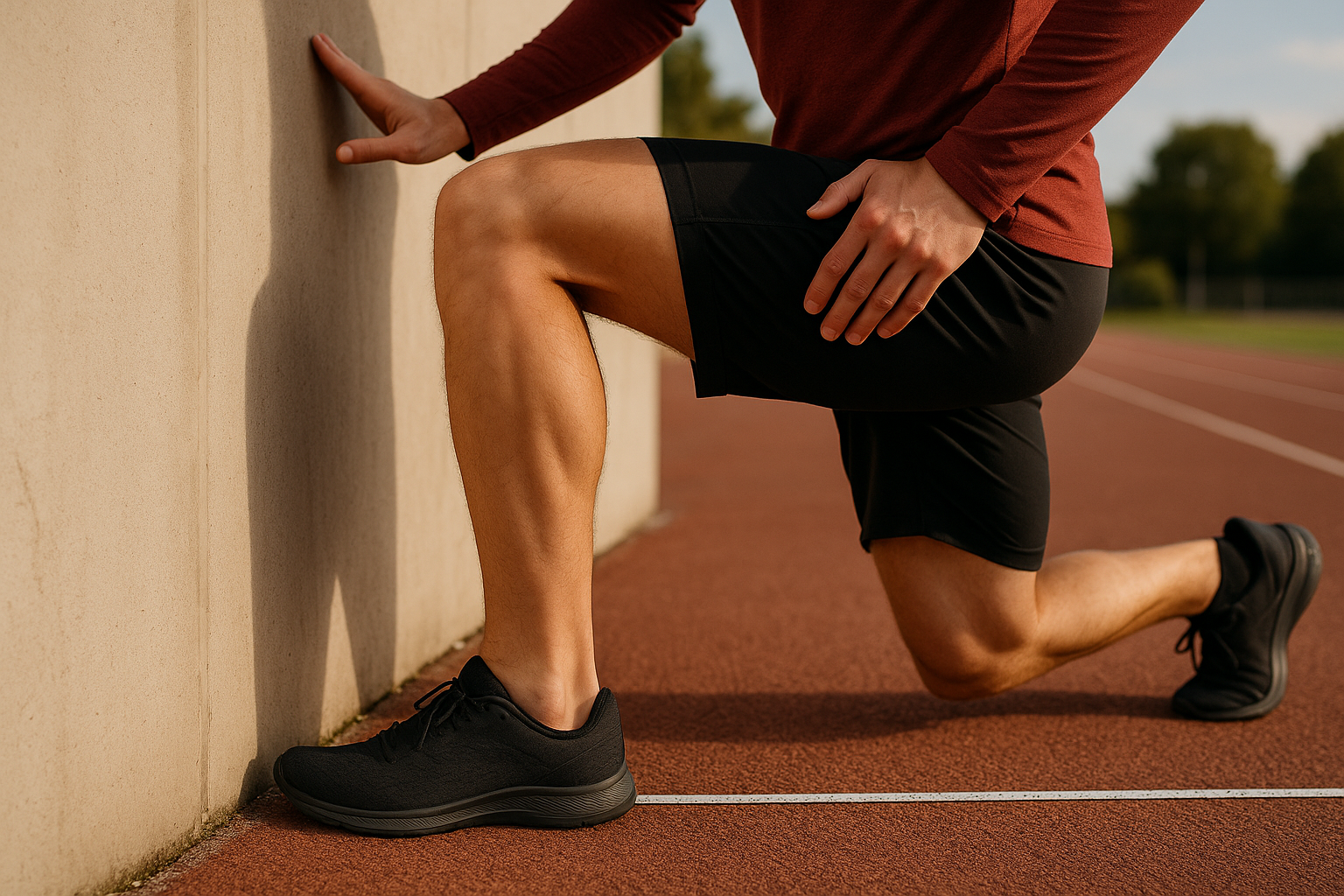
1. Knee-to-Wall (Weight-Bearing Lunge) Mobilization
This is the simplest way to both measure and improve dorsiflexion. Standing facing a wall, you drive the knee toward the wall without letting your heel lift; over days and weeks you gradually step the foot back. It mirrors running because it’s weight-bearing, and it gives you a clear benchmark (centimeters from big toe to wall). The weight-bearing lunge/knee-to-wall test shows excellent reliability and is widely used in sport settings, so you can trust changes you see. Many adults land around 8–12 cm; use your baseline and work from there. If one side is tighter by >2 cm, prioritize that side for a few weeks.
How to do it (daily or post-run):
- Stand in a half-lunge with the front foot ~5 cm from a wall; keep the heel down.
- Gently touch the front knee to the wall; don’t collapse the arch.
- Slide the foot back 1–2 cm at a time until the heel wants to lift; stop there.
- Pulse in and out of the end range for 10–15 reps; hold the last rep 10–20 s.
- Do 2–3 sets per side; retest distance weekly and note the best of three.
Why it works
Weight-bearing dorsiflexion is task-specific for running and squatting. The test has good intra-/inter-rater reliability (ICC often ≥0.85–0.99), so small gains (≥1–2 cm) are meaningful.
Numbers & guardrails
- Target: Add 1–3 cm over 4–8 weeks.
- Norms vary: Average adult knee-to-wall often falls near 10–11 cm in some cohorts; don’t chase a number—chase symmetry and pain-free function.
Bottom line: Make this your anchor drill—measure, mobilize, and track your progress with the same setup each time.
2. Banded Posterior Talar Glide (Ankle Joint Mobilization)
When ankle bone (talus) glide is limited, mobilizations can help create space for the tibia to travel over the foot. The popular banded posterior glide wraps a thick band low across the ankle (just below the malleoli) and pulls backward as you drive the knee forward. Runners like it because it often gives an immediate sense of extra room at the front of the ankle. Evidence is emerging for manual/tissue techniques to acutely increase dorsiflexion; think of this as a gentle adjunct to your weight-bearing lunge and not a standalone cure.
How to do it (3–4×/week):
- Anchor a heavy band at floor level behind you; loop it around the ankle crease of the working leg.
- Step forward so the band pulls straight back on the talus.
- Keep the heel heavy; drive the knee over the 2nd–3rd toes for 10 slow reps.
- Hold the last rep 20–30 s; do 2–3 sets, then retest knee-to-wall.
Common mistakes
- Band riding too high (on the shin) or too loose.
- Collapsing the arch or turning the foot out to “fake” range.
- Forcing through pinching pain at the front of the ankle.
Numbers & guardrails
If you feel a sharp pinch at the front, back off and switch to #1 and #3 for a week. Mobilizations should feel like pressure/ stretch—not pain. Evidence supports manual/mobilization techniques for short-term dorsiflexion increases; long-term changes require consistent loading and stretching.
Bottom line: Use the band to “clear the jam,” then load the new range with stretches and heel raises.
3. Bent-Knee Soleus Wall Stretch (Soleus-Biased Calf Stretch)
If your ankle feels blocked mostly with the knee bent, your soleus (deep calf) is likely the limiter. Bent-knee wall stretches bias the soleus and are essential for runners because mid-stance dorsiflexion happens with a flexed knee. Major guidelines suggest static stretches of 10–30 s for most adults (30–60 s for older adults), repeated 2–4 times; place them after running or a warm-up to avoid performance dips. PMC
How to do it (post-run or evenings):
- Stand facing a wall; step the stretching leg forward.
- Bend both knees and drive the front knee toward the wall, heel down.
- You should feel it low in the calf/Achilles (not behind the knee).
- Hold 20–30 s, ease out 10 s, repeat 2–4 times.
- Breathe; keep the arch from collapsing.
Why it matters
Weight-bearing dorsiflexion with a bent knee mirrors running. In weight-bearing studies, dorsiflexion angles are substantially higher with the knee flexed versus extended, indicating different tissue constraints (soleus vs. gastrocnemius). Train both.
Numbers & guardrails
- Frequency: 4–7 days/week for 4–8 weeks.
- Progression: Gradually increase hold time to 30–45 s if tolerated.
- Caution: If you have Achilles pain, pair this with #6 and progress slowly.
Bottom line: For most runners, a consistent bent-knee calf stretch is the single highest-yield flexibility habit.
4. Straight-Leg Calf Stretch on a Slant Board (Gastrocnemius-Biased)
When the knee is straight, the gastrocnemius is on stretch; runners who feel tightness higher up the calf usually benefit here. A slant board (or a curb) helps standardize angle, letting you relax into the stretch without wobbling. Perform these after training or on easy days; pre-run static holds can slightly reduce strength/power on explosive tasks, so favor dynamic options before speed days.
How to do it (3–6×/week):
- Stand on a slant board with the stretching leg behind, knee straight.
- Keep the heel anchored; lean forward until you feel a firm stretch high in the calf.
- Hold 20–30 s × 2–4; switch legs; repeat 1–2 rounds.
Why it matters
Gastrocnemius extensibility influences stride mechanics and squat depth; reduced extensibility correlates with lower jump metrics and altered coordination in sport settings—another nudge to train both calf heads.
Numbers & guardrails
- Angle: 15–25° board for most; start lower if very tight.
- Cycle: Deload every 4th week (halve volume) if calves stay sore.
Bottom line: Pair this with #3 to cover both calf muscles and unlock more even dorsiflexion.
5. End-Range Heel Raises (Knee-Over-Toe, Soleus-Biased Strength)
Mobility sticks when you strengthen the new range. End-range heel raises with the knee over the toes load the soleus in deep dorsiflexion—exactly where runners need control. Compared with stretching alone, resistance training through full range can also improve flexibility, giving you two benefits in one drill. Do these slowly, pausing at the bottom to own the position and at the top to load the Achilles. BioMed Central
How to do it (2–4×/week):
- Hold a support; step both feet hip-width, knees slightly bent, shins forward.
- Lower your heels slowly into max dorsiflexion; pause 2–3 s.
- Press up to the balls of your feet; pause 2–3 s at the top.
- 3–4 sets of 8–12 reps at a 3–1–3–1 tempo; add a dumbbell when 12 is easy.
- Optional: do them on a slant board to bias deeper dorsiflexion.
Common mistakes
- Bouncing through the bottom.
- Letting arches collapse or heels drift inward/outward.
- Rushing the tempo—time under tension matters.
Numbers & guardrails
- RPE 7–8/10 effort; rest 60–90 s between sets.
- If Achilles pain >3/10, reduce volume and switch to #6 for a few weeks.
Bottom line: Strength at end range is the glue that makes new mobility “stick” in your stride.
6. Eccentric & Heavy-Slow Heel Drops (Achilles-Smart Loading)
If your Achilles gets cranky with mileage, progressive eccentrics and heavy-slow resistance are gold-standard options to restore tendon capacity while improving ankle function. The classic Alfredson heel-drop and its modern heavy-slow variations reduce pain and improve function over 6–12+ weeks; some studies suggest heel lifts may temporarily ease pain too. Use a step, progress load slowly, and be consistent.
How to do it (3×/week for tendons):
- Straight-leg and bent-knee heel drops off a step, lowering on 1 leg, rising on 2.
- 3–4 sets of 8–12 reps each variation; add a backpack/dumbbell as tolerated.
- Tempo: 3–4 s down, 1 s up.
- Mild, manageable soreness (≤3–4/10) is normal; sharp pain is not.
Why it matters
Eccentric/heavy-load programs improve pain and function in mid-portion Achilles tendinopathy; heel lifts can also reduce strain, but may not beat exercise long-term—use them judiciously. Strengthening here often improves perceived ankle “stiffness” limits in running. BioMed Central
Numbers & guardrails
- Timeline: Expect meaningful changes in 6–12 weeks; progress load, not speed.
- Pair with: #3 or #4 after sessions for tolerance.
Bottom line: Load is medicine for tendons—dose it carefully and consistently.
7. Tibialis Anterior Raises (“Tib Raises”) & Band Dorsiflexion
Your dorsiflexors (especially tibialis anterior) lift the foot and help you land quietly. Strengthening them improves control into and out of dorsiflexion and may augment total usable range when combined with calf stretching. Simple wall tib raises (heels on floor, toes up repeatedly) or band-resisted dorsiflexion are low-impact, high-reward accessories—especially for runners prone to shin splints or foot drop mechanics.
How to do it (2–4×/week):
- Wall tib raises: Lean back against a wall, feet 30–45 cm forward. Lift toes up hard for 2 s, lower 2 s.
- Band dorsiflexion: Anchor a band to a heavy object; loop over mid-foot and pull the toes toward your shin.
- 3 sets of 12–20 reps; rest 45–60 s.
Why it matters
Combining tibialis anterior resistance work with gastrocnemius stretching increased active dorsiflexion range and TA activation more than stretching alone in controlled studies—practical for runners who want more toe-up clearance and quiet landings.
Numbers & guardrails
- Progress by moving feet farther from the wall or using a thicker band.
- If you feel front-shin tenderness, hold reps short of fatigue and build slowly.
Bottom line: Strong dorsiflexors help “own” your new range and smooth your stride. jptrs.org
8. Short-Foot & Toe-Yoga (Foot Intrinsic Control)
A mobile ankle needs a stable, reactive foot. Short-foot (lifting the arch without curling toes) and toe-yoga variations (spreading, big-toe down/little-toes up, etc.) train the intrinsic foot muscles that support alignment as the knee moves forward. Systematic reviews show intrinsic foot training can improve arch measures, balance, and mechanics, with growing evidence it helps active populations—including distance runners—move better. MDPIPLOS
How to do it (daily micro-sessions):
- Stand barefoot. Gently draw the ball of the big toe toward the heel to “lift” the arch; keep toes long.
- Hold 5–10 s, relax 5 s; repeat 8–12 reps.
- Add toe-yoga: big toe presses while other toes lift, then reverse.
- Progress to short-foot holds during mini-squats or step-downs.
Why it matters
Foot intrinsics contribute to arch stiffness and mid-foot control; better control reduces excessive collapse as the tibia tracks over the foot, freeing up clean dorsiflexion. Evidence is mixed for pain outcomes but positive for mechanics and balance—perfect for runners looking to tidy technique. BioMed Central
Numbers & guardrails
- Dose: 1–2 sets, 1–2×/day; barefoot on a firm surface.
- Keep the effort subtle—no toe cramping contests.
Bottom line: Teach the foot to support what the ankle can do; your knees will thank you.
9. Single-Leg Balance with Reaches (Proprioception Under Load)
Ankles aren’t just hinges—they’re sensors. Balance drills with multi-directional reaches improve proprioception and reflexes that protect you on uneven paths. After sprains or stiffness phases, programs that combine calf stretching, progressive strengthening, and balance work speed return to sport and reduce re-injury risk. Keep it simple and progressive: barefoot, then eyes-closed, then add light reaches or a clock-face pattern.
How to do it (3×/week):
- Stand on one foot; keep the arch lifted (short-foot “on”).
- Reach the free foot forward/back/side in a slow “clock” (12-3-6-9 o’clock).
- 3 rounds of 20–40 s per leg; rest 30–45 s.
- Progress by adding a light kettlebell pass or small hops to stable landings.
Why it matters
Running is a controlled series of single-leg landings. Better ankle-foot proprioception helps you react to trail camber, potholes, or fatigue-induced wobbles without over-bracing.
Numbers & guardrails
- Keep movements small; quality beats range.
- If you wobble into pain, reset and shorten the reach.
Bottom line: Balance training makes strong ankles useful ankles when it counts—mid-run.
10. Calf Foam Rolling & Myofascial Release (Smart Prep, Not a Cure)
Foam rolling the triceps surae (calf complex) can acutely decrease stiffness and sometimes increase dorsiflexion—useful before drills or after hard sessions. Meta-analyses suggest rolling can improve joint ROM, though results are muscle- and dose-dependent and long-term ankle-specific changes are mixed; for some, >4-week programs help, for others not much changes. Treat it as a primer to make stretches and end-range strength more comfortable.
How to do it (5 minutes, pre- or post-run):
- Sit with the roller under your calf; support with hands.
- Slow rolls (2–3 cm/s) from Achilles to below the knee for 60–90 s.
- Spend 30–45 s on tender spots; add ankle pumps while holding pressure.
- Optional: switch to a stick or massage tool if more comfortable.
Why it matters
Short-term ROM bumps and reduced perceived stiffness can make mobility and strength work more effective. Just don’t let rolling replace the work (#3–#7). PMCScienceDirect
Numbers & guardrails
- Limit total time to 5–10 minutes; more isn’t necessarily better.
- If you bruise easily or have circulatory issues, skip heavy pressure.
Bottom line: Roll to prepare, then stretch and load to change.
FAQs
1) How much ankle dorsiflexion do runners actually need?
There isn’t a single magic number; aim for symmetry and pain-free loading. Lab values vary by method, but non-weight-bearing dorsiflexion around ~20–25° and weight-bearing angles higher with knee flexed are commonly reported. Use the knee-to-wall test and watch for side-to-side differences >2 cm; improving symmetry and function matters more than hitting a universal target.
2) Should I stretch before or after running?
Before a run, emphasize dynamic activity (light jogs, drills, dynamic ankle mobility). Save long static stretches for after your run or separate sessions; longer pre-run static holds can slightly reduce strength/power acutely, which matters on speed days. On easy runs, brief 10–20 s holds are unlikely to hurt.
3) What’s a “good” knee-to-wall distance?
There’s no single standard, but many healthy adults land ~8–12 cm; athletes and taller folks may see more. The test is highly reliable, so track your own baseline and progress. A small weekly gain (1–3 mm) compounds quickly over a training block. ScienceDirectJournalGRID
4) I feel a pinch in the front of my ankle—what now?
That’s often joint compression rather than muscular stretch. Switch to banded posterior glides (#2) and bent-knee stretches (#3) for a couple of weeks, mobilizing gently without pain. If pinching persists, consult a clinician for targeted manual therapy and programming. ScienceDirect
5) Do foam rolling and massage actually increase ankle range?
They can acutely increase ROM and reduce stiffness; long-term ankle-specific changes are mixed and seem to depend on muscle group and program length (>4 weeks may help). Use rolling as a primer for stretching and strength, not as a replacement. Frontiers
6) Are heel lifts “bad” if I have Achilles pain?
Not necessarily. In adults with mid-portion Achilles tendinopathy, a randomized trial found heel lifts reduced pain and improved function more than eccentrics at 12 weeks, though exercise remains essential for long-term tendon health. Discuss with a clinician; many runners use lifts short-term while loading the tendon progressively.
7) What’s the best way to measure progress without fancy tools?
Use the knee-to-wall distance in centimeters and a simple smartphone inclinometer for shin angle. Both approaches are reliable enough for home tracking; re-test the same way each week after a light warm-up.
8) Can better ankle mobility help knee or hip discomfort?
It can. Restricted dorsiflexion changes hip/knee kinematics and may increase loads linked to common running pains. Mobility is only one piece—pair it with strength and technique—but freeing the ankle often reduces compensations upstream. ScienceDirect
9) How often should I do these drills?
For flexibility, aim for most days (4–7×/week) with 2–4 sets of 20–30 s holds. For strength, 2–4 sessions/week is plenty. Small, frequent doses beat marathon sessions—and help you adapt without soreness that disrupts running.
10) Will these exercises help if I’ve had an ankle sprain?
Yes—programs that combine calf stretching, progressive strengthening, and balance/proprioception speed rehabilitation and reduce re-injury risk. Start with pain-free range and progress load and balance complexity week by week. PMC
11) Is there a single “best” exercise to unlock dorsiflexion?
No single drill works for everyone. A reliable plan blends: (a) weight-bearing mobility (#1–#2), (b) targeted stretching (#3–#4), (c) end-range strength (#5–#7), and (d) control (#8–#9). Foam rolling (#10) makes the rest more comfortable. The combination sticks. PubMed
12) How long until I notice change?
Many runners feel easier forward knee travel within 2–3 weeks; larger, lasting gains arrive over 6–8+ weeks when you also strengthen end range. Tendon changes (Achilles) typically need 8–12+ weeks of progressive loading.
Conclusion
Runners don’t need circus-level flexibility; they need enough dorsiflexion to let the knee glide over the foot without the heel popping up or the arch collapsing. The recipe that works: measure with the knee-to-wall, mobilize in weight-bearing, stretch both calf heads, load the end range, and teach your foot to hold shape while you move. Spread these 10 drills across your week—two or three at a time—and tie them to existing habits (post-run, kettle boil, pre-shower) so consistency is easy. Keep notes on your knee-to-wall distance and perceived stiffness after runs; a couple of millimeters per week adds up over a training block. If you’re rehabbing the Achilles, embrace the long game with progressive loading and, if needed, short-term heel lifts. When in doubt, choose the minimum effective dose and progress slowly.
Copy-ready CTA: Pick three drills (one mobility, one stretch, one strength) and do them today—then retest your knee-to-wall in 7 days.
References
- Reference Values for Normal Joint Range of Motion, U.S. CDC (archived), 2023. CDC Archive
- Baumbach SF et al. The influence of knee position on ankle dorsiflexion, Foot & Ankle Surgery, 2014. PMC
- Konor MM et al. Reliability of three measures of ankle dorsiflexion range of motion, J Sport Rehabil, 2012. PMC
- Chisholm MD et al. Reliability and Validity of a Weight-Bearing Measure of Ankle Dorsiflexion, N Am J Sports Phys Ther, 2012. PMC
- Zunko H et al. Reliability of weight-bearing ankle dorsiflexion using a smartphone goniometer app, PeerJ, 2021. PeerJ
- Taylor JB et al. Ankle dorsiflexion affects hip and knee biomechanics and injury risk, Int J Sports Phys Ther, 2021. PMC
- Behm DG et al. Potential Effects of Dynamic Stretching on Injury Incidence, Sports Med, 2023. PMC
- Chaabene H et al. Acute Effects of Static Stretching on Muscle Strength and Power, Sports Med, 2019. PMC
- Radovanović G et al. Evidence-Based High-Loading Tendon Exercise for 12 Weeks, Int J Environ Res Public Health, 2022. PMC
- Jayaseelan DJ et al. Eccentric Exercise for Achilles Tendinopathy: A Narrative Review, Int J Sports Phys Ther, 2019. PMC
- Rabusin CL et al. Heel lifts vs calf eccentrics for mid-portion Achilles tendinopathy (RCT), Br J Sports Med, 2021. British Journal of Sports Medicine
- Konrad A et al. Foam Rolling Training Effects on Range of Motion: Systematic Review & Meta-analysis, Sports Med-Open, 2022. PMC
- Škarabot J et al. Comparing Self-Myofascial Release with Static Stretching on Ankle ROM, Int J Sports Phys Ther, 2015. PMC
- APTA. Ankle Dorsiflexion Range of Motion – Tests & Measures, 2024. American Physical Therapy Association
- Almansoof HS et al. Role of ankle dorsiflexion in sports performance and injury risk: narrative review, EJGM, 2023. Electronic Journal of General Medicine
- Jaffri AH et al. Intrinsic foot muscle training and performance outcomes: systematic review, Healthcare (Basel), 2023. PMC
- Wei Z et al. Effect of intrinsic foot muscle training: systematic review, J Orthop Surg Res, 2022. PMC