



















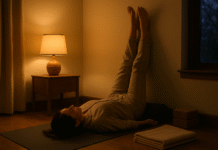





Breathwork is a simple skill you can carry into any part of your day to steady your nervous system, sharpen focus, and sleep more soundly. This guide shows you exactly how to weave it into mornings, work blocks, workouts, meals, and evenings—without apps or special gear. In plain terms, breathwork means intentional breathing patterns that favor slower rates and longer exhales to nudge the body toward calm. As of August 2025, evidence shows slow, paced breathing around ~5.5–6 breaths per minute can increase heart rate variability (HRV) by engaging baroreflex mechanisms, a reliable signal of parasympathetic activation.
Quick start: To incorporate breathwork into your daily routine, pick a “trigger” (waking, a red light, a meeting reminder), sit or stand tall, close your mouth, inhale through your nose toward the belly, and exhale longer than you inhale (e.g., in for 4, out for 6–8) for 2–5 minutes.
Note: This article is educational and not a substitute for medical advice. If you have lung or heart conditions, are pregnant, or experience dizziness, modify or stop and speak with a clinician.
1. Wake Up With 5 Minutes of Exhale-Focused Breathing
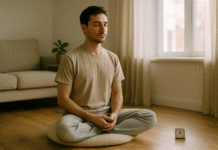
Start your day with a calm, intentional rhythm before your phone grabs your attention. In the first minutes after waking, your physiology is highly “suggestible”: a brief breathing session can set a steadier autonomic tone for the hours ahead. A strong option is exhale-focused breathing—keeping the out-breath longer than the in-breath—which has been shown to reduce physiological arousal and improve mood when practiced for 5 minutes daily over several weeks. A large remote randomized trial also found that brief, structured breathwork (including exhale-biased “cyclic sighing”) improved mood more than mindfulness meditation of the same duration. Place one hand on your belly, seal your lips, and breathe nasally; aim for 4 seconds in, 8 seconds out, without strain.
1.1 How to do it
- Sit up in bed or on a chair; spine long, shoulders soft.
- Inhale through your nose for ~4 seconds, expanding low in the belly.
- Exhale through your nose for ~8 seconds; imagine “fogging a mirror” quietly.
- Continue for 5 minutes (about 30–40 breaths).
- If 8 seconds is too long, use 4 in / 6 out and lengthen gradually.
1.2 Numbers & guardrails
- Time: 5 minutes.
- Rate: ~6 breaths/minute (in 4 / out 6) or slower if comfortable.
- Cue: Place your phone face-down until you’re done.
Finish with one normal breath and a gentle shoulder roll—the goal is a calm wake-up, not lightheadedness.
2. Habit-Stack With Things You Already Do (Teeth, Kettle, Shower)
The easiest way to incorporate breathwork into your daily routine is to attach it to rituals you never miss—brushing teeth, boiling water for tea/coffee, or waiting for the shower to warm. Habit stacking removes friction and makes consistency nearly automatic. Choose one anchor you do twice daily (e.g., brushing), and add 60–90 seconds of slow nasal breathing, keeping the exhale a little longer than the inhale. Over days to weeks, this repetition trains your nervous system to associate these mundane moments with downshifting, so your baseline reactivity drops. Evidence suggests diaphragmatic breathing protocols reduce stress biomarkers and self-reported anxiety; short, frequent sessions align with how habits stick.
2.1 Mini-checklist
- Pick one anchor (AM teeth, PM teeth, kettle, shower).
- Decide a fixed pattern (e.g., in 4 / out 6).
- Do 10–15 breaths while the task runs.
- Track a simple tally in your notes app for the first 14 days.
2.2 Common mistakes
- Going too hard: breath holds or forceful exhalations while standing can cause dizziness.
- Mouth breathing: keep lips sealed for smoother, quieter airflow.
- Inconsistency: switch anchors only after 2 solid weeks.
When small breaths ride on everyday anchors, practice takes care of itself.
3. Commute Breathing: Red Lights, Ride-Shares, and Public Transit
Commuting is perfect for micro-sessions: you’re seated, externally cued, and often stressed. Use every red light or the first minutes after you sit on the bus/train as a reminder to do coherent breathing—a steady cadence around 5.5–6 breaths/minute with equal or slightly longer exhales. This pace closely matches many people’s “resonance” range, enhancing HRV by syncing heart and blood-pressure oscillations through the baroreflex. Over time, that translates to better stress resilience throughout the day. Keep it light and effortless—if you’re driving, work eyes-open and never hold your breath.
3.1 Steps
- At a red light or station stop, relax your jaw and tongue.
- Breathe in for 5, out for 5–6, quietly through the nose.
- Repeat for 2–3 minutes, or until the light changes.
- Resume normal breathing; posture tall, shoulders down.
3.2 Region-specific tip
In dense traffic or rickshaw rides, air can be dusty—nasal breathing filters, warms, and humidifies air and delivers a bit more nitric oxide, which supports airway tone and oxygen transport.
A gentle cadence while you commute turns a daily stressor into structured recovery.
4. Prime Before Meetings or Presentations
Two to three minutes of breathwork can temper pre-meeting jitters and improve clarity. While “box breathing” (in-hold-out-hold, equal counts) is popular, many people find exhale-emphasis without long holds more comfortable and equally calming—especially when speaking soon after. Research indicates that exhale-biased breathing downregulates arousal, and brief daily breathwork can outperform mindfulness for mood when time-matched. Use a discrete pattern like in 4 / out 8 at your desk right before the call. If you like holds, keep them gentle (e.g., in 4, hold 2, out 6, hold 2).
4.1 Tools/Examples
- Timer: set a 2-minute countdown on your watch.
- Noise: low fan/AC hum is fine; keep mouth closed.
- Script: “In through the nose… soften the shoulders… out slow.”
4.2 Common mistakes
- Over-breathing (feeling buzzy or tingly). If that happens, shorten the inhale and lengthen the exhale for the next minute.
- Long holds right before speaking; they can make you feel breathless.
Arrive in the meeting with a lower heart rate and a steadier voice—no one has to know why.
5. Reset Between Focus Sprints (Pomodoro + 90-Second Breathing)
Use breathwork to bookend deep work. After a 25- to 50-minute focus sprint, stand up, step away, and do 90 seconds of paced nasal breathing at ~6 breaths/minute. This brief reset nudges HRV up and prevents the stress “carryover” that blurs into your next task. Over weeks, these micro-breaks act like strength training for your regulation system. A growing body of research links slow, paced breathing and HRV biofeedback to better self-control, decision-making, and cognitive performance—useful when you’re shipping work on a deadline. ScienceDirect
5.1 How to do it
- Set a work timer (25–50 min).
- At the bell, stand and breathe in 4 / out 6 for 90 sec.
- Return for another sprint; repeat 3–4 cycles per half-day.
5.2 Mini-checklist
- Keep breaths silent and through the nose.
- Eyes soft or closed; shoulders drop on each exhale.
- Stop if lightheaded; resume normal breathing.
A short cadence between sprints keeps attention crisp without caffeine spikes.
6. Warm-Up Your Workout With Nasal Breathing
Pair breathwork with movement by starting workouts in nasal-only mode for the first 5–10 minutes. Gentle nasal breathing reduces hyperventilation tendencies and encourages diaphragmatic mechanics, setting a calmer baseline before intensity rises. On brisk walks or easy jogs, try an in-for-4-steps / out-for-6-steps rhythm; during mobility drills, maintain in 4 / out 6. Nasal breathing can modestly modulate ventilation and gas exchange without reducing power in low-to-moderate efforts, making it a practical on-ramp for most training days.
6.1 Numbers & guardrails
- Warm-up: 5–10 minutes.
- Effort: easy conversational pace.
- Switch: if you feel air-hunger, relax the jaw and shorten the exhale a bit.
6.2 Common mistakes
- Forcing nasal-only breathing at high intensity (can feel suffocating).
- Breath-holding during mobility—keep the air moving.
A calmer start lets you go harder later without staying “keyed up” afterward.
7. Downshift After Exercise With Coherent Breathing
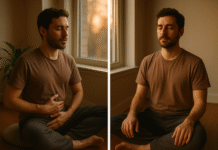
What you do after a workout matters for recovery. Sit or lie down and spend 2–5 minutes at ~6 breaths/minute to hasten the shift from sympathetic drive to parasympathetic recovery. This approach—often called coherent or resonance breathing—has been tied to increases in HRV and reductions in perceived stress across multiple studies and reviews, including RCTs. Keep it quiet through the nose and let your heart rate drift down smoothly.
7.1 Steps
- Prop the upper back on a cushion; hands on belly and ribs.
- Breathe in 5 / out 5–6 for 2–5 minutes.
- Finish with two normal breaths and a long, easy sigh.
7.2 Mini-checklist
- If you feel “stuck on high,” lengthen the exhale slightly.
- Avoid long breath holds when overheated.
A brief downshift locks in the training effect and readies you for the rest of the day.
8. Take Three Slow Breaths Before Meals
Before you eat, pause for three slow nasal breaths with longer exhales. The aim isn’t to “biohack digestion” but to arrive at the table and switch out of hurry mode. Diaphragmatic, exhale-biased breathing has been associated with lower stress markers; calmer states can support mindful pacing, which indirectly benefits digestion and glucose control habits. Keep it effortless—this is a cue, not a ceremony.
8.1 How to do it
- Sit, place feet flat, and put one hand on your belly.
- Breathe in 4 / out 6–8 three times.
- Then eat at a pace where you can breathe quietly through your nose.
8.2 Common mistakes
- Breath-holding before big bites; just resume gentle nasal breathing.
- Turning it into a long ritual that delays warm food.
Three quiet breaths create a boundary between work and a meal—small, helpful, done.
9. Beat the Afternoon Slump With a 3-Minute Coherent Set
Mid-afternoon lethargy is a perfect time for a 3-minute breathing reset. Sit tall, set a timer, and breathe in 5 / out 5–6. This is long enough to lift HRV and smooth the edges without making you sleepy. Systematic reviews and trials indicate that regular slow-breathing practice can reduce blood pressure modestly and improve perceived stress—useful when energy dips and temptation for a second coffee hits. If you’re wearing a smartwatch, you’ll often see heart rate and breathing rate fall within a few cycles. Frontiers
9.1 Mini-case
- Before: Raza, 34, slumped at 3:30 p.m., reaching for sweets.
- Intervention: 3 minutes at in 5 / out 6, plus a short walk.
- After 2 weeks: steadier energy; fewer late-day crashes.
9.2 Common mistakes
- Pushing pace too slow, causing air hunger.
- Using mouth breaths—keep it nasal and quiet.
Three minutes is short enough to do daily—and long enough to matter.
10. Replace Doomscrolling With an Evening 4-7-8 or 1:2 Session
Evenings are for downshifting. Swap 5 minutes of scrolling for 4-7-8 breathing (inhale 4, hold 7, exhale 8) or a simpler 1:2 ratio (inhale 4, exhale 8). Emerging research suggests 4-7-8 can improve HRV and blood pressure in rested adults, and in general, slow deep breathing reduces cardiovascular arousal; choose the pattern that feels easiest to maintain. Keep holds gentle—especially if you’re new to breathwork—and stop if you feel dizzy. Dim lights and silence notifications to reinforce the signal that the day is landing. PMC
10.1 How to do it
- Sit or lie down, phone on Do Not Disturb.
- 4-7-8: in 4, hold 7, out 8 × 10 cycles.
- Or 1:2 ratio: in 4, out 8 for 5 minutes.
10.2 Numbers & guardrails
- If the 7-second hold feels edgy, try 4-2-8 or skip holds entirely.
- Gentle is effective; no need to “max out” the durations.
A calm pre-bed window makes it easier to fall asleep when you finally turn in.
11. Use a Bedtime “Coherence” Set to Drift Into Sleep
In bed, turn to your side or lie on your back with a thin pillow and practice coherent breathing for 5–10 minutes. Many people find in 4–5 / out 6–8 just right. This is simply a paced, nasal, exhale-biased rhythm that guides your physiology toward sleep. Trials show slow, paced breathing improves perceived stress and can support better sleep quality; combined with a consistent lights-out time, it’s a reliable pre-sleep routine. If your mind races, silently count the exhale up to 6 or 8. If you wake at night, repeat for two minutes rather than staring at the ceiling. Nature
11.1 Mini-checklist
- Room dark, cool, quiet; screens off 30–60 minutes before bed.
- Nasal breathing; lips lightly closed.
- If you get lightheaded, shorten the inhale and soften the exhale.
11.2 Common mistakes
- Over-focusing on “perfect” timing; think “slow and quiet” instead.
- Long holds that feel stressful—skip them at night.
Let this become the last thing you remember before sleep takes over.
12. Deploy On-Demand “Physiological Sighs” During Stress Spikes
When stress spikes—an argument, a near-miss in traffic, an anxiety flare—use 1–3 “physiological sighs”: two short nasal inhales (the second “tops off” the lungs) followed by a long, unforced exhale through the nose. Then switch to exhale-biased breathing for a minute. Research indicates that exhale-focused patterns (“cyclic sighing”) practiced daily can reduce arousal and boost mood; as an acute tool, this pattern often cuts through tension fastest. The key is softness: no gasping, no huffing—just a quiet double-inhale and a long sigh out.
12.1 How to do it
- Take a short nasal inhale, then another shorter nasal inhale.
- Exhale long and slow through the nose until empty is comfortable.
- Repeat 1–3 times, then breathe in 4 / out 6 for 60–90 sec.
12.2 Common mistakes
- Mouth breathing loudly (can feel agitating).
- Forcing too many repetitions—1–3 is enough.
You’ve just turned a spike into a wave you can ride.
FAQs
1) What’s the fastest way to get started if I’m brand new?
Pick one anchor you already do daily—like brushing your teeth—and add ten nasal breaths with longer exhales (e.g., in 4 / out 6). Keep it gentle and repeat for 14 days before adding more. Consistency beats intensity; you’re training a reflex, not chasing a record.
2) How many minutes per day do I need for results?
Most studies showing benefits use 5–10 minutes per day, often split across multiple bouts. A 2023 randomized trial found 5 minutes daily of structured breathwork improved mood and reduced arousal over four weeks, outperforming time-matched mindfulness. Start small and build.
3) Should I breathe through my nose or mouth?
Nose first. Nasal breathing filters and conditions air and contributes small amounts of nitric oxide that support airway tone and oxygen transport. Mouth breathing is fine during higher-intensity exercise or if congested, but default to nasal for calm work.
4) What’s “resonance” or “coherent” breathing?
It refers to a steady rhythm near 5.5–6 breaths/minute (often in 5 / out 5–6) that maximizes respiratory-cardiac coupling and HRV through baroreflex dynamics. Many HRV-biofeedback protocols target this zone for stress resilience. The exact “best” rate varies slightly by person, so use what feels smooth. PMC
5) Is 4-7-8 breathing safe?
Yes for most healthy adults when done gently. If the 7-second hold feels uncomfortable, shorten the hold (e.g., 4-2-8) or skip holds. Evidence suggests 4-7-8 can improve HRV and blood pressure acutely in rested adults, but avoid long holds if you get dizzy.
6) Can breathwork lower blood pressure?
Slow, deep breathing shows modest, clinically meaningful reductions in blood pressure in meta-analyses, and device-guided protocols are recognized as a non-pharmacologic adjunct—not a medication substitute. Keep expectations realistic and continue any prescribed care.
7) Will this help my anxiety?
Trials and reviews link diaphragmatic and paced breathing to lower stress and state anxiety, with exhale-biased patterns particularly calming. For persistent or impairing anxiety, breathwork is a support, not a replacement, for therapy or medical care.
8) What if I feel lightheaded?
You’re likely over-breathing. Shorten the inhale, make the exhale soft (not forceful), and return to normal breathing for a minute. Practice seated and keep sessions shorter until your system adapts.
9) Do I need an app or device?
No. A timer and a metronome (or your internal count) are enough. Apps can coach cadence; HRV-biofeedback devices add feedback but aren’t required to benefit from slow, nasal, exhale-biased breathing. PMC
10) How long until I notice a difference?
Many people feel calmer during the first session. Measurable changes in mood, resting rate, or blood pressure typically appear after 2–4 weeks of near-daily practice. Keep sessions comfortable so you’ll actually do them.
11) Does breathwork replace meditation?
They’re complementary. If sitting still with thoughts feels tough, structured breathing can be an easier on-ramp and, in at least one trial, improved mood more than time-matched mindfulness practice. You can layer meditation later if you like.
12) Are there groups or classes I should consider?
If you enjoy community, look for yoga pranayama or clinical breathwork sessions taught by qualified instructors. Many protocols emphasize slow, nasal, exhale-biased patterns similar to those in this guide and can help with pacing and accountability.
Conclusion
Breathwork sticks when you make it small, specific, and tied to something you already do. Begin with a five-minute exhale-focused session on waking, then add a couple of micro-sets at natural anchors—red lights, between focus sprints, before meals, after workouts, and before bed. Keep the nose closed, the breath quiet, and the exhale a touch longer than the inhale. Over the next two to four weeks, expect calmer baseline energy, steadier focus, and easier sleep. You don’t need perfect technique—just a gentle rhythm you repeat. Start with one anchor today, and add a second next week; let the habit grow with you.
Ready to begin? Do one minute of in-for-4 / out-for-6 right now, then schedule your five-minute wake-up session for tomorrow.
References
- Heart Rate Variability Biofeedback: How and Why Does It Work? Frontiers in Psychology (Lehrer et al.), 2014. https://www.frontiersin.org/articles/10.3389/fpsyg.2014.00756/full Frontiers
- A Practical Guide to Resonance Frequency Assessment for HRV Biofeedback Practice. Frontiers in Neuroscience (Shaffer et al.), 2020. https://www.frontiersin.org/articles/10.3389/fnins.2020.570400/full Frontiers
- Effectiveness of Diaphragmatic Breathing for Reducing Physiological and Psychological Stress. Systematic review, Frontiers in Psychology (Hopper et al.), 2019. PubMed
- Brief Structured Respiration Practices Enhance Mood and Reduce Physiological Arousal. Cell Reports Medicine (Balban et al.), 2023. and PDF https://www.cell.com/cell-reports-medicine/pdf/S2666-3791(22)00474-8.pdf PubMedCell
- Nose vs. Mouth Breathing—Acute Effect of Different Breathing Modes. International Journal of Environmental Research and Public Health (Lörinczi et al.), 2024. https://www.ncbi.nlm.nih.gov/pmc/articles/PMC10858538/ PMC
- Effects of Nasal or Oral Breathing on Anaerobic Power Output. International Journal of Exercise Science (Recinto et al.), 2017. https://www.ncbi.nlm.nih.gov/pmc/articles/PMC5466403/ PMC
- Effect of Resonance Breathing on HRV, Stress, and Cognition. Journal of Education and Health Promotion (Chaitanya et al.), 2022. https://www.ncbi.nlm.nih.gov/pmc/articles/PMC8924557/ PMC
- Effect of Breathing Exercises on Blood Pressure and Heart Rate: A Systematic Review and Meta-analysis. Journal of Integrative Cardiology (Garg et al.), 2024. ScienceDirect
- Effects of Sleep Deprivation and 4-7-8 Breathing Control on HRV and Blood Pressure. Physiological Reports (Vierra et al.), 2022. PubMed
- Breathing Practices for Stress and Anxiety Reduction: Review. International Journal of Environmental Research and Public Health (Bentley et al.), 2023. https://www.ncbi.nlm.nih.gov/pmc/articles/PMC10741869/ PMC