





















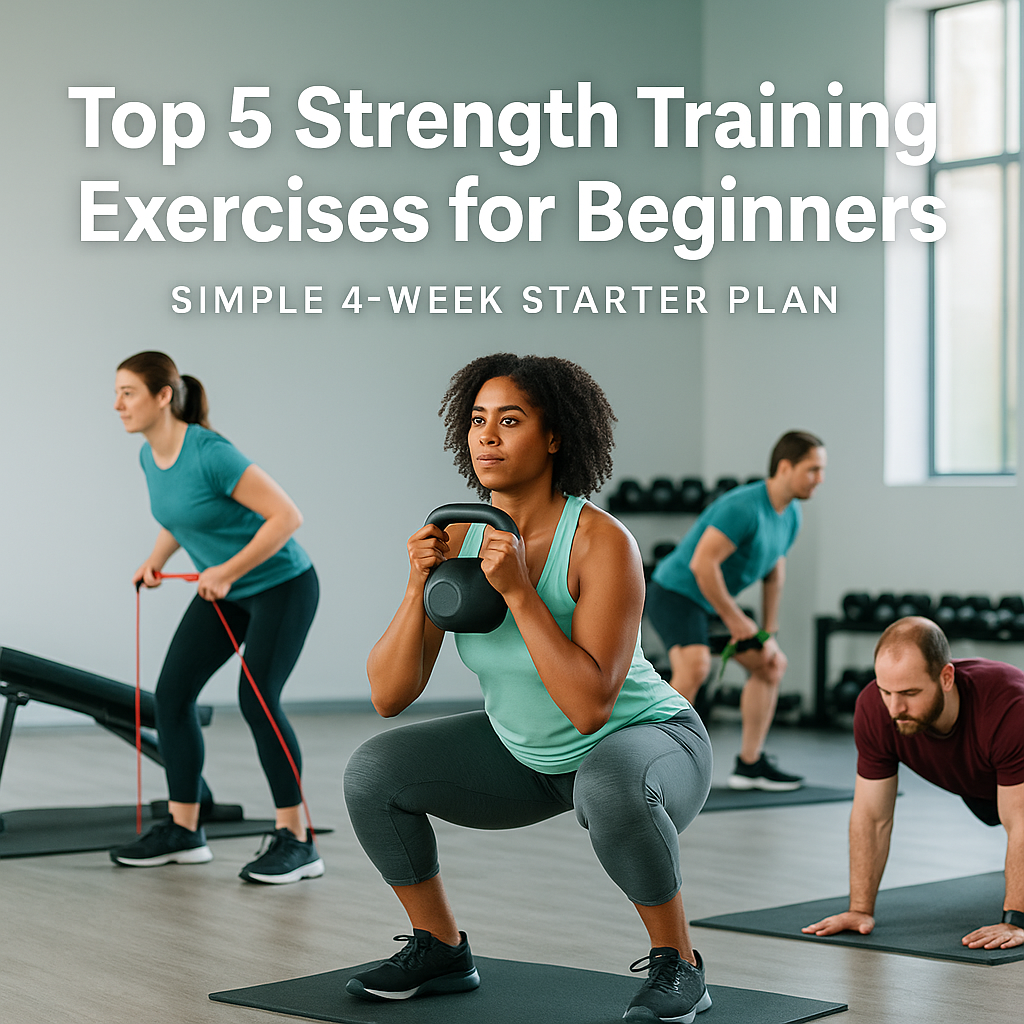
Starting strength training can feel like stepping into a new world: racks and dumbbells everywhere, a dozen exercises you’ve never tried, and wildly different advice on what to do first. This guide cuts through the noise with a simple, safe place to start. Below you’ll learn the top 5 strength training exercises for beginners, why they work, exactly how to do them, and how to progress week by week. You’ll also get a quick-start warm-up, a four-week plan, troubleshooting tips, and clear answers to common questions.
Medical disclaimer: The guidance below is general information for healthy adults. If you have a medical condition, are pregnant, recently injured, or unsure about exercise safety, consult a qualified healthcare professional before starting.
Who this is for: true beginners, anyone returning after a long break, and busy people who want a clear, efficient plan that builds real-world strength.
What you’ll get: the fundamentals—done right—so you gain confidence, avoid common mistakes, and actually see progress.
Key takeaways
- Start with movement patterns, not machines. Mastering a squat, hinge, push, pull, and core brace builds whole-body strength fast.
- Consistency beats complexity. Two to three full-body sessions per week with 2–3 sets of 8–12 reps per exercise is a proven beginner sweet spot.
- Warm up, then lift with control. A brief dynamic warm-up (around 6 minutes) and slow, smooth reps help you lift safer and better.
- Progress gradually. When you can do extra reps with good form, add a small amount of weight (about 2–10%) or a tougher variation.
- Use simple cues to judge effort. The “talk test” and how many reps you have “in the tank” are easy, effective guides for intensity.
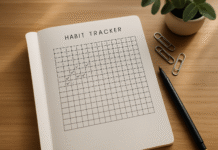
- Track three things. Reps, load, and how hard it felt. That’s enough to see steady improvements.
Quick-start warm-up (6–8 minutes)
Why warm up: To raise your temperature, wake up your nervous system, and practice good positions before lifting. A short, dynamic warm-up is enough to feel ready.
Do this before every session:
- March in place (2–3 minutes). Add arm swings.
- Heel digs (60 seconds). Alternate heels forward, toes up.
- Knee lifts (60 seconds). Alternate knees to opposite hand.
- Shoulder rolls (10 forward + 10 backward).
- Easy squat pulses (10 reps). Only as low as feels good.
If you feel stiff or are training in the cold, add another 2–3 minutes of light movement. You should feel warmer, breathing a little faster, but still able to talk in full sentences.
How to use this program
- Schedule: 2–3 non-consecutive days per week (e.g., Mon/Wed/Fri).
- Sets & reps: Start with 2 sets of 8–12 reps per exercise. If 8 reps are hard, stop there; if 12 are easy, choose a tougher variation next session.
- Tempo: Smooth and controlled—about 2 seconds down, pause briefly, then 1–2 seconds up.
- Rest: 60–120 seconds between sets.
- Effort: Finish each set with 1–3 reps left in reserve (you could do 1–3 more reps with perfect form).
- Progression rule: When you exceed the top of your rep range in good form (e.g., 13–14 reps on a 12-rep target), increase the load slightly next time (smallest plate or band upgrade).
The Top 5 Strength Training Exercises for Beginners
1) The Squat (Bodyweight → Goblet Squat)
What it is & why it’s great
The squat is a fundamental human movement: sit down, stand up. It strengthens your quads, glutes, and core; improves mobility in your hips and ankles; and carries over directly to daily life—getting up from chairs, climbing stairs, and lifting things from low positions.
What you need
- Beginner: Just your bodyweight and a stable box or chair.
- Low-cost gear: A backpack filled with books, a water jug, or a single dumbbell/kettlebell for goblet squats.
Step-by-step
- Set up: Stand with feet about shoulder-width apart, toes slightly out. Brace your core (gentle “tighten belt” feeling).
- Descend: Sit your hips down and back as if to a chair, keeping your chest tall. Knees track in line with toes.
- Depth: Go as low as you can while keeping your heels down and spine neutral (box height helps).
- Stand: Drive through mid-foot to stand up; squeeze glutes at the top without leaning back.
Beginner modifications
- Box/bench squat: Tap a box to standardize depth and build confidence.
- Counterbalance squat: Hold a light plate or book at arm’s length for balance.
- Heels-elevated squat: Place thin plates or a rolled towel under heels if ankles are stiff.
Progressions
- Goblet squat (hold a dumbbell/kettlebell at chest).
- Tempo squats (3 seconds down, 1 second pause).
- Front or back squat (later, if you have access and coaching).
Frequency & metrics
- 2–3 sessions/week, 2–3 sets of 8–12 reps.
- Track deepest pain-free depth, reps, and load (or variation). Aim to improve at least one each week.
Safety & common mistakes
- Mistake: Knees collapsing inward. Fix: Drive knees out to track over toes.
- Mistake: Heels lifting. Fix: Shorten depth, elevate heels slightly, or mobilize ankles.
- Mistake: Rounding the low back. Fix: Keep ribs “down,” brace before you move, use a box.
Mini-plan
- Week 1: Box squat to comfortable depth—2×8.
- Week 2: Same depth, add a light goblet hold—2×10.
2) The Hip Hinge (Romanian Deadlift / Kettlebell Deadlift)
What it is & why it’s great
The hinge trains your posterior chain—glutes, hamstrings, and back—critical for lifting groceries, picking up kids, and protecting your spine. It teaches you to bend at the hips while keeping a neutral, braced torso.
What you need
- Beginner: A dowel or broomstick to learn the hinge pattern.
- Low-cost gear: One kettlebell/dumbbell or a pair of dumbbells.
Step-by-step (Romanian deadlift with dumbbells)
- Set up: Stand tall, feet hip-width, dumbbells by thighs. Brace your core.
- Hinge: Push hips back while keeping a slight knee bend; slide dumbbells down the thighs, chest stays proud, spine long.
- Range: Lower until you feel a hamstring stretch without rounding (usually to mid-shin).
- Stand: Drive hips forward to stand tall, glutes tight at the top.
Beginner modifications
- Dowel 3-point hinge: Dowel touches back of head, upper back, and tailbone to teach a neutral spine.
- Elevated kettlebell deadlift: Place bell on a step to reduce range.
- Suitcase hinge: One dumbbell held with both hands to simplify.
Progressions
- Heavier RDL with dumbbells/kettlebell.
- Trap-bar deadlift if available (user-friendly).
- Conventional deadlift (optional and best learned with coaching).
Frequency & metrics
- 2–3 sessions/week, 2–3 sets of 8–12 reps.
- Track hamstring stretch without back rounding, reps, load. Prioritize pristine form over weight.
Safety & common mistakes
- Mistake: Bending the knees like a squat. Fix: Think “back with hips,” not “down.”
- Mistake: Rounding low back. Fix: Use the dowel drill; shorten range.
- Mistake: Hyperextending at lockout. Fix: Stand tall, ribs down, glutes on—don’t lean back.
Mini-plan
- Week 1: Dowel hinge 3×8 (slow).
- Week 2: Light kettlebell RDL 2×10, stop above mid-shin.
3) The Push-Up (Incline → Floor)
What it is & why it’s great
The push-up builds chest, shoulders, triceps, and a braced core while teaching you to control your body as a unit. It’s joint-friendly, efficient, and needs zero equipment once you’ve earned the floor version.
What you need
- Beginner: A stable surface for incline push-ups (countertop, bench, wall).
- Low-cost gear: None.
Step-by-step (incline push-up)
- Set up: Hands slightly wider than shoulders, body in a straight line from head to heels.
- Lower: Bend elbows about 45° from your body, keep ribs down and glutes lightly squeezed.
- Press: Push the surface away, reaching long through the upper back at the top.
Beginner modifications
- Higher incline (easier), lower incline (harder).
- Knee push-ups if an appropriate incline isn’t available.
- Hand-elevated eccentric (slow lower, stand up) to groove control.
Progressions
- Lower the incline over time to floor push-ups.
- Tempo push-ups (2–3 seconds down).
- Diamond/close-grip (later) for triceps.
Frequency & metrics
- 2–3 sessions/week, 2–3 sets of 6–12 reps.
- When you hit 12+ reps easily at a given height, lower the surface next session.
Safety & common mistakes
- Mistake: Sagging hips. Fix: Squeeze glutes, brace; shorten range or raise incline.
- Mistake: Elbows flared to 90°. Fix: Tuck to ~45° for shoulder comfort.
- Mistake: Neck jutting. Fix: Keep a “long neck,” eyes slightly ahead.
Mini-plan
- Week 1: Countertop push-ups 2×8.
- Week 2: Same, 3×10. If smooth, drop to a slightly lower surface.
4) The Row (Dumbbell / Band Row)
What it is & why it’s great
Rows target the back of your body: mid-back, lats, rear shoulders, and biceps. They balance pressing work, improve posture, and build shoulder health.
What you need
- Beginner: A resistance band or one dumbbell.
- Low-cost gear: Bands (cheap and versatile) or a single medium dumbbell.
Step-by-step (one-arm dumbbell row)
- Set up: One knee and hand supported on a bench or sturdy chair; other foot on the floor, back flat.
- Pull: Row the dumbbell toward your hip, elbow close to your body.
- Lower: Control the weight back down; keep shoulders level.
Beginner modifications
- Chest-supported row (lying face down on a bench) reduces torso fatigue.
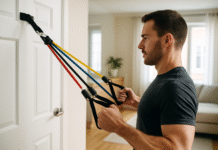
- Band row anchored at chest height for an easier learning curve.
- Two-hand band row if stability is an issue.
Progressions
- Heavier dumbbell or slow eccentrics.
- Bent-over barbell row (later), if you have equipment and solid hinge mechanics.
Frequency & metrics
- 2–3 sessions/week, 2–3 sets of 8–12 reps per side.
- Track symmetry (left vs. right), load, and tempo.
Safety & common mistakes
- Mistake: Shrugging the shoulder toward the ear. Fix: “Pocket your shoulder blade”—pull it down/back first.
- Mistake: Twisting the torso. Fix: Brace the core and keep ribs square to the floor.
- Mistake: Short stroking. Fix: Pause briefly at the top for a full squeeze.
Mini-plan
- Week 1: Band rows 2×12 (pause at the chest).
- Week 2: One-arm dumbbell rows 3×10 each side.
5) The Plank (Front Plank → Side Plank & Dead Bug)
What it is & why it’s great
The plank trains anti-extension core strength—resisting the urge for your lower back to arch under load. A stronger brace protects your spine and makes every other lift safer and stronger.
What you need
- Beginner: A mat.
- Low-cost gear: None.
Step-by-step (front plank)
- Set up: Elbows under shoulders, forearms on floor, legs straight, feet about hip-width.
- Brace: Imagine zipping up tight from ribs to pelvis; squeeze glutes lightly.
- Hold: Keep a straight line from head to heels. Breathe through your nose or short controlled breaths—no breath-holding.
Beginner modifications
- High plank (hands on floor) or elevated plank (hands on bench).
- Knee plank to shorten the lever.
- Intervals: 15–20 seconds on, 10 seconds off, repeated.
Progressions
- Longer holds (up to 30–45 seconds with perfect form).
- Side plank (targets obliques).
- Dead bug (alternating arm/leg while keeping ribs down).
- Plank with reach or shoulder taps (later).
Frequency & metrics
- 2–3 sessions/week, 2–3 sets of 20–40 seconds total time under tension.
- End every set with perfect posture—not shaking, hips not sagging.
Safety & common mistakes
- Mistake: Hips too high or low. Fix: Think “ribs down, glutes on.”
- Mistake: Holding breath. Fix: Smooth, controlled breathing.
- Mistake: Neck craned up. Fix: Gaze down, lengthen the back of your neck.
Mini-plan
- Week 1: 3×20-second holds (rest as needed).
- Week 2: 3×30-second holds or 4×20-second intervals (perfect form only).
Troubleshooting & common pitfalls
“My knees cave in on squats.”
Slow down. Use a box, lighten the load, and cue “push the floor apart” to keep knees tracking with toes.
“My lower back feels it during hinges.”
Use the dowel drill to maintain three contact points (head, upper back, tailbone). Reduce range until you feel the work in the hamstrings, not the back.
“Push-ups feel impossible.”
Raise the incline (countertop or wall). Build sets of 6–8 there; lower the surface once you can do 12+ clean reps.
“I’m out of breath.”
Use the talk test: you should be able to speak short sentences between sets. If you cannot, extend rest to 90–120 seconds.
“I’m sore for days.”
Some next-day soreness is normal when you’re new, especially after squats and hinges. Keep moving with easy walks, hydrate, and reduce next session’s volume if soreness lingers beyond a few days or limits daily activity. Sharp, sudden, or worsening pain is a red flag—stop and get professional advice.
“I’m not progressing.”
Track your reps, variation, and load. When you can do more than the top of your rep range with clean form, add the smallest possible weight bump (or a tougher variation). Small, steady increases win.
How to measure progress (simple & objective)
- Reps & load: Can you do more reps at the same weight, or the same reps with a bit more weight?
- Form quality: Deeper squats without heels lifting; hinges to mid-shin without rounding; push-ups on a lower incline; rows with less torso sway.
- Time under tension: Longer perfect planks or slower lowering phases.
- Session notes (1–10 effort scale): Were the last reps a 7/10 challenge? That’s about right for beginners.
Aim to improve one variable per session—reps, load, form, or control. That’s progress.
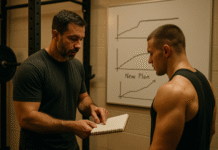
A simple 4-week beginner plan (3 days/week)
Week 1 — Learn the movements (light & crisp)
- Warm-up: 6–8 minutes dynamic.
- A1 Squat (box or bodyweight): 2×8–10
- A2 Row (band or light dumbbell): 2×10/side
- B1 Hinge (dowel drill → light RDL): 2×8
- B2 Incline push-up: 2×6–8
- C Plank: 3×20 seconds
- Rest: 60–90 seconds between sets.
- Walk 10–20 min after if you like.
Week 2 — Add a little volume
- Squat (goblet if ready): 3×8–10
- Row: 3×10/side
- Hinge (light RDL or kettlebell deadlift): 3×8–10
- Incline push-up: 3×8–10
- Plank: 3×25–30 seconds
Week 3 — Small progression
- If you reached the top of the rep range, add the smallest load available (e.g., 1–2 kg) or increase difficulty (lower incline, deeper squat, slightly heavier bell).
- Keep 2–3 reps in reserve per set.
- Maintain 3×8–12 on main lifts; plank 3×30–40 seconds if form is solid.
Week 4 — Consolidate & test clean reps
- Choose one variable to improve on each exercise: +1–2 reps, +2–5% load, or slightly harder variation—only if technique is rock solid.
- End the week with a “quality check” session: film a set of each exercise for your future self to compare against in 4 weeks.
Optional Day 2-only version (busy weeks): Do the same plan on two non-consecutive days; keep total sets the same but spread across fewer sessions.
Safety notes you shouldn’t skip
- Stop on sharp pain, numbness, or joint instability. Soreness that feels like a dull, even burn is common; sharp pain is not.
- Control the negative (lowering) phase. Most mistakes happen on the way down.
- Respect recovery. Sleep and easy walking help a lot. If soreness limits daily life for several days, reduce volume next time.
- Warm up and cool down. A short warm-up improves comfort and readiness; a brief cool-down walk and gentle stretches can feel great.
- Progress gradually. Big jumps in weight or volume spike injury risk; think small weekly nudges instead.
FAQs
1) How many days per week should beginners strength train?
Two to three non-consecutive days per week is ideal for beginners. That frequency fits recovery, learning, and progress without overwhelming your schedule.
2) How many sets and reps should I do?
Start with 2–3 sets of 8–12 reps for each exercise. If you hit 12 clean reps easily, make it slightly harder next time (more weight or a tougher variation).
3) How hard should sets feel?
Aim to finish with 1–3 reps “left in the tank.” If you’re grinding or losing form, you’re going too heavy. If you breeze past 12 and could keep going, progress the difficulty next session.
4) Do I really need to warm up?
Yes—a brief dynamic warm-up (about 6 minutes) raises temperature, rehearses positions, and helps you move better. It doesn’t have to be fancy.
5) What if I get sore after the first few workouts?
Some next-day soreness is normal when you start or change a routine. Light movement, hydration, and sleep usually help. If soreness is sharp, worsening, or lingers for several days, rest and consider professional advice.
6) Can I combine this with cardio?
Absolutely. Walking, cycling, or other aerobic activity pairs well with this plan. Spread your cardio across the week and keep strength days separate or do cardio after lifting.
7) How long should rest periods be?
For these beginner sets, rest 60–120 seconds. If your breathing is still heavy or your next set’s form suffers, rest a bit longer.
8) When should I add weight?
When you exceed the top of your rep range with great form, add the smallest available load (or progress the variation). Small, steady increases beat big jumps.
9) What if I only have resistance bands?
You can do all five patterns with bands: band squats, band RDLs, band push-ups (band around your back), band rows, and band planks (with reaches). The principles—reps, control, progression—are the same.
10) Is bodyweight enough to start?
Yes. Bodyweight squats, incline push-ups, and planks are perfect to learn positions. Add load as soon as reps become easy so you keep progressing.
11) I’m short on time—can I do fewer exercises?
If you only have 15–20 minutes, do one set of each pattern (squat, hinge, push, pull, core) with minimal rest. It’s not perfect, but it keeps momentum on busy days.
12) Should I stretch before or after?
Use dynamic movements before (your warm-up). Save longer static stretches for after training or on rest days if they help you feel better.
Put it together—your first session (15–25 minutes)
- Warm-up: 6 minutes (march, heel digs, knee lifts, shoulder rolls, easy squat pulses).
- Main lifts:
- Squat (box/goblet): 2×8–10
- Row (band/dumbbell): 2×10/side
- Hinge (RDL): 2×8–10
- Push-up (incline): 2×6–10
- Plank: 2×20–30 seconds
- Cool-down: Walk 3–5 minutes. Note your loads, reps, and how it felt (0–10).
Repeat in two days. Nudge one variable forward each session. That’s the whole game.
Conclusion
You don’t need a complicated routine, fancy equipment, or marathon gym sessions to get strong. Nail the five fundamental patterns—squat, hinge, push, pull, and brace—with consistent practice, small weekly progress, and patient form work. In a month you’ll move better, feel more capable, and have numbers in your training log that prove it.
Copy-ready CTA: Start today: do the warm-up and one set of each exercise—then put your next session on the calendar.
References
- Adult Activity: An Overview, Centers for Disease Control and Prevention (CDC), December 20, 2023. https://www.cdc.gov/physical-activity-basics/guidelines/adults.html
- Measuring Physical Activity Intensity, CDC, December 6, 2023. https://www.cdc.gov/physical-activity-basics/measuring/index.html
- Physical activity guidelines for adults aged 19 to 64, NHS, Page last reviewed May 22, 2024. https://www.nhs.uk/live-well/exercise/physical-activity-guidelines-for-adults-aged-19-to-64/
- How to improve your strength and flexibility, NHS, Page last reviewed November 18, 2022. https://www.nhs.uk/live-well/exercise/how-to-improve-strength-flexibility/
- How to warm up before exercising, NHS, Page last reviewed July 12, 2022. https://www.nhs.uk/live-well/exercise/how-to-warm-up-before-exercising/
- American College of Sports Medicine position stand: Progression Models in Resistance Training for Healthy Adults, Medicine & Science in Sports & Exercise, March 2009. PubMed: https://pubmed.ncbi.nlm.nih.gov/19204579/
- World Health Organization 2020 guidelines on physical activity and sedentary behaviour, WHO Guideline, November 25, 2020. https://www.who.int/publications/i/item/9789240015128
- World Health Organization 2020 guidelines on physical activity and sedentary behaviour, British Journal of Sports Medicine (Open Access summary), 2020. https://pmc.ncbi.nlm.nih.gov/articles/PMC7719906/
- If You’re Sore After a Workout, Should You Be Concerned?, Cleveland Clinic Health Essentials, April 4, 2025. https://health.clevelandclinic.org/should-you-workout-when-sore