























A 20-minute nap sounds almost too simple: lie down, set a timer, wake up fresher. Yet behind this everyday habit is a surprisingly rich body of sleep science that explains why short naps can sharpen attention, boost mood, and steady performance—without wrecking your nighttime sleep. In the first 100 words here’s the gist: the “20-minute nap rule” aims to confine sleep to lighter stages so you wake without heavy grogginess (sleep inertia) and still capture measurable benefits in alertness and cognition. In this guide, you’ll learn what happens in your brain during a short nap, where the 20-minute idea comes from, when it does (and doesn’t) work, and exactly how to implement it—step by step.
Medical disclaimer: This article is educational and not a substitute for personalized medical advice. If you have a sleep disorder, medical condition, are pregnant, or take medications that affect alertness, talk with a qualified healthcare professional before changing your sleep routine.
Key takeaways
- Why 20 minutes: It aims to keep you in light, non-deep sleep to avoid grogginess while still improving alertness, attention, and mood.
- Evidence snapshot: Brief naps of 10–20 minutes can yield rapid gains; longer naps risk sleep inertia unless you complete a ~90-minute cycle.
- Timing matters: Early afternoon aligns with a natural circadian dip; late-day naps are more likely to disrupt night sleep.
- Coffee + nap (“nappuccino”): Caffeine peaks ~30–60 minutes after ingestion; a quick sip then a 15–20 minute doze can enhance post-nap alertness.
- Not for everyone: Chronic insomniacs and people with excessive daytime sleepiness should seek medical guidance; frequent long naps can signal underlying issues.
What the 20-Minute Nap Rule Actually Means
What it is & core purpose.
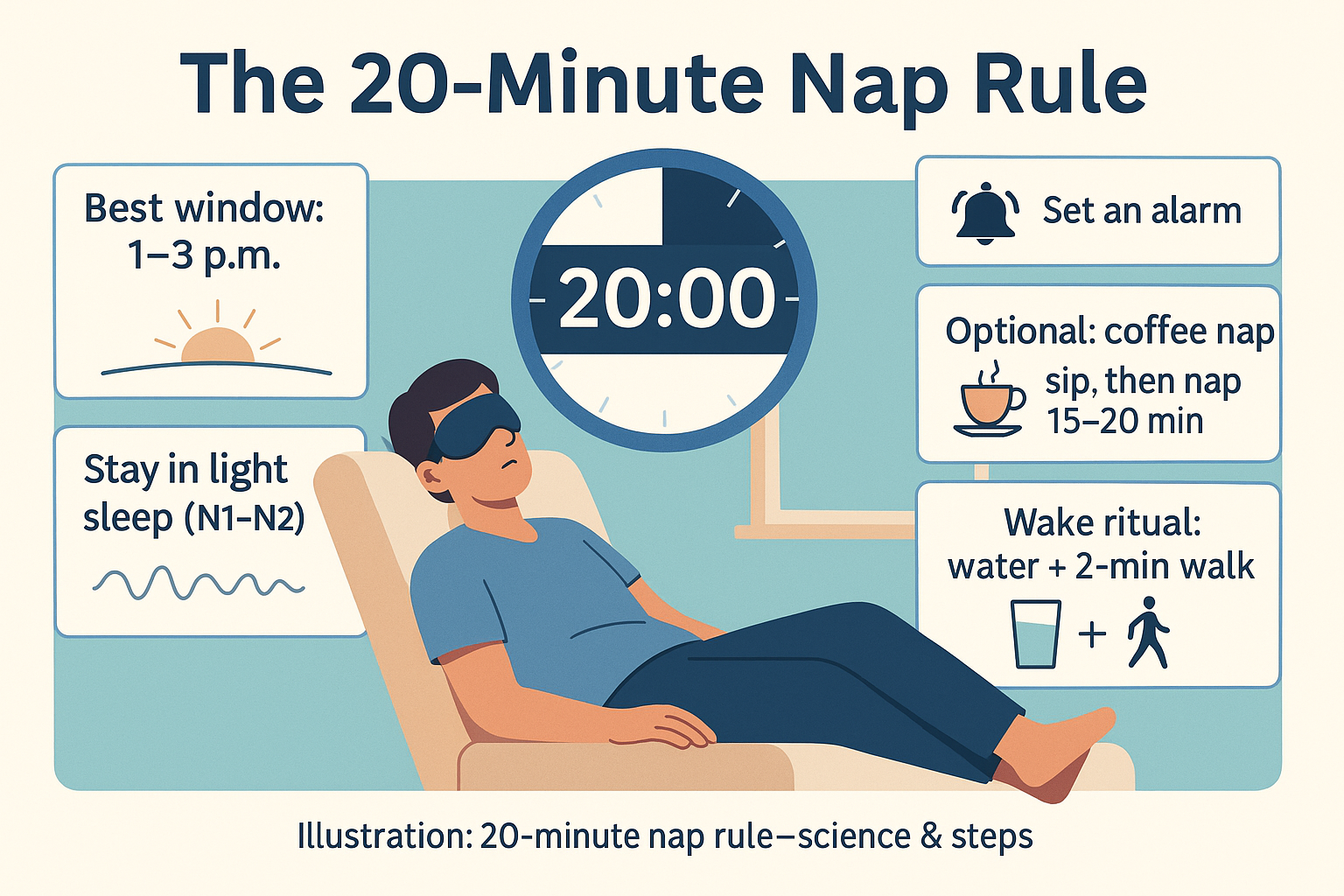
The 20-minute nap rule is a practical limit: keep your nap short enough that you remain in the lighter stages of non-REM sleep (N1–N2), so you wake clear-headed instead of groggy. In the first sleep cycle, N1 typically lasts ~1–7 minutes and N2 about 10–25 minutes. Deep slow-wave sleep (N3) usually arrives later; if you wake from N3, you’re far likelier to feel disoriented (sleep inertia). A 20-minute cap targets the sweet spot before N3 becomes likely.
Requirements / prerequisites.
- A quiet, dim space (bed, sofa, recliner, or a reclining office chair).
- Timer or alarm (phone/watch).
- Optional sleep mask and earplugs or white-noise app.
- Optional: a light throw/blanket to avoid getting cold.
Step-by-step for beginners.
- Choose your window: Aim between 1:00–3:00 p.m., the common circadian “dip.”
- Prep the space: Darken the room, silence notifications, and set a 20-minute alarm.
- Wind down fast: Two slow breaths per second for 30 seconds, then normal breathing; let the body sink.
- Wake + re-boot: When the alarm rings, sit up, drink water, and take 2 minutes of light movement (neck rolls, shoulder circles).
Beginner modifications & progressions.
- If 20 minutes feels rushed: Start with 10–15 minutes to prove the concept, then add 2–3 minutes per week as needed.
- If you wake groggy: Trim to 15–18 minutes for a few days, or add a gentle “wake window” (see safety below).
- If you’re severely sleep-restricted: Consider a full-cycle nap (~90 minutes) instead of 20, but only when schedule and nighttime sleep allow.
Recommended frequency & metrics.
- Frequency: 0–1 short nap most days you feel the dip.
- Duration: 15–20 minutes from eyes-closed to alarm.
- Metrics: Track a 1–9 alertness score before/after; note errors/lapses in a routine task; time to refocus after waking. Over a week you should see steadier afternoons.
- Optional objective metric: a 3–10 minute psychomotor vigilance test (PVT) once daily; lapses and reaction time reflect alertness.
Safety, caveats & common mistakes.
- Don’t nap too late (after ~3–4 p.m.) if it disrupts night sleep.
- If you’re actively treating insomnia, most clinicians recommend avoiding naps until sleep consolidates (nuance below).
- Micro-oversleeping (dozing past 20 into N3) drives grogginess; set a vibrating alarm and keep lights on dim rather than blackout if you’re prone to deep sleep.
Mini-plan example (first week).
- Day 1–2: 15-minute cap at 2:00 p.m.; measure alertness before/after.
- Day 3–5: 18–20 minutes; add earplugs; repeat metrics.
- Day 6–7: Keep what works; if groggy, trim by 2–3 minutes the next week.
Why 20 Minutes Works: Sleep Stages and Sleep Inertia
What it is & benefits.
Sleep inertia is the temporary fogginess and performance dip after waking, strongest when you’re roused from deep N3 sleep or after sleep deprivation. Short naps aim to dodge N3 so you get the “upside” (alertness, vigilance, mood) without the inertia “downside.”
Requirements / prerequisites.
- A reliable alarm and a post-nap buffer (2–10 minutes) to let residual inertia clear.
- A consistent nap length (±2 minutes) so your brain learns the pattern.
Step-by-step to minimize inertia.
- Stay within 10–20 minutes of sleep time.
- Nap earlier in the day (the longer you’ve been awake, the deeper the nap tends to run).
- Stand and move for 2–3 minutes immediately after waking to dissipate inertia.
Beginner modifications & progressions.
- If you’re very sensitive to grogginess, try 10–15 minutes or a “quiet rest” (eyes closed, no sleep) for a week, then expand to 18–20 minutes.
Recommended frequency & metrics.
- Grogginess score (0–10) at 3 and 10 minutes post-nap.
- If 10-minute scores consistently ≤2, keep your routine; if ≥4, shorten or move the nap earlier.
Safety & mistakes to avoid.
- Don’t snooze the alarm; a second micro-doze can kick you deeper.
- Avoid dark-cold-silent conditions if you’re an easy deep sleeper—go dim-cool-quiet instead of maximal.
Mini-plan example.
- Week 1: 15-minute naps, 2:00 p.m., add 10-minute post-nap light walk.
- Week 2: Increase to 18–20 minutes if grogginess scores are low.
What the Research Says About Short Naps
What it is & benefits.
Controlled studies repeatedly show that brief naps deliver fast improvements in sleepiness, vigilance, and certain cognitive tasks. For example, a well-cited laboratory study found 10-minute naps produced immediate improvements with minimal inertia, while benefits from 20–30 minutes emerged later but lasted longer—consistent with the idea that nap length trades off speed vs. endurance of benefits.
A broader research narrative concludes: short naps can reduce sleepiness, improve performance, and are most effective when kept brief; longer naps may cause short-term impairment from inertia but can yield longer-lasting benefits once inertia clears.
Where the 20–30 minute window came from.
Operational settings (aviation, shift work) pioneered strategic napping to stabilize performance. Findings popularized the idea that keeping naps short avoids sleep inertia during safety-critical work, while still improving alertness—one reason a 20-minute target caught on outside the lab.
Requirements / prerequisites.
- A consistent testing window for your personal experiment (same time, similar workload).
- Simple before/after measures (alertness, error count, reaction time).
Step-by-step to self-validate.
- Pick one task you do daily (e.g., inbox triage).
- Track time-to-focus and errors for 10 minutes before vs. 30–60 minutes after the nap for one week.
- Compare with a no-nap week.
Modifications & progressions.
- Try 10-minute naps if you need instant bounce-back.
- Try 20–25 minutes if you value longer-lasting benefit and tolerate a brief groggy window.
Recommended frequency & metrics.
- 3–5 test days per week over two weeks.
- Metrics: alertness score, PVT or reaction test if available, task errors, self-rated mood.
Safety & mistakes to avoid.
- Don’t generalize from a single day; personal responses to naps vary.
- Avoid late naps if night sleep suffers.
Mini-plan example.
- Week 1: 10-minute naps; track alertness + errors.
- Week 2: 20-minute naps; compare results and choose your default.
NASA’s “26-Minute” Mythos (and What It Really Means)
What it is & benefits.
Aviation research is often cited for eye-catching numbers: a brief in-flight nap opportunity produced average ~26 minutes of sleep and was linked to improved alertness and performance compared with no nap. Popular summaries often quote increases in alertness and performance in this context—one reason “NASA naps” entered public vocabulary.
Practical translation.
For non-pilots, the takeaway is strategic timing and brevity. A carefully planned short nap can stabilize vigilance in demanding, monotonous tasks (e.g., long drives, tedious analysis). It’s not a license to replace night sleep; it’s a countermeasure for predictable dips.
Requirements / prerequisites.
- Strict timing (pre-defined window, not ad-hoc dozing).
- Safe environment where waking promptly is essential.
Step-by-step.
- Define a fixed 20-minute rest opportunity.
- Use eye mask + earplugs to shorten sleep onset.
- After waking, insert a 5–10 minute activation (hydration, light movement, bright light).
Modifications & progressions.
- If you routinely fall asleep in <3 minutes, set 18-minute alarms to reduce inertia risk.
- If sleep onset is >10 minutes, add breathing or body-scan to speed relaxation.
Recommended frequency & metrics.
- Use on high-demand days or predictable dips (post-lunch, long meetings).
- Metric: vigilance scores or error counts on your most fatigue-sensitive tasks.
Safety & mistakes to avoid.
- Don’t rely on naps to compensate for chronic sleep debt.
- Never nap when you’re responsible for safety-critical monitoring unless a trained colleague is on duty.
Mini-plan example.
- Set a daily 2:15 p.m. “rest slot” with a 20-minute alarm and 5-minute activation ritual for one month; track error rates.
The Coffee Nap Protocol (Optional Boost)
What it is & benefits.
A coffee nap combines a short nap with a pre-nap dose of caffeine. Because caffeine’s alerting effect typically peaks 30–60 minutes after ingestion and is absorbed largely within ~45 minutes, drinking a small coffee then napping for ~15–20 minutes can yield a double benefit: sleep clears adenosine, and caffeine hits as you wake. Studies using 200 mg caffeine + brief nap show combined improvements in sleepiness and simulated driving outcomes versus caffeine alone. NCBIPubMed
Requirements / prerequisites.
- Caffeine dose: 80–200 mg (about a small espresso to a strong cup).
- Timer: 15–20 minutes.
- Avoid if you’re caffeine-sensitive, pregnant, or napping after 3 p.m. (risk to night sleep).
Step-by-step.
- Drink your coffee/tea quickly (avoid sipping through the nap).
- Lie down immediately, set 15–20 minutes.
- Wake, hydrate, move for 2–3 minutes.
Beginner modifications & progressions.
- Start at ~80–120 mg caffeine; adjust slowly.
- If you can’t nap after coffee, try decaf or half-caf or skip caffeine entirely.
Recommended frequency & metrics.
- Use sparingly (e.g., 2–4 times/week) to avoid tolerance.
- Track post-nap alertness and sleep latency that night.
Safety & mistakes to avoid.
- Don’t exceed ~400 mg/day total caffeine (typical adult threshold).
- Watch for jitters, palpitations, or anxiety; if present, reduce or discontinue.
Mini-plan example.
- Tues/Thu: 120 mg caffeine + 18-minute nap before a demanding afternoon task; compare with non-caffeine nap days.
Timing Your Nap Around Biology
What it is & benefits.
Most people experience a post-lunch dip in alertness in the early afternoon due to the interplay of circadian rhythms and rising sleep pressure—this makes 1–3 p.m. a high-yield nap window. The dip occurs even without eating lunch and even when the person doesn’t know the time. PubMed
Requirements / prerequisites.
- A consistent daily slot (calendar block).
- A pre-nap routine to decelerate (breathwork, stretching, quick journal).
Step-by-step.
- Place a 20-minute block between 1–3 p.m.; protect it like a meeting.
- Keep a 60–90 minute buffer from heavy exercise or large meals.
- After the nap, seek light (window or lamp) to reinforce the circadian signal.
Beginner modifications & progressions.
- Morning-type people may do best closer to 1 p.m.; evening types around 2–3 p.m.
- Shifted schedules: align the nap ~7–9 hours after wake-time.
Recommended frequency & metrics.
- Try 4–5 days/week for two weeks to entrain the habit.
- Metrics: sleep onset latency, alertness, nighttime sleep impact.
Safety & mistakes to avoid.
- Napping too close to bedtime can fragment night sleep.
- If you’re consistently nodding off before the nap, move it earlier.
Mini-plan example.
- Workdays: 2:10–2:30 p.m. nap + 5-minute light exposure; log alertness & bedtime latency.
Quick-Start Checklist
- Pick your time window (1–3 p.m. or 7–9 hours after wake).
- Choose your duration (start 15–20 minutes).
- Set an alarm and a backup (watch + phone).
- Prep mask/earplugs/white noise.
- Decide on coffee or no coffee.
- Plan a wake ritual (water + 2-minute walk).
- Pick two metrics to track (alertness 1–9; errors or reaction test).
- Block the time on your calendar for two weeks.
Troubleshooting & Common Pitfalls
Problem: “I can’t fall asleep in 20 minutes.”
- Treat it as “quiet rest”—beneficial on its own.
- Add a 2-minute body-scan and box breathing (4-4-4-4).
- Nudge the nap earlier and reduce caffeine in the morning.
Problem: “I wake up groggy.”
- Trim to 15–18 minutes; add a 2–10 minute post-nap activation (water, light, movement).
- Try a coffee nap (earlier in the day).
Problem: “Naps keep me up at night.”
- Move naps earlier; cap at 15 minutes; skip naps within 8 hours of bedtime.
- If you struggle with insomnia, prioritize treatment first; naps may be temporarily discouraged during CBT-I.
Problem: “I oversleep past the alarm.”
- Use two alarms (sound + vibration).
- Nap semi-reclined instead of fully prone; keep room dim rather than pitch-black.
Problem: “I don’t notice benefits.”
- Validate with simple metrics (PVT app, typo rate, time-to-focus). The PVT is a sensitive alertness assay used in sleep research.
How to Measure Whether Your 20-Minute Nap Works
What it is & benefits.
Objective and subjective tracking turns a nice habit into a repeatable performance tool. Use quick, low-friction measures that fit your day: you’ll see patterns within a week.
Requirements / tools.
- Subjective: Karolinska Sleepiness Scale (1–9).
- Objective (optional): a 3–10 minute PVT app or browser test; or a consistent reaction-time mini-task.
- Context log: time of nap, caffeine dose, prior night sleep.
Step-by-step.
- Record KSS before and 30 minutes after the nap for 5–10 workdays.
- Run a 3–10 minute PVT at the same times (before vs. after) on three days per week.
- Compare to no-nap days. PubMed
Modifications & progressions.
- If a PVT isn’t practical, track error counts (e.g., typos in a 2-minute typing test) or a timed reading comprehension.
- For students, use quiz accuracy after napping vs. not napping.
Recommended frequency & metrics.
- Two weeks of data is enough for a decision.
- Metrics to watch: KSS drop ≥2 points, PVT lapses down ≥20%, subjective productivity up.
Safety & mistakes to avoid.
- Avoid obsessing over day-to-day noise—look for weekly trends.
- Don’t test while driving or doing safety-critical tasks.
Mini-plan example.
- Mon/Wed/Fri: KSS + 3-minute PVT before/after nap; Tue/Thu: no nap; compare Friday.
When 20 Minutes Isn’t Enough (or Is Too Much)
What it is & benefits.
If you’re severely sleep-restricted or on a night shift, a 20-minute nap may not fully restore vigilance. Here, 10-minute naps can blunt immediate impairment with minimal inertia; 30–60+ minute naps can help later at the cost of short-term grogginess. For continuous night work, research shows 10-minute nighttime naps can mitigate short-term performance drops better than 30-minute naps, which often come with heavier inertia right after waking.
Requirements / prerequisites.
- Understand task demands (do you need instant clarity or sustained stamina later?).
- Safe post-nap buffer if taking longer naps.
Step-by-step.
- Choose strategy: 10 minutes for instant bounce, 20 minutes for balanced benefit, 90 minutes for full-cycle recovery.
- Schedule buffers: 10–20 minutes of wake-up time for longer naps.
- Test and tune for a week.
Modifications & progressions.
- Combine a 10-minute nap with bright light or caffeine afterward for night shifts.
- Use noise-canceling and eye masks to accelerate onset in bright workplaces.
Recommended frequency & metrics.
- Night shift: 1–2 planned naps in circumscribed windows.
- Metrics: near-miss events, PVT lapses, subjective alertness.
Safety & mistakes to avoid.
- Don’t wake from a 30–60 minute nap and immediately resume safety-critical tasks; allow an inertia buffer.
- Check employer policies on controlled rest.
Mini-plan example.
- Night shift (simulated): 10-minute nap at 02:00, caffeine at 02:15, bright light at 02:20; track PVT at 03:00.
Safety & Caveats You Should Actually Know
- Insomnia and CBT-I: During active therapy, clinicians often advise limiting naps to consolidate night sleep; emerging data suggest authorized brief naps may not derail improvements, but talk to your clinician. PubMed
- Underlying conditions: Frequent long naps are associated in observational studies with higher risks of cardiovascular and all-cause mortality; often they reflect underlying illness or poor night sleep rather than harm from short naps per se. Keep them short and earlier unless your clinician advises otherwise. PLOS
- Caffeine sensitivities: Dose varies by genetics, meds, and pregnancy; typical adult threshold is around 400 mg/day. Start low, especially if anxious or prone to palpitations. U.S. Food and Drug Administration
- Driving & safety-critical work: Never rely on a nap as your sole countermeasure if you’re dangerously sleepy; pull over, nap safely, then reassess fitness to drive.
A Simple 4-Week Starter Plan
Goal: Build a sustainable 20-minute nap routine that improves afternoon performance without harming night sleep.
Week 1 – Learn your window
- Schedule: 15–18 minutes at 2:00 p.m. on Mon/Wed/Fri.
- Setup: Mask, earplugs, white noise; alarm + backup vibration.
- Metrics: KSS before/after; bedtime latency.
- Adjustment: If groggy, trim to 15 minutes; if wide awake, keep it as quiet rest.
Week 2 – Standardize
- Schedule: 20 minutes at 2:00 p.m. on Mon–Thu.
- Add: 2–3 minutes of post-nap movement and bright light.
- Optional: One coffee nap day (≤120 mg caffeine), earlier in the window.
- Metrics: Add a 3-minute PVT before/after once mid-week. PMC
Week 3 – Personalize
- Schedule: Keep 20 minutes; test 1:30 p.m. vs 2:30 p.m.
- Tune: If night sleep worsens, move earlier and/or drop Friday.
- Task test: Compare error rate on a routine task nap vs. no-nap.
Week 4 – Lock it in
- Schedule: Your best-fit slot 3–5 days/week.
- Refinements: Reserve coffee naps for major workload days; avoid after 3 p.m.
- Decision: Keep 20 minutes as default, with a 10-minute option for instant clarity or a 90-minute option reserved for rare, severe sleep debt.
FAQs
1) Is 20 minutes the best nap length for everyone?
No. Many people thrive at 15–20 minutes, but some prefer 10 minutes (fast bounce, minimal grogginess) or ~90 minutes (full cycle). Use two weeks of tracking to find your fit.
2) Do I have to fall asleep to benefit?
Not necessarily. Quiet, eyes-closed rest lowers sensory load and can restore mental bandwidth. If you don’t doze, keep the ritual—sleep onset often speeds up with practice.
3) Won’t naps ruin my nighttime sleep?
Short, early-afternoon naps usually don’t, but late or long naps can. If you have insomnia, prioritize treatment first; a clinician may temporarily limit naps. PMC
4) What if I wake up feeling worse?
You likely dipped into deeper sleep. Trim the nap to 15–18 minutes, add a wake buffer, or try a coffee nap earlier in the day.
5) Is a 20-minute nap safe for drivers on road trips?
A short planned nap at a safe stop is far better than drowsy driving. Pair it with hydration and a brief walk before resuming. Don’t rely on naps to push through severe fatigue.
6) Can short naps improve memory and learning?
They can support attention and certain memory processes, though longer naps that include more sleep stages can enhance consolidation further. Use naps to protect attention for study sessions; consider a longer nap for deeper consolidation when schedule allows.
7) Is the “NASA 26-minute nap” real?
Aviation research reported average ~26 minutes of sleep during a controlled rest opportunity, with improved subsequent alertness/performance relative to no nap. The public “26 minutes” shorthand comes from those operational studies.
8) Should I try a coffee nap?
If you tolerate caffeine and nap early, it’s worth an experiment. Caffeine typically peaks 30–60 minutes after intake; a 15–20 minute nap dovetails with that pharmacokinetic curve. PMC
9) Are frequent long naps dangerous?
Evidence links long or frequent daytime naps with higher risks of cardiovascular and all-cause mortality, though these findings are observational and likely reflect underlying health issues for many people. Keep naps short and earlier unless medically indicated. PMC
10) What if I work nights?
Consider 10-minute tactical naps for immediate performance and longer naps with a buffer if you can afford inertia afterward. Combine with bright light and caffeine as appropriate.
11) Can I nap on an empty stomach?
Yes. In fact, very heavy meals can raise the odds of dozing too deeply; keep pre-nap snacks light.
12) How quickly should I see results?
Often day one—but give it two weeks of consistent timing and measurement to dial in the right duration and window for you.
Conclusion
The 20-minute nap rule works because it leverages how sleep unfolds: it keeps you in lighter stages where a quick wake-up is possible, while still delivering real gains in alertness, vigilance, and mood. Anchor it to your natural afternoon dip, protect the time like any meeting, and track two simple metrics. Within a couple of weeks you’ll know whether 10, 15, or 20 minutes is your personal sweet spot—and when to save longer naps for deeper recovery.
Try it this week: block 20 minutes at 2:00 p.m., set an alarm, and adopt a 2-minute wake ritual—water, light, and a short walk—to test how much brighter your afternoons can feel.
References
- Stages of Sleep: What Happens in a Normal Sleep Cycle? Sleep Foundation. Updated July 25, 2025. https://www.sleepfoundation.org/stages-of-sleep
- Physiology, Sleep Stages. StatPearls (NCBI Bookshelf). Updated 2024. https://www.ncbi.nlm.nih.gov/books/NBK526132/
- Sleep inertia. Sleep Medicine Reviews (abstract page). 2000. https://www.sciencedirect.com/science/article/abs/pii/S1087079200900984
- A Brief Afternoon Nap Following Nocturnal Sleep Restriction: Which Nap Duration Is Most Recuperative? Sleep. 2006. https://academic.oup.com/sleep/article-pdf/29/6/831/13663418/sleep-29-6-831.pdf
- The effects of napping on cognitive functioning. Progress in Brain Research (review; abstract). 2010. https://pubmed.ncbi.nlm.nih.gov/21075238/
- A 30-Minute, but Not a 10-Minute Nighttime Nap is Detrimental to Sleepiness and Performance in Simulated Night Work. Journal of Clinical Sleep Medicine (PMCID). 2016. https://pmc.ncbi.nlm.nih.gov/articles/PMC4763354/
- Alertness management: strategic naps in operational settings. Aviation, Space, and Environmental Medicine (PubMed abstract). 1995. https://pubmed.ncbi.nlm.nih.gov/10607214/
- Crew Factors in Flight Operations IX: Effects of Planned Cockpit Rest on Crew Performance and Alertness in Long-Haul Operations. NASA Technical Memorandum (PDF). 1994. https://ntrs.nasa.gov/api/citations/19950006379/downloads/19950006379.pdf
- Crew factors in flight operations 9: Effects of planned cockpit rest on crew performance and alertness in long-haul operations. NASA (landing page). 1994. https://ntrs.nasa.gov/citations/19950006379
- Crew Factors in Flight Operations X. NASA Technical Report (PDF). 2001. https://ntrs.nasa.gov/api/citations/20020078410/downloads/20020078410.pdf
- NASA Nap: How to Power Nap Like an Astronaut. Sleep Foundation. Updated October 27, 2023. https://www.sleepfoundation.org/sleep-hygiene/nasa-nap