




























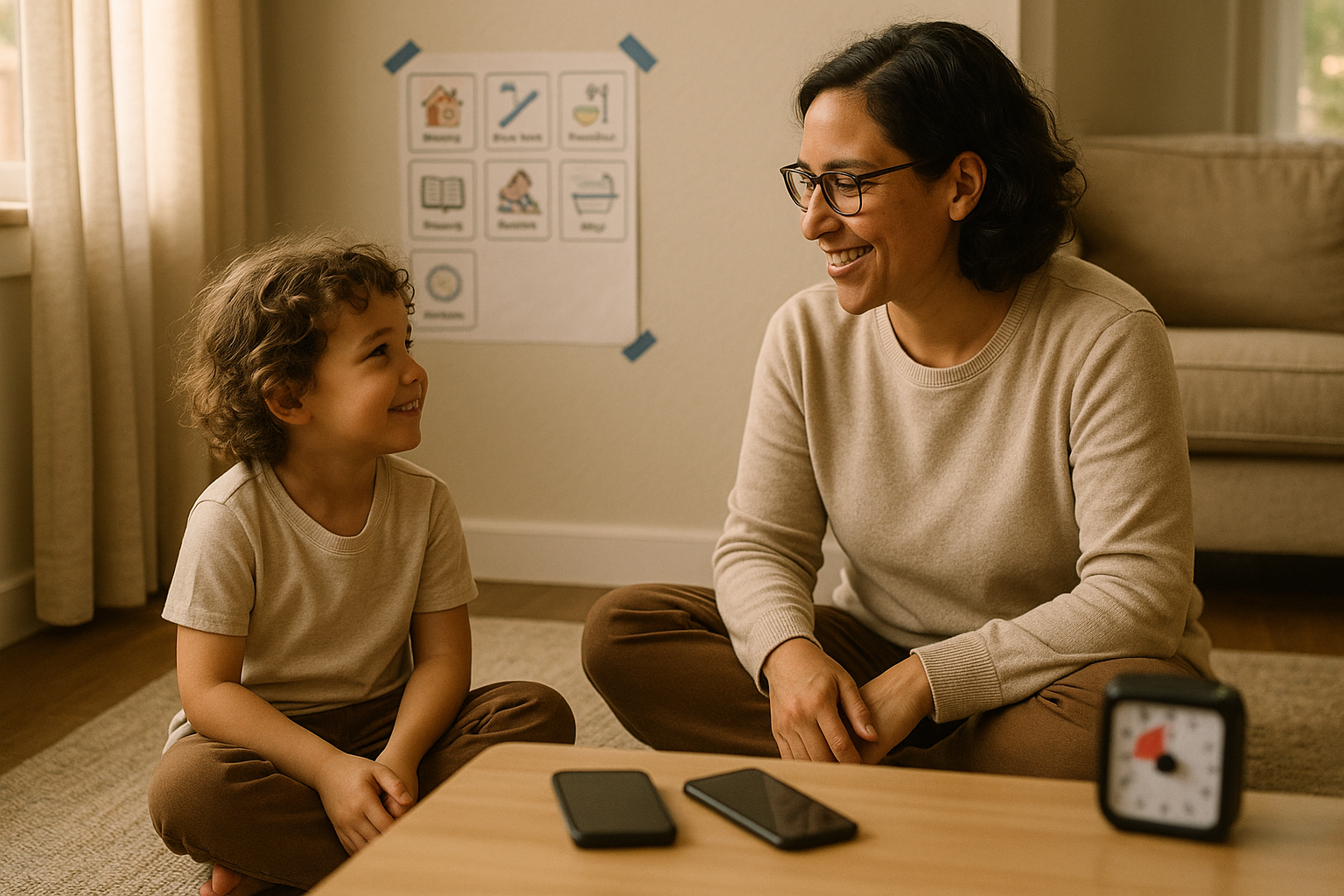
Active listening is how parents show children—at any age—that their words and feelings matter. In practice, it means giving full attention, reflecting back what you hear, and responding with empathy before problem-solving. Done consistently, active listening reduces power struggles, strengthens attachment, and helps kids learn to communicate clearly. This guide is for busy caregivers who want practical, research-supported strategies they can use with toddlers, school-age kids, and teens. Note: This guide is educational and not a substitute for individualized medical, developmental, or mental-health advice; consult your pediatrician or a licensed professional when needed.
Quick start (the “micro-loop”): Pause and make eye contact → reflect what you heard (“So you’re upset the game ended”) → label the feeling → ask an open question (“What would help now?”) → agree on a next step.
1. Get at Eye Level and Use “Serve-and-Return” Attention
Start by giving your full, distraction-free attention at your child’s level; then, match each “serve” (a look, word, gesture) with a calm, responsive “return.” These back-and-forth exchanges build trust and teach conversation skills. For babies and toddlers, eye contact, warm tone, and mirroring sounds or gestures are enough; for older kids, it’s steady presence and thoughtful replies. The goal is not perfect dialogue but consistent, contingent responses that signal “I see you, I’m with you.” Neuroscience-informed early-childhood research describes this as “serve and return,” foundational for language and social development. You can apply it anywhere—during play, homework, car rides—by pausing other tasks and making space for the volley. Over time, kids internalize this rhythm and use it with peers and adults. ZERO TO THREEAHRQ
1.1 How to do it
- Drop to their level: Kneel or sit so eyes align; soften your voice.
- Return each serve: Nod, paraphrase, or mirror a gesture; avoid rushing in with solutions.
- Name what you see: “Your shoulders look tight—that project is stressing you.”
- Keep volleys short: Aim for 3–5 back-and-forths before shifting.
- Protect the moment: Silence notifications; put phones face down.
1.2 Mini-checklist
- My body is still and turned toward my child
- I responded to their last “serve”
- I reflected content and feeling
- I resisted fixing too soon
Close: Eye-level, back-and-forth attention is the fastest way to signal safety and invite real conversation.
2. Reflect Feelings and Practice Emotion Coaching
Reflective listening turns “hearing” into understanding: restate your child’s words and label the emotion—“You’re furious your tower fell.” This validates experience without endorsing misbehavior and opens the door to coaching. Emotion-coaching steps include noticing feelings, seeing them as teaching moments, listening with empathy, naming emotions, and setting limits with problem-solving. Parents who coach emotions help kids build vocabulary for inner states and regulate more effectively, especially during conflicts. Use simple scripts: “I get why that felt unfair; let’s figure out what to do next.” This balance of empathy + guidance is teachable and can be learned in everyday moments. Gottman Instituteparentingcounts.orgHealthyChildren.org
2.1 Common mistakes
- Minimizing: “It’s not a big deal.”
- Fixing too fast: Jumping straight to advice.
- Interrogating: Rapid-fire questions that flood a dysregulated child.
2.2 How to do it
- Lead with empathy: “You’re disappointed the plan changed.”
- Name, then tame: Label feelings before limits (“It’s okay to be mad; it’s not okay to hit”).
- Co-create options: “Want to cool off together or take a solo break?”
Close: Reflecting feelings first lowers defenses and primes kids to engage in solutions.
3. Build Listening Habits with PRIDE Skills in Child-Led Play
Five minutes a day of child-led play rewires the parent-child dynamic for cooperation. In Parent-Child Interaction Therapy (PCIT), caregivers follow the child’s lead and use PRIDE skills: Praise (labeled, specific), Reflect (paraphrase their words), Imitate (copy appropriate play), Describe (sportscast actions), and show Enthusiasm. This “special playtime” boosts connection and models reciprocal listening. The PCIT model recommends daily 5-minute practice during Child-Directed Interaction, emphasizing following the child’s lead and maximizing positive attention.
3.1 Mini-routine (5 minutes)
- Minute 0–1: Child chooses activity; you kneel/sit close.
- Minutes 1–4: Use PRIDE—“I like how you stacked those blocks so carefully.”
- Minute 5: Gentle wrap-up and transition cue (“Two more blocks, then snack”).
3.2 Why it works
- Increases positive attention and cooperation; creates daily reps of reflective listening in a low-stakes context.
Close: Small, consistent doses of PRIDE play compound into easier communication the rest of the day.
4. Ask Open-Ended Questions—and Wait a Full 3–5 Seconds
Open questions invite stories (“What felt hardest about today?”) while closed questions limit responses (“Was school okay?”). The missing ingredient is wait time: research in education shows when adults pause ≥3 seconds after asking—or after a child responds—kids share more, use richer language, and reason better. Many of us reflexively jump in at ~1 second; stretching to 3–5 seconds feels long but unlocks depth. Combine open questions + wait time + gentle prompts (“Say more”) to help kids organize thoughts without pressure. For shy children, write/draw options; for teens, try parallel activities (walking, driving) that ease eye-contact intensity. Faculty Focus
4.1 Prompts to try
- “What surprised you most?”
- “How did you decide that?”
- “What should we consider next time?”
4.2 Numbers & guardrails
- Aim for 3–5 seconds of silence after your question and after their answer; avoid stacking questions back-to-back.
Close: Ask open, spacious questions—and protect the silence that lets kids think.
5. Use the Teach-Back Method to Ensure You Truly Understood
“Teach-back” is a health-communication tool you can borrow at home: ask your child to explain the plan in their own words, or paraphrase what you heard and invite correction. This checks clarity without sounding like a quiz: “Just to be sure I got it—your plan is to text your coach before 6 and finish math by 7. What am I missing?” Evidence in healthcare links teach-back to better understanding and follow-through; at home, it surfaces mismatches early and builds metacognition (“What did I hear? What’s my next step?”). Keep tone collaborative; if emotions are high, regulate first, then summarize. AAFP
5.1 How to do it
- You summarize, then invite edits: “Here’s my take—fix it if I’m off.”
- They teach back the plan: “So I’ll pack the uniform and set the alarm.”
- Close the loop: “Great—let’s check in at 7:30.”
5.2 Mini case
A tween repeatedly “forgets” library day. Parent: “Walk me through your plan.” Child: “Put the books by the door after dinner.” Parent: “I’ll put the tote there now—sound right?” (Mutual clarity achieved.)
Close: Teach-back swaps assumptions for shared understanding—no nagging required.
6. Collaborate on Problems with Plan B Conversations
When expectations and skills clash (“He won’t do homework”), a collaborative problem-solving chat helps: Empathy (gather the child’s perspective), Define adult concerns, then Invite solutions you both can live with. Known as Plan B in Dr. Ross Greene’s model, it starts with “I’ve noticed [specific issue]—what’s up?” and uses reflective listening to reveal lagging skills, then names your concern (health, safety, learning, fairness) before brainstorming. The sequence reduces resistance because kids feel heard, and solutions are co-owned. Use it outside the heat of the moment; keep problems narrow and actionable.
6.1 Steps
- Empathy: “I’ve noticed mornings are rough—what’s up?” (Drill with clarifiers.)
- Adult concern: “I worry we’re late and you miss warm-ups.”
- Invitation: “Ideas to help both of us?” → pick a specific, testable plan.
6.2 Common pitfalls
- Mixing multiple issues; vague concerns; proposing solutions for the child instead of with them.
Close: Plan B turns conflict into a joint design session—listening first, problem-solving second.
7. Lead with Labeled Praise and Positive Attention
Kids (and teens) listen better when they feel seen for what’s going right. Labeled praise—“Thanks for putting your shoes by the door without reminders”—tells them exactly which behavior you value and increases the odds you’ll see it again. Pair praise with genuine positive attention (smiles, high-fives, warm tone), and use it more often than corrective attention. Even brief, specific acknowledgments during routines can change the tone (“Appreciate you starting homework at 4:30”). For younger children, this approach is a core CDC-endorsed strategy to strengthen communication and cooperation.
7.1 How to do it
- Catch the small wins: “You asked for help calmly—nice self-control.”
- Be specific: Describe exactly what worked.
- Balance correction: Aim for a higher ratio of positive to negative attention. CDC
7.2 Mini-checklist
- Praise includes the behavior
- Tone is warm, not sarcastic
- Praise is timely (within seconds/minutes)
Close: What you notice grows—labeled praise teaches kids precisely how to succeed with you.
8. Minimize Distractions and Choose the Right Listening Window
Even the best listening skills falter when your attention is split. “Technoference” (phones, notifications, multitasking) interrupts serve-and-return moments and can dilute the quality of parent-child interactions. Make deliberate “no-phone zones” (mealtimes, bedtime) and choose times when your child is most talkative—often during play, car rides, or before lights-out. For teens, late-evening check-ins or post-activity decompression windows can yield more sharing than direct interrogation after school. The American Academy of Pediatrics encourages parents of young children to put down smartphones to protect these conversational rhythms.
8.1 Tools/Examples
- Place phones face down with Do Not Disturb during 10-minute chats.
- Family media plan: Agree on shared tech boundaries; revisit quarterly.
- Ritualize windows: “Talk-and-toast” at breakfast; “one good/one hard” at bedtime.
8.2 Mini case
After shifting to no-phone dinners and a 10-minute bedtime chat, a parent noticed their 9-year-old volunteering stories without prompts. The structure made listening predictable and safe.
Close: When attention is protected by time and context, kids fill the space with words.
9. Regulate First, Then Relate and Reason
Trying to reason with a dysregulated child is like explaining algebra on a roller coaster. In stress moments, aim for the 3 Rs: Regulate (help the nervous system settle), Relate (connect with empathy), then Reason (discuss and plan). Start with breathing, movement, or sensory breaks; use few words and a calm tone. Once the child’s body is settled, reflect feelings and only then problem-solve. The AAP advises this sequence when kids are stressed; it aligns with trauma-informed practice and keeps listening mutually possible.
9.1 Mini-checklist
- We paused to breathe/move
- I reflected the feeling in one sentence
- We discussed options after calm returned
9.2 Guardrails
- Skip lectures in the red zone; aim for short, concrete choices after regulation (“Water first or jump 10 times?”).
Close: Calm bodies listen better—yours and theirs.
10. Prepare Transitions with Previews, Choices, and Timers
Many blowups happen at transitions (leaving the park, starting homework). Active listening here means anticipating friction, previewing what’s next, and offering limited choices within your boundary. Use visual schedules, first-then language, and visual/auditory timers to make time tangible: “First clean-up, then snack” with a 5-minute timer and a 1-minute verbal countdown. Children—especially those with ADHD, anxiety, or sensory differences—benefit from predictable routines and consistent cues that respect their need to shift gears gradually.
10.1 How to do it
- Preview the day: “After school: snack → piano → playground.”
- Offer two choices: “Brush teeth or PJs first?” (both meet your goal).
- Use timers: Start with external timers; fade prompts as skills grow. Step Ahead ABA
10.2 Region-neutral tools
- Visual schedules (printable or app), sand timers, kitchen timers, smartwatch alarms; picture cards for nonreaders. Penn State Extension
Close: When kids can see and choose within what’s coming, they meet you halfway.
11. Add Visual Supports and AAC for Diverse Communicators
Active listening includes meeting kids where they are linguistically. Visual supports—choice boards, first-then cards, visual schedules, social stories, timers—clarify expectations and reduce anxiety. For children with speech/language differences, AAC (augmentative and alternative communication) can supplement or replace speech, from low-tech picture boards to speech-generating apps. Evidence and professional guidance from ASHA and autism organizations support introducing AAC early and using visuals across routines. Listening expands when kids have multiple ways to express themselves; your job is to attend to symbols, gestures, pictures, and devices with the same respect you give spoken words.
11.1 Practical moves
- Choice boards for snacks/activities; first-then cards for tasks.
- Visual timers for waiting/turn-taking; schedules for mornings.
- Partner with an SLP to trial AAC; keep modeling language on the system.
11.2 Mini case
A 6-year-old with limited speech began using a picture card to request “help.” Parents mirrored the card and labeled the feeling; outbursts dropped because the child felt heard via visuals.
Close: When you widen the channel for expression, listening becomes truly inclusive.
12. Use OARS with Tweens and Teens: Open Questions, Affirmations, Reflections, Summaries
With adolescents, motivation grows from being heard, not lectured. Borrow Motivational Interviewing micro-skills—OARS—to keep conversations collaborative. Open questions (“What worries you about this plan?”) invite thinking; Affirmations notice strengths (“You took initiative texting your coach”); Reflections show you get their view; Summaries knit threads and invite next steps. These skills lower resistance and respect autonomy while maintaining boundaries. Multiple public-health and youth-care resources teach OARS as a core conversational framework you can practice at home.
12.1 Script you can use
- Open: “What do you want me to understand about this friend group?”
- Affirm: “You’ve been thinking hard about balancing grades and band.”
- Reflect: “Part of you wants independence; part wants support.”
- Summarize: “So tonight you’ll study 30 minutes, then check in at 9.”
12.2 Mini-checklist
- I asked before advising
- I named a real strength
- I reflected both content and emotion
- We agreed on a next step
Close: OARS keeps teen talks respectful and change-oriented—even when you disagree.
FAQs
1) What is the simplest definition of active listening for parents?
It’s focused, non-judgmental attention to your child’s words, behaviors, and feelings—followed by a brief reflection to show you understood—before you teach, correct, or fix. Think: pause, reflect content and feeling, then collaborate on a next step. Starting with even 60–90 seconds of undivided attention can change the tone of an entire interaction.
2) How much eye contact is “right”?
Use comfortable, culturally sensitive eye contact—never force it. Sit at the child’s level and angle your body toward them; for kids who find eye contact intense (including some autistic children), try side-by-side activities (drawing, walking) while you listen. Attend to their serves (gestures, looks, words) and respond contingently. National Autistic Society
3) Isn’t praise manipulative?
Random flattery can feel hollow. Labeled praise (“Thanks for starting homework at 4:30”) is feedback: it tells kids exactly what worked, builds competence, and is linked to more of the behavior you want—especially when paired with warmth and opportunities for choice.
4) What if my child clams up and says “I don’t know”?
Slow down and widen the path. Use wait time (count to three silently), offer choices of how to communicate (talk, write, draw), or reflect a guess (“Sounds like there’s more there and it’s hard to say”). If it’s a recurring pattern, switch to Plan B at a calm time and explore what makes answering tough. livesinthebalance.org
5) Does teach-back feel patronizing?
It shouldn’t if your tone is humble. Frame it as your check for clarity: “Let me make sure I’ve got this right,” or “Tell me your plan so I don’t mess it up.” Healthcare uses teach-back widely because people often leave conversations misaligned on next steps; at home it prevents repeated reminders and resentment.
6) How do I listen during tantrums or meltdowns?
Don’t debate a dysregulated brain. Help the body calm first (breathing, movement, quiet space), then reflect the feeling in one sentence, and only afterward reason or problem-solve. This “regulate → relate → reason” sequence protects connection and yields better outcomes.
7) What if listening seems to “reward” bad behavior?
You can validate feelings and set firm limits: “You’re really mad we’re leaving; it’s okay to be mad. Hitting is not okay. Do you want a piggyback or to stomp it out together to the car?” Separate the emotion (always welcome) from the behavior (some allowed, some not), and praise even small recoveries.
8) How do I adapt these ideas for non-speaking or speech-delayed kids?
Lean on visual supports (pictures, schedules, first-then, timers) and consider AAC with guidance from an SLP. Treat pointing, pictures, or device taps as real language and respond with the same care you would to spoken words. Early AAC use is encouraged when speech is limited. Leader
9) What are good conversation starters for teens?
Try open prompts about their world: “What’s the group chat arguing about this week?” “Whose track is stuck in your head?” Pair with OARS—affirm a strength, reflect their perspective, then summarize any plan. Pick good windows (after practice, late evening) and avoid pouncing at the door.
10) How do I handle background screens and multitasking?
Designate daily no-phone listening windows (meals, bedtime chat), use a Family Media Plan, and put devices out of sight. Kids read your attention like a barometer; when you model focus, they respond in kind. AAP
Conclusion
Active listening is not a single trick; it’s a set of small, repeatable moves that tell your child, “You matter here.” When you get to eye level, reflect feelings, and slow down for honest back-and-forth, kids open up. Layer PRIDE play, labeled praise, and collaborative problem-solving, and you shift from policing to partnering. Timers, previews, and visual supports make expectations clear; OARS keeps teen talks respectful; teach-back locks in shared plans. None of this requires hours—just consistent, protected minutes across the day. Start with one change (for example, five minutes of special playtime or a nightly phone-free chat) and build. In a few weeks you’ll likely notice fewer power struggles, more initiative, and a warmer family tone. Try one strategy today and celebrate the first small win you hear.
CTA: Pick one listening window (10 minutes today), put the phone away, and practice the pause-reflect-plan loop.
References
- Tips for Active Listening | CDC Essentials for Parenting Toddlers (Aug 8, 2024). CDC
- Tips for Communicating With Your Child | CDC Essentials for Parenting Toddlers (Aug 8, 2024).
- Serve and Return – Key Concept | Center on the Developing Child, Harvard University (accessed 2025). Harvard Child Development Center
- A Guide to Serve & Return | Center on the Developing Child, Harvard University (resource guide, 2019 and prior). Harvard Child Development Center
- Healthy Communication With Your Child | American Academy of Pediatrics (June 28, 2022). AAP Publications
- Parents of Young Children: Why Your Screen Time Matters | HealthyChildren.org (AAP) (Oct 31, 2023). HealthyChildren.org
- Creating Calm: How to Talk With Your Child When They’re Stressed | HealthyChildren.org (AAP) (Apr 12, 2023). HealthyChildren.org
- Official PCIT: Child-Directed Interaction (CDI) | PCIT International (accessed 2025). PCIT – Official Home
- Tips for Praise, Imitation, and Description | CDC Essentials for Parenting Toddlers (Aug 8, 2024). CDC
- Wait-Time and Rewards as Instructional Variables | ERIC (Rowe, 1972). ERIC
- Wait Time: Slowing Down May Be a Way of Speeding Up | Journal of Teacher Education (Rowe, 1986). SAGE Journals
- Tool: Teach-Back | AHRQ TeamSTEPPS (accessed 2025). AHRQ
- Teach-Back: Guide to Improving Patient Safety in Primary Care | AHRQ (accessed 2025). AHRQ
- Plan B Cheat Sheet | Lives in the Balance (Ross Greene) (Oct 26, 2022). livesinthebalance.org
- Motivational Interviewing OARS—Brochure for Parents | APA Foundation (2024). apaf.org
- Using OARS with Youth | National Center for School Mental Health (July 2, 2024). schoolmentalhealth.org
- Augmentative and Alternative Communication (AAC)—Public Guidance | ASHA (accessed 2025). ASHA
- ATN/AIR-P Visual Supports and Autism (tool kit) | Autism Speaks (accessed 2025). Autism Speaks
- Tips for Communicating with Your Child—Active Listening, Praise, Play | CDC Essentials (Aug 8, 2024). CDC
- How Can We Help Kids With Transitions? | Child Mind Institute (Feb 5, 2025). Child Mind Institute