



























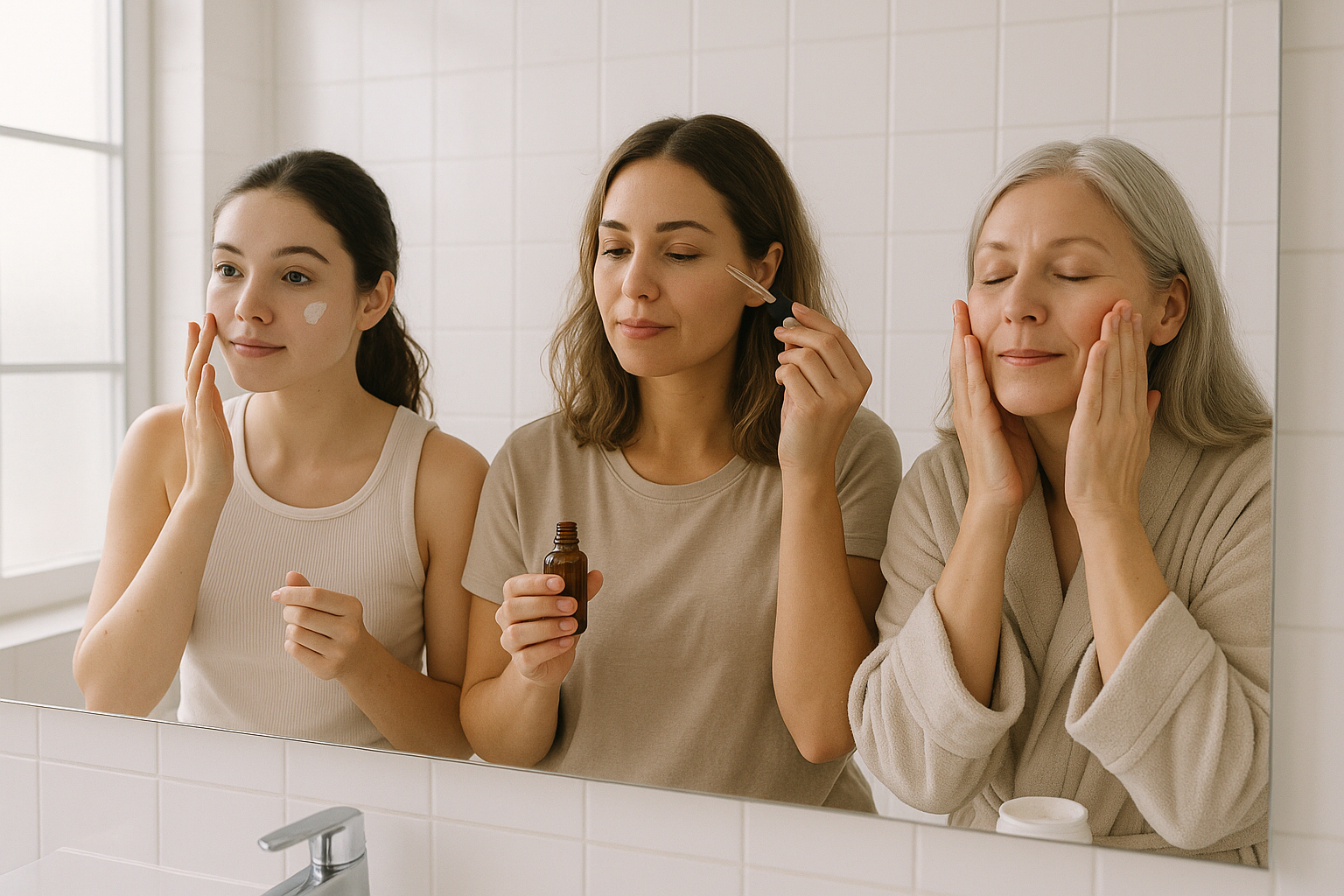
Healthy skin routines evolve with you. Your 20s often call for prevention and consistency, your 30s for strategic actives, and your 40s for barrier-first hydration and targeted repair. In one line: “changing skincare needs” means adjusting products and habits as biology (hormones, collagen, UV history) shifts by decade. A simple core never changes—cleanse, moisturize, protect—while add-ons (retinoids, antioxidants, brighteners) scale in strength and frequency as your skin’s tolerance and goals change. As with any health topic, the guidance below is educational only; if you have a condition, allergies, pregnancy, or medications to consider, talk with a board-certified dermatologist.
Quick-start steps (for all ages): morning = gentle cleanse → antioxidant serum (optional) → moisturizer → broad-spectrum SPF 30+; evening = cleanse → treatment (retinoid or other, if used) → moisturizer.
1. Treat SPF as the non-negotiable (and change how you use it by decade)
Daily, broad-spectrum sunscreen is the most important anti-aging product at any age; the difference with each decade is precision: amount, reapplication, formula, and sun behavior. As of August 2025, dermatology guidance emphasizes SPF 30+ broad-spectrum (UVA/UVB) every day, applying enough and reapplying at least every two hours when outdoors. Most people under-apply; aim for about a teaspoon for the face/neck and a shot-glass (~1 oz/30 mL) for the body, and don’t forget ears, eyes’ perimeter, lips, neck, chest, and hands. If you deal with hyperpigmentation, consider a tinted sunscreen that includes iron oxides to help with visible light—a key trigger in deeper skin tones. Pair SPF with hats, shade, and UV-aware habits.
1.1 Why it matters
UV radiation accelerates lines, spots, and laxity and raises skin cancer risk; behavior change (shade, clothing) and correct dosing of sunscreen deliver the biggest lifetime ROI. Regionally, high-UV areas or high altitudes increase risk—check the daily UV Index to decide on extra protection.
1.2 How to do it (by decade)
- 20s: Build the habit. Wear SPF 30+ daily; reapply outdoors. Try lightweight gel or fluid textures if oily/combo.
- 30s: Upgrade to SPF 50 for long days outside; consider tinted mineral formulas if uneven tone appears.
- 40s: Cover neck/chest/hands as religiously as face; use more emollient textures if drier; keep a brush-on mineral SPF in your bag for hand reapplication after washing.
Mini-checklist: broad-spectrum 30+; correct amount; 2-hour reapply outdoors; hat/sunglasses; UV-index check on high-sun days. Bottom line: sun behavior and dosing—not just “having SPF”—separate good from great results.
2. Start (then scale) retinoids smartly—avoid in pregnancy
Retinoids (retinol, retinaldehyde, adapalene, tretinoin) improve texture, fine lines, and acne. The decade-by-decade difference is strength and cadence. In your 20s, you’re building tolerance and preventing; in your 30s, you’re optimizing strength and frequency; by your 40s, you’re maintaining results while minimizing irritation with barrier support. Important: topical retinoids are not recommended in pregnancy; if pregnant or trying, stop retinoids and use alternatives like azelaic acid after discussing with your clinician.
2.1 How to start and scale
- 20s: Begin with over-the-counter retinol or adapalene 0.1% 2–3 nights/week; pea-sized for face; moisturize sandwich if sensitive.
- 30s: If well-tolerated, increase to nightly or step up to retinaldehyde/ prescription tretinoin under guidance.
- 40s: Maintain effective dose; buffer with richer moisturizers and avoid stacking strong acids the same night to limit irritation.
2.2 Pregnancy-safe pivots
When retinoids are off the table, azelaic acid is commonly used for acne and pigment, and benzoyl peroxide or glycolic/other AHAs may be options—confirm with your provider.
Pro tip list:
- Introduce slowly; expect 6–12 weeks for visible change.
- Use at night; wear daily SPF.
- Pause during irritation flares; restart at lower frequency.
- Avoid during pregnancy/breastfeeding unless cleared by your doctor.
Bottom line: retinoids are the most proven at-home “rework” tool, but timing, formulation, and your life stage dictate the smartest version for you.
3. Build a barrier-first routine: gentle cleansing and the right moisturizer mix
Your skin barrier (stratum corneum lipids and corneocytes) keeps water in and irritants out. Across decades, the winning move is gentle cleansing plus moisturizers that combine humectants (e.g., glycerin, hyaluronic acid), emollients, and (when needed) occlusives. Harsh soaps and over-washing strip lipids, leading to tightness, redness, and flaking—issues that increase with age and lower sebum. Dermatology basics recommend a gentle, non-abrasive cleanser and moisturizer applied after cleansing; textures get richer as skin gets drier.
3.1 Numbers & guardrails
Short, lukewarm face washes; pat—not rub—dry; moisturize within minutes to trap water. If very dry (more common in late 30s–40s), consider ointment/cream formats at night; hands often need heavier moisturizers, too.
3.2 Ingredient highlights
- Humectants: hyaluronic acid and glycerin attract water.
- Emollients: squalane, triglycerides, esters soften feel.
- Occlusives: petrolatum, dimethicone seal hydration (helpful in colder, drier months).
Quick pitfalls: hot water, fragranced scrubs, high-alcohol toners, and too many actives at once. Bottom line: prioritize comfort and consistency; a calm barrier makes every active work better.
4. Add a morning antioxidant (usually vitamin C), then tailor by decade
Antioxidants neutralize free radicals from UV and pollution and help with brightness and tone. A well-formulated vitamin C serum (often L-ascorbic acid in the 10–20% range with supportive partners like vitamin E or ferulic acid) is a popular, evidence-based morning add-on. Sensitive skin may prefer derivatives or different antioxidants (e.g., azelaic acid, niacinamide). Your decade influences strength and layering: lighter in your 20s, more targeted or stabilized in your 30s, and paired with barrier care in your 40s.
4.1 How to do it
- Apply after cleansing, before moisturizer and SPF.
- Start 3–4 mornings/week; increase as tolerated.
- If stinging or redness persists, try a derivative or use every other morning.
4.2 Mini case
If early melasma or PIH shows in your 30s, a vitamin C + tinted mineral SPF combo improves tone while protecting against UVA/UVB and some visible light.
Bottom line: a morning antioxidant protects your “investment” in SPF; choose form and frequency your skin happily tolerates.
5. Manage uneven tone and spots with sunscreen first, then targeted actives
Hyperpigmentation—from past acne, hormones, or sun—rises through the decades. The first treatment is sun protection (including tinted SPF for visible light). Then layer gentle brighteners: niacinamide, azelaic acid, vitamin C; dermatology-guided options like hydroquinone or combination formulas may be used for melasma or stubborn spots. Expect months—not days—of consistent care; deeper discoloration fades slower.
5.1 How it looks by decade
- 20s: Focus on prevention and post-blemish care; SPF + azelaic or niacinamide.
- 30s: Maintain prevention; consider derm-directed topicals if melasma appears.
- 40s: Combine brighteners with barrier support; consider in-office options if home care plateaus.
5.2 Quick pitfalls (and fixes)
- Over-exfoliating irritated skin → pull back to 1–2×/week gentle acids.
- Chasing too many brighteners → simplify to two actives max plus SPF.
- Neglecting hands/neck → apply the same regimen there daily.
Bottom line: sunscreen sets the ceiling for progress; smart, steady brighteners raise the floor.
6. Exfoliate for texture—lightly in your 20s, strategically in your 30s, gently in your 40s
Exfoliation (chemical > physical for most) smooths texture and helps actives penetrate, but the dose makes the difference. The more aggressive the method, the less frequent it should be, and over-exfoliation leads to redness and barrier damage. Use frequency tailored to skin type and product strength—often 1–3×/week—and avoid stacking strong acids with retinoids on the same night unless directed by your clinician.
6.1 How to set your cadence
- 20s: Try a mild AHA/BHA 1–2×/week for congestion.
- 30s: Keep 1–3×/week if tolerated; alternate with retinoid nights.
- 40s: Prefer lactic or PHA if sensitive; emphasize moisturizers afterward.
6.2 Mini-checklist
- Patch-test new acids.
- Skip when wind-burned, after procedures, or during irritation.
- Always wear SPF the next day.
Bottom line: exfoliation is a scalpel, not a shovel—light, precise use beats daily abrasion.
7. Don’t forget eyes, neck, chest, and hands—thin skin needs daily protection
These thinner-skin areas show sun and movement earlier, especially in your 30s–40s. Treat them as part of your face routine: apply SPF, bring serums/moisturizer down to the chest, and include the backs of hands (reapply after washing). Nightly, a bland eye cream can reduce irritation if retinoids creep too close; some tolerate dedicated low-strength eye retinoids with care. Moisturizing hands after washing and at bedtime (cotton gloves optional) helps barrier repair.
7.1 Practical moves
- SPF: extend to eyelids (if tolerated), ears, neck, chest, hands.
- Hydration: richer textures for neck/chest at night.
- Habits: stash a travel SPF for hands; reapply outdoors.
7.2 Mini example
If typing or washing frequently, keep a fragrance-free hand cream at your desk and a brush-on mineral SPF in your bag for on-the-go reapplication.
Bottom line: your skincare doesn’t end at the jawline; treat secondary zones like first-class citizens daily.
8. Leverage lifestyle levers: sleep, stress, and diet support clearer, calmer skin
Skin reflects routines beyond the bathroom. Research associates poor sleep with diminished barrier function and more visible intrinsic aging; smoking accelerates collagen breakdown via MMPs; and dietary patterns (particularly high glycemic load) correlate with more acne in some people. Practical shifts—prioritizing 7–9 hours of sleep, not smoking, moderating high-GI surges, and managing stress—help all decades.
8.1 Evidence snapshots
- Sleep: Poor sleepers show worse barrier recovery and aging markers compared with good sleepers.
- Smoking: Increases matrix metalloproteinases (MMPs), reducing collagen and elastin integrity.
- Diet: Lower-glycemic patterns are linked with fewer acne lesions in some studies; evidence is evolving—use an n=1 approach.
8.2 Mini-checklist
- Aim for consistent bed/wake times and a dark, cool bedroom.
- If you smoke, seek cessation support—your skin (and health) will thank you.
- Trial a lower-GI emphasis for 8–12 weeks while tracking breakouts.
Bottom line: no serum compensates for chronic sleep loss, smoking, and constant glucose spikes; tune the basics first.
9. Calibrate pro care and product order: when to see a derm, how to layer for results
Skin questions typically increase in your 30s–40s: lingering acne, melasma, or texture that home care can’t shift. That’s your cue to see a board-certified dermatologist for diagnosis and options (prescription topicals, peels, lasers, neuromodulators, fillers). Separately, correct layering order improves results—cleanse → prescription/targeted treatment → moisturizer/SPF—so actives reach skin and SPF performance isn’t diluted.
9.1 When pro help adds value
- Melasma or stubborn PIH unaffected by months of SPF + brighteners.
- Scarring or cystic acne (risk of marks).
- Troubleshooting irritation cycles (e.g., retinoid “start-stop”).
9.2 Layering guardrails
- Morning: cleanse → antioxidant → moisturizer → SPF.
- Night: cleanse → treatment (retinoid/other) → moisturizer.
- Keep routines small and stable; add one new product at a time.
Bottom line: a dermatologist can accelerate progress and prevent missteps; smart sequencing makes every product pull its weight.
FAQs
1) Do I really need SPF 50, or is SPF 30 enough?
SPF 30 is the baseline daily recommendation; it blocks ~97% of UVB. SPF 50 blocks slightly more (~98%), and is helpful for long outdoor days, high-UV climates, or if you chronically under-apply. Reapplication every two hours outdoors matters more than chasing a higher number, and tinted mineral options can help with visible light if pigment is a concern.
2) What’s the right order to layer products?
General rule: cleanse → targeted treatment → moisturizer/SPF. In the morning, treatments often mean antioxidants; at night, a retinoid or other prescription. Layering this way helps actives reach skin and preserves sunscreen performance as the final step. Keep routines simple—too many steps can irritate and reduce consistency.
3) When should I start a retinoid?
Start when you’re ready to be consistent—many people begin in their early-to-mid 20s for acne/maintenance. Go slow (2–3 nights/week), use a pea-sized amount, moisturize if needed, and wear daily SPF. If pregnant or trying, avoid retinoids and discuss alternatives like azelaic acid with your clinician.
4) How often should I exfoliate?
Think in terms of tolerance, not trends. Chemical exfoliants 1–3×/week are plenty for most; the more aggressive the product, the less often you should use it. Over-exfoliation shows up as stinging, redness, or tightness—signs to pause and hydrate. Don’t layer strong acids with retinoids the same night unless directed.
5) Is vitamin C required? What if I’m sensitive?
Vitamin C is a helpful morning add-on for brightness and environmental protection, but it isn’t mandatory. Sensitive skin can use derivatives or alternative antioxidants (e.g., azelaic acid, niacinamide) less frequently. Always pair with SPF and stop if persistent irritation occurs.
6) I’m getting dark spots in my 30s. What should I do first?
Sunscreen, every day—consider tinted options for visible light. Then add a gentle brightener like niacinamide or azelaic acid; for melasma or stubborn PIH, ask a dermatologist about prescription combinations. Progress is measured in months; patience and sun protection are non-negotiable.
7) Do I need a separate eye cream?
Not necessarily. Many can use their face moisturizer around the eyes; if you’re sensitive, a gentle eye cream can help buffer irritation. If you try a retinoid eye product, introduce slowly and moisturize well. Regardless, SPF and sunglasses are protective musts for this thin skin.
8) How do sleep and stress show up on skin?
Inconsistent or short sleep correlates with weaker barrier recovery and more visible signs of intrinsic aging; stress can drive breakouts and dullness. Stabilizing sleep (7–9 hours) and stress routines (movement, breath work) supports all skin goals and improves tolerance to actives.
9) Are diet changes worth it for acne?
Evidence suggests some people break out less on lower-glycemic patterns; responses vary. Try an 8–12-week experiment (consistent, lower-GI emphasis) while tracking breakouts, and review with your clinician if you have questions or restrictive diets.
10) What changes most after 40?
Lower estrogen and sebum often mean drier, less elastic skin and more visible pigment. Routines usually shift toward richer moisturizers, steady retinoid use (if tolerated), and diligent sunscreen on neck/chest/hands. Professional guidance becomes more useful for melasma and texture.
11) Can oily skin skip moisturizer?
No. Oily skin still needs hydration; choose lightweight, non-comedogenic gels or lotions. Moisturizer helps maintain barrier function and can reduce the temptation to over-strip with harsh cleansers, which can worsen oiliness.
12) Is there a universal routine that works for everyone?
The core (cleanse, moisturize, protect) is universal, but formulas, actives, and frequency change with tolerance, climate, and decade. Introduce one new product at a time, give changes weeks—not days—to work, and use your dermatologist as a co-pilot for persistent concerns.
Conclusion
Adapting to changing skincare needs isn’t about chasing trends; it’s about aligning routine with biology and behavior. Your 20s set foundations: sunscreen as a habit, gentle cleansing, and optional starter actives. Your 30s reward consistency with strategic upgrades—retinoids and antioxidants balanced against barrier care. Your 40s (and beyond) emphasize hydration, sun behavior, and more deliberate pigment and texture strategies, with professional help as needed. Across decades, the rules stay simple: protect daily, treat slowly, moisturize generously, and measure progress in seasons, not weekends. If you’re unsure where to start, apply Rule #1 tomorrow morning and Rule #2 twice this week—then build outward. Ready to evolve your routine? Pick one upgrade from the list today and do it consistently for 8–12 weeks.
References
- How to apply sunscreen — American Academy of Dermatology (AAD), updated Aug 15, 2025. https://www.aad.org/public/everyday-care/sun-protection/shade-clothing-sunscreen/how-to-apply-sunscreen
- Should I apply my skin care products in a certain order? — AAD, n.d. https://www.aad.org/public/everyday-care/skin-care-basics/care/apply-skin-care-certain-order
- Face washing 101 — AAD, 2025. https://www.aad.org/public/everyday-care/skin-care-basics/care/face-washing-101
- UV Radiation & Sun Protection Basics — U.S. EPA, 2025. https://www.epa.gov/sunsafety/uv-radiation
- Retinoids: what they are and how to use them — AAD, 2021. https://www.aad.org/public/everyday-care/skin-care-secrets/anti-aging/retinoids-skin-care
- Is any acne treatment safe to use during pregnancy? — AAD, June 26, 2025. https://www.aad.org/public/diseases/acne/derm-treat/pregnancy
- How to safely exfoliate at home — AAD, n.d. https://www.aad.org/public/everyday-care/skin-care-secrets/routine/safely-exfoliate-at-home
- Hyaluronic Acid: Benefits for Skin — Cleveland Clinic, Dec 1, 2022. https://health.clevelandclinic.org/hyaluronic-acid-skin-benefits/
- Vitamin C for skin: Pros and cons — Harvard Health Publishing, July 2021. https://www.health.harvard.edu/blog/vitamin-c-for-skin-2019112718299
- How to fade dark spots in darker skin tones — AAD, Mar 10, 2025. https://www.aad.org/public/everyday-care/skin-care-secrets/routine/fade-dark-spots
- Melasma: Diagnosis and treatment — AAD, Feb 15, 2022. https://www.aad.org/public/diseases/a-z/melasma-treatment
- Caring for your skin in menopause — AAD, Nov 20, 2023. https://www.aad.org/public/everyday-care/skin-care-secrets/anti-aging/skin-care-during-menopause
- Oyetakin-White P., et al. Does poor sleep quality affect skin ageing? Clin Exp Dermatol (2015). PubMed: https://pubmed.ncbi.nlm.nih.gov/25266053/
- Knuutinen A., et al. Smoking affects collagen synthesis and extracellular matrix turnover in human skin — J Invest Dermatol, 2002. PubMed: https://pubmed.ncbi.nlm.nih.gov/11966688/
- Baldwin H. Effects of Diet on Acne and Its Response to Treatment — J Clin Aesthet Dermatol, 2020. https://pmc.ncbi.nlm.nih.gov/articles/PMC7847434/
- AAD. Can the right diet get rid of acne? (Diet & acne explainer), n.d. https://www.aad.org/public/diseases/acne-and-rosacea/can-the-right-diet-get-rid-of-acne