



























Rest days aren’t “doing nothing”—they’re where the gains actually happen. Physical recovery is the process by which muscles repair micro-damage, replenish fuel, and remodel connective tissues so they come back stronger for the next bout. In simple terms, training provides the stimulus; recovery provides the adaptation. On rest days, muscle protein synthesis (MPS) rises to repair fibers, glycogen stores are restored to power future sessions, and tendons/ligaments rebuild to tolerate load better—this is when strength and size improvements consolidate.
Brief note: This guide is educational, not medical advice. If you have an injury, chronic condition, or are on medication (e.g., NSAIDs), consult a qualified clinician.
Below are nine science-backed principles to structure your rest days so your body heals—and then some.
1. Recovery = Repair + Rebuild: Most Strength Gains Consolidate After You Stop Lifting
Muscles get stronger between sessions as micro-tears from training are repaired and remodeled; this happens through elevated muscle protein synthesis (MPS) on rest days. In the first day or two after a hard lift, MPS rises above baseline, especially if you eat sufficient protein—this positive protein balance is what turns stress into adaptation. Practically, that means you don’t have to “feel wrecked” to grow; you have to train hard enough to trigger adaptation and then give your body the materials and time to build back better. For most trained lifters, MPS elevation is shorter than for novices, but the principle is the same: the magic is in the recovery window. Hitting your daily protein target consistently matters more than obsessing over a single post-workout shake, and creatine monohydrate is a well-supported add-on that complements this process over weeks.
Why it matters
- Training only provides the stimulus; net growth requires MPS > MPB (breakdown) repeatedly over time.
- In trained athletes, damage contributes less over time; repeated MPS elevations (fed plus rested) explain hypertrophy.
Numbers & guardrails
- Protein: ~1.6 g/kg/day (upper 95% CI up to ~2.2 g/kg) supports hypertrophy with resistance training. Distribute across 3–5 meals.
- Creatine monohydrate: 3–5 g/day, any time; safe and effective for strength and lean mass across populations.
Mini-checklist
- Hit your daily protein target (don’t just “save it” for training days).
- Add 3–5 g creatine monohydrate daily if you want a proven edge.
- Plan rest days after your hardest sessions to capture the biggest MPS upswing.
Bottom line: Train hard, then fuel and wait—your body needs that window to convert stress into strength.
2. Refill Glycogen and Fluids: Fuel Your Next Session on Your Day Off
A major piece of feeling “snappy” again is restoring muscle glycogen and fluid balance. Heavy resistance or mixed training can significantly deplete glycogen, which affects power output, bar speed, and perceived effort next time. Rest days are ideal for topping up: adequate carbs (and some sodium) help pull water back into muscle, normalize neuromuscular function, and stabilize mood/effort. If you have back-to-back demanding sessions (e.g., two-a-days or a meet weekend), you’ll benefit from more aggressive refueling protocols; if you have a full day off before training, daily totals matter most.
How to do it
- Daily carbs: ~5–7 g/kg/day for moderate training; 7–10+ g/kg/day if volume is high.
- Rapid recovery (turnarounds <8 h): ~1.0–1.2 g/kg/hour for the first 4 hours after exercise, then resume normal intake.
- Fluids & sodium: Rehydrate to clear-urine baseline; include salty foods (or an electrolyte mix in hot/humid climates).
Numeric example
- 70-kg athlete after a glycogen-depleting day:
- Next-day rest: aim ~420–560 g carbs across meals; pair with lean protein and produce.
- If competing again same day: target ~70–85 g carbs/hour for the first 4 hours, then normal meals. SportsEngine
Bottom line: Carbs and fluids are your “reset button.” Replenish on rest days so your next session starts at full battery.
3. Sleep Is Your Most Potent Legal Recovery Aid
If you change one recovery habit, change your sleep. Short or fragmented sleep consistently impairs strength, power, skill execution, and recovery markers; it also increases injury risk and worsens soreness perception. Aim for 7–9 hours with a consistent schedule. As of August 2025, meta-analyses show sleep loss (deprivation or restriction) has a negative effect on performance, especially later in the day; sleep extension and better sleep hygiene can partially reverse this. Caffeine late in the day, bright evening light, and irregular bedtimes are low-hanging enemies. Europe PMC
Mini-checklist
- Wind-down: dim lights 60–90 minutes pre-bed; screens to night-mode.
- Cut caffeine after ~8 hours before bed (earlier if sensitive).
- Keep a cool room (~18–20°C), quiet, and dark.
- Protect a consistent sleep/wake window, even on rest days.
Tools/Examples
- If you train at night, a small carb-protein snack and a warm shower can reduce sleep-onset latency.
- Track time in bed and actual sleep (not just “readiness scores”). If sleep debt builds, schedule an extra easy day.
Bottom line: Sleep multiplies the effect of your other recovery habits; you can’t out-supplement a bad night’s sleep.
4. Move, Don’t Park: Active Recovery Improves Circulation and Reduces Stiffness
Light movement on rest days boosts blood flow, maintains range of motion, and often reduces perceived soreness (DOMS). Importantly, “active recovery” should be easy—think 15–30 minutes at conversational pace or low-impact flows, not a secret second workout. Evidence suggests modalities like easy cycling, walking, mobility flows, or pool work can aid subjective recovery and some performance metrics the following day, especially compared with doing nothing. The goal is circulation and gentle tissue loading, not fatigue.
Simple active-recovery menu
- 20–30 minutes brisk walking or easy cycling (50–60% HRmax).
- 10–15 minutes of joint-by-joint mobility (hips, T-spine, ankles, shoulders).
- 5–10 minutes of diaphragmatic breathing to downshift the nervous system.
Common mistakes
- Going too hard (“recovery run” at threshold pace).
- Skipping movement entirely, then feeling wooden the next day.
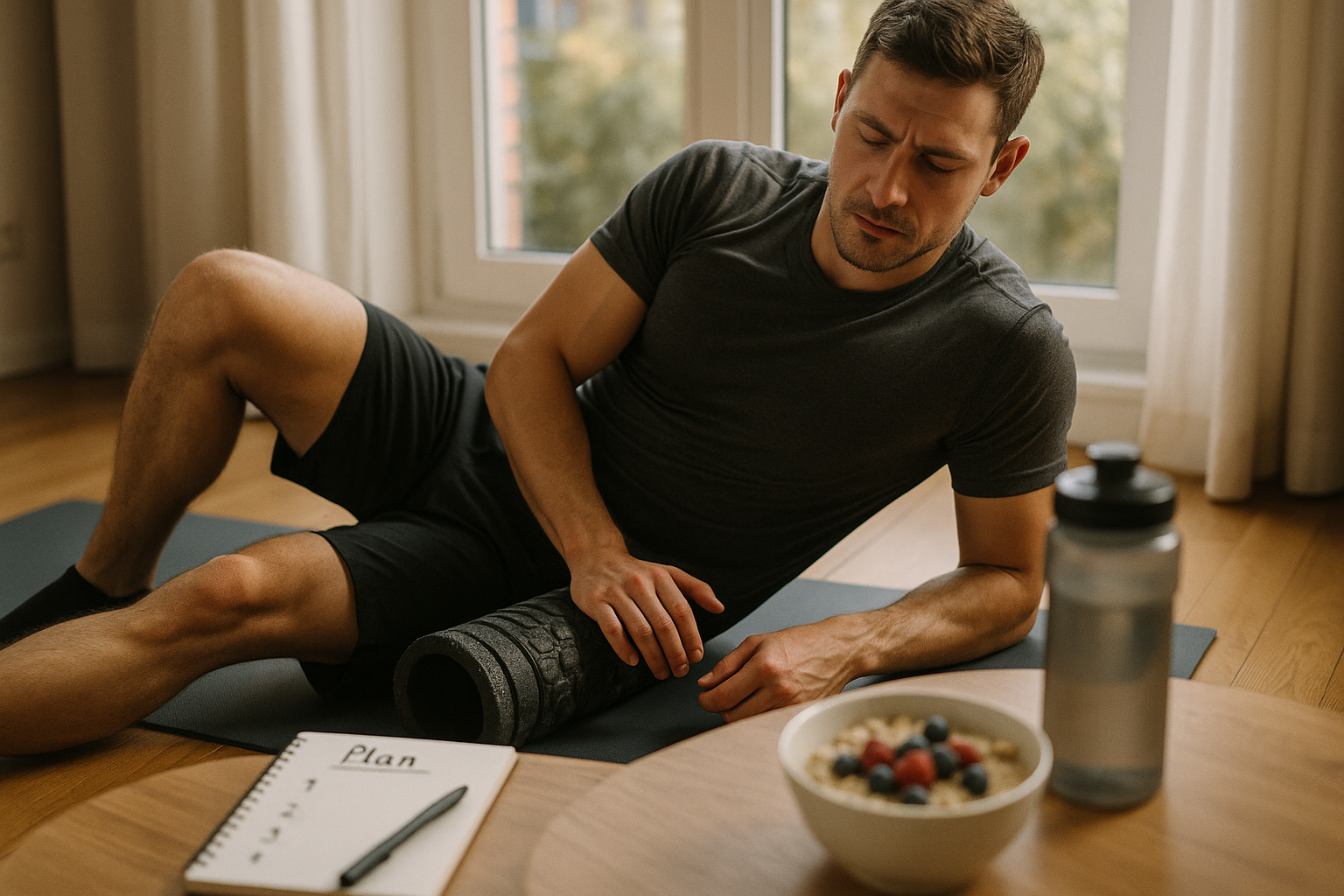
- Confusing foam rolling with a training session—use it as a short adjunct, not the main dish.
Bottom line: Gentle movement helps you feel and perform better tomorrow without stealing from your next session.
5. Modulate Inflammation—Don’t Nuke It: Cold, Heat, and Pain Meds with Purpose
Inflammation after training is part of the remodeling signal. Blunting it too aggressively, too often can reduce some long-term adaptations. For example, regular post-lift cold-water immersion (CWI) has been shown to attenuate anabolic signaling and muscle hypertrophy over weeks, even if it temporarily reduces soreness. That doesn’t make cold wrong; it means reserve cold plunges and aggressive icing for tournaments, heat management, or very high competition density—not after every hypertrophy session. Heat can be useful to relax and increase comfort on rest days away from training, but treat all modalities as contextual tools rather than default habits.
When to use what
- Cold (acute): After games or two-a-days to reduce soreness/swelling, manage heat; avoid immediately after hypertrophy-focused lifts when gains are the priority.
- Heat: Gentle heat on rest days can ease stiffness and promote relaxation—best used when no heavy training is imminent.
- OTC pain meds: Helpful for pain management under clinician guidance; avoid chronic, prophylactic use for “routine soreness.”
Mini-checklist
- Ask, “What is my goal today—performance tomorrow or adaptation long-term?”
- If it’s long-term growth, skip routine post-lift cold. If it’s back-to-back performance, cold can be appropriate.
Bottom line: Choose modalities intentionally. Don’t mute the very signals you’re paying to create in the gym.
6. Don’t Forget Tendons, Fascia, and Ligaments: They Remodel Slower Than Muscle
Muscle strength often outpaces connective-tissue resilience, which is why rest-day care for tendons and fascia pays off. Collagen turnover responds to mechanical loading plus nutrients, not nutrients alone. Early human work shows that taking gelatin/collagen with vitamin C ~30–60 minutes before loading can increase blood markers of collagen synthesis; pair that with low-to-moderate tendon-friendly loading (e.g., isometrics, slow eccentrics) to teach tissues to tolerate force. On rest days, that might look like a short “prehab” circuit for historically cranky areas—ankles, patellar tendon, rotator cuff—without pushing fatigue.
How to do it
- Supplement timing (optional): ~15 g gelatin/collagen + 50–200 mg vitamin C, 30–60 minutes before 5–10 minutes of tendon-focused loading.
- Loading ideas: 5×45-second isometric holds for the target tendon; or 2–3 sets of slow eccentrics (3–5 s down).
Mini-checklist
- Progress slowly (tendons adapt over weeks to months).
- Keep volumes tiny on rest days; aim for “grease the groove,” not training.
Bottom line: Strong muscles need durable attachments; feed and nudge connective tissues to keep up.
7. Autoregulate Rest with Readiness Markers: HRV + How You Feel + Basic Performance
Your body’s day-to-day readiness fluctuates. Combine subjective measures (sleep quality, soreness, mood) with simple objective checks (resting HR, heart-rate variability/RMSSD, bar speed on warm-ups) to decide whether to push, maintain, or back off. HRV is especially popular because it reflects autonomic balance; trends over several days are more useful than any single number. Practical guidance: gather at least 3 valid morning readings/week, compare against your rolling baseline, and adjust training if values stay suppressed and you feel off. Use these tools to protect long-term progress—not to obsess over daily noise. ResearchGate
Tools/Examples
- Morning app with validated camera sensor or chest strap; use similar time/position daily.
- If HRV drops meaningfully for 2–3 days and you’re sore/sleep-deprived, take a low-intensity day or add rest.
- Track a simple submaximal metric (e.g., bar speed at 60% 1RM, or a 3-minute step test HR recovery).
Common mistakes
- Chasing a “perfect” HRV; ignoring how you actually feel and move.
- Drawing conclusions from a single reading after a poor night’s sleep.
Bottom line: Let readiness data support, not dictate, your plan—use trends plus common sense to place rest where it returns the most.
8. Program Your Rest: Frequency, Spacing, and Occasional Deloads
Effective programs bake rest into the week. Training each major muscle at least twice per week tends to grow muscle better than once—provided volume is sensibly distributed and recovery is respected. Many lifters do well spacing hard stimuli 48–72 hours apart for the same muscle group so recovery windows overlap with real life (work, sleep, stress). Every 4–8 weeks, consider a deload: temporarily reduce volume/intensity ~20–40% to drop fatigue while maintaining skill. This planned ebb prevents unplanned stalls.
How to do it
- Pick a split that hits each muscle ~2x/week without crushing you (e.g., upper/lower, push/pull/legs).
- Stagger high-stress days (e.g., heavy squats) from high-skill/impact days.
- Insert a deload when progress stalls, motivation dips, or aches accumulate.
Numbers & guardrails
- Volume is the big rock; set weekly sets per muscle, then place them with 48–72 h between hard hits on the same tissue.
- Keep one or two “easy” days in any 7-day cycle.
Bottom line: Consistent progress comes from a rhythm of stress and recovery—program your rest as deliberately as your lifts.
9. Pick Recovery Modalities and Supplements That Actually Help (and Won’t Backfire)
Not all recovery aids are equal. Creatine monohydrate has decades of evidence for strength, lean mass, and high-intensity performance and is safe for long-term use in healthy people. Massage, compression, and foam rolling tend to provide small-to-moderate relief of soreness and can improve comfort and range of motion—use them to feel better, not as substitutes for sleep and programming. Be cautious with anything that chronically suppresses inflammation (see Principle 5). When in doubt, prioritize fundamentals (sleep, protein, carbs, hydration) before gadgets.
Mini-checklist
- Yes: Creatine monohydrate 3–5 g/day; short foam-rolling or massage for comfort; compression if you like the feel.
- Maybe: Heat/sauna on rest days (relaxation, sleep); cold strategically (tournaments, heat).
- Skip as defaults: Routine post-lift cold plunges for hypertrophy blocks.
Bottom line: Use evidence-based tools to complement (not replace) sleep, food, and smart scheduling.
FAQs
1) How long does muscle recovery take after lifting?
For most sessions, the main repair and refuel processes happen over 24–72 hours, depending on training stress, nutrition, and sleep. In trained lifters, MPS returns to baseline sooner than in novices, but repeated fed recovery windows are what accumulate into gains. If you’re still unusually sore or weak after 72 hours, consider adding rest or reducing volume next week.
2) Do I have to feel sore (DOMS) to grow?
No. Soreness is not a direct proxy for adaptation. You can make excellent progress with minimal DOMS if your program progressively overloads and you recover well. Excessive DOMS can even interfere with quality sessions later in the week. Use performance trends and weekly volume—not soreness—as your main guide.
3) How much protein should I eat on rest days?
About the same as training days. A robust meta-analysis suggests ~1.6 g/kg/day (with little extra benefit above ~2.2 g/kg/day) supports hypertrophy when paired with resistance training. Spread intake across 3–5 meals with protein-rich foods you tolerate well. BioMed Central
4) Is active recovery better than complete rest?
Often, yes—if it’s truly light. Easy movement increases blood flow, maintains range of motion, and can reduce perceived soreness. Think gentle walks, mobility flows, or pool work; avoid “secret workouts” that add fatigue.
5) Should I cold plunge on rest days?
Use it strategically. Regular cold-water immersion after lifting can dampen anabolic signaling and hypertrophy over time, even if it feels good acutely. Save it for tournament congestion, heat management, or when performance tomorrow beats growth later. Physiology Journals
6) What’s the best supplement for recovery?
For most lifters, creatine monohydrate (3–5 g/day) is the best-supported choice for strength and lean mass. Beyond that, focus on protein, carbs, sleep, and hydration before shopping for extras.
7) How do I know if I need an extra rest day?
Stack signals: poor sleep, elevated resting HR, HRV down versus your baseline for a few days, bar speed slower on warm-ups, and low motivation. If several align, trade a hard session for an easy/recovery day and reassess.
8) How should I schedule rest if I train 4–6 days/week?
Hit each muscle ~2x/week and keep 48–72 h between hard hits to the same area. Many find upper/lower or push/pull/legs splits with one to two easy days per week sustainable long-term. Add a deload (volume/intensity drop) every 4–8 weeks.
9) Do foam rolling, massage, or compression really help?
They can reduce soreness and improve comfort and range of motion in the short term. Think of them as supportive, not essential—sleep and nutrition move the needle more.
10) Should I change nutrition on rest days?
Keep protein consistent; scale carbs to training load. On full rest days, moderate carbs may suffice; on recovery days before a hard session or during high-volume blocks, keep carbs higher to refill glycogen. Hydrate as if it’s your job.
Conclusion
Progress depends on a rhythm: apply stress, then let your body recover and adapt. The nine principles above give you a practical blueprint: prioritize sleep, hit daily protein, and restore glycogen and fluids; sprinkle in easy movement and connective-tissue care; choose modalities on purpose (not out of habit); and use simple readiness markers to decide when rest will pay the biggest dividends. Program rest as deliberately as sets and reps, spacing hard stimuli and inserting the occasional deload so fatigue doesn’t quietly cap your performance. Do these consistently and you’ll feel fresher, lift better, and build strength that actually shows up on testing day.
Ready to lock it in? Pick one principle to improve this week—sleep, protein, or scheduling—and make that your non-negotiable.
References
- Thomas DT, Erdman KA, Burke LM. Nutrition and Athletic Performance. Journal of the Academy of Nutrition and Dietetics. 2016. PubMed
- Morton RW, Murphy KT, McKellar SR, et al. A systematic review, meta-analysis and meta-regression of the effect of protein supplementation on resistance training-induced gains in muscle mass and strength in healthy adults. Br J Sports Med. 2018. PubMed
- Damas F, Phillips S, Vechin FC, Ugrinowitsch C. Resistance training-induced changes in integrated myofibrillar protein synthesis are related to hypertrophy after damage attenuates. J Physiol. 2016. PMC
- Phillips SM. A Brief Review of Critical Processes in Exercise-Induced Muscular Hypertrophy. J Orthop Sports Phys Ther. 2014. PMC
- Schoenfeld BJ, Ogborn D, Krieger JW. Effects of Resistance Training Frequency on Measures of Muscle Hypertrophy: A Systematic Review and Meta-Analysis. Sports Med. 2016. PubMed
- Thomas DT, Erdman KA, Burke LM. Nutrition and Athletic Performance (Position Paper). ACSM/AND/DC. 2016. PDF with carb recovery table. drugfreesport.org.za
- Wallis GA. Dietary Carbohydrate and the Endurance Athlete. Gatorade Sports Science Institute. 2022. Gatorade Sports Science Institute
- Craven J, et al. Effects of Acute Sleep Loss on Physical Performance: A Systematic Review and Meta-analysis. Sports Med. 2022. SpringerLink
- Walsh NP, et al. Sleep and the Athlete: Narrative Review and 2021 Expert Consensus. Br J Sports Med. 2021. British Journal of Sports Medicine
- Peake JM, Roberts LA, Figueiredo VC, et al. The Effects of Cold Water Immersion and Active Recovery on Molecular Factors That Regulate Growth and Remodeling of Skeletal Muscle After Resistance Exercise. Front Sports Act Living. 2020. PMC
- Roberts LA, et al. Post-exercise cold water immersion attenuates acute anabolic signaling and long-term hypertrophy. J Physiol. 2015. Physiological Reviews
- Fyfe JJ, et al. Cold water immersion attenuates anabolic signaling and skeletal muscle fiber hypertrophy following whole-body resistance training. J Appl Physiol. 2019. paulogentil.com
- Shaw G, Lee-Barthel A, Ross ML, Wang B, Baar K. Vitamin C-enriched gelatin supplementation before intermittent activity augments collagen synthesis. Am J Clin Nutr. 2017. PubMed
- Kreider RB, et al. International Society of Sports Nutrition (ISSN) position stand: safety and efficacy of creatine supplementation in exercise, sport, and medicine. J Int Soc Sports Nutr. 2017. BioMed Central
- Kreider RB, et al. Safety of creatine supplementation: analysis of the prevalence of reported side effects in clinical trials. J Int Soc Sports Nutr. 2025. PMC
- Buchheit M. Monitoring training status with HR measures: do all roads lead to Rome? Front Physiol. 2014. Frontiers
- Plews DJ, Laursen PB, Stanley J, Kilding AE, Buchheit M. Training adaptation and heart rate variability in elite endurance athletes—opening the door to effective monitoring. Sports Med. 2013. PubMed
- Schneider C, et al. Heart Rate Variability Monitoring During Strength and High-Intensity Interval Training. Front Physiol. 2019. PMC
- Watson AM. Sleep and Athletic Performance. Curr Sports Med Rep. 2017. PubMed
- Schoenfeld BJ, Ogborn D, Krieger JW. Effects of Resistance Training Frequency on Hypertrophy (PDF). Sports Med. 2016. paulogentil.com